


Renewable Natural Gas Market Research, 2034
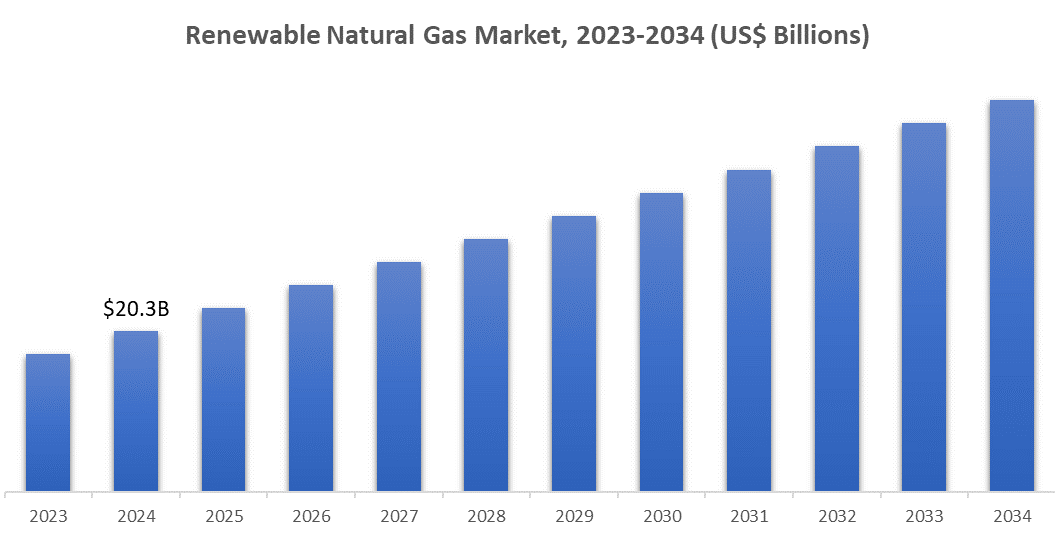
The global renewable natural gas market is expected to surge at a compound annual growth rate (CAGR) of 33.8% between 2024 and 2034. In 2023, the market was valued at US$ 15.2 billion, and by 2034, it's projected to reach a staggering US$ 375.6 billion.
Renewable Natural Gas (RNG), also known as biomethane, is a sustainable alternative to regular natural gas. It is produced from organic waste materials such as agricultural waste, sewage, and landfills by anaerobic digestion and gasification. RNG absorbs methane that would otherwise be released into the atmosphere, reducing greenhouse gas emissions and addressing climate change.
It can create energy, fuel vehicles, and be put into the gas grid. RNG delivers numerous benefits, including reduced dependency on fossil fuels, improved waste disposal, and increased energy security. Despite its advantages, problems such as high production costs, limited infrastructure, and regulatory complications must be overcome before it can fully realize its promise.
Market Highlights
The market is rising due to the environmental regulations promoting clean energy adoption and boosting RNG demand. Increasing recognition of climate change and the necessity to further decrease greenhouse gas emissions continue to drive its acceptance. Advances in technology for producing RNG have increased efficiency and reduced costs, enhancing its competitiveness.
Moreover, RNG also offers financial advantages through carbon credits and renewable energy certificates. Anticipated growth in the future is due to industries and governments increasingly focusing on sustainability, expanding infrastructure, and ongoing technological advancements improving RNG production and distribution capabilities.
Market Segmentation
Landfill RNG Resources dominate due to their easier availability and better-existing infrastructure
The market is segmented based on Source into Agricultural RNG Resource, Sewage & Wastewater RNG Resource, and Landfill RNG Resource. At present, Landfills RNG Resources are the dominant force in the market due to multiple strong reasons. One key factor is that landfills offer a steady and dependable supply of organic waste that breaks down and produces methane gas, which can be easily used as a feedstock for RNG production.
Additionally, numerous landfills already have the necessary infrastructure to collect landfill gas (LFG) for different purposes, and this can easily be modified for producing RNG with minimal extra costs. Moreover, by capturing landfill gas for RNG production, there are substantial environmental advantages including the prevention of methane, a powerful greenhouse gas, from being released into the atmosphere and exacerbating climate change. Finally, government regulations aiming to reduce methane emissions from landfills encourage landfill operators to prioritize investing in RNG production.
Vehicle Fuel leads the market owing to the growing demand for sustainable transportation
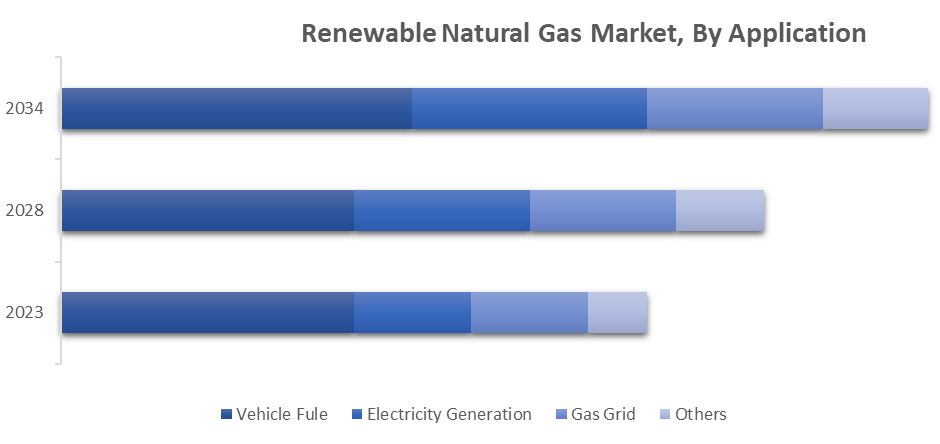
The market is segmented based on Application into Electricity Generation, Vehicle Fuel, Gas Grid, and Others. The Vehicle Fuel application segment currently leads the Renewable Natural Gas (RNG) market due to several factors. Governments worldwide are implementing stricter environmental policies to reduce greenhouse gas emissions from the transportation industry. RNG offers a more environmentally friendly option than conventional fossil fuels, helping to comply with these mandates.
Additionally, the demand for sustainable transportation is increasing as more consumers seek to reduce their environmental footprint. RNG-powered vehicles provide a practical choice that appeals to a growing customer base. Furthermore, RNG can be easily implemented in natural gas vehicles with minimal adjustments, allowing for quick deployment. The existing infrastructure used for CNG and LNG fuelling stations can be adapted to accommodate RNG. Many countries provide tax breaks or financial assistance for RNG vehicles and fuel, making them more appealing to both consumers and businesses.
Market Dynamics
Growth Drivers
Growing Demand for Renewable Energy Across Multiple Sectors to Fuel Market Growth
The increasing demand for sustainable energy in various industries is being driven by several key factors. A growing understanding of climate change and its impacts is leading to a global shift towards sustainable energy sources. Governments and companies are setting ambitious goals to reduce their reliance on fossil fuels and lower greenhouse gas emissions. Consumers and businesses are becoming more environmentally conscious, leading to a greater need for sustainable products and services.
Renewable Natural Gas (RNG) provides a sustainable alternative to traditional natural gas, supporting sustainability objectives. Advancements in technology are improving the efficiency and cost-competitiveness of renewable energy technologies, making RNG economically feasible compared to conventional energy sources. Additionally, many countries are seeking to diversify their energy sources to reduce dependence on a single type of fuel and ensure energy security, with RNG playing a role in achieving energy independence as a domestically produced renewable source.
Government Incentives and Subsidies for Renewable Natural Gas Production to Propel Overall Market Development
Government backing is essential for boosting the growth of the market. To begin with, establishing RNG production plants may come with a high price tag, but government support in the form of tax credits or grants can assist in mitigating these expenses, ultimately increasing the appeal of RNG production for companies. Additionally, providing subsidies or feed-in tariffs to RNG producers can establish a favourable pricing atmosphere, which promotes investment in RNG production and enhances the competitiveness of RNG as a fuel choice for consumers.
Furthermore, government funding aids in research and development for RNG production technologies, resulting in advancements that enhance sustainability, improve efficiency, and lower costs. Finally, government backing is vital in building the required infrastructure for RNG production, transportation, and integration into the natural gas network, which is crucial for expanding the RNG market and ensuring its widespread accessibility.
Restraints
Limited Infrastructure Availability to Create Significant Challenges for the Market
The growth of the market is significantly hindered by limited infrastructure availability. Many regions are still experiencing limited capacity in their RNG processing facilities, which hinders their ability to keep up with the increasing demand for production. Furthermore, the infrastructure for gathering and moving organic waste material, particularly from scattered agricultural sites, is frequently inadequate, resulting in logistical obstacles and higher expenses. The current gas pipeline infrastructure may not support RNG in every region, and updating pipelines could be costly and time-consuming.
The lack of development in RNG vehicle fuelling station infrastructure hinders the availability of RNG for transportation, in contrast to traditional fuel stations. Establishing grid injection infrastructure presents technical obstacles and necessitates uniform regulations. These restrictions in infrastructure result in increased expenses, restricted access, and sluggish adoption of RNG in the market. Government backing and private capital are crucial for speeding up infrastructure growth and realizing the RNG market's possibilities.
Recent Developments
- In the financial years 2023-2024, Clean Energy Fuels Corp completed a new RNG production facility at Drumgoon Dairy in Lake Norden, SD. This project is expected to produce 1.66 million gallons of RNG annually. The company also opened two new fueling stations in the Dallas-Fort Worth area, enhancing its network for heavy-duty trucks and other fleet vehicles.
- In 2023, Air Liquide expanded its RNG production capacity at several facilities across North America, increasing its total output by 20%. The company also acquired an RNG production company in Canada, integrating its technology and expanding its market reach.
- In 2023-24, BP plc partnered with Clean Energy Fuels to develop multiple RNG projects at dairies in the Midwest, aiming to enhance RNG supply. The company announced the expansion of its RNG production at its US facilities, increasing its capacity by 15%.
- In 2023-24, Chevron Corporation launched two new RNG projects in California, focusing on converting dairy waste into clean energy. The company has actively invested in expanding its RNG fueling infrastructure to support its growing RNG production.
- In 2023, Dominion Energy Inc. completed a new RNG facility in Utah, which converts agricultural waste into RNG. The company also partnered with a major waste management firm to develop additional RNG projects.
Key Players
- Clean Energy Fuels Corp.
- Air Liquide
- BP plc
- Chevron Corporation
- Dominion Energy, Inc.
- Royal Dutch Shell plc
- TotalEnergies SE
- Engie
- FortisBC
- Kinder Morgan, Inc.
- NW Natural
- Southern California Gas Company (SoCalGas)
- Waste Management, Inc.
- Xebec Adsorption Inc.
- Ameresco, Inc.
- Other Prominent Players (Company Overview, Business Strategy, Key Product Offerings, Financial Performance, Key Performance Indicators, Risk Analysis, Recent Development, Regional Presence, SWOT Analysis)
Regional Analysis
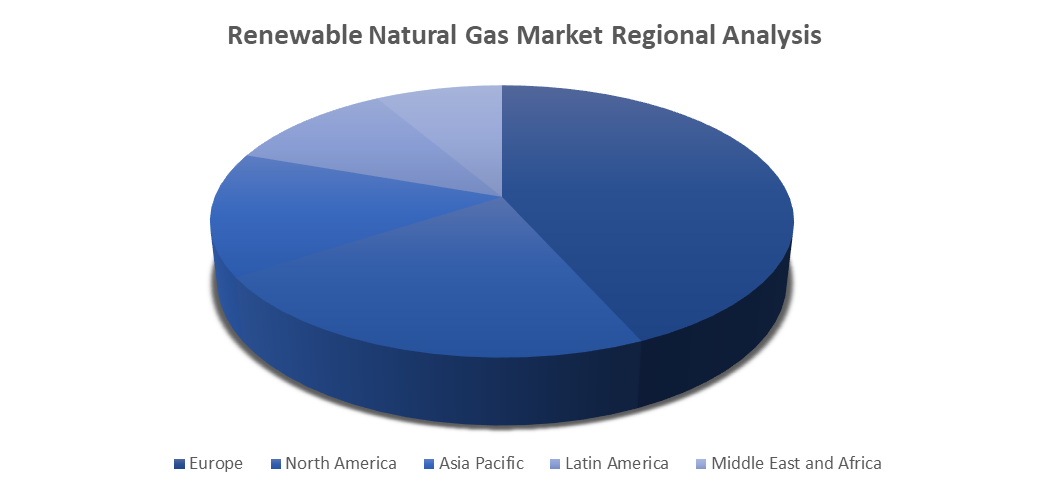
Global market is segmented based on regional analysis into five major regions: North America, Latin America, Europe, Asia Pacific, and the Middle East and Africa.
Europe is currently the leader in the Renewable Natural Gas (RNG) market due to various important reasons. The Renewable Energy Directive (RED) requires higher utilization of renewable energy, including RNG, with robust regulatory backing. The already established natural gas infrastructure in Europe can easily be modified to accommodate RNG injection, lowering costs and simplifying the process.
Stringent waste management regulations in Europe promote the use of waste materials such as landfill gas and sewage sludge for the production of RNG. Moreover, the increasing demand from European consumers for environmentally friendly and renewable energy solutions is fuelling the growth of the market.
Supportive federal and state policies are driving growth in the North American market, although it still falls behind Europe in both market size and infrastructure. Regulatory support and infrastructure development present challenges in harnessing the potential of the Asia-Pacific region, attributed to its significant waste generation and increasing energy demand.
Latin America and the Middle East & Africa are at the beginning of RNG development, encountering challenges such as insufficient investment and infrastructure.
Market is further segmented by region into:
- North America Market Size, Share, Trends, Opportunities, Y-o-Y Growth, CAGR – United States and Canada
- Latin America Market Size, Share, Trends, Opportunities, Y-o-Y Growth, CAGR – Mexico, Argentina, Brazil, and Rest of Latin America
- Europe Market Size, Share, Trends, Opportunities, Y-o-Y Growth, CAGR – United Kingdom, France, Germany, Italy, Spain, Belgium, Hungary, Luxembourg, Netherlands, Poland, NORDIC, Russia, Turkey, and Rest of Europe
- Asia Pacific Market Size, Share, Trends, Opportunities, Y-o-Y Growth, CAGR – India, China, South Korea, Japan, Malaysia, Indonesia, New Zealand, Australia, and Rest of APAC
- Middle East and Africa Market Size, Share, Trends, Opportunities, Y-o-Y Growth, CAGR – North Africa, Israel, GCC, South Africa, and Rest of MENA
Market Scope and Segments
|
ATTRIBUTE |
DETAILS |
|
Study Period |
2018-2034 |
|
Base Year |
2023 |
|
Forecast Period |
2024-2034 |
|
Historical Period |
2019-2022 |
|
Growth Rate |
CAGR of 33.8% from 2024-2034 |
|
Unit |
Value (US$ Billion) |
|
Segmentation |
Main Segments List |
|
By Source |
|
|
By Application |
|
|
By Region |
|
Frequently Asked Questions (FAQ):
The global renewable natural gas market size was valued at US$ 15.2 billion in 2023 and is projected to reach the value of US$ 375.6 billion in 2034, exhibiting a CAGR of 33.8% during the forecast period.
The market involves the production, distribution, and utilization of methane derived from organic waste materials like agricultural waste, landfills, and sewage. RNG serves as a sustainable alternative to traditional natural gas, reducing greenhouse gas emissions and contributing to energy diversification and environmental sustainability.
The Landfill RNG Resource and Vehicle Fuel segment accounted for the largest market share.
Key players in the renewable natural gas market include Clean Energy Fuels Corp., Air Liquide, BP plc, Chevron Corporation, Dominion Energy, Inc., Royal Dutch Shell plc, TotalEnergies SE, Engie, FortisBC, Kinder Morgan, Inc., NW Natural, Southern California Gas Company (SoCalGas), Waste Management, Inc., Xebec Adsorption Inc., Ameresco, Inc. and Other Prominent Players.
The market is surging due to rising demand for clean energy, government incentives, and waste management solutions.
 Select License Type


.png)


