


Solar Farm Market Research 2035
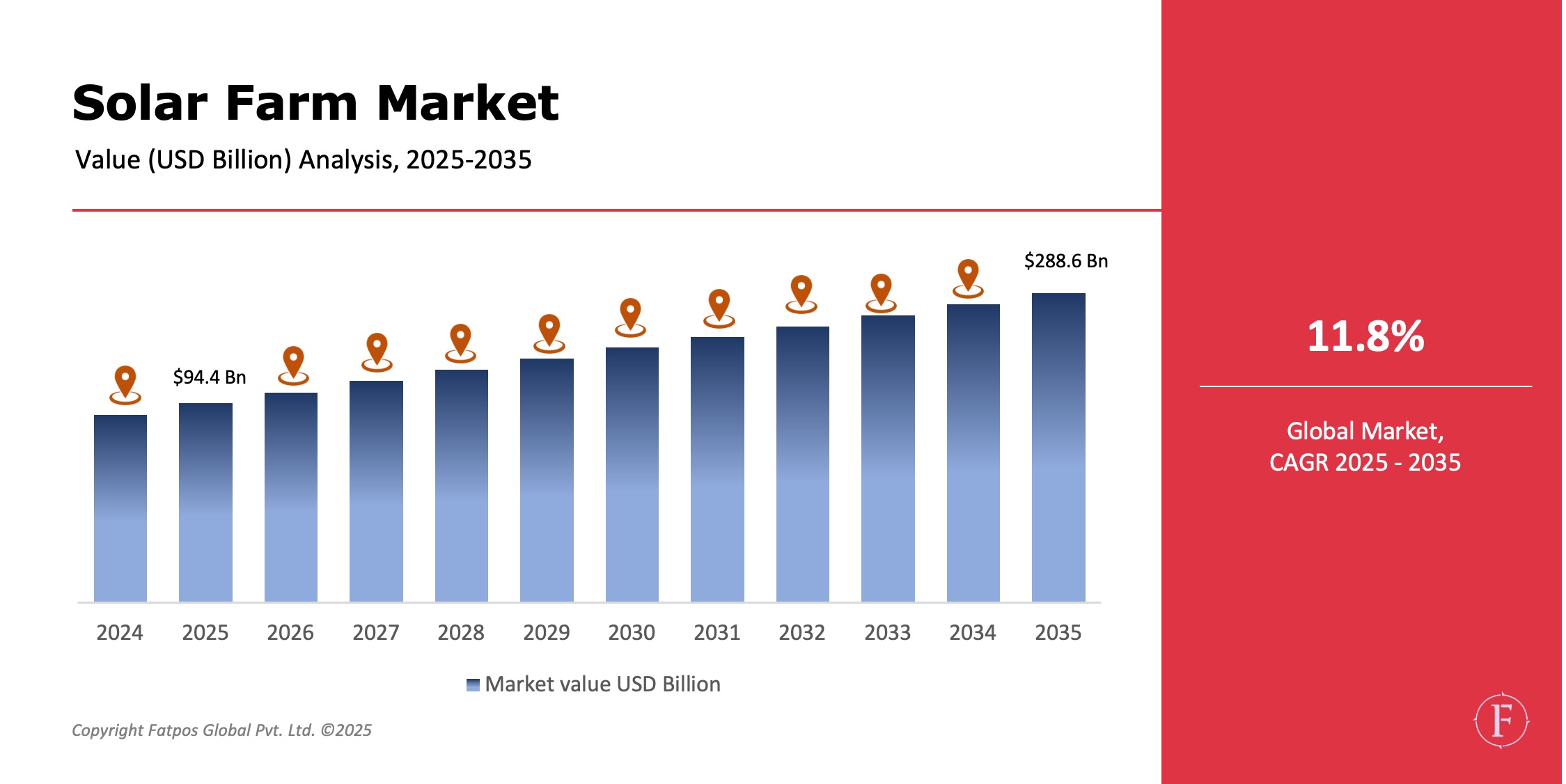
Solar Farm Market Size was valued at USD 94.4 billion in 2025 and is projected to reach USD 288.6 billion by 2035, registering a CAGR of 11.8% during the forecast period. Market growth is driven by increasing global demand for renewable energy, government incentives, declining solar technology costs, and rising investments in large-scale clean energy infrastructure.
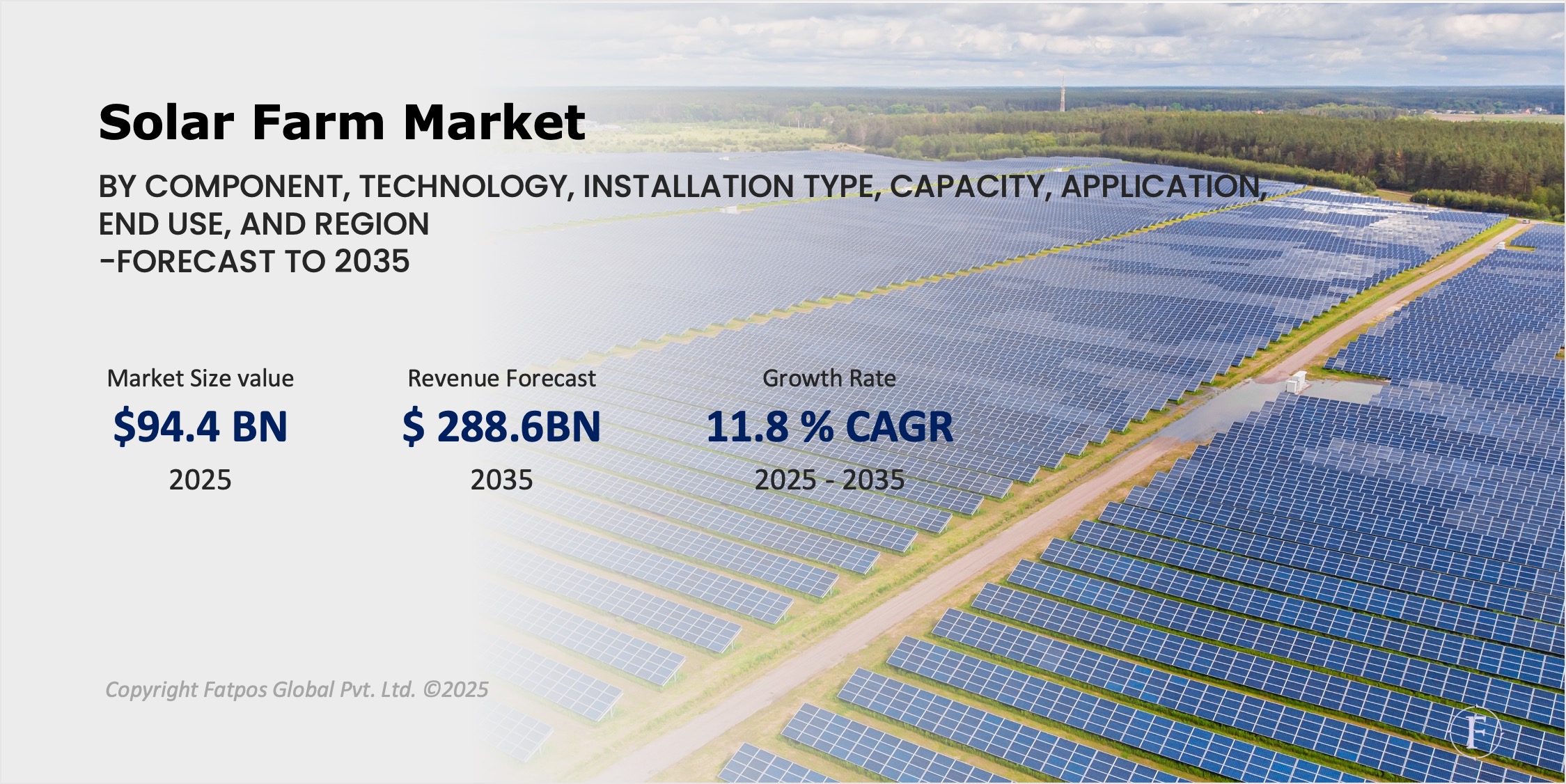
Solar farms, also known as solar power plants, are large-scale installations designed to generate electricity using solar energy. These systems contribute significantly to reducing carbon emissions and supporting energy transition goals. As countries aim to achieve net-zero emissions, solar farms are becoming a key component of global energy strategies.
Product Overview
Solar farms use photovoltaic (PV) panels or concentrated solar power (CSP) systems to convert sunlight into electricity. PV systems directly convert sunlight into electricity using semiconductor materials, while CSP systems use mirrors or lenses to concentrate sunlight and generate heat for power production.
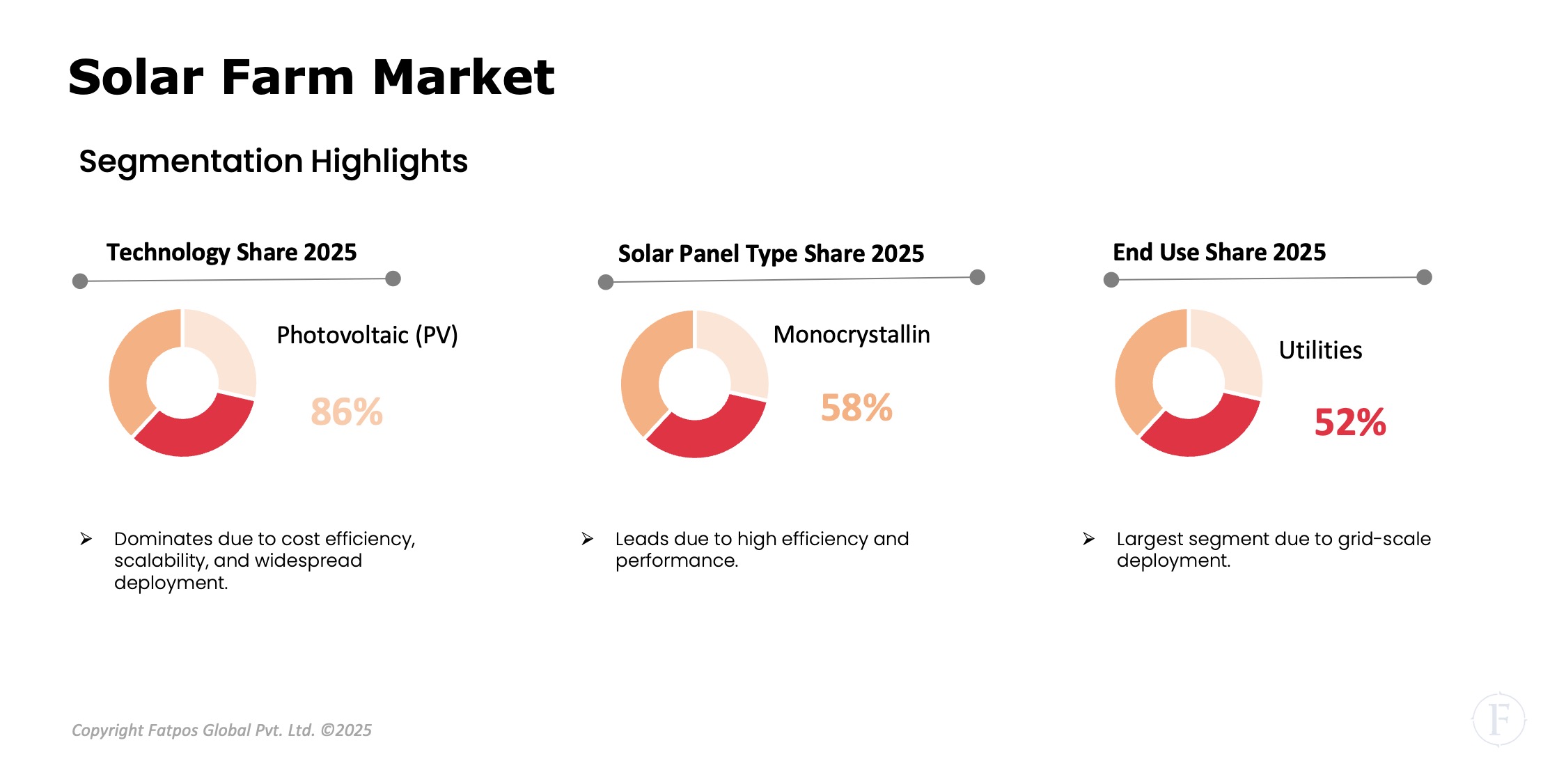
By component, solar panels represent the largest share as the primary energy-generating element. Inverters convert DC electricity into usable AC power, while mounting systems and tracking systems optimize panel positioning and efficiency. The balance of system (BoS) includes wiring, transformers, and monitoring systems.
By panel type, monocrystalline panels dominate due to higher efficiency and performance. Polycrystalline panels offer cost advantages, while thin-film panels are used in specialized applications.
Key Takeaways :
- The Solar Farm Market is expected to grow at ~11.8% CAGR through 2035
- Utility-scale solar farms dominate global installations
- Photovoltaic technology leads market adoption
- Asia-Pacific is the largest and fastest-growing region
- Government policies and incentives drive investments
- Tracking systems and efficiency optimization are key trends
Market Dynamics
Drivers
The solar farm market is mainly driven by the global shift toward renewable energy and efforts to reduce carbon emissions. Governments support this transition through policies, subsidies, and tax incentives that encourage solar adoption. Falling costs of solar panels and related technologies have improved economic feasibility, while advances in photovoltaic efficiency boost performance. Growing electricity demand, especially in emerging economies, fuels further investment in solar infrastructure. Overall, solar farms offer a scalable, cost-effective, and sustainable solution to meet increasing energy needs worldwide while supporting environmental goals.
Restrictions
The solar farm market is constrained by high initial capital investment and extensive land requirements for large-scale projects, including costs for equipment, infrastructure, and land acquisition. Power generation is affected by the intermittent nature of solar energy and reliance on weather conditions, leading to inconsistent output. In many regions, limited energy storage capacity further reduces reliability and efficiency. Additionally, complex regulatory frameworks and lengthy permitting processes slow project approvals and development timelines, especially in areas with evolving or unclear energy policies. These factors together hinder rapid expansion and create barriers for new entrants and large-scale deployment of solar farms.
Opportunities
The solar farm market presents strong opportunities through innovations and expanding global demand. Floating solar farms offer a practical solution to land constraints by utilizing water bodies while improving efficiency. Integration of advanced energy storage systems enhances grid stability and ensures reliable power supply. Rapid electrification and rising energy needs in emerging markets across Asia, Africa, and Latin America create significant growth potential. Technological advancements such as bifacial solar panels and AI-driven monitoring systems further boost efficiency, reduce operational costs, and optimize performance. These developments position solar farms as a key solution for sustainable energy expansion worldwide.
Challenges
The solar farm market faces several operational and structural challenges. Grid integration remains a major issue due to inadequate transmission infrastructure and the variable nature of solar power generation. Managing large-scale installations requires sophisticated monitoring, maintenance, and control systems to ensure efficiency. Environmental concerns, particularly related to land use and ecosystem disruption, also pose significant hurdles. Additionally, competition from other renewable energy sources such as wind and hydropower influences market dynamics and investment decisions. These challenges demand improved infrastructure, better planning, and advanced technologies to ensure sustainable and efficient solar farm deployment.
Solar Farm Market Trends
The solar farm market is evolving with a shift toward large utility-scale projects that deliver higher capacity and improved efficiency. Adoption of solar tracking systems is increasing, allowing panels to follow sunlight and maximize energy generation throughout the day. Integration of battery energy storage systems (BESS) is enhancing reliability and enabling continuous power supply. Floating solar farms are gaining popularity in regions with limited land resources. Additionally, digitalization and AI-driven analytics are transforming operations by enabling predictive maintenance, real-time monitoring, and improved performance optimization, leading to more efficient and cost-effective solar energy production.
Key Players in the Global Solar Farm Industry
- NextEra Energy, Inc.
- First Solar, Inc.
- Canadian Solar Inc.
- JinkoSolar Holding Co., Ltd.
- Trina Solar Limited
- LONGi Green Energy Technology Co., Ltd.
- SunPower Corporation
- Enel Green Power
- EDF Renewables
- Adani Green Energy Limited
Regional & Country Analysis
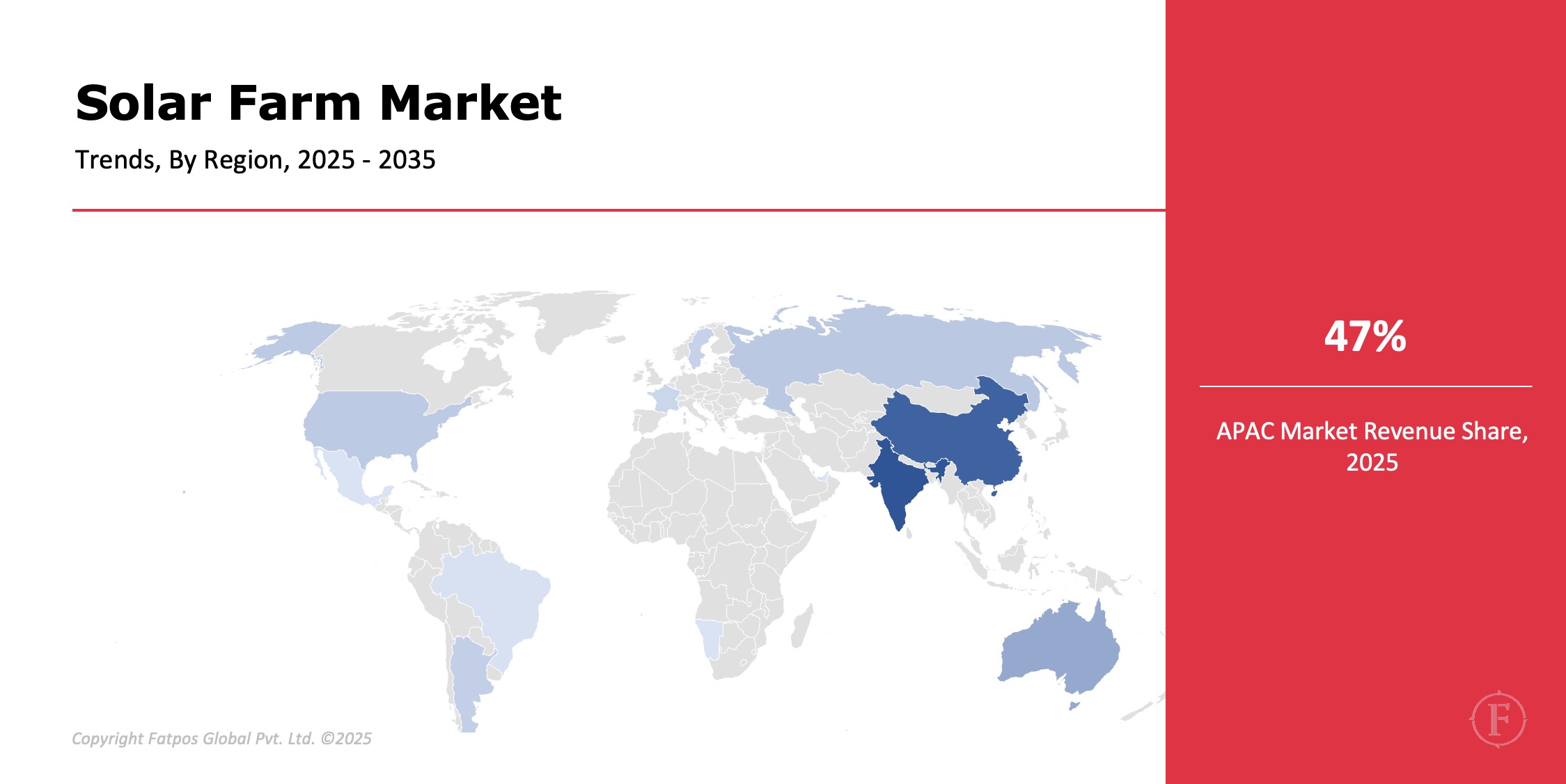
The solar farm market is led by Asia-Pacific, driven by large-scale deployments in China, India, and Japan, with China dominating global capacity and manufacturing. North America is experiencing strong growth due to supportive government incentives and renewable energy targets in the United States and Canada. Europe continues expanding solar installations to meet sustainability goals and reduce fossil fuel dependence, with Germany, Spain, and France leading adoption. Meanwhile, Latin America and the Middle East & Africa are emerging as high-potential regions, supported by rising investments in solar infrastructure and increasing focus on energy diversification and long-term sustainability.
Segmentation Highlights
The solar farm market is led by Asia-Pacific, driven by large-scale deployments in China, India, and Japan, with China dominating global capacity and manufacturing. North America is experiencing strong growth due to supportive government incentives and renewable energy targets in the United States and Canada. Europe continues expanding solar installations to meet sustainability goals and reduce fossil fuel dependence, with Germany, Spain, and France leading adoption. Meanwhile, Latin America and the Middle East & Africa are emerging as high-potential regions, supported by rising investments in solar infrastructure and increasing focus on energy diversification and long-term sustainability.
Report Key Elements
|
ATTRIBUTES |
DETAILS |
|
Study Period |
2019–2035 |
|
Base Year |
2024 |
|
Forecast Period |
2025–2035 |
|
Market Size by 2035 |
USD 288.6.6 billion |
|
Market CAGR |
11.8% |
|
By Component |
Solar Panels, Inverters, Mounting Systems, Tracking Systems, Balance of System |
|
By Panel Type |
Monocrystalline, Polycrystalline, Thin Film |
|
By Technology |
Photovoltaic, Concentrated Solar Power |
|
By Installation Type |
Ground-Mounted, Floating Solar Farms |
|
By Capacity |
Utility-Scale, Medium-Scale, Small-Scale |
|
By Application |
Electricity Generation, Industrial Power Supply, Grid Support, Others |
|
By End User |
Utilities, Independent Power Producers, Commercial, Government |
|
By Region |
NA, Europe, APAC, LATAM, MEA |
|
Solar Farm Market: Key Players |
NextEra Energy, Inc., First Solar, Inc., Canadian Solar Inc., JinkoSolar Holding Co., Ltd |
Global Solar Farm Industry Instances
- Governments launched large-scale solar park initiatives
- Companies deployed floating solar farms to optimize land use
- Utilities integrated battery storage with solar farms
- Developers adopted AI-based monitoring systems for efficiency.
Analyst Review
As per our Solar Farm Market analysis report, the market is experiencing rapid expansion driven by renewable energy adoption and technological advancements. While challenges related to land use, intermittency, and infrastructure persist, declining costs and supportive policies are expected to sustain growth.
Companies focusing on efficiency, storage integration, and large-scale deployment are likely to lead the market through 2035
Frequently Asked Questions (FAQ):
A solar farm is a large-scale installation of solar panels designed to generate electricity for grid supply or industrial use, supporting renewable energy production and reducing carbon emissions globally.
Growth is driven by renewable energy demand, government incentives, declining solar technology costs, and increasing investments in large-scale clean energy infrastructure to support global decarbonization goals.
Photovoltaic (PV) technology dominates due to cost efficiency, scalability, and ease of installation, making it the preferred choice for utility-scale solar farms worldwide.
Ground-mounted solar farms are most common due to scalability, cost efficiency, and suitability for large land areas, enabling high-capacity electricity generation.
Tracking systems improve solar panel efficiency by following the sun’s movement, increasing energy generation compared to fixed systems, especially in large-scale installations.
 Select License Type


.png)


