


Global Hydro Turbine Market Research 2035
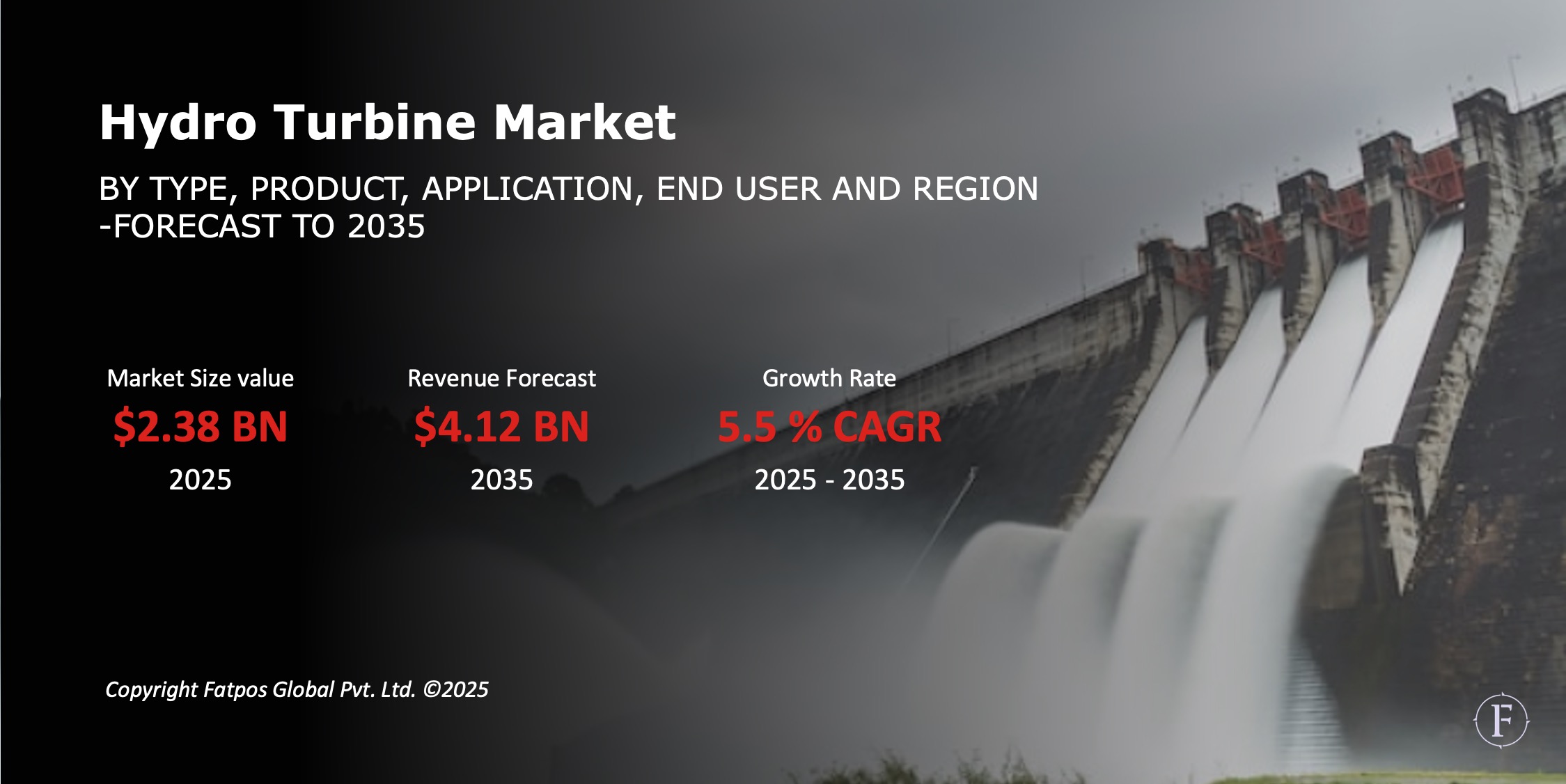
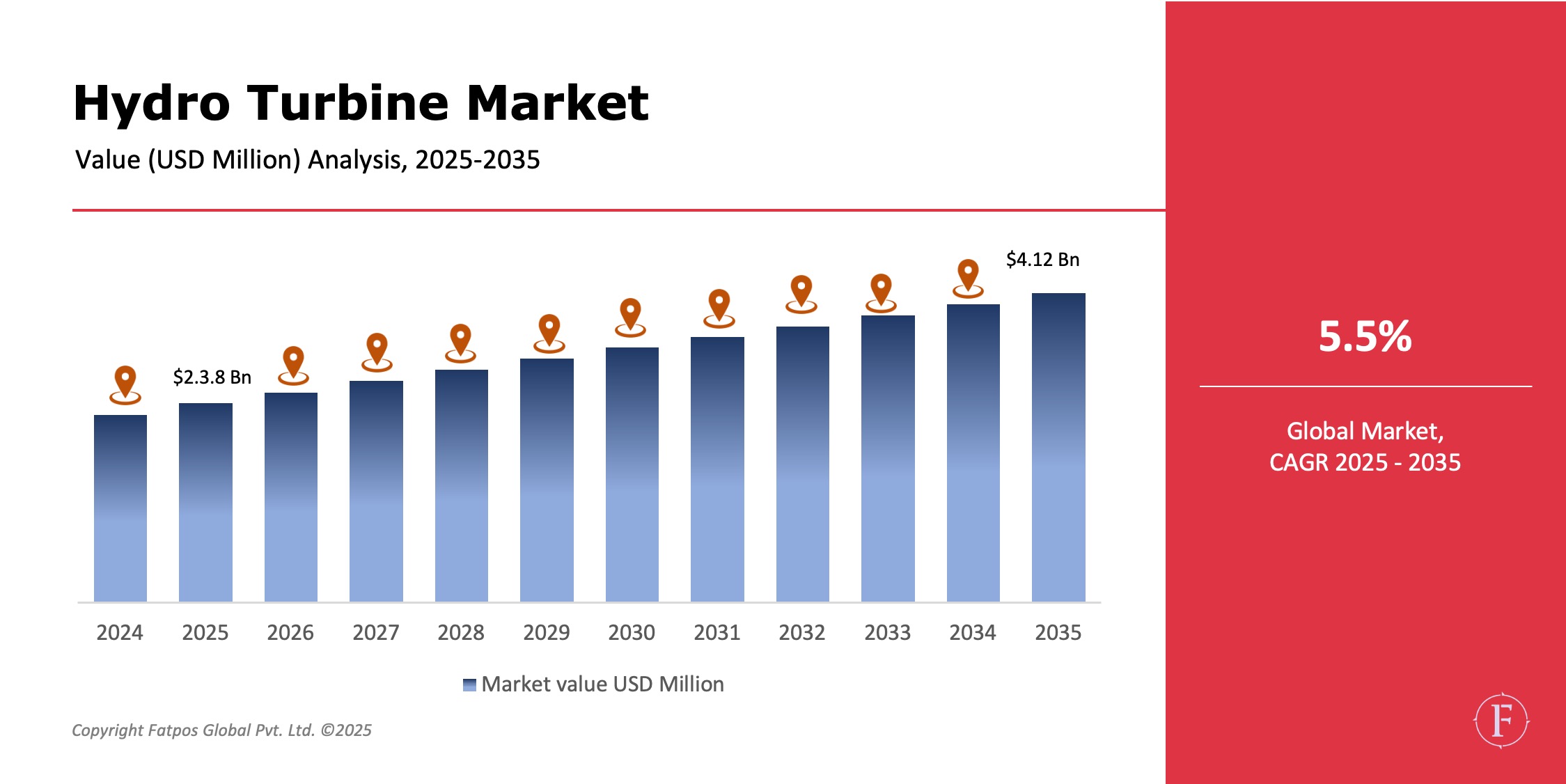
The Global Hydro Turbine Market Size was USD 2.38 billion in 2025 and is projected to reach USD 4.12 billion by 2035, registering a CAGR of 5.5%, as the growth is fueled by renewable energy investments, modernization of aging hydropower fleets, and expansion of small and micro-hydro in emerging markets, as hydropower remains a reliable, cost-effective green source. Advanced fish-friendly, variable-speed turbines, improved blade designs, smart monitoring, and hybrid hydro-solar plants are further boosting efficiency, sustainability, and operational reliability.
Product Overview
Hydro turbines fall into two main types: impulse and reaction. Impulse turbines like Pelton, Turgo, and Crossflow work in high-head, low-flow or small hydro settings, where water jets strike the runner. Reaction turbines such as Francis, Kaplan, and Bulb operate submerged in low‑to‑medium head, higher-flow conditions and dominate large hydro and run‑of‑river plants, with hydrokinetic designs serving river and tidal currents.
Key Takeaways:
- Market is forecasted to grow at 5.5% CAGR during 2025–2035.
- Francis turbines dominate global installations due to flexibility and efficiency.
- Rapid growth expected in small hydropower (SHP, ≤10 MW) across emerging markets.
- Modernization and refurbishment of aging hydropower plants account for rising demand.
- Asia-Pacific leads globally, driven by China, India, Nepal, and Southeast Asia.
- Strong government incentives and renewable energy policies accelerate adoption.
- Adoption of fish-safe and variable-speed turbines improves ecological outcomes.
Market Dynamics
Drivers
Hydro turbine demand is supported by rising global electricity needs and aggressive renewable energy expansion, with hydropower valued for delivering stable baseload generation. Supportive policies such as incentives, feed-in tariffs, and national hydro programs further boost deployment, alongside growing investment in run-of-river and off-grid projects. Progress in turbine materials and digital monitoring enhances performance, efficiency, and asset life.
Restraints
Hydro turbine deployment faces notable restraints. High upfront capital costs for hydropower projects limit investment, especially in developing markets. Environmental concerns around river ecology and aquatic habitat disruption increase permitting complexity and mitigation costs. Long development timelines, stringent regulatory approvals, and the shrinking pool of economically viable, greenfield hydropower sites in some regions further constrain of the hydro turbine market growth.
Opportunities
Hydro turbine market opportunities are strengthening as small and micro-hydropower systems support rural electrification and decentralized energy access. New floating and modular hydro concepts, along with low-head hydrokinetic units for rivers and canals, enable deployment at previously untapped sites. At the same time, digitalized plants using IoT sensors, predictive maintenance, and AI-based monitoring improve reliability, performance, and lifetime asset value.
Challenges
Climate variability is emerging as a key challenge for the Hydro Turbine Market, as changing rainfall and glacial melt patterns alter river flows and reservoir levels, reducing predictability of power generation. Sedimentation and erosion in reservoirs and waterways damage turbine components, lower efficiency, and increase maintenance needs. Upgrading aging hydropower plants is technically complex, requiring retrofits in constrained sites while maintaining safety, grid stability, and regulatory compliance.
Global Hydro Turbine Market Trends
Hydro turbine market trends highlight a shift toward sustainability and digitalization. Manufacturers are developing eco-friendly, fish-friendly designs and deploying hybrid hydro-solar plants to smooth seasonal output. Plants are becoming increasingly digital, using predictive health monitoring and, in some cases, 3D-printed turbine components for optimized geometries. Micro-hydro solutions are gaining traction in off-grid regions, while government-backed modernization programs upgrade existing assets for higher efficiency and longer lifespans.
Key Players in the Global Hydro Turbine Industry
- GE Renewable Energy
- Voith Group
- Andritz Hydro
- Toshiba Energy Systems
- Siemens Energy
- BHEL (Bharat Heavy Electricals Limited)
- Harbin Electric Machinery Co.
- Hitachi Mitsubishi Hydro
- CKD Blansko Engineering
- Gilkes
- Wärtsilä Hydro & Tidal
- Litostroj Power
Regional & Country Analysis
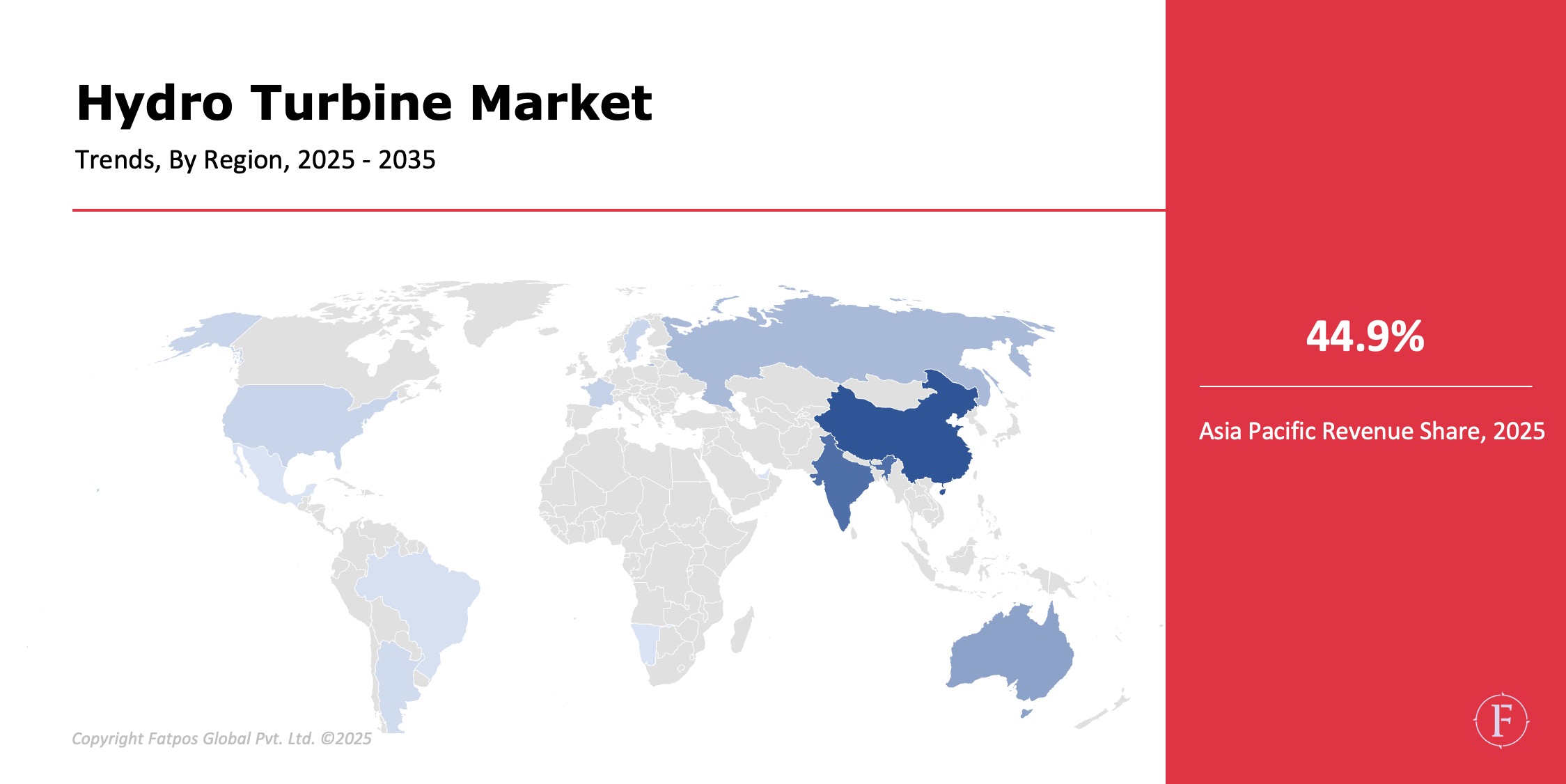
The Hydro Turbine Market exhibits distinct regional patterns. North America grows steadily through modernization and small hydro investments in the U.S. and Canada, with a focus on grid stability and sustainability. Europe is a mature market prioritizing refurbishment, eco-friendly turbines, and run-of-river optimization, led by Norway, France, Austria, and Switzerland. Asia-Pacific is the largest and fastest-growing region with largest hydro turbine market share, driven by mega projects in China and India and SHP expansion in Southeast Asia under incentive and rural electrification schemes. Africa and the Middle East see growth from new projects and upgrades in Ethiopia, DRC, Zambia, Turkey, and Iran, while Latin America expands capacity through supportive policies and large reservoirs in Brazil, Colombia, and Chile.
Segmentation Highlights
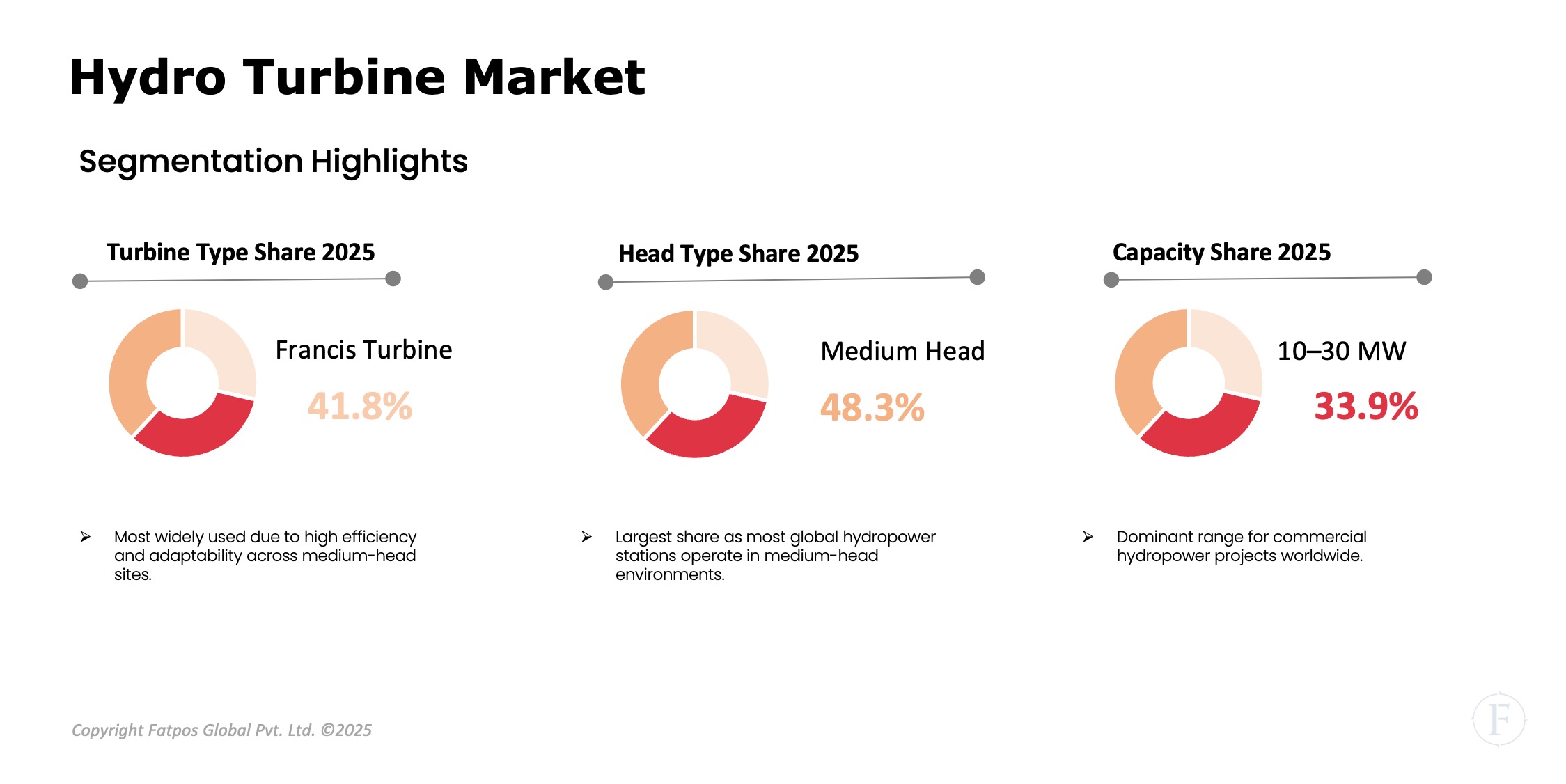
Francis turbines dominate the Hydro Turbine Market because they operate efficiently over a wide medium-head range. Small hydropower projects of up to 10 MW are the fastest-growing segment, favored for lower costs and shorter build times. Modernization and refurbishment are rising as many plants near end-of-life, with utilities still the main buyers while IPPs and industries increasingly adopt SHP, especially for high-head sites in mountainous APAC and LATAM regions.
Report Key Elements
|
ATTRIBUTES |
DETAILS |
|
Study Period |
2019–2035 |
|
Base Year |
2024 |
|
Global Hydro Turbine Market Forecast Period |
2025–2035 |
|
Global Hydro Turbine Market Size by 2035 |
USD 4.12 billion |
|
Market CAGR |
5.5% |
|
By Turbine Type |
Impulse Turbines: Pelton, Turgo, Crossflow; Reaction Turbines: Francis, Kaplan, Bulb; Other Custom Turbines |
|
By Capacity |
≤1 MW, 1–10 MW, 10–30 MW, 30–100 MW, >100 MW |
|
By Head Type |
Low Head, Medium Head, High Head |
|
By Application |
Power Generation, Irrigation, Industrial, Marine/Hydrokinetic |
|
By End User |
Utilities, IPPs, Industrial Operators, Small Hydropower Developers |
|
By Region |
NA, Europe, APAC, LATAM, MEA |
|
Key Market Players |
GE Renewable Energy, Voith Group, Andritz Hydro, Toshiba Energy Systems, Siemens Energy, BHEL (Bharat Heavy Electricals Limited) |
Global Hydro Turbine Industry Instances
- Major refurbishment project replacing decades-old turbines with high-efficiency designs, increasing output by 20–30%.
- Pelton turbines installed in high-head Himalayan hydropower plants.
- Adoption of fish-friendly Kaplan turbines in Europe to meet ecological standards.
- Remote monitoring systems deployed in Canadian and Scandinavian hydropower stations.
- Micro hydro kits installed in rural Asia for decentralized power generation.
Analyst Review
As per our Global Hydro Turbine Market Analysis report, the market is set for stable long-term growth as global energy systems transition toward renewable sources. While hydropower remains a mature sector, modernization, digitalization, and eco-friendly turbine advancements offer significant expansion opportunities. A rise in small hydropower installations and refurbishment of aging infrastructure will drive continuous demand. However, environmental concerns and limited new large-scale site availability remain key constraints.
Frequently Asked Questions (FAQ):
USD 4.21 billion.
Francis turbines dominate due to versatility and efficiency.
Asia-Pacific.
Renewable energy expansion, modernization programs, small hydropower demand.
Utilities, Independent Power Producers (IPPs), and industrial hydropower operators.
 Select License Type


.png)


