


Floating Solar Market Research 2035
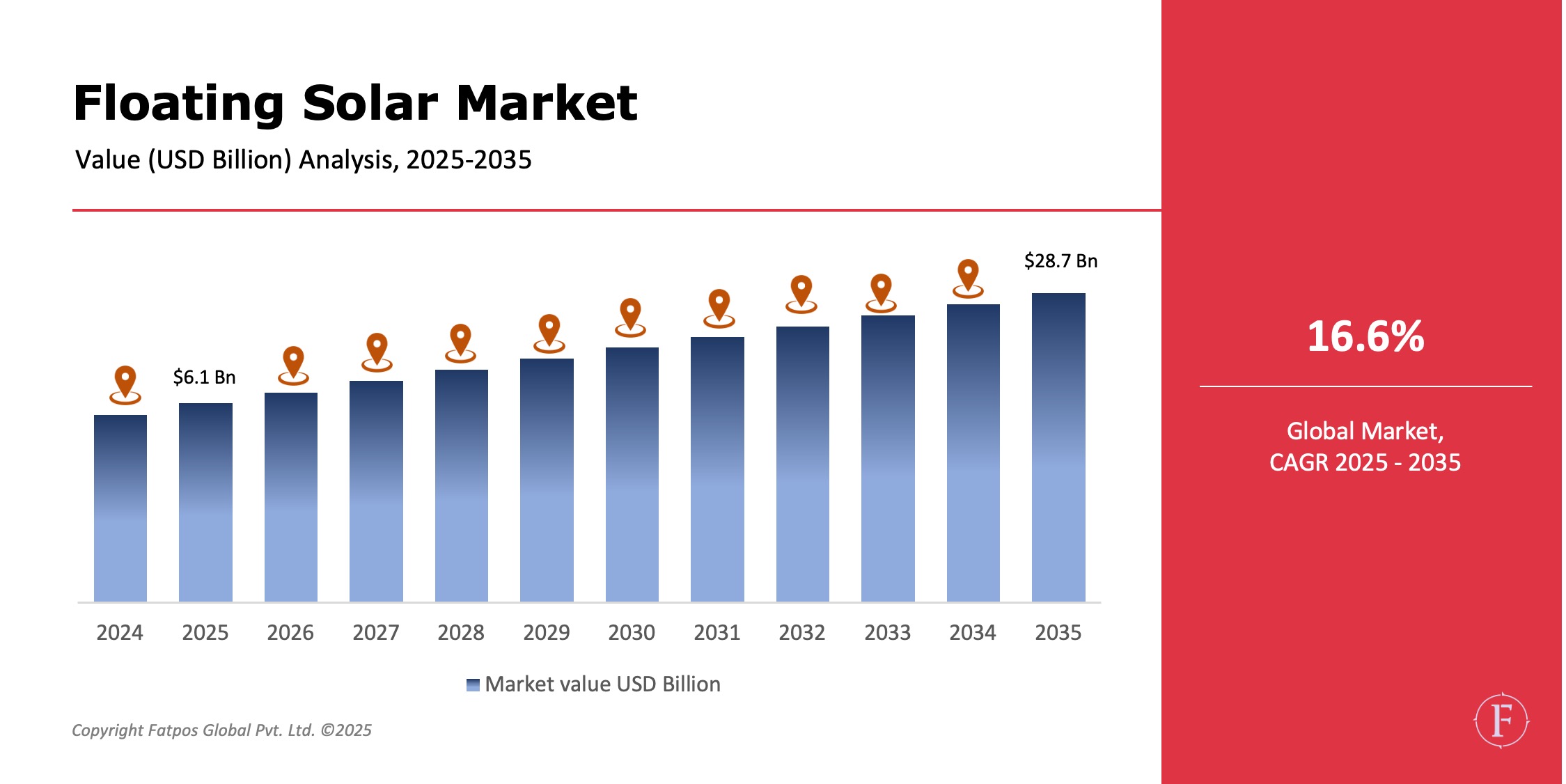
The Floating Solar Market was valued at USD 6.1 billion in 2025 and is projected to reach USD 28.7 billion by 2035, registering a robust CAGR of 16.6% during the forecast period. The market is experiencing rapid growth due to increasing land constraints, rising renewable energy targets, and growing adoption of solar installations on water bodies.
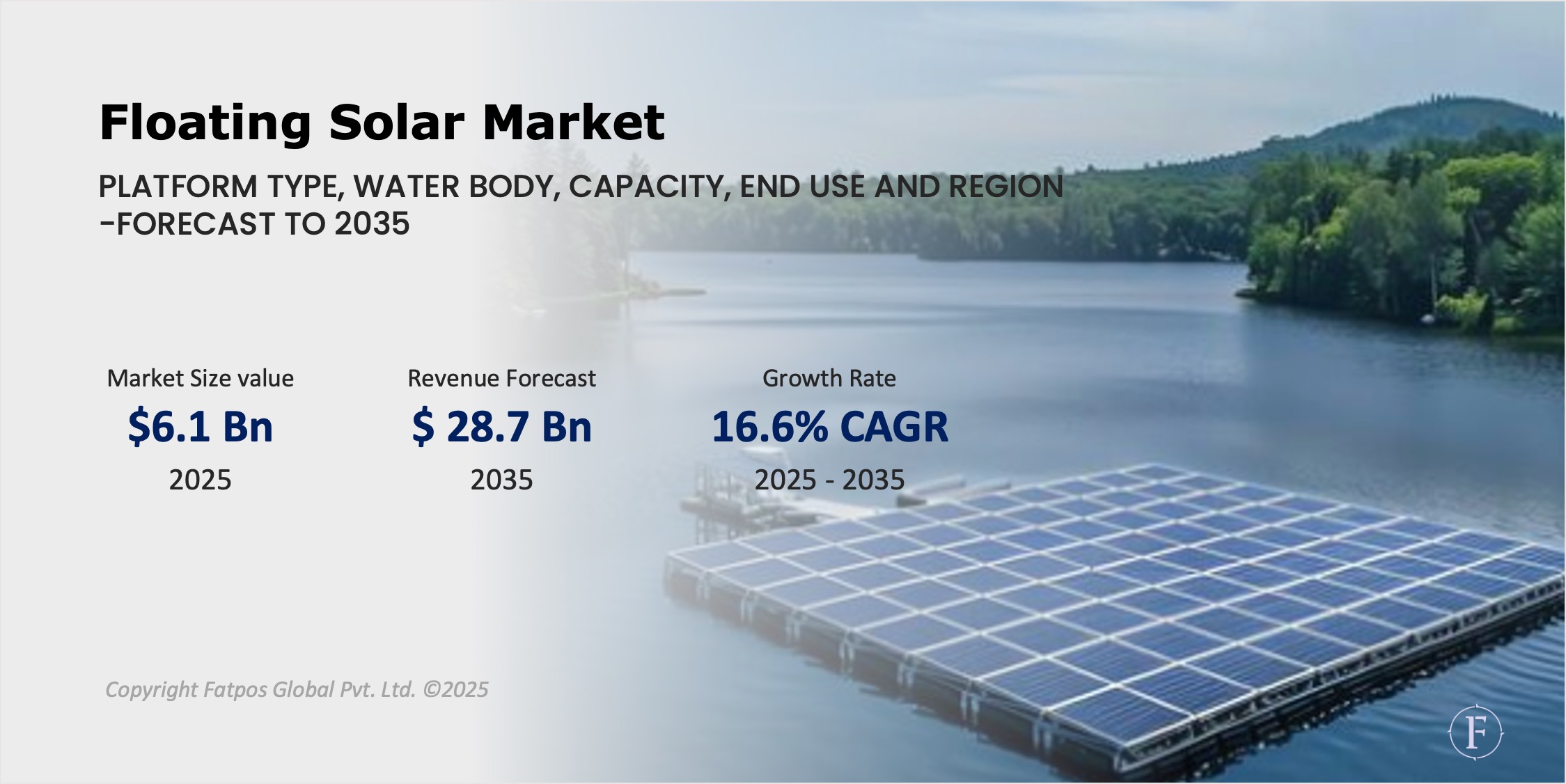
Floating solar photovoltaic (FPV) systems are deployed on reservoirs, lakes, ponds, and other water surfaces, offering higher efficiency compared to ground-mounted systems due to natural cooling effects. Governments and utilities are increasingly adopting floating solar to optimize land use, reduce water evaporation, and improve power generation efficiency, making FPV a key component of future renewable energy infrastructure.
Product Overview
Floating solar systems consist of photovoltaic panels mounted on buoyant structures that float on water surfaces. These systems are anchored and connected to onshore or offshore power infrastructure. FPV installations reduce land-use conflicts and are particularly attractive in regions with limited land availability or high population density.
Floating solar platforms are typically constructed using high-density polyethylene or corrosion-resistant materials to withstand harsh environmental conditions. FPV systems can be installed as standalone projects or integrated with existing hydropower plants, enabling hybrid energy generation. Reduced dust accumulation, improved panel performance, and lower water evaporation further enhance the economic and environmental benefits of floating solar solutions.
Key Takeaways:
- Floating Solar Market expected to grow at 16.6% CAGR through 2035
- Pontoon-based platforms dominate platform type segmentation
- Reservoirs are the most preferred water bodies for FPV installations
- Utility-scale projects represent the largest end-use segment
- Asia-Pacific leads global floating solar deployment
Market Dynamics
Drivers
The Floating Solar Market is primarily driven by increasing land scarcity and the need to optimize renewable energy generation without competing with agriculture or urban development. Governments worldwide are setting ambitious renewable energy targets, encouraging utilities to adopt innovative solutions such as floating solar.
Higher energy yield due to panel cooling from water surfaces improves system efficiency and return on investment. Additionally, FPV systems reduce water evaporation in reservoirs, offering dual benefits for water conservation and energy generation. Integration with hydropower infrastructure enables grid stability and efficient power management, further driving market growth.
Restraints
High initial capital costs associated with floating structures, anchoring systems, and installation restrain market growth. Limited availability of standardized designs and lack of skilled installation expertise in emerging regions increase project complexity.
Environmental concerns related to aquatic ecosystems and water quality impact project approvals. Additionally, exposure to extreme weather conditions such as storms, high winds, and fluctuating water levels poses operational risks. Limited long-term performance data in certain climates further restricts adoption among conservative investors.
Opportunities
Floating solar presents significant opportunities in countries with large water reservoirs and ambitious renewable energy goals. Expansion of hybrid floating solar-hydropower projects enables efficient use of existing transmission infrastructure.
Emerging economies with limited land availability offer strong growth potential. Technological advancements in floating materials, anchoring systems, and corrosion resistance are reducing costs and improving durability. Government incentives, feed-in tariffs, and public-private partnerships further accelerate FPV deployment. Floating solar also offers opportunities for offshore and nearshore applications in future energy systems.
Challenges
The Floating Solar Market faces challenges related to system durability, environmental impact, and high installation complexity. Floating platforms must withstand harsh weather conditions, water level fluctuations, and long-term exposure to moisture and UV radiation. Regulatory uncertainty regarding water surface usage and environmental approvals can delay project development. Limited availability of skilled contractors and specialized equipment increases project timelines and costs. Additionally, concerns about potential impacts on aquatic ecosystems and water quality require continuous monitoring and mitigation strategies. Developing standardized designs and long-term performance benchmarks remains critical for widespread adoption.
Floating Solar Market Trends
The market is witnessing rapid adoption of large-scale floating solar projects integrated with hydropower facilities. Advancements in modular floating platforms and anchoring technologies are improving installation efficiency and scalability.
Digital monitoring systems and AI-based performance analytics are being deployed to optimize energy output and maintenance. Countries are increasingly launching national floating solar tenders, while utilities explore offshore and nearshore floating solar applications. Sustainability-driven investments and carbon neutrality commitments are accelerating innovation and global adoption of floating solar technology.
Key Players in the Global Floating Solar Industry
- Ciel & Terre
- Sungrow Power Supply Co., Ltd.
- Trina Solar
- LONGi Green Energy Technology
- JA Solar Technology
- First Solar
- SPG Solar
- Yingli Solar
- Vikram Solar
- Tata Power Solar
Regional & Country Analysis
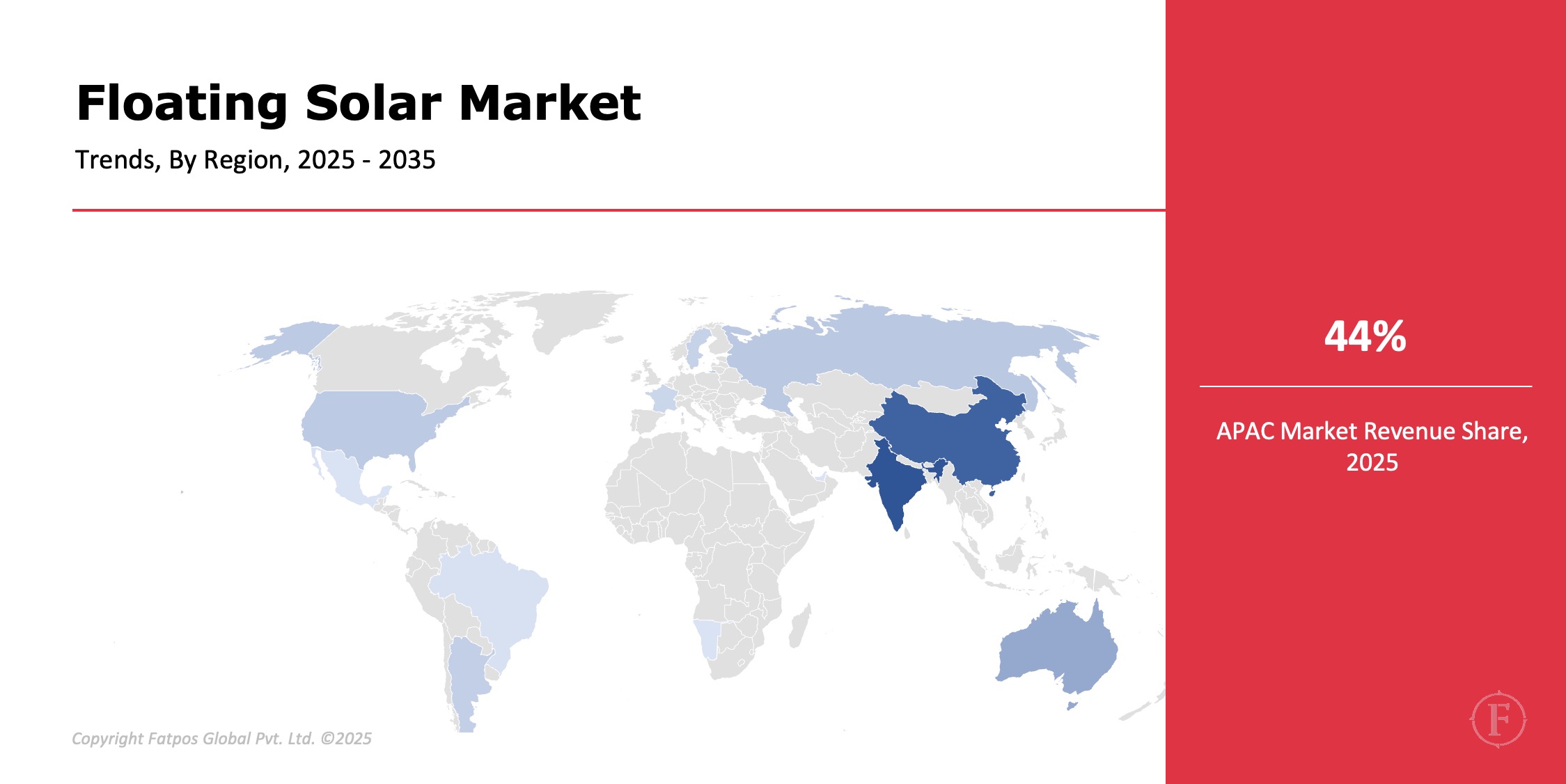
Asia-Pacific dominates the Floating Solar Market due to extensive reservoir infrastructure, rapid renewable energy deployment, and strong government support in China, India, Japan, and South Korea. China leads global installations with large utility-scale projects. India is emerging as a key market due to land constraints and ambitious solar targets.
Europe shows steady growth, supported by sustainability policies and pilot FPV projects in countries such as the Netherlands, France, and the UK. North America is expanding adoption, particularly in the United States, driven by water conservation benefits and utility-scale renewable investments. Latin America and the Middle East & Africa represent emerging markets with strong long-term potential.
Segmentation Highlights
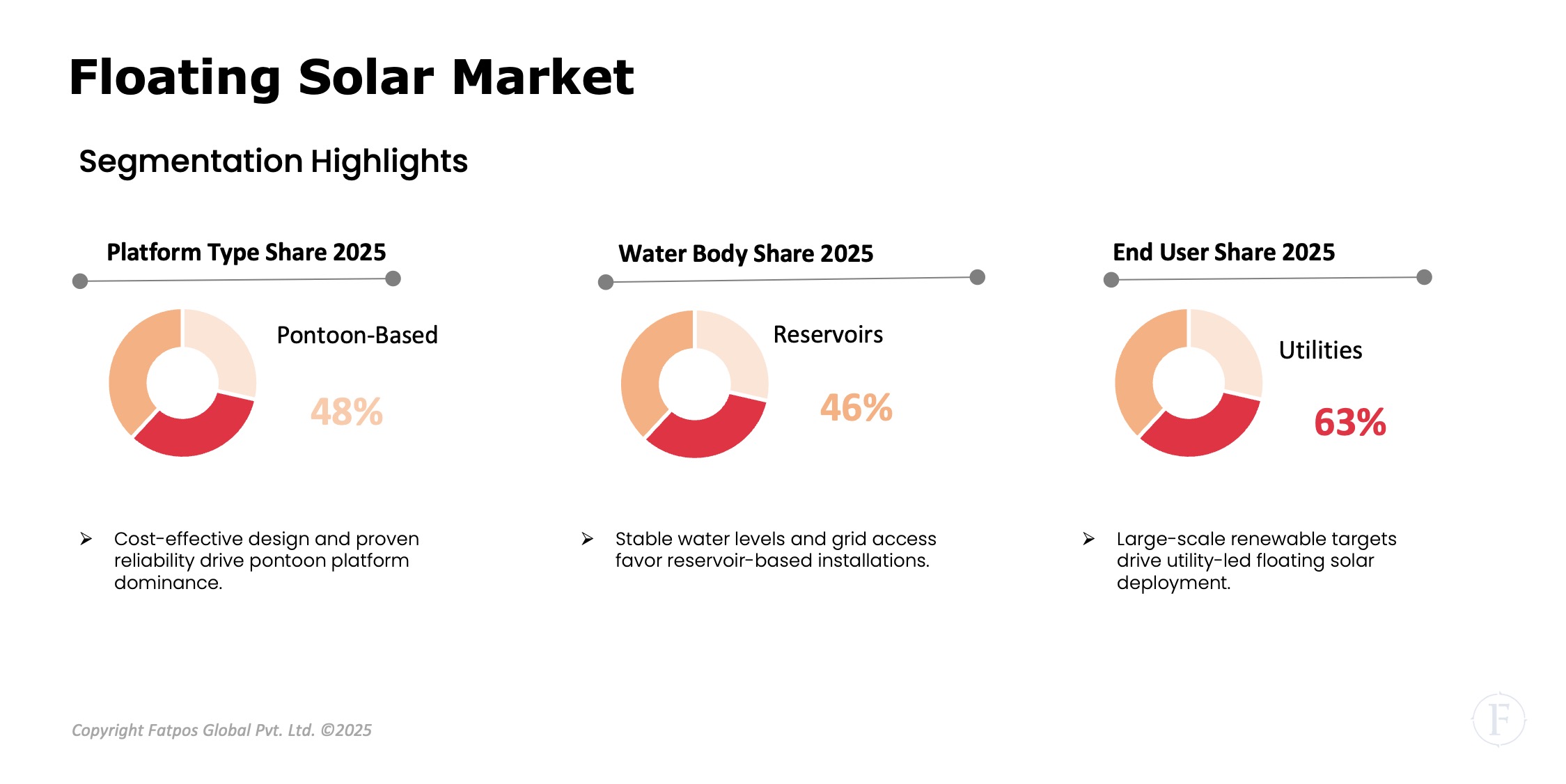
Pontoon-based platforms hold the largest share due to cost efficiency and proven performance. Reservoir-based installations dominate water body segmentation. Utility-scale projects account for the highest end-use share driven by national renewable targets. Asia-Pacific remains the leading region supported by government-backed floating solar programs and extensive water infrastructure.
Report Key Elements
|
ATTRIBUTES |
DETAILS |
|
Study Period |
2019–2035 |
|
Base Year |
2024 |
|
Forecast Period |
2025–2035 |
|
Market Size by 2035 |
USD 28.7 Billion |
|
Market CAGR |
16.6% |
|
By Platform Type |
Pontoon-Based, Membrane-Based, Hybrid |
|
By Water Body |
Reservoirs, Lakes, Ponds, Canals, Others |
|
By Capacity |
Below 5 MW, 5–50 MW, Above 50 MW |
|
By End Use |
Utilities, Commercial & Industrial |
|
By Region |
North America, Europe, Asia-Pacific, Latin America, MEA |
|
Floating Solar Market: Key Players |
Ciel & Terre, Sungrow Power Supply Co., Ltd., Trina Solar, LONGi Green Energy Technology, JA Solar Technology |
Global Floating Solar Industry Instances
- Utilities deployed hybrid floating solar-hydropower projects
- Governments launched large-scale reservoir-based FPV tenders
- Manufacturers developed corrosion-resistant floating platforms
- Energy companies adopted AI monitoring for floating solar optimization
Analyst Review
As per our Floating Solar Market analysis, the market will witness sustained growth through 2035 driven by land scarcity, renewable energy mandates, and efficiency advantages. Despite technical and regulatory challenges, technological advancements and government support will significantly accelerate adoption, positioning floating solar as a core component of future clean energy systems.
Frequently Asked Questions (FAQ):
Floating solar refers to photovoltaic systems installed on water bodies using buoyant structures to generate renewable electricity.
Growth is driven by land scarcity, renewable energy targets, higher efficiency, and water conservation benefits.
Pontoon-based platforms dominate due to cost efficiency, modular design, and proven operational reliability.
Utilities lead adoption through large-scale projects supporting national renewable energy targets.
Asia-Pacific leads due to strong government support, extensive reservoirs, and high renewable demand.
 Select License Type


.png)


