


Satellite Antenna Market Research 2035
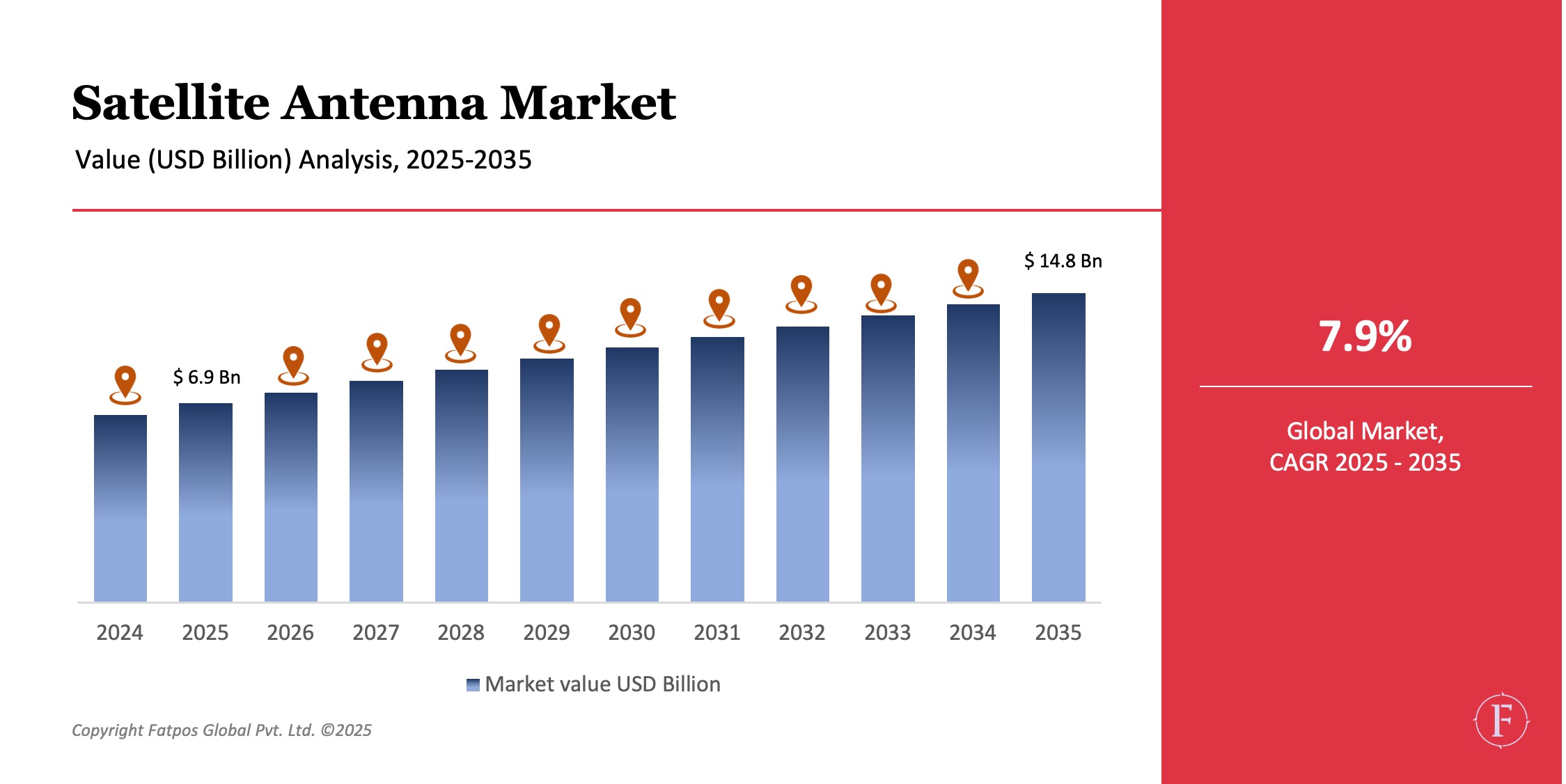
The Satellite Antenna Market was valued at USD 6.9 billion in 2025 and is projected to reach USD 14.8 billion by 2035, growing at a CAGR of 7.9% during the forecast period. Market growth is primarily driven by rising demand for satellite-based communication services, expansion of low Earth orbit (LEO) satellite constellations, increasing defense and space exploration investments, and growing adoption of satellite connectivity across aviation, maritime, and remote regions.
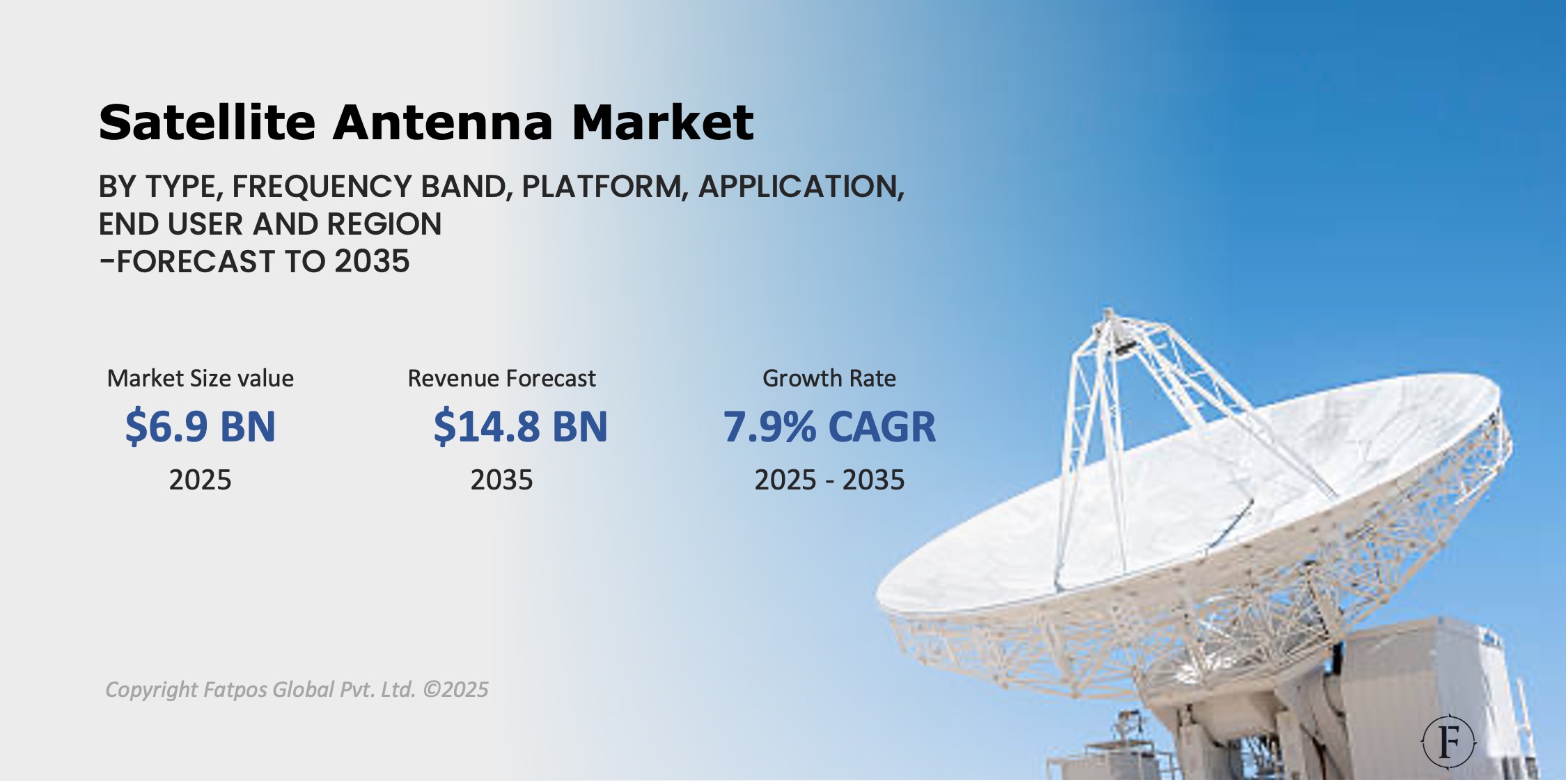
Satellite antennas are critical components enabling reliable transmission and reception of signals between satellites and ground terminals. Continuous advancements in antenna design, including electronically steered and flat-panel antennas, are enhancing performance, mobility, and bandwidth efficiency, further accelerating market growth.
Product Overview
Satellite antennas are specialized devices designed to transmit and receive electromagnetic signals to and from satellites. They play a vital role in enabling satellite communication, broadcasting, navigation, earth observation, and defense applications.
By type, the market includes parabolic antennas, which are widely used due to their high gain and signal accuracy, flat panel antennas offering compact and electronically steerable solutions, horn antennas used in measurement and space applications, and other specialized antenna types. Flat panel antennas are gaining significant traction due to their low-profile design and suitability for mobile platforms.
Satellite antennas operate across various frequency bands such as C-band, Ku-band, Ka-band, and X-band, each offering different performance characteristics related to bandwidth, coverage, and weather resistance. Increasing demand for high-throughput satellites is driving adoption of Ka-band antennas.
Key Takeaways :
- Satellite Antenna Market expected to grow at 7.9% CAGR through 2035
- Parabolic antennas dominate due to high signal gain and reliability
- Ka-band adoption increasing for high-speed data transmission
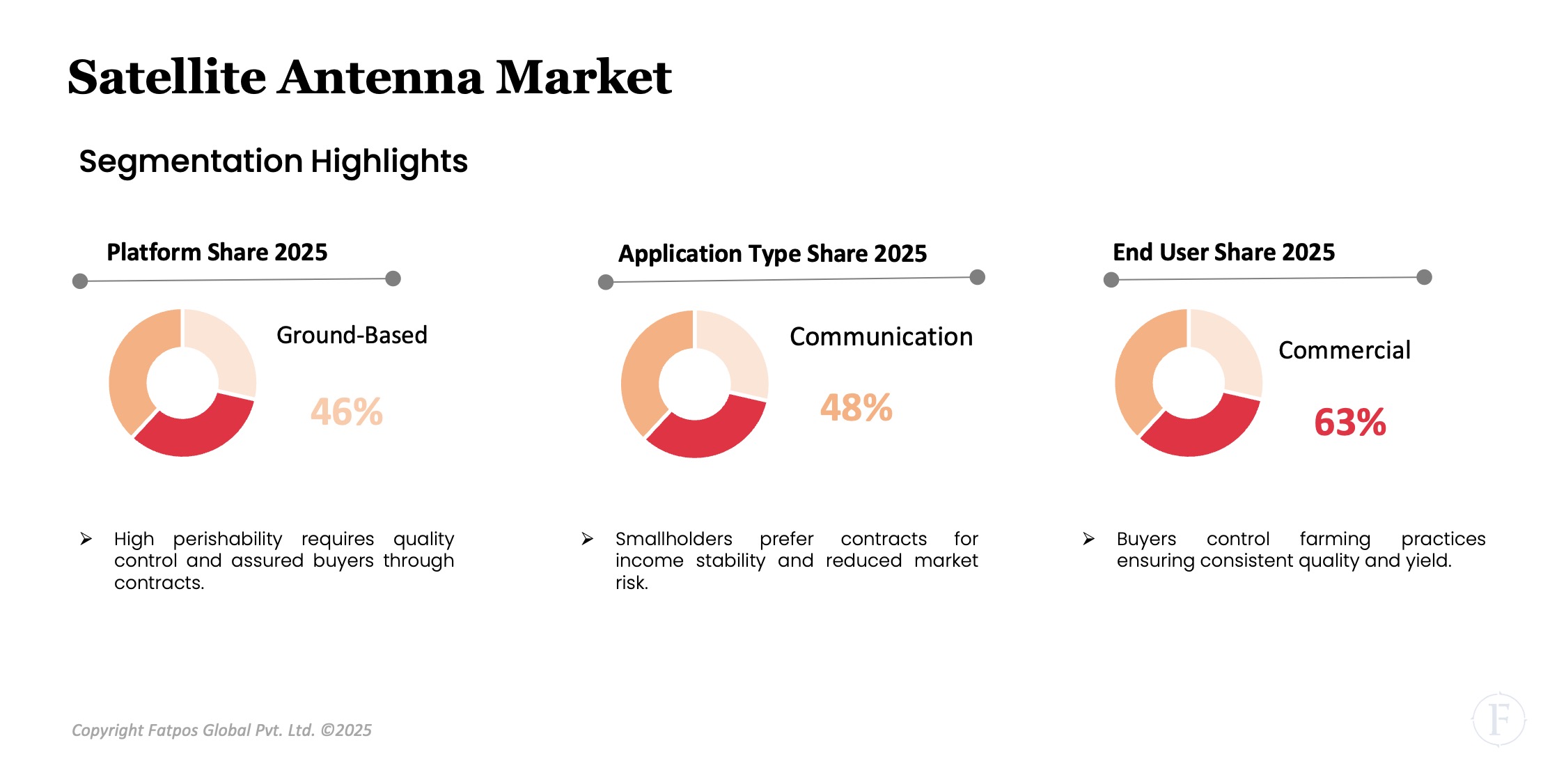
- Commercial applications account for the largest market share
- Defense and aerospace investments drive advanced antenna development
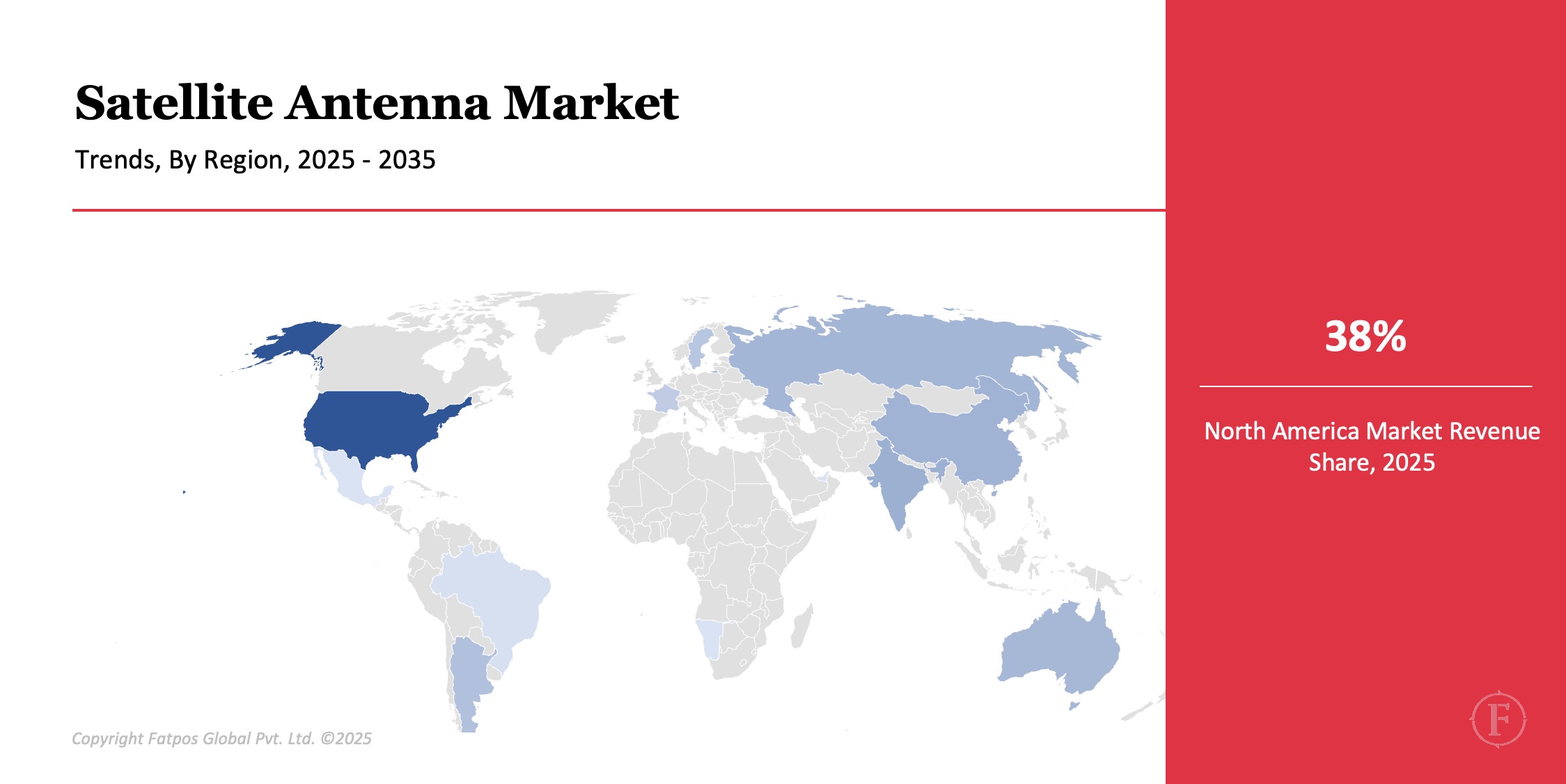
- North America leads the global market
Market Dynamics
Drivers
The growing demand for high-speed broadband connectivity in remote and underserved regions is a major driver of the Satellite Antenna Market. Satellite communication provides reliable connectivity where terrestrial networks are impractical or unavailable.
Expansion of LEO satellite constellations for global internet coverage has significantly increased demand for advanced satellite antennas capable of tracking fast-moving satellites. Rising investments in defense communication systems, surveillance, and space exploration missions further contribute to market growth.
Restrictions
High capital costs associated with advanced satellite antenna systems remain a significant restraint for market growth. Installation complexity, maintenance requirements, and the need for skilled technical personnel further increase total ownership costs. Regulatory challenges related to spectrum allocation and licensing also restrict deployment, particularly across international markets.
Additionally, signal degradation due to weather conditions, especially in higher frequency bands such as Ka-band, affects reliability and adoption. Integration challenges with existing infrastructure and interoperability issues across satellite networks further limit large-scale deployment, particularly for small commercial operators and emerging markets.
Opportunities
The rapid expansion of low Earth orbit satellite constellations presents substantial growth opportunities for the Satellite Antenna Market. Increasing demand for high-speed satellite broadband in remote and underserved regions is accelerating adoption. Advancements in electronically steered flat panel antennas offer improved mobility, reduced mechanical complexity, and faster satellite tracking capabilities.
Growing use of satellite antennas in connected aircraft, autonomous maritime vessels, disaster recovery, and defense modernization programs further enhances market potential. Emerging economies investing in space and telecommunications infrastructure also provide strong long-term opportunities.
Challenges
Maintaining signal reliability and minimizing latency across dynamic satellite networks remains a major challenge. Rapid technological advancements require continuous innovation, increasing research and development costs for manufacturers. Spectrum congestion and interference management are growing concerns as satellite launches increase globally. Compatibility across different satellite systems and frequency bands further complicates deployment.
Additionally, balancing performance improvements with cost competitiveness remains difficult, particularly for commercial users seeking affordable yet high-performance antenna solutions. These challenges demand continuous technological upgrades and regulatory coordination.
Satellite Antenna Market Trends
The market is witnessing a strong shift toward electronically steered flat panel antennas, particularly for LEO satellite networks. Demand for lightweight, compact, and multi-band antennas is increasing across aviation, maritime, and defense sectors. Integration of satellite antennas with IoT systems, autonomous platforms, and smart defense networks is expanding.
Hybrid antenna solutions supporting multiple frequency bands are gaining popularity. Additionally, software-defined antennas enabling dynamic beam steering and network adaptability are emerging as a key trend shaping future market development.
Key Players in the Global Satellite Antenna Industry
- Viasat, Inc.
- Cobham Limited
- Honeywell International Inc.
- L3Harris Technologies, Inc.
- Thales Group
- Mitsubishi Electric Corporation
- General Dynamics Corporation
- Hanwha Systems
- Ball Aerospace
- Airbus Defence and Space
Regional & Country Analysis
North America holds a dominant share of the Satellite Antenna Market due to strong defense spending, advanced space programs, and the presence of major satellite operators and manufacturers. The United States leads regional growth supported by commercial satellite broadband expansion and military modernization initiatives.
Europe demonstrates steady growth driven by space exploration programs and increasing satellite-based communication services. Asia-Pacific is expected to be the fastest-growing region due to rising investments in space technology, expanding telecommunications infrastructure, and increasing adoption of satellite services across aviation and maritime sectors. Latin America and the Middle East & Africa represent emerging markets with growing demand for satellite connectivity.
Segmentation Highlights
By type, parabolic antennas dominate the market due to proven performance and widespread deployment. By frequency band, Ka-band is gaining momentum due to demand for higher data throughput. Commercial end users lead market demand, while government and defense applications drive technological innovation and high-value contracts.
Report Key Elements
|
ATTRIBUTES |
DETAILS |
|
Study Period |
2019–2035 |
|
Base Year |
2024 |
|
Forecast Period |
2025–2035 |
|
Market Size by 2035 |
USD 14.8 Billion |
|
Market CAGR |
7.9% |
|
By Type |
Parabolic Antenna, Flat Panel Antenna, Horn Antenna, Others |
|
By Frequency Band |
C-Band, Ku-Band, Ka-Band, X-Band, Others |
|
By Platform |
Ground-Based, Airborne, Maritime, Spaceborne |
|
By Application |
Communication, Navigation, Earth Observation, Broadcasting, Others |
|
By Region
|
North America, Europe, Asia-Pacific, Latin America, MEA |
|
Satellite Antenna Market: Key Players |
Viasat, Inc., Cobham Limited, Honeywell International Inc., L3Harris Technologies, Inc., Thales Group |
Global Satellite Antenna Industry Instances
- Satellite broadband providers expanded antenna deployment for global connectivity
- Defense agencies upgraded satellite communication and surveillance antenna systems
- Aviation sector adopted satellite antennas for in-flight connectivity
- Space agencies invested in advanced antenna technologies for exploration missions
Analyst Review
As per our satellite antenna market analysis, market is expected to witness steady growth driven by expanding satellite networks, defense modernization, and rising demand for global connectivity. Technological innovation, particularly in flat panel and electronically steered antennas, will play a crucial role in shaping the market's future.

Frequently Asked Questions (FAQ):
A satellite antenna transmits and receives radio signals between satellites and ground, airborne, or maritime systems for communication and data transfer.
Growing satellite broadband demand, LEO constellation expansion, defense modernization, and increased satellite communication adoption drive market growth globally.
Parabolic antennas dominate due to high signal gain, reliability, and widespread deployment in ground-based satellite communication systems.
North America leads due to strong defense spending, advanced space programs, and high satellite communication infrastructure adoption.
The market shows strong growth driven by satellite connectivity expansion, technological innovation, and rising global communication needs.
 Select License Type


.png)


