


Aviation Cloud Market Size
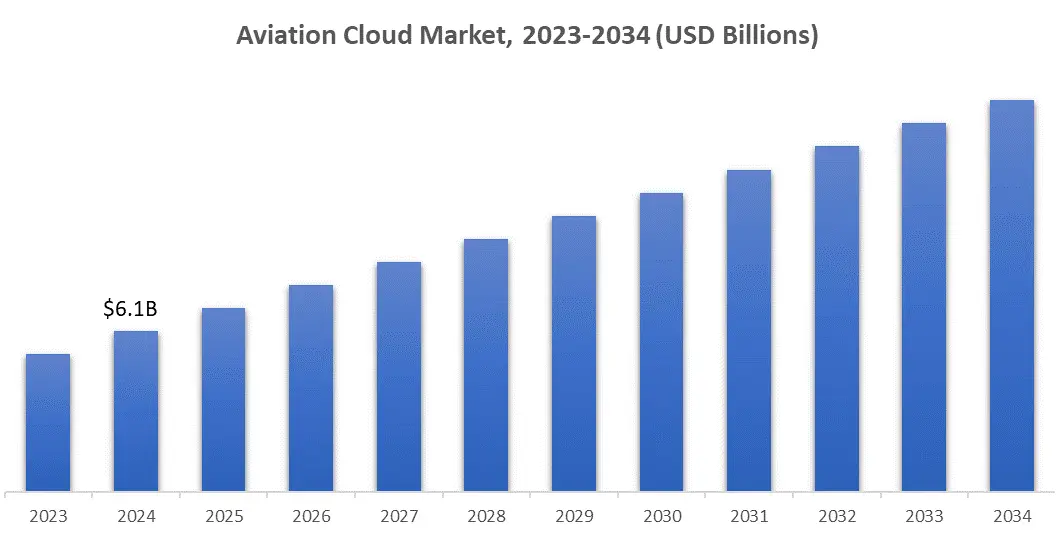
Aviation Cloud Market is expected to witness robust growth at a Compound Annual Growth Rate (CAGR) of 16.5% during the forecast period from 2024 to 2034. The market, valued at USD 5.3 billion in 2023, is projected to reach a substantial value of USD 28.2 billion by 2034.
Product Overview:
Aviation Cloud is a cloud-based system designed for the aviation sector to improve efficiency, safety, and customer satisfaction. These solutions cover various range of applications such as flight operations, maintenance, repair, overhaul (MRO), ground operations, and passenger service systems (PSS). By utilizing cloud technology, airlines and airports can tap into real-time data, enhance teamwork, and simplify operations. Adopting cloud solutions also enables scalability, saves costs, and improves data management, all while incorporating advanced technologies such as AI and IoT for predictive analysis and automation. Despite several challenges such as data security and integration with older systems, the aviation cloud industry is fueled by the demand for streamlined operations, growing air travel, and following regulations.
Market Highlights:
Aviation Cloud Market is expected to exhibit a CAGR of 16.5% during the forecast period, 2024-2034
Aviation Cloud Market is anticipated to reach USD 28.2 billion, growing at a CAGR of 16.5% during the forecast period owing to rising demand for effective flight operations, improved passenger experiences, and cost savings. The increase in global air passenger travel requires adaptable and scalable IT solutions, which are offered by cloud technologies. Advancements in cloud computing, such as the incorporation of AI and IoT, allow for the implementation of predictive analytics and automation, leading to increased market acceptance. Furthermore, airlines and airports are compelled to adopt secure cloud solutions due to regulatory mandates for data security and compliance. With technology advancing and the aviation sector aiming for more sustainable and efficient practices, the Aviation Cloud market is projected to expand, showing promise for the future.
Aviation Cloud Market Segmentation:
The ease of use and scalability of SaaS solidify its position as the dominant market segment
Aviation cloud market is based on the Service Model into IaaS, PaaS, and SaaS segments. In the existing market framework, the SaaS (Software as a Service) segment holds the dominant market position owing to its ease of use, better scalability, cost-effectiveness, and focus on core business functions. SaaS offers pre-built aviation software that is easily accessible through a web browser, removing the need for complicated infrastructure configuration and enabling simple scalability. The pricing model based on subscriptions offers stable expenses, making it cost-effective when compared to Infrastructure as a Service (IaaS) or Platform as a Service (PaaS). SaaS allows aviation companies to concentrate on key areas such as passenger experience and flight operations, instead of handling IT infrastructure. Moreover, SaaS provides a variety of options for flight operations, passenger check-in, revenue management, and maintenance. For example, an airline could easily adopt a cloud-hosted check-in system, cutting expenses and taking advantage of the newest functionalities.
Public cloud segment dominates the market due to the robust security and cost-effectiveness it tends to offer
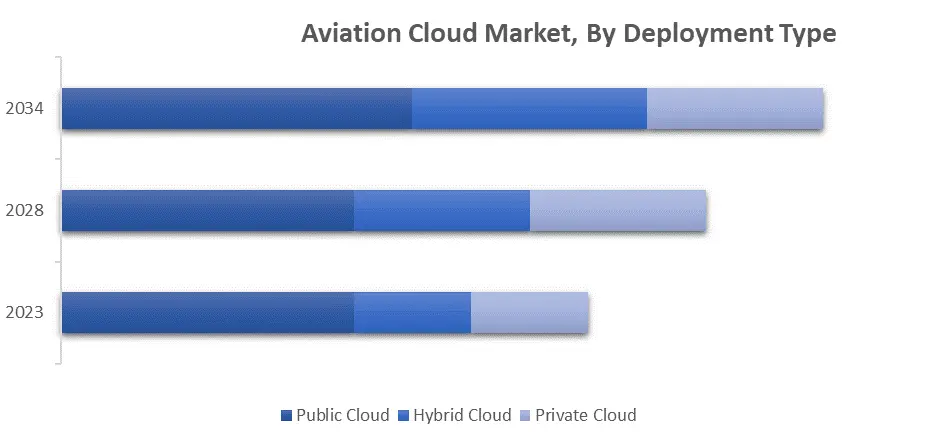
Aviation cloud market is categorized based on Deployment type into Public Cloud, Private Cloud, and Hybrid Cloud. The public cloud currently holds the dominant market due to its cost-effectiveness, scalability, security, and innovation. The pay-as-you-go model of the public cloud eliminates the significant need for any form of upfront investment in infrastructure enabling aviation businesses to easily adjust resource levels according to demand, cutting down on expenses linked to idle servers. Major public cloud providers dedicate significant resources to implementing strong security measures and obtaining compliance certifications to maintain data privacy and follow industry regulations. The continuous innovation from different providers introduces advanced features and capabilities to aviation companies. The use of the public cloud allows airlines and airports to concentrate on key skills such as passenger satisfaction and safety while providing an easier transition from old systems and extensive data storage and processing capacities to enhance operations and customize passenger experiences.
Market Dynamics:
Growth Drivers
Increase in Air Passenger Traffic to Create Significant Growth Opportunities for Aviation Cloud Market
Airlines and airports face the challenge of managing increasing numbers of passengers while also ensuring efficiency and seamless travel experiences. The traditional IT infrastructure finds it challenging to rapidly expand or adjust to evolving market and regulatory requirements. Cloud computing allows for the ability to easily adjust to changing passenger volumes by offering the required scalability and flexibility. Airlines can effortlessly adjust IT resources to meet demands during peak seasons or sudden increases, maintaining efficient operations and avoiding unnecessary expenses on unused on-site infrastructure. Scalable cloud solutions help airlines enhance passenger management, optimize flight schedules, and efficiently handle resources during peak times. Airports can make use of cloud technology for controlling passenger traffic, improving baggage handling processes, and strengthening security protocols to ensure a smooth travel experience.
Growing Adoption of Emerging Technologies to Facilitate Market Expansion
In recent times aviation cloud market has been at the forefront of fostering innovation by serving as the basis for new technologies such as AI, ML, and IoT. AI and ML need extensive data processing power and storage, which is provided by cloud platforms, allowing for the analysis of flight data, optimization of routes, maintenance predictions, personalized passenger experiences, and increased operational efficiency. IoT enables aviation assets such as airplanes, sensors, and luggage tags to be connected to the cloud for real-time monitoring, improved maintenance planning, and increased operational safety. Traditional on-premise infrastructure frequently does not have sufficient processing power and storage capacity for these applications. Cloud computing creates the necessary foundation for the growth of AI, ML, and IoT in the aviation sector, driving innovation and advancement.
Restraints
Security Concerns Around Sensitive Aviation Data to Hinder Market Growth
Security issues regarding sensitive aviation data act as a major restraint towards the expansion of the Aviation Cloud Market. This private information consists of passenger details (such as names, passport data, payment details), operational information (flight schedules, maintenance logs, crew details), and air traffic control (ATC) data. Security breaches can result in the theft of one's identity, fraudulent activities, disruption in operations, and safety hazards. Major security issues include data breaches, internal threats, unintentional data loss, and ensuring compliance with regulations such as GDPR and CCPA. To deal with these issues, strong security measures like encryption, access controls, and frequent vulnerability assessments are necessary. Mitigating risks can be achieved by ensuring better data compliance, offering cybersecurity training to employees, and prioritizing data encryption.
Recent Developments
- In early 2023, Microsoft launched its Azure Cloud for Aviation, a comprehensive suite of cloud solutions tailored specifically for the aviation industry, including flight operations, maintenance, and passenger services.
- In late 2023, IBM entered into a joint venture with Airbus to develop advanced cloud-based analytics and artificial intelligence solutions for aircraft maintenance and predictive maintenance.
- In mid-2023, Oracle Corporation introduced its Aviation Cloud Platform, a comprehensive suite of cloud-based solutions for airline operations, revenue management, and passenger services. The company acquired AirCraft Analytics, a startup specializing in aircraft data analytics and predictive maintenance, to enhance its aviation cloud offerings.
- In 2023, AWS announced its AWS for Aerospace and Satellite Solutions initiative, focusing on providing cloud services and solutions tailored for the aviation and aerospace industries. In early 2024, AWS partnered with Airbus to develop cloud-based digital solutions for aircraft design, manufacturing, and operations.
- In late 2023, SAP launched its SAP S/4HANA Cloud for Aviation, a cloud-based ERP solution specifically designed for the aviation industry, covering areas such as maintenance, repair, and overhaul (MRO), flight operations, and passenger services.
Aviation Cloud Market, Key Players:
- Microsoft Corporation
- Oracle Corporation
- Amazon Web Services (AWS)
- SAP SE
- Google Cloud
- IBM Corporation
- Siemens AG
- Lufthansa Systems
- Honeywell International Inc.
- Ramco Systems
- Wipro Limited
- Fujitsu Limited
- SITA
- GE Aviation
- CISCO Systems, Inc.
- Other Prominent Players (Company Overview, Business Strategy, Key Product Offerings, Financial Performance, Key Performance Indicators, Risk Analysis, Recent Development, Regional Presence, SWOT Analysis)
Regional Analysis
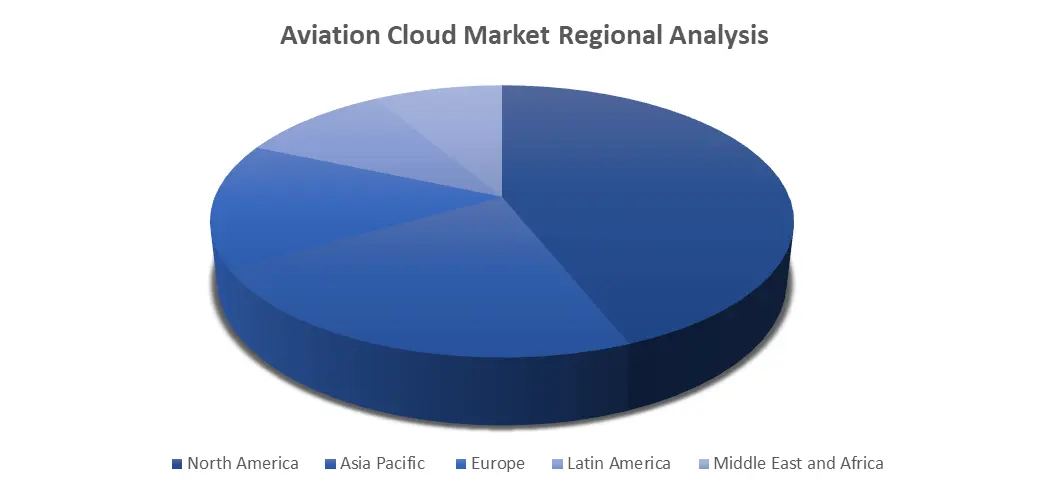
Aviation Cloud Market is segmented based on regional analysis into five major regions: North America, Latin America, Europe, Asia Pacific, and the Middle East and Africa. While the Aviation Cloud Market is experiencing global market growth, North America is currently in the leading position due to various important factors. Firstly, North America has a high-quality technological infrastructure with high-speed internet and strong data centers, which support easy and effective cloud integration. Furthermore, this region is home to significant market players in the aviation industry, such as airlines, airplane makers, and tech firms, who are advancing cloud adoption and market expansion with new ideas.
Moving forward, other regions have shown significant growth potential in the Aviation Cloud Market. In the Asia Pacific region, the market is expanding due to the rapid growth in air travel and infrastructure development, along with government efforts to promote digital transformation and invest in cloud computing. Europe's advanced aviation sector and strict data privacy laws guarantee a strong shift and focus toward secure cloud options, establishing it as a crucial market. Latin America and the Middle East & Africa are in the early stages of adopting cloud technology, which provides them a great growth potential credited to the rising demand for air travel and the development of infrastructure.
Source: Fatpos Global
Impact of Covid-19 on Aviation Cloud Market
Aviation cloud market was significantly impacted by the COVID-19 pandemic, experiencing both negative and positive outcomes. A significant decrease in air travel led to a sharp decline in the overall demand for cloud-based solutions specifically designed for aviation activities. Airline companies, experiencing financial difficulties, frequently postponed or reduced their investments in cloud technologies. On the positive side, the pandemic also led to beneficial transformations. Airlines shifted their focus towards operational efficiency, seeing cloud adoption as a way to enhance operations, cut costs, and boost efficiency. Cloud platforms enabled remote work and collaboration, guaranteeing business operations continuation even with travel constraints in place. Furthermore, the Aviation Cloud Market remained stable in certain regions due to increased usage of cloud solutions for logistics and supply chain management, propelled by growth in cargo traffic amid the pandemic.
Aviation Cloud Market is further segmented by region into:
- North America Market Size, Share, Trends, Opportunities, Y-o-Y Growth, CAGR – United States and Canada
- Latin America Market Size, Share, Trends, Opportunities, Y-o-Y Growth, CAGR – Mexico, Argentina, Brazil, and Rest of Latin America
- Europe Market Size, Share, Trends, Opportunities, Y-o-Y Growth, CAGR – United Kingdom, France, Germany, Italy, Spain, Belgium, Hungary, Luxembourg, Netherlands, Poland, NORDIC, Russia, Turkey, and Rest of Europe
- Asia Pacific Market Size, Share, Trends, Opportunities, Y-o-Y Growth, CAGR – India, China, South Korea, Japan, Malaysia, Indonesia, New Zealand, Australia, and Rest of APAC
- Middle East and Africa Market Size, Share, Trends, Opportunities, Y-o-Y Growth, CAGR – North Africa, Israel, GCC, South Africa, and Rest of MENA
Aviation Cloud Market Scope and Segments:
|
ATTRIBUTE |
DETAILS |
|
Study Period |
2018-2034 |
|
Base Year |
2023 |
|
Forecast Period |
2024-2034 |
|
Historical Period |
2019-2022 |
|
Growth Rate |
CAGR of 16.5% from 2024-2034 |
|
Unit |
Value (USD Billion) |
|
Segmentation |
Main Segments List |
|
By Service Mode |
|
|
By Deployment Type |
|
|
By End User |
|
|
By Application |
|
|
By Region |
|
Frequently Asked Questions (FAQ):
Aviation cloud market size was valued at USD 5.3 billion in 2023 and is projected to reach the value of USD 28.2 billion in 2034, exhibiting a CAGR of 16.5% during the forecast period.
Aviation Cloud Market encompasses cloud-based solutions tailored for the aviation industry, including airlines, airports, and related entities. These solutions offer scalability, efficiency, and innovation in areas such as flight operations, maintenance, passenger services, and data analytics, enhancing overall operational performance and customer experience.
The SaaS (Software as a Service) and Public Cloud segments accounted for the largest Aviation Cloud Market share.
Key players in the Aviation Cloud Market include Microsoft Corporation, Oracle Corporation, Amazon Web Services (AWS), SAP SE, Google Cloud, IBM Corporation, Siemens AG, Lufthansa Systems, Honeywell International Inc., Ramco Systems, Wipro Limited, Fujitsu Limited, SITA, GE Aviation, CISCO Systems, Inc. and Other Prominent Players.
Factors propelling growth in the Aviation Cloud Market include the demand for operational efficiency, scalability, data analytics, and innovation in the aviation sector.
 Select License Type


.png)


