


Commercial Drone Market Research 2030
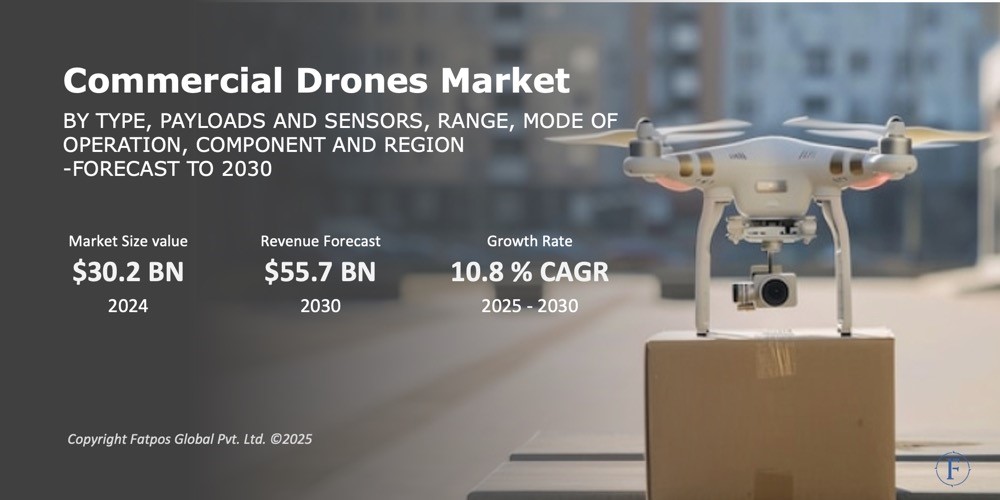
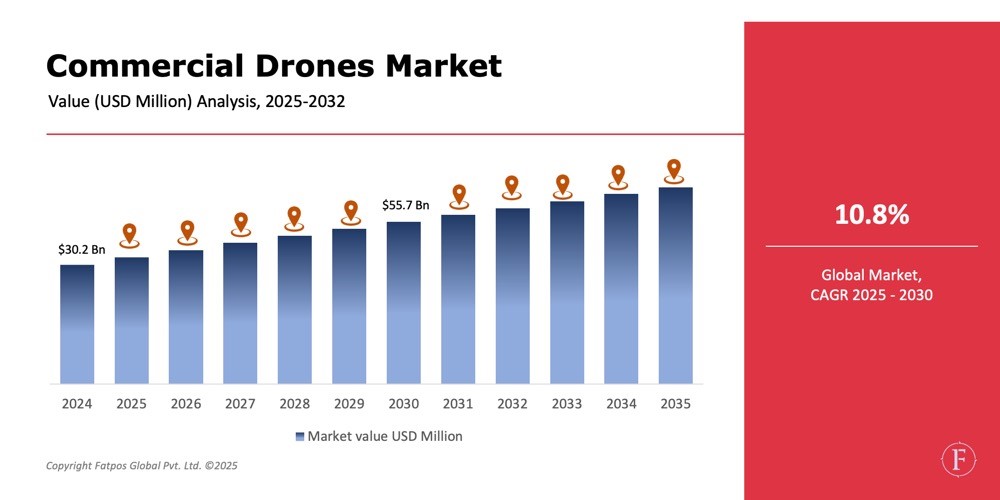
The global commercial drones market was valued at approximately USD 30.2 billion in 2024 and is projected to grow to about USD 55.7 billion by 2030, exhibiting a compound annual growth rate (CAGR) of around 10.8% during the forecast period. The increasing enterprise adoption of drones coupled with technological advancements in battery life, sensor capabilities, and artificial intelligence contributes significantly to market growth. Broadening applications ranging from precision agriculture, infrastructure inspection, aerial filming, to logistics and emergency services are driving demand. Government initiatives, regulatory relaxations specifically regarding beyond-visual-line-of-sight (BVLOS) operations, and increased funding for drone R&D further support expansion. North America leads in market share owing to early technology adoption, followed by the rapidly growing Asia-Pacific region with increasing commercial usage and manufacturing capabilities.
Product Overview
Commercial drones are unmanned aerial vehicles used for professional applications such as mapping, inspection, agriculture, logistics, public safety, and media. They integrate airframes, electric propulsion, GNSS positioning, onboard sensors, communications links, and increasingly AI-based flight control and analytics. As regulations evolve and component costs fall, drones are shifting from experimental tools to core assets in digital operations and data-driven decision-making.
Key Takeaways :
- Multirotor drones dominate unit shipments thanks to their versatility, low cost, and ease of use for imaging, inspection, and short-range missions.
- Fixed-wing and VTOL platforms are gaining traction in long-range surveying, pipeline inspection, and early-stage delivery corridors.
- Software and data services now capture a rising share of market value, as enterprises prioritize analytics, automation, and fleet management over pure hardware ownership.
- North America and Asia-Pacific are the most dynamic regions, underpinned by strong enterprise demand, active regulations, and test corridors for BVLOS (beyond visual line of sight) operations.
Market Dynamics
Drivers
The commercial drones market growth is propelled by the search for safer, cheaper, and faster alternatives to manned aircraft, ground crews, and manual surveys. Organizations use drones to reduce inspection costs, improve worker safety in hazardous environments, and generate high-resolution geospatial data. Growth in e-commerce, infrastructure development, precision agriculture, and climate resilience projects further boosts demand for aerial intelligence and automated logistics.
Restrictions
Stringent airspace rules, limited BVLOS approvals, and complex certification requirements still constrain wide-scale deployment. Many countries lack harmonized regulations, forcing vendors to customize operations by jurisdiction. Concerns around privacy, noise, and potential misuse can delay community acceptance, while enterprises often face internal skills gaps for pilot training, data analysis, and integration with existing IT systems.
Opportunities
Autonomous mobility services such as robotaxis and delivery fleets are emerging as major Drones‑as‑a‑service models allow customers to access aerial capabilities without owning hardware, opening opportunities for specialist operators and platforms. Integration with 5G, edge computing, and cloud analytics enables real-time applications such as automated asset inspection, live digital twins, and dynamic traffic or disaster monitoring. Emerging commercial drone markets offer large potential in agriculture, mining, and infrastructure, where ground coverage is difficult and data gaps are significant.
Challenges
Key challenges include airspace integration with manned aviation, development of credible detect‑and‑avoid systems, and robust cybersecurity for connected fleets. Fragmented hardware and software ecosystems can create interoperability issues, while battery limitations still constrain endurance and payload for many missions. To unlock scale, stakeholders must align standards across hardware, communication protocols, and data formats.
Commercial Drone Market Trends
The market is transitioning from pilot projects to scaled, recurring operations. Enterprises increasingly adopt end-to-end platforms that combine mission planning, autonomous flight, data capture, and AI-based analytics. Regulatory sandboxes and designated drone corridors are expanding, particularly for logistics and inspection use cases. Environmental considerations are also growing in importance, as drones replace helicopters, boats, or trucks for certain tasks, reducing fuel consumption and emissions.
Key Players in the Commercial Drone Market Industry
- DJI (China)
- AeroVironment Inc. (USA)
- Parrot SA (France)
- Yuneec International (China)
- Insitu – a Boeing company (USA)
- Skydio (USA)
- Delair (France)
- Autel Robotics (China)
- PrecisionHawk (USA)
- Ehang Holdings (China)
Regional & Country Analysis
North America
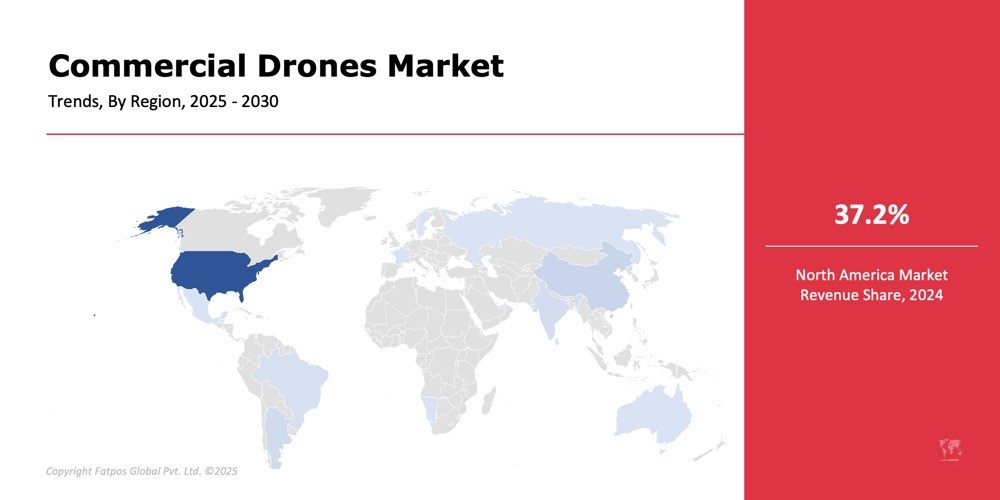
North America remains at the forefront of commercial drone adoption, supported by active regulations, enterprise innovation, and strong venture funding, hence the region occupies the highest commercial drone market share. Utilities, oil and gas operators, and public safety agencies are major users, while pilot projects in parcel delivery and medical transportation are expanding around designated test corridors.
Europe
Europe emphasizes safety, privacy, and airspace integration, with a structured framework for U-space/UTM and cross-border operations. Adoption is strong in infrastructure inspection, renewable energy, and environmental monitoring. Pilot projects for urban air mobility and cargo drones are progressing in selected cities and industrial regions.
Asia - Pacific
Asia-Pacific is one of the fastest-growing regions, with large-scale use in agriculture, construction, and logistics. Dense urban centers and extensive rural areas alike benefit from drone-based services, from crop spraying and yield mapping to tower inspections and same-day parcel delivery. Several countries are developing national drone strategies and low-altitude air-traffic systems.
Latin America
Latin American markets use commercial drones primarily in agriculture, mining, and forestry, where aerial data significantly improves productivity and environmental compliance. Regulatory frameworks are evolving, with growing interest in drones for infrastructure surveys, disaster assessment, and security.
Middle East & Africa
In the Middle East, drones are increasingly used for oil and gas inspection, construction megaprojects, and smart‑city initiatives. African markets are pioneering long-range medical and humanitarian delivery services in regions with limited ground infrastructure. Across both regions, government-backed pilot programs are critical for demonstrating feasibility and building local capabilities.
Segmentation Highlights
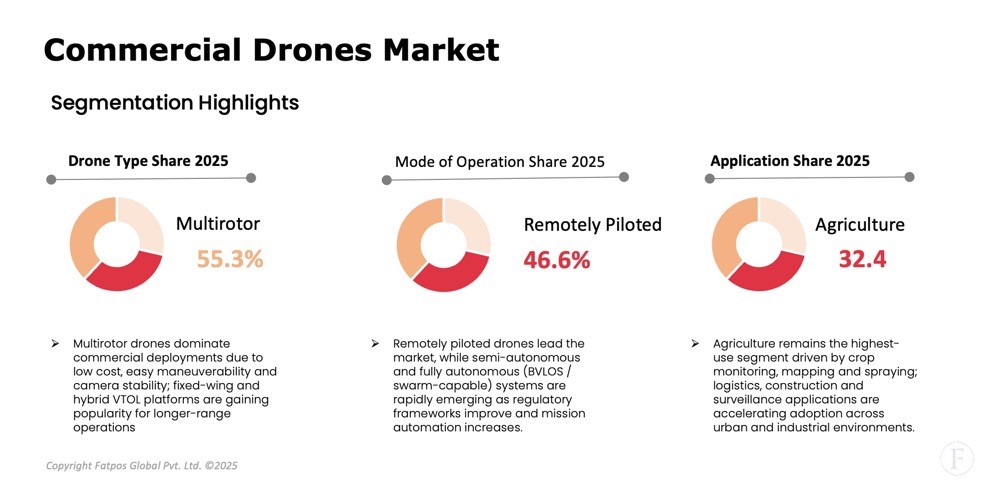
Multirotor drones currently dominate the commercial drones market because they are inexpensive, simple to fly, and ideal for close-range imaging and inspection work. Fixed-wing and hybrid VTOL models form a smaller but quickly growing niche in long-range mapping and delivery. Most missions remain remotely piloted or semi-autonomous, yet fully autonomous BVLOS operations are rising as regulations and detect-and-avoid technologies improve. While hardware still accounts for a large share of spend, software and services—analytics, fleet management, and drone-as-a-service—are capturing more value, especially in data-intensive inspection, agriculture, logistics, and public-safety use cases in North America and Asia-Pacific.
Report Key Elements
|
ATTRIBUTES |
DETAILS |
|
Study Period |
2019–2030 |
|
Base Year |
2024 |
|
Forecast Period |
2025–2030 |
|
Commercial Drone Market Size by 2030 |
USD 55.7 billion |
|
Market CAGR |
10.8% |
|
By Drone Type |
Multirotor, Fixed-Wing, Hybrid VTOL, Nano/Micro Drones |
|
By Mode of Operation |
Remotely Piloted, Semi‑Autonomous, Fully Autonomous (BVLOS) |
|
By Component |
Hardware (airframe, propulsion, batteries, sensors), Software (flight control, analytics, fleet management), Services (Drone‑as‑a‑Service, maintenance, training) |
|
By Application |
Agriculture, Construction & Infrastructure, Media & Entertainment, Logistics & Delivery, Public Safety & Surveillance, Others |
|
By Region |
NA, Europe, APAC, LATAM, MEA |
|
Key Market Players |
DJI, Parrot, Skydio, Autel Robotics, Wingtra, Zipline, Wing (Alphabet), Amazon Prime Air |
Key Developments
Recent years have seen increased deployment of artificial intelligence-enabled drones capable of autonomous data collection and mission execution. Integration with IoT and cloud platforms allows real-time analytics, enhancing decision-making in agriculture and infrastructure management. Multi-drone systems or swarms offer novel applications in search-and-rescue and large-area surveillance. Companies are also innovating in lightweight materials to improve durability and flight duration. Regulatory bodies adapt with evolving frameworks to facilitate emerging technologies such as delivery drones crossing urban airspaces while ensuring privacy and safety.
Analyst Review
As per our commercial drones market analysis, the market is expected to maintain a double-digit CAGR through 2030, driven by expanding enterprise adoption, continuous technological progress, and increasing regulatory accommodations. Customized drones specialized for specific industries will grow in prominence. Investment in related infrastructure such as drone ports and traffic management solutions will accelerate. Market leaders focusing on product innovation, autonomous operation, and comprehensive service offerings will consolidate leadership. The increasing importance of drones in emerging sectors cements their role as transformative tools for operational efficiency, data-driven decision-making, and new business models.
Frequently Asked Questions (FAQ):
USD 30.2 billion in 2024.
The United States, followed by China and Japan.
Search for safer, cheaper, and faster alternatives to manned aircraft, ground crews, and manual surveys.
High cost, evolving and complex aviation regulations, and concerns around cybersecurity, privacy, and airspace integration.
strong double‑digit growth, with autonomous fleets, logistics automation, and data‑driven inspection services expected to be the primary engines of expansion through 2030 and beyond.
 Select License Type


.png)


