


Saliva collection and diagnostics market research, 2034
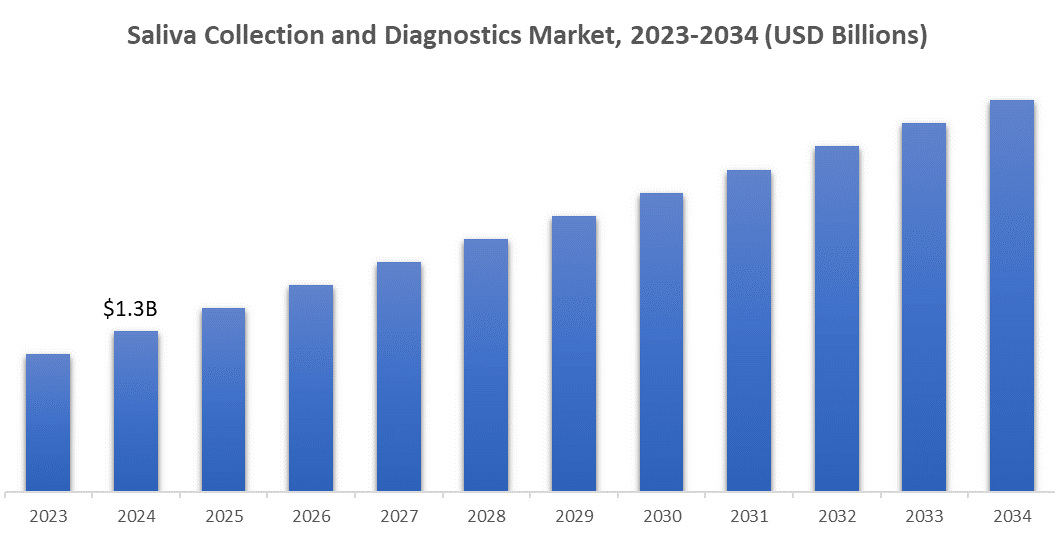
The global saliva collection and diagnostics market is anticipated to grow at a CAGR of 8.5% in the forecast period (2024-2034), with the market size valued at USD 1.2 billion in 2023 and projected to reach USD 2.9 billion by 2034.
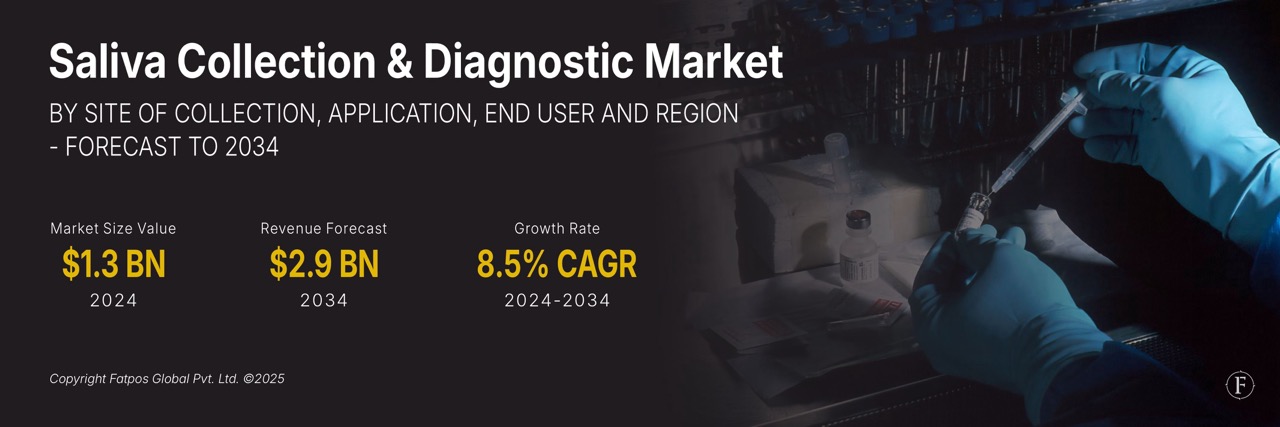
Saliva Collection and Diagnostics is a non-invasive approach to identifying biomarkers, aiding in disease diagnosis, health evaluation, and genetic analysis. Saliva contains various biological molecules like DNA, RNA, proteins, and hormones, which can indicate an individual's health or disease status. In contrast to regular blood tests, saliva-based diagnostics provide a painless, convenient substitute that eliminates the necessity for skilled medical personnel and lab facilities, making it perfect for self-testing at home.
Several applications include disease identification, medication tracking, DNA testing, and forensic examination. Saliva diagnostics is widely utilized in healthcare, pharmaceuticals, and research, offering dependable information on infectious diseases, oncology, hormone levels, and other health conditions due to its flexible nature.
Market Highlights
The market is growing due to the rising demand for non-invasive testing, advancements in molecular diagnostics, and the growing incidence of chronic illnesses. The painless and simple collection process of saliva makes it perfect for testing at home, a requirement that has increased during the COVID-19 crisis. Increased utilization in the diagnosis of diseases, pharmacogenomics, and genomics, with the help of advancements in lab-on-a-chip technologies and next-generation sequencing, has broadened the applicability of saliva.
Moreover, the growing popularity of genetic testing for personalized healthcare has resulted in saliva-based tests becoming more readily available and has resulted in strong market growth. In the future, market growth is expected to be driven further by continued technological advancements and the increasing demand for convenient diagnostics that can be done remotely.
Market Segmentation
Sublingual gland is the dominant site of collection due to high yield and biomarkers presence
The market is categorized based on the Site of Collection into Parotid Gland Collection, Submandibular/Sublingual Gland Collection, Minor Salivary Glands Collection, and Others. The submandibular/sublingual gland is the most preferred location for diagnostics and saliva collection owing to its high yield and presence of reliable biomarkers.
These glands tend to produce large amounts of saliva that is high in proteins, enzymes, and hormones making it ideal for diagnostic purposes, particularly in identifying certain forms of diseases and testing hormones. Saliva gathered from the submandibular and sublingual glands is appropriate for molecular diagnostics due to its consistent sample, crucial for precise and reproducible outcomes. This method of collection is simpler to execute compared to other methods that target specific glands, allowing for regular diagnostic applications in clinical and home environments. Its market dominance is further supported by its adaptability in various areas, such as infectious disease screening and pharmacogenomics.
Disease diagnosis is the dominant application due to the growing demand for non-invasive testing in infectious diseases
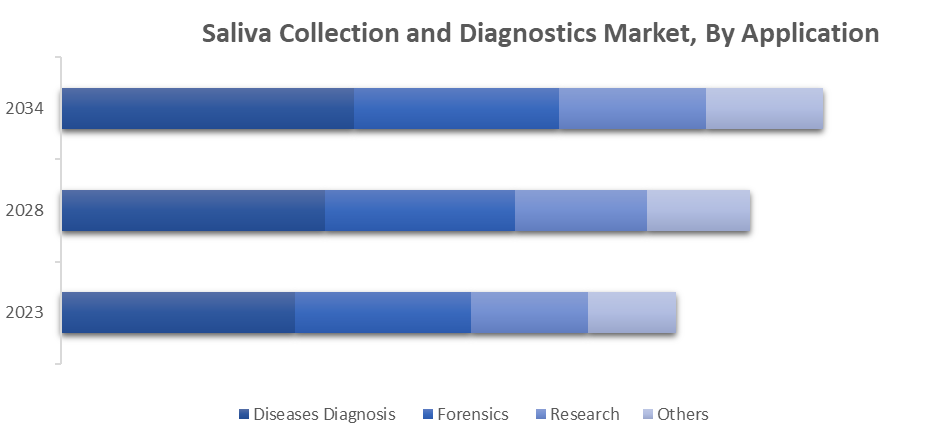
The market is categorized based on the Application into Disease Diagnosis, Forensics, Research, and Others. Diseases diagnosis tends to lead the market, influenced by the growing need for non-invasive testing in infectious diseases, oncology, and other forms of chronic conditions. Saliva-based tests provide a painless and convenient option in contrast to traditional blood tests, especially helpful for frequent monitoring or for individuals who are not in favor of having their blood drawn.
The COVID-19 pandemic accelerated the demand for saliva tests for detecting diseases, demonstrating the efficiency of saliva in rapidly pinpointing pathogens. Furthermore, saliva testing is becoming more important in the fields of oncology for identifying cancer markers and endocrinology for examining hormones. Due to technological developments in biomarker detection, saliva is being used increasingly in routine disease diagnostics, establishing itself as the top application in the market.
Market Dynamics
Growth Drivers
Increased Demand for Non-Invasive Testing Methods to Drive Market Growth
The growing global shift towards non-invasive testing has been a major factor in the market. Due to increasing demand for less intrusive and easier testing methodologies, saliva collection provides a patient-friendly option in place of traditional blood draws. Saliva tests are particularly beneficial for home-based testing, especially in fields such as infectious diseases, genetic profiling, and hormone analysis.
The ease of collecting samples and their stability, along with the ability to detect different biomarkers, has resulted in their increased applications in medical and home care environments. The increasing understanding of the advantages of non-invasive methods by patients and healthcare professionals is contributing to the growing demand for saliva diagnostics.
Advances in Molecular Diagnostics and Genomics Enhance Saliva-based Diagnostics
Advancements in molecular diagnostics, such as PCR and next-generation sequencing, have significantly improved the precision and constancy of saliva diagnostics. These advancements have facilitated the accurate identification of biomarkers and have increased the applications of saliva in the fields of disease diagnosis and health tracking. In the field of oncology, molecular diagnostics utilizing saliva can detect early-stage cancers through the identification of particular DNA mutations.
Similarly, in the field of pharmacogenomics, progress enables the customization of drug treatments using genetic data from saliva. Technological advancements have enhanced the accuracy of saliva-based diagnostics, enabling their increased utilization in medical settings such as drug monitoring and endocrine health, leading to market expansion.
Restraints
Limited Awareness and Acceptance in Some Regions May Restrict Market Growth
Despite its popularity saliva diagnostics have several benefits, but they are not widely accepted in some regions owing to the lack of awareness and preference for traditional blood-based testing. Healthcare providers in developing countries may not be familiar with saliva testing, and there is typically not enough data showing saliva's accuracy for certain tests.
Moreover, in certain medical environments, existing diagnostic standards create obstacles for saliva-based techniques to become widely accepted. This reluctance impacts market penetration, as both healthcare professionals and patients might see saliva testing as an add-on rather than a main focus. The lack of awareness also affects government and insurance reimbursement policies, making it difficult for saliva diagnostics to be adopted, especially in underdeveloped regions.
Recent Developments
- In 2023-2024, OraSure launched a rapid, saliva-based COVID-19 test for at-home use, expanding accessibility for large populations. Additionally, the company collaborated with academic institutions to develop saliva-based diagnostics for infectious diseases beyond COVID-19, including influenza.
- In 2023-2024, Abbott Laboratories released a saliva-based diagnostics kit for early cancer detection, focusing on oncology applications. The company further enhanced its saliva diagnostic capabilities through a strategic partnership with a genetic testing firm, improving precision diagnostics.
- In 2023-2024, Neogen Corporation introduced a saliva-based drug testing service for workplace and forensic applications. The company also partnered with a digital health firm in 2024 to offer personalized health insights leveraging saliva diagnostics.
- In 2023-2024, Thermo Fisher Scientific Inc. unveiled a new line of high-precision saliva collection devices, prioritizing accurate biomarker stability. The company acquired a molecular diagnostics firm, bolstering its expertise in saliva-based genetic testing.
Key Players
- OraSure Technologies, Inc.
- Abbott Laboratories
- Neogen Corporation
- Thermo Fisher Scientific Inc.
- Quest Diagnostics
- Salimetrics, LLC
- Zymo Research Corporation
- DNA Genotek Inc.
- Qiagen N.V.
- Agilent Technologies, Inc.
- PerkinElmer, Inc.
- Diomics Corporation
- Cargene Biopharma Inc.
- Cell Projects Ltd.
- Mirimus, Inc
- Other Prominent Players (Company Overview, Business Strategy, Key Product Offerings, Financial Performance, Key Performance Indicators, Risk Analysis, Recent Development, Regional Presence, SWOT Analysis)
Regional Analysis
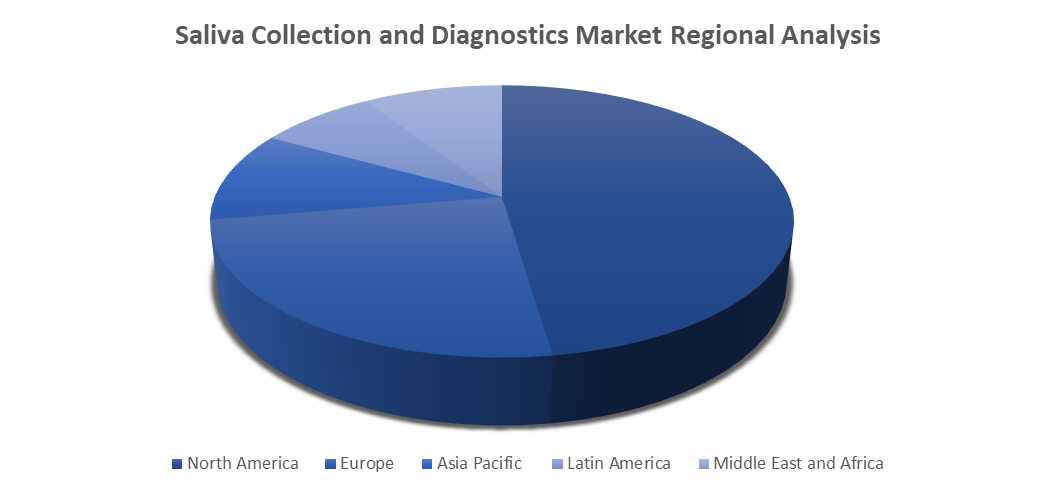
The Global Saliva Collection and Diagnostics Market is segmented based on regional analysis into five major regions: North America, Latin America, Europe, Asia Pacific, and the Middle East and Africa.
North America dominates the market due to its advanced healthcare system and widespread use of non-invasive diagnostic methods. The United States excels in both need and creativity, with a strong representation of key companies and significant research and development funding in molecular diagnostics. Government support for healthcare advancements, a large number of chronic illnesses, and quick integration of genetic testing all contribute to the market's expansion.
Europe closely follows North America due to favorable healthcare policies and growing interest in preventive diagnostics.
Asia-Pacific is an emerging market with strong growth potential, driven by increasing healthcare investments, a large population base, and expanding genetic testing demand in countries like China and Japan.
Latin America and the Middle East & Africa are less dominant but show promise as awareness grows, and healthcare infrastructure gradually improves. These regions are expected to see steady growth as saliva diagnostics become more affordable and accessible in emerging economies.
Market is further segmented by region into:
- North America Market Size, Share, Trends, Opportunities, Y-o-Y Growth, CAGR – United States and Canada
- Latin America Market Size, Share, Trends, Opportunities, Y-o-Y Growth, CAGR – Mexico, Argentina, Brazil, and Rest of Latin America
- Europe Market Size, Share, Trends, Opportunities, Y-o-Y Growth, CAGR – United Kingdom, France, Germany, Italy, Spain, Belgium, Hungary, Luxembourg, Netherlands, Poland, NORDIC, Russia, Turkey, and Rest of Europe
- Asia Pacific Market Size, Share, Trends, Opportunities, Y-o-Y Growth, CAGR – India, China, South Korea, Japan, Malaysia, Indonesia, New Zealand, Australia, and Rest of APAC
- Middle East and Africa Market Size, Share, Trends, Opportunities, Y-o-Y Growth, CAGR – North Africa, Israel, GCC, South Africa, and Rest of MENA
Market Scope and Segments
|
ATTRIBUTE |
DETAILS |
|
Study Period |
2018-2034 |
|
Base Year |
2023 |
|
Forecast Period |
2024-2034 |
|
Historical Period |
2019-2022 |
|
Growth Rate |
CAGR of 8.5% from 2024-2034 |
|
Unit |
Value (USD Billion) |
|
Segmentation |
Main Segments List |
|
By Site of Collection |
|
|
By Application |
|
|
By End User |
|
|
By Region |
|
Frequently Asked Questions (FAQ):
The global saliva collection and diagnostics market size was valued at USD 1.2 billion in 2023 and is projected to reach the value of USD 2.9 billion in 2034, exhibiting a CAGR of 8.5% during the forecast period.
The saliva collection and diagnostics involves products and services for collecting, processing, and analyzing saliva samples for medical diagnosis. This non-invasive method offers convenient disease detection, drug monitoring, and hormone testing. The market includes collection devices, testing kits, and diagnostic tools used in healthcare settings and research laboratories.
The Submandibular/Sublingual Gland Collection and Disease Diagnosis segment accounted for the largest market share.
Key players in the global saliva collection and diagnostics market include OraSure Technologies, Inc., Abbott Laboratories, Neogen Corporation, Thermo Fisher Scientific Inc., Quest Diagnostics, Salimetrics, LLC, Zymo Research Corporation, DNA Genotek Inc., Qiagen N.V., Agilent Technologies, Inc., PerkinElmer, Inc., Diomics Corporation, Cargene Biopharma Inc., Cell Projects Ltd., Mirimus, Inc. and Other Prominent Players.
The growing preference for non-invasive diagnostics, increasing prevalence of infectious diseases, rising demand for home-based testing, and technological advancements in diagnostic tools, drive the market.
 Select License Type


.png)


