


Ocean Carbon Removal Market Research, 2034
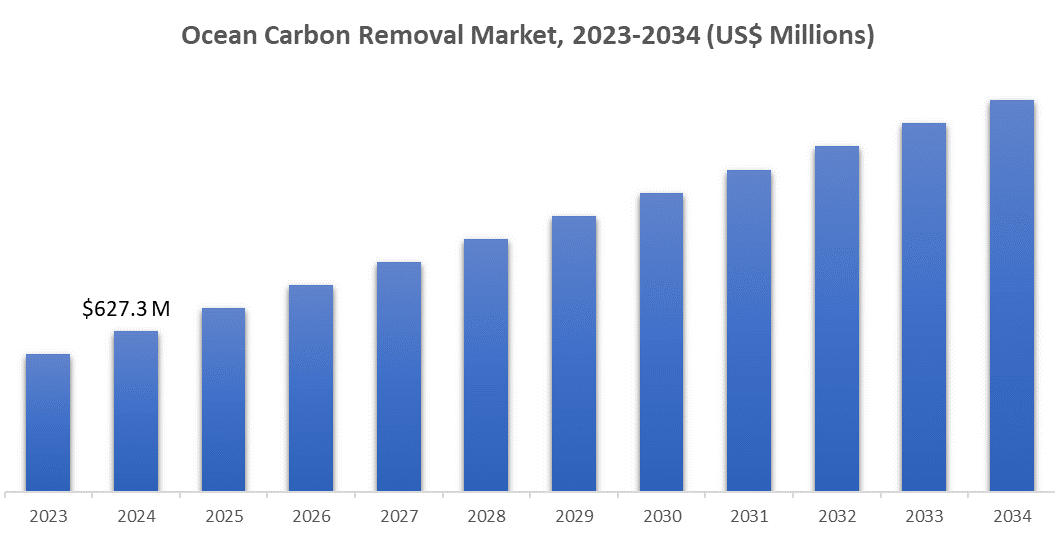
With an initial valuation of US$ 534.5 million in 2023, the Global Ocean Carbon Removal Market is projected to grow at a CAGR of 17.5% from 2024 to 2034, culminating in a market size of US$ 3184.3 million by the end of the forecast period.
Ocean carbon extraction involves methods aimed at removing carbon dioxide (CO2) from the air and sequestering it in the ocean. These methods include enhancing ocean productivity, cultivating algae, and increasing ocean alkalinity. Enhanced ocean productivity promotes the growth of phytoplankton, which absorbs CO2 during photosynthesis.
Algae cultivation involves growing seaweed, which captures carbon and can be harvested for various purposes. Increasing alkalinity through ocean alkalinity enhancement can enhance the ocean's capacity to absorb CO2 by incorporating alkaline materials. These methods can help address climate change by reducing CO2 levels in the atmosphere, supporting the restoration of marine ecosystems, and participating in carbon offset markets.
Market Highlights
The market growth is attributed to the urgent need to combat climate change, as higher atmospheric CO2 levels call for new and creative solutions. Government policies and global agreements backing carbon reduction are driving investment and studies in ocean-based methods. Advances in technology are increasingly enabling these methods to be more practical and effective.
Companies' pledges to sustainability and goals of achieving net zero are also increasing the need for efficient carbon offset solutions. Public knowledge and promotion of ocean well-being are also bolstering market growth. Anticipated future expansion is expected as regulatory frameworks become clearer, technology advances and the economic benefits of carbon credits and marine ecosystem restoration gain more recognition.
Market Segmentation
Direct Air Capture (DAC) is gaining traction due to its efficient atmospheric CO2 removal and cost-effectiveness
The market is segmented based on Process into Enhanced Ocean Productivity, Algae Cultivation, Direct Air Capture, Ocean Alkalinity Enhancement, Subsurface Injection, Seaweed Farming, and Ocean Afforestation, Mineralization. Direct Air Capture (DAC) is becoming a leading industry method. DAC involves taking CO2 from the air and depositing it in the ocean. This method has gained popularity since it can directly target atmospheric CO2, effectively reducing overall carbon levels.
Businesses such as Equatic are combining advanced DAC technologies with seawater electrolysis to produce green hydrogen, reducing operational costs and enhancing effectiveness. This collaboration not only improves the carbon capture method but also generates useful by-products such as hydrogen, making it a cost-efficient and expandable option for extensive carbon elimination.
Biological Carbon Removal dominates due to its superior scalability and lower perceived risks
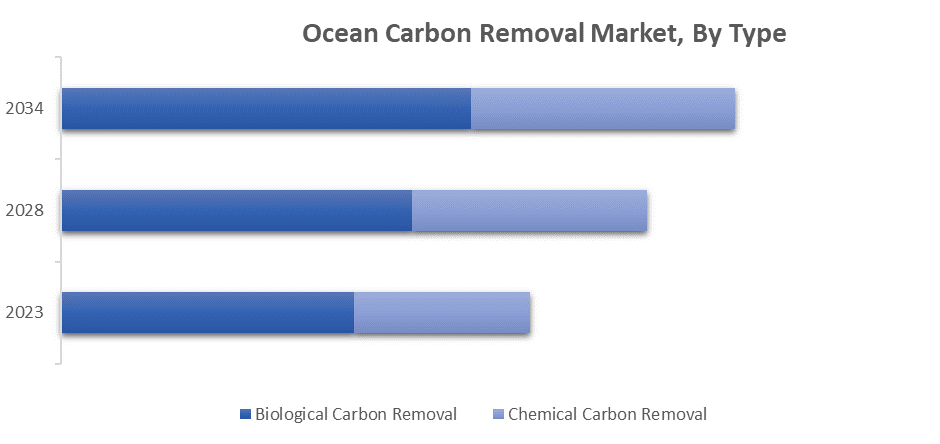
The market is segmented based on Type into Biological Carbon Removal, and Chemical Carbon Removal. Biological Carbon Removal (BCR) is presently the leading method for removing carbon from the ocean, surpassing Chemical Carbon Removal (CCR). This dominance is attributed to several key factors. BCR takes advantage of natural biological processes such as photosynthesis, reducing the possibility of unexpected environmental impacts.
There is notable room for growth, especially in activities like seaweed cultivation, that can be extended over large stretches of the ocean. BCR techniques offer important additional benefits, such as improved food security through seaweed farming, the restoration of habitats for ocean creatures, and better water quality. Ongoing research is aimed at improving the efficiency of the well-established science behind BCR. Moreover, BCR usually has a reduced level of risk in comparison to CCR methods, which frequently require the introduction of new chemicals or processes to the marine ecosystem. BCR's top position in ocean carbon removal strategies has been strengthened by these collective benefits.
Market Dynamics
Growth Drivers
Growing Urgency to Address Climate Change Will Provide Significant Growth Opportunities
The increasing need to tackle climate change has a major effect on the market. The increasing need for carbon removal solutions, including ocean-focused ones, is fuelled by this sense of urgency. With the growing focus on climate issues, there is a higher probability that both governments and private investors will direct more resources towards addressing climate change, leading to increased funding for OCR research, development, and implementation.
Moreover, such immediacy might result in favourable policies and rules that encourage OCR. These measures could involve establishing carbon offset markets that specifically acknowledge and appreciate ocean-based carbon credits, further speeding up the development and usage of OCR technologies.
Increasing Corporate Sustainability Commitments are Expected to Foster Market Expansion
Numerous businesses are progressively dedicating themselves to sustainability through the establishment of ambitious net-zero emission targets. Offsetting the remaining emissions is vital to meet these goals, leading to an increase in the demand for carbon offsets. Ocean carbon removal provides top-notch offsets, especially appealing to firms looking for nature-centric solutions.
Additionally, taking action against climate change by implementing strategies such as ocean carbon removal can greatly improve brand reputation, meeting the increasing demands of consumers for environmental accountability. Moreover, investors are facing increasing pressure regarding Environmental, Social, and Governance (ESG) standards.
Companies can increase their investments by aligning with priorities when they implement strategies for ocean carbon removal. These patterns highlight an increasing corporate shift towards sustainability-focused strategies, utilizing ocean carbon removal for environmental benefits and a competitive edge.
Restraints
Environmental Impact and Risks Will Create Challenges for the Market in the Future
OCR market encounters major obstacles due to unclear ecological effects of practices such as extensive seaweed cultivation, necessitating thorough evaluation and supervision. Establishing effective long-term carbon capture requires strong verification systems that balance strategies to combat ocean acidification with potential hazards.
Methods such as carbon storage underground cause worries about disturbance to deep-sea ecosystems. Transparent communication, as well as promoting increased ocean productivity, are crucial in gaining the trust of the public.
Investor hesitation and possible regulatory holdups may impede support for OCR projects, underscoring the importance of thorough research, effective monitoring, and engaging the public to promote sustainable OCR growth.
Recent Developments
- In 2023-24, Climeworks introduced a new ocean-based carbon capture system designed to enhance direct air capture efficiency. The company also partnered with a major energy company to develop integrated carbon removal and storage solutions.
- In 2023, Vesta expanded its pilot projects in multiple coastal regions to test the scalability of enhanced weathering techniques. The company launched a new line of bio-enhanced sand for accelerated coastal carbon sequestration.
- During 2023-24, Captura developed a modular ocean capture device aimed at small-scale operations. The company also collaborated with marine research institutes to optimize ocean-based carbon capture methodologies.
- In 2023, Ocean Visions allied with academic institutions to advance ocean carbon removal technologies. They also launched an open-access platform for sharing research and data on ocean carbon sequestration.
- In 2023, Running Tide Technologies deployed autonomous kelp farming systems designed for large-scale carbon sequestration.
Key Players
- Climeworks
- Vesta
- Captura
- Ocean Visions
- Running Tide Technologies
- Global Thermostat
- The Ocean Cleanup
- Equatic
- Ocean-Based Climate Solutions Inc.
- Brilliant Planet
- Seafields Solutions
- Ocean Nourishment Corporation
- Marine BioEnergy, Inc.
- Planetary Technologies Inc.
- C-Quest Capital
- Other Prominent Players (Company Overview, Business Strategy, Key Product Offerings, Financial Performance, Key Performance Indicators, Risk Analysis, Recent Development, Regional Presence, SWOT Analysis)
Regional Analysis
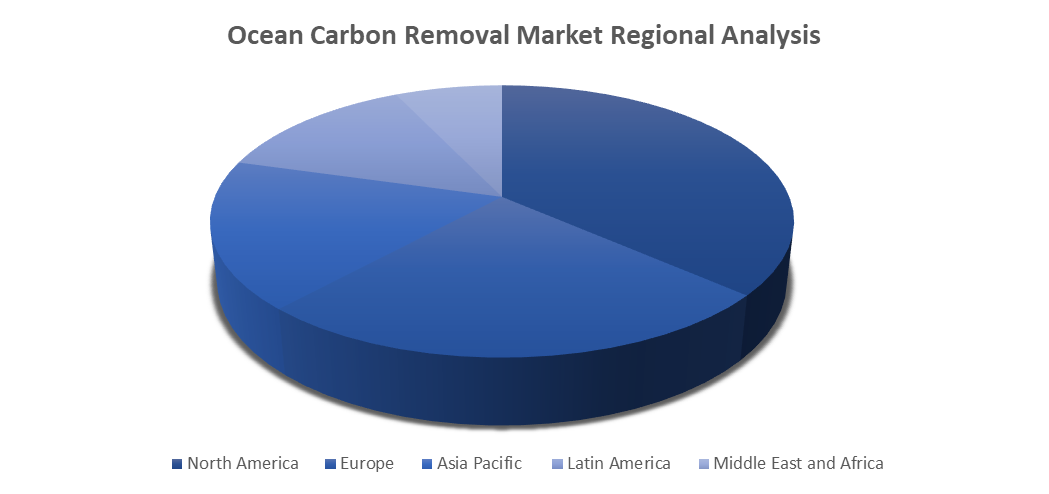
Global ocean carbon removal market is segmented based on regional analysis into five major regions: North America, Latin America, Europe, Asia Pacific, and the Middle East and Africa.
Several key factors currently contribute to North America's dominance in the market. Innovative OCR technologies are propelled by robust research and development capabilities in leading institutions and companies.
Government backing, especially in the US, promotes investments in carbon removal technologies, strengthening the market. A lot of companies in North America are early adopters of sustainability measures, which is driving a strong need for OCR solutions within the country. The region significantly benefits from the well-established marine infrastructure, aiding in the implementation and surveillance of OCR projects.
While North America leads, Europe is quickly catching up with ambitious climate targets and considerable investments in OCR. Asia-Pacific, led by China and Japan, is becoming more involved due to rising climate concerns and big coastal populations.
Market is further segmented by region into:
- North America Market Size, Share, Trends, Opportunities, Y-o-Y Growth, CAGR – United States and Canada
- Latin America Market Size, Share, Trends, Opportunities, Y-o-Y Growth, CAGR – Mexico, Argentina, Brazil, and Rest of Latin America
- Europe Market Size, Share, Trends, Opportunities, Y-o-Y Growth, CAGR – United Kingdom, France, Germany, Italy, Spain, Belgium, Hungary, Luxembourg, Netherlands, Poland, NORDIC, Russia, Turkey, and Rest of Europe
- Asia Pacific Market Size, Share, Trends, Opportunities, Y-o-Y Growth, CAGR – India, China, South Korea, Japan, Malaysia, Indonesia, New Zealand, Australia, and Rest of APAC
- Middle East and Africa Market Size, Share, Trends, Opportunities, Y-o-Y Growth, CAGR – North Africa, Israel, GCC, South Africa, and Rest of MENA
Market Scope and Segments:
|
ATTRIBUTE |
DETAILS |
|
Study Period |
2018-2034 |
|
Base Year |
2023 |
|
Forecast Period |
2024-2034 |
|
Historical Period |
2019-2022 |
|
Growth Rate |
CAGR of 17.6% from 2024-2034 |
|
Unit |
Value (US$ Million) |
|
Segmentation |
Main Segments List |
|
By Process |
|
|
By Type |
|
|
By Application |
|
|
By End User |
|
|
By Region |
|
Frequently Asked Questions (FAQ):
The global market size was valued at US$ 534.5 million in 2023 and is projected to reach US$ 3184.3 million in 2034, exhibiting a CAGR of 17.6% during the forecast period.
The market involves technologies and methods aimed at removing carbon dioxide from the oceans to mitigate climate change. It includes approaches like enhanced ocean productivity, seaweed farming, and direct air capture in marine environments. OCR seeks to enhance carbon sequestration capacity and restore ocean health.
The Direct Air Capture and Biological Carbon Removal segment accounted for the largest Ocean Carbon Removal Market share.
Key players in the Ocean Carbon Removal Market include Climeworks, Vesta, Captura, Ocean Visions, Running Tide Technologies, Global Thermostat, The Ocean Cleanup, Equatic, Ocean-Based Climate Solutions Inc., Brilliant Planet, Seafields Solutions, Ocean Nourishment Corporation, Marine BioEnergy, Inc., Planetary Technologies Inc., C-Quest Capita and Other Prominent Players.
Growing urgency to address climate change and rising corporate sustainability commitments are driving the Market.
 Select License Type


.png)


