


Nanomaterials Market Research 2035
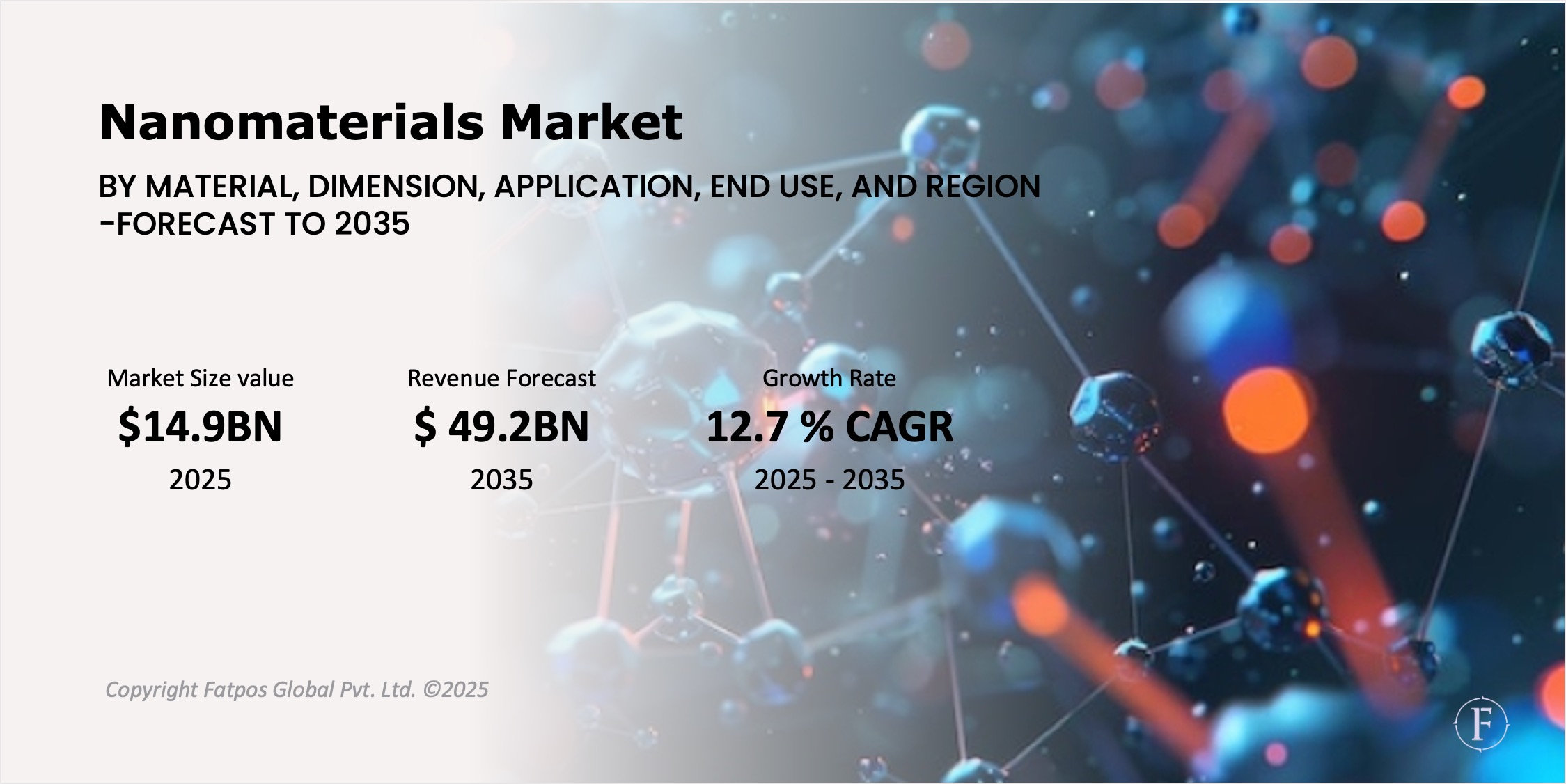
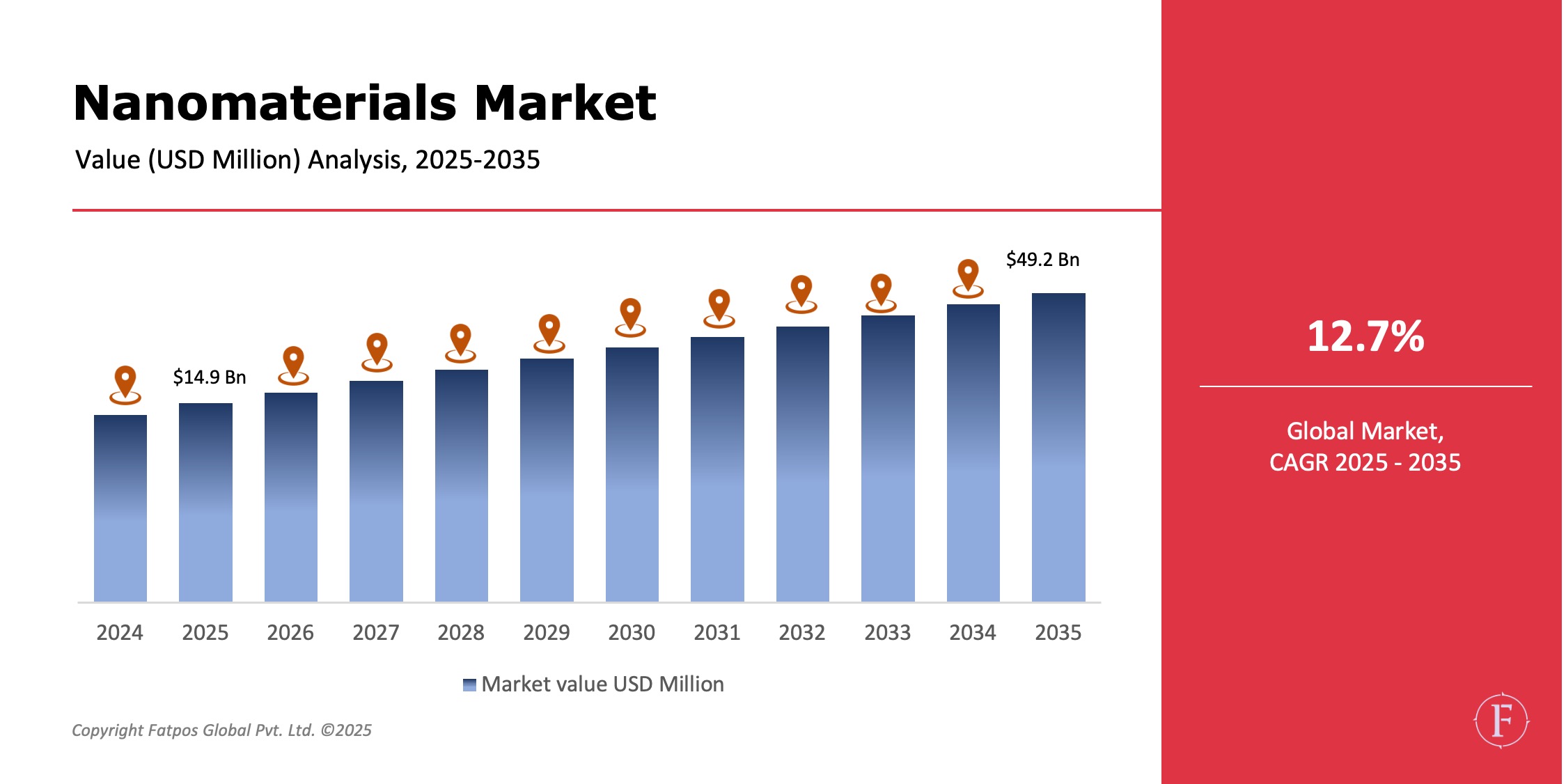
The Nanomaterials Market Size was USD 14.9 billion in 2025 and is projected to reach USD 49.2 billion by 2035, registering a CAGR of 12.7%, Market growth is driven by rapid advancements in nanotechnology, increasing adoption of lightweight and high-performance materials, rising demand from electronics, energy storage, healthcare, and automotive industries, and growing investments in research and development.
Nanomaterials—materials engineered at the nanoscale (1–100 nm)—exhibit superior electrical, mechanical, thermal, and chemical properties compared to conventional materials. These enhanced characteristics are enabling breakthrough innovations across industries, including high-efficiency batteries, advanced coatings, targeted drug delivery systems, flexible electronics, and next-generation composites.
Product Overview
Nanomaterials features high-end seating, tables, storage, beds, outdoor pieces, and bespoke Nanomaterials classify by material type, dimension, and function, revolutionizing industries through nanoscale properties. Carbon-based variants—nanotubes, graphene, fullerenes—excel in electronics, composites, and energy storage for superior conductivity and strength. Metal and metal oxide nanomaterials, including silver, gold, titanium dioxide, and zinc oxide, drive catalysis, antimicrobial coatings, sensors, and healthcare via plasmonic and photocatalytic effects.
Polymer nanomaterials enhance packaging, biomedicine, and lightweight parts with flexibility and biocompatibility. Nanocomposites integrate nano-elements into bulk matrices, boosting mechanical durability, thermal stability, and electrical performance.
Dimensionally, 0D structures like nanoparticles and quantum dots enable targeted drug delivery and displays; 1D forms—nanowires, nanotubes—suit wiring and filtration; 2D sheets such as graphene offer atom-thin barriers and transistors; 3D bulk nanostructures provide macroscopic reinforced materials. These classifications underpin applications from sustainable energy to advanced therapeutics, with market growth tied to scalability and safety innovations.
Key Takeaways :
- The Nanomaterials Market is projected to grow at ~12.7% CAGR through 2035.
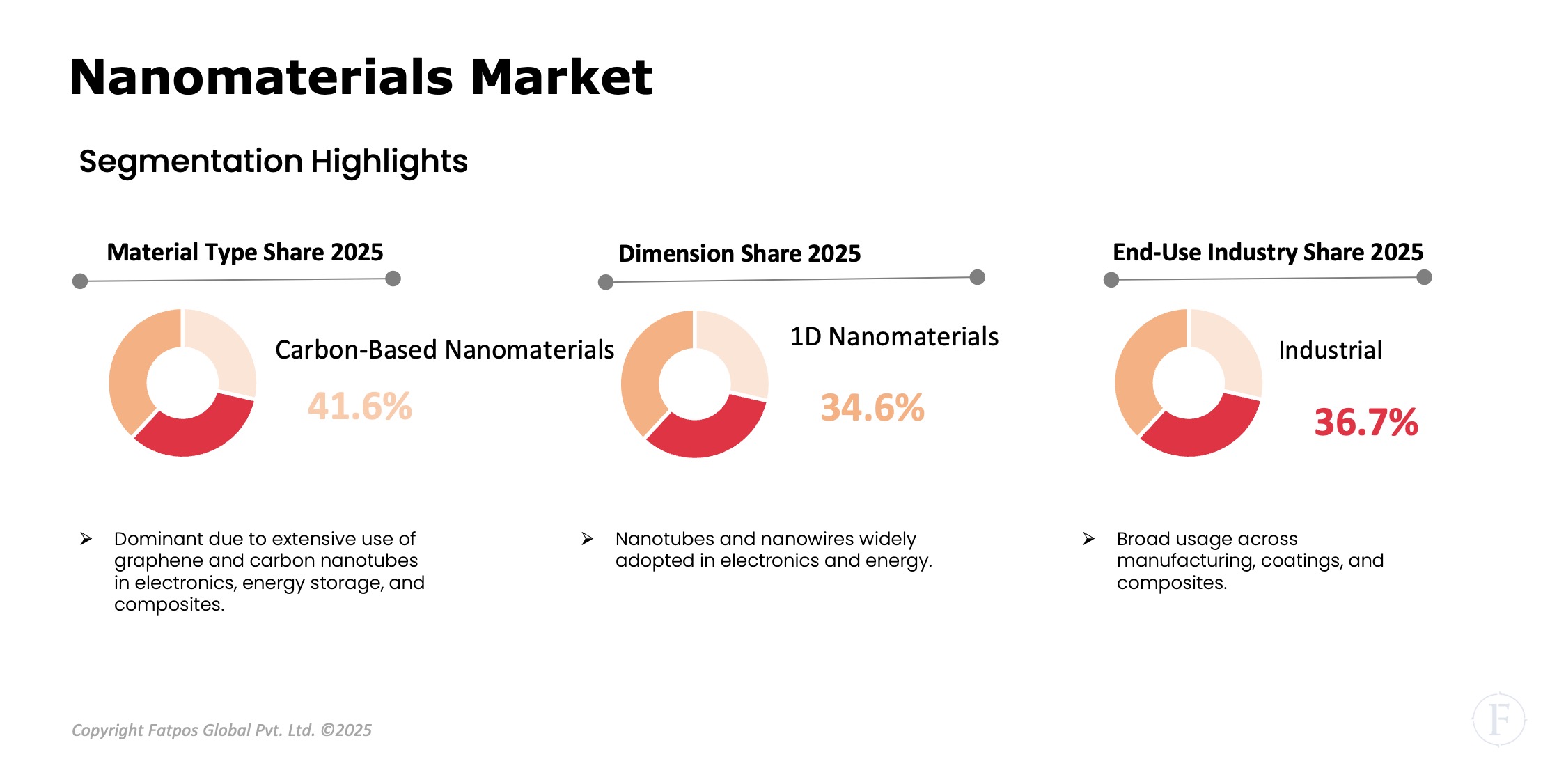
- Carbon-based nanomaterials hold the largest market share due to widespread use in electronics and composites.
- Electronics & semiconductors represent the leading application segment.
- Strong growth in energy storage, healthcare, and advanced coatings applications.
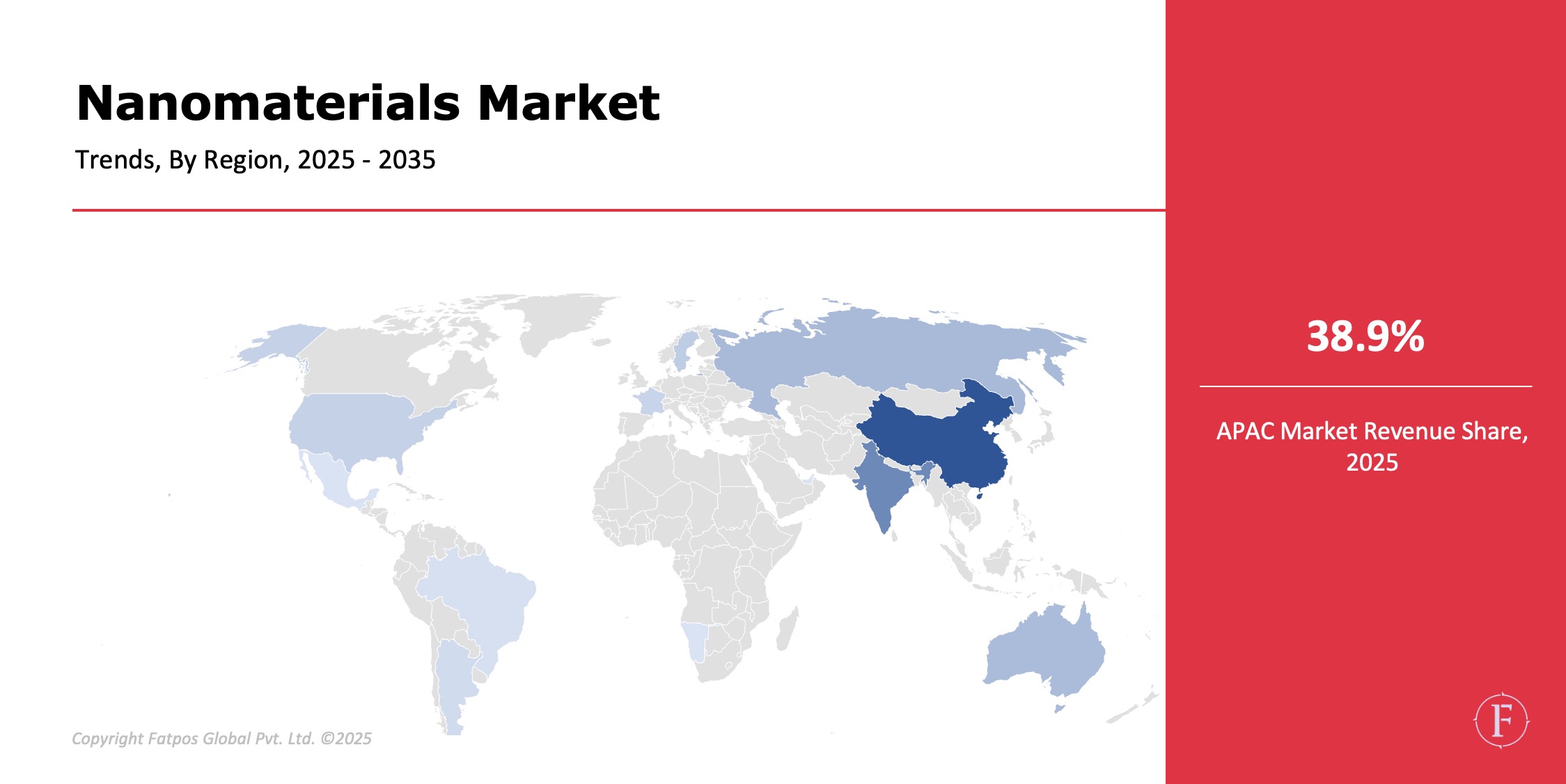
- Asia-Pacific dominates market growth due to manufacturing expansion and R&D investments.
- Increasing focus on sustainable and high-performance nanomaterials.
Market Dynamics
Drivers
Rapid advancements in nanotechnology and materials science propel nanomaterial innovation, enabling precise engineering at atomic scales. Demand arises for lightweight, durable, high-performance materials in aerospace, automotive, and construction, slashing weight while boosting strength.
Electronics, renewable energy, and EV sectors expand applications—graphene batteries, efficient solar cells, conductive coatings—driving scalability. Healthcare leverages nanomaterials for targeted diagnostics, drug delivery, and imaging via quantum dots and gold nanoparticles.
Government and private R&D investments accelerate commercialization, funding from DARPA to venture capital, fostering breakthroughs amid global sustainability goals.
Restrictions
High production and processing costs hinder nanomaterial adoption, as synthesis methods like chemical vapor deposition demand expensive equipment, energy, and ultra-pure precursors, limiting scalability for commercial volumes.
Health, safety, and environmental risks from nanoparticle exposure—potential toxicity, bioaccumulation, and inhalation hazards—prompt caution, requiring rigorous toxicology studies and worker protections.
Complex regulatory frameworks vary globally without standardization; agencies like EPA and REACH impose stringent testing, delaying approvals and raising compliance burdens for innovators.
Opportunities
Expansion of nanomaterials in battery technology boosts energy density and charging speeds, with graphene anodes enabling next-gen EVs and grid storage. Biomedical applications grown in personalized medicine, using targeted nanoparticles for precise drug delivery and cancer therapies.
Eco-friendly, biodegradable nanomaterials emerge, reducing environmental impact in packaging and agriculture via cellulose nanocrystals. Demand arises for nanocomposites in aerospace and automotive lightweighting, cutting fuel use by 20-30% through carbon fiber-graphene hybrids. These opportunities align with sustainability and performance demands.
Challenges
Scaling laboratory innovations to commercial production proves difficult, as lab methods like CVD often fail to maintain uniformity, yield, or cost-effectiveness at industrial volumes, requiring new continuous-flow processes. Managing safety risks and regulatory compliance intensifies with nanoparticle toxicity concerns—inhalation, bioaccumulation—demanding rigorous toxicology data amid fragmented global standards from EPA to REACH, delaying market entry.
Ensuring consistent quality and performance at scale falters due to batch variability, reproducibility issues, and metrology gaps, where small changes in synthesis alter properties, complicating QA in high-stakes applications like batteries or medicine.
Economic hurdles—high raw material/energy costs—and defect control further impede progress, though green synthesis and standardization efforts offer paths forward.
Nanomaterials Market Trends
Nanomaterials trends fuse modern minimalism—clean lines, neutral palettes—with classic opulent finishes like gold leaf or velvet for versatile, timeless elegance that suits contemporary homes. Smart, connected pieces embedded wireless charging pads in tables, IoT lighting in chairs, and voice-activated recliners, catering to tech-forward affluent lifestyles while maintaining discreet sophistication.
Sustainability gains prominence through certified ethically sourced woods (FSC teak), recycled metals, and non-toxic eco-finishes, appealing to eco-aware HNWIs without sacrificing luxury. Experiential retail immerses via flagship showrooms with interactive displays, personalized design studios, and on-site consulting for holistic interiors.
Digital AR apps let buyers visualize pieces in real spaces via smartphones, revolutionizing e-commerce by cutting returns and boosting confidence in high-stakes purchases.
Key Players in the Global Nanomaterials Industry
- BASF SE
- Evonik Industries AG
- Cabot Corporation
- Arkema
- Nanocyl SA
- Showa Denko KK
- Umicore
- LG Chem
- Nanosys, Inc.
- American Elements
- Sigma-Aldrich (Merck Group)
- NanoComposite
Regional & Country level: Nanomaterials Market Analysis
North America excels with advanced R&D, semiconductor manufacturing, and healthcare breakthroughs like targeted therapies. Europe advances through stringent regulations, sustainability pushes, and aerospace/automotive uses for lightweight composites.
Asia-Pacific dominates as the largest, fastest-growing region, propelled by electronics hubs in China, Japan, South Korea, and India's government nanotech initiatives. Latin America emerges in construction additives, chemicals, and university-led research.
Middle East & Africa see steady progress via energy sector coatings and rising R&D funding. These dynamics highlight innovation disparities and application diversity.
Segmentation Highlights
Carbon-based nanomaterials, including graphene and carbon nanotubes, lead due to exceptional electrical conductivity and mechanical strength, powering applications from batteries to composites.
1D nanomaterials like nanotubes and nanowires, alongside 2D materials such as graphene, drive growth in flexible electronics, sensors, and energy storage with high surface area advantages.
Electronics and semiconductors dominate applications, leveraging conductivity for chips and displays, followed by energy (batteries/supercapacitors) and healthcare (drug delivery).
Industrial manufacturing and electronics end-use sectors consume the most, fueled by demand for lightweight, durable enhancements in automotive and consumer tech.
Report Key Elements
|
ATTRIBUTES |
DETAILS |
|
Study Period |
2019–2035 |
|
Base Year |
2024 |
|
Nanomaterials Market Forecast Period |
2025–2035 |
|
Nanomaterials Market Size by 2035 |
USD 49.2 billion |
|
Market CAGR |
12.7% |
| By Material | Carbon-Based Nanomaterials, Metal & Metal Oxide Nanomaterials, Polymer Nanomaterials, Nanocomposites, Others |
|
By Dimension |
0D, 1D, 2D, 3D |
|
By Application |
Electronics & Semiconductors, Energy, Healthcare & Pharmaceuticals, Chemicals, Construction, Aerospace & Defense, Automotive, Others |
|
By End User |
Industrial, Healthcare, Electronics, Energy, Research & Academic |
|
By Region |
NA, Europe, APAC, LATAM, MEA |
|
Key Market Players |
BASF SE, Evonik Industries AG, Cabot Corporation, Arkema, Nanocyl SA |
Global Nanomaterials Industry Instances
- Electronics manufacturers adopted graphene-based conductive films for flexible displays.
- Battery producers integrated nanostructured electrodes to enhance energy density.
- Healthcare companies deployed nanoparticle drug delivery systems for targeted therapies.
- Construction firms used nano-enhanced coatings for durability and corrosion resistance.
Analyst Review
As per our Nanomaterials Market analysis report, market is positioned for rapid long-term growth as industries increasingly demand materials with superior performance, efficiency, and miniaturization capabilities. While regulatory and safety challenges remain, continuous advancements in synthesis, processing, and application development are expected to overcome barriers. Companies investing in scalable production, sustainability, and application-specific innovation will gain significant competitive advantage through 2035.
Frequently Asked Questions (FAQ):
Materials engineered at the nanoscale (1–100 nm) with enhanced properties.
Advances in nanotechnology, electronics, energy storage, and healthcare applications.
Carbon-based nanomaterials.
Asia-Pacific.
Strong double-digit growth driven by innovation and expanding industrial adoption.
 Select License Type


.png)


