


Contract Farming Market Research 2035
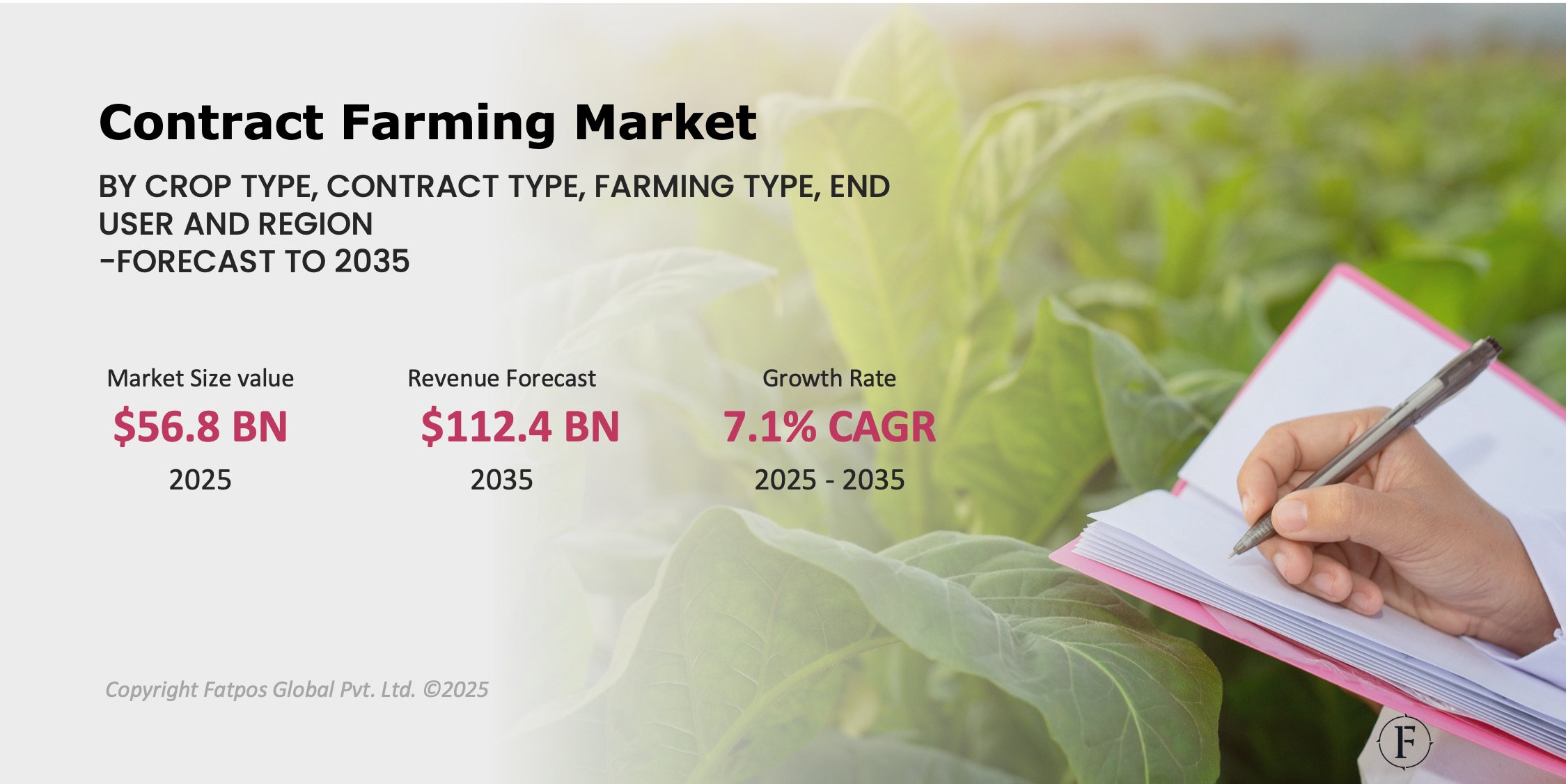
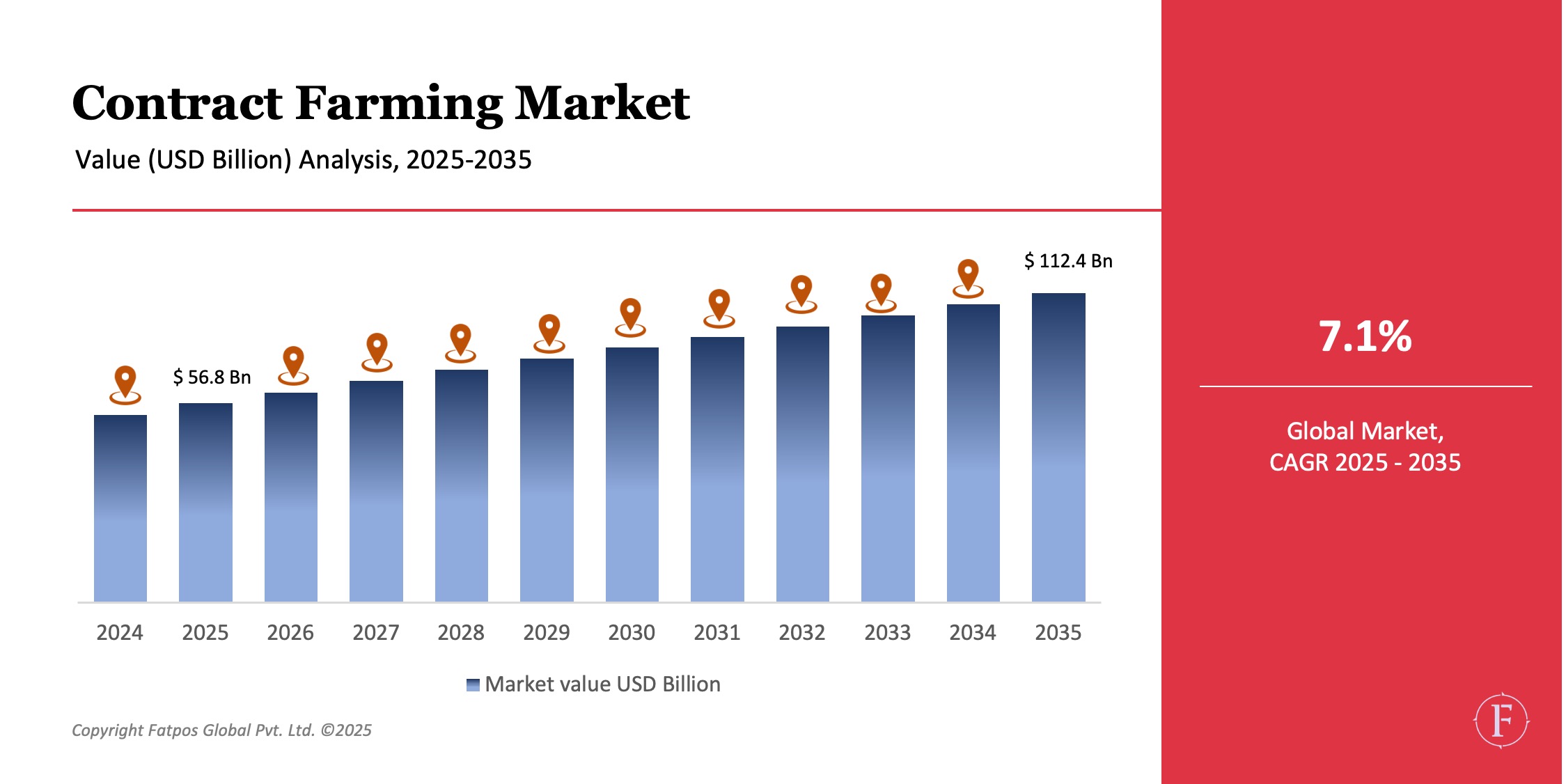
The Contract Farming Market was valued at USD 56.8 billion in 2025 and is projected to reach USD 112.4 billion by 2035, registering a CAGR of 7.1% during the forecast period. Market growth is driven by rising demand for assured agricultural output, increasing need for supply chain stability, growing commercialization of agriculture, and expanding participation of agribusiness companies in primary production activities.
Contract farming is increasingly adopted as a strategic model that benefits both farmers and buyers by ensuring predictable pricing, quality consistency, and market access. Governments across developing and developed economies are promoting contract farming frameworks to improve farmer income stability and strengthen agri-value chains
Product Overview
Contract farming is an agricultural production system where farmers enter agreements with buyers for predefined production quantities, quality standards, and pricing mechanisms. These agreements may also include technical support, input supply, and financial assistance.
The model is widely adopted across cereals, fruits, vegetables, livestock, and oil seeds production. Contract farming minimizes market risks for farmers while enabling buyers to secure reliable raw material supply. Increasing global demand for processed foods, export-oriented crops, and traceable agricultural produce is accelerating adoption of contract farming models.
Key Takeaways :
- Contract Farming Market projected to grow at 7.1% CAGR through 2035
- Fruits & vegetables dominate crop type segmentation
- Production contracts hold the largest market share
- Food processing companies remain the leading end users
- Contract farming improves income predictability for farmers
- Asia-Pacific represents the fastest-growing regional market
Market Dynamics
Drivers
The rising demand for consistent quality and traceable agricultural produce is one of the most significant drivers of the contract farming market. Food processing companies, exporters, and large retailers increasingly require standardized raw materials that meet strict quality, safety, and regulatory norms. Contract farming enables these buyers to closely monitor cultivation practices, input usage, harvesting methods, and post-harvest handling, thereby ensuring product uniformity and compliance with domestic and international standards. This structured approach significantly reduces supply uncertainty and quality-related risks for buyers.
In addition, price volatility in open agricultural markets has heightened financial uncertainty for farmers, making contract-based production increasingly attractive. Under contract farming arrangements, farmers benefit from pre-agreed pricing mechanisms, assured procurement, and reduced exposure to sudden market fluctuations.
Restrictions
A major restraint affecting the contract farming market is the power imbalance between large agribusiness firms and small or marginal farmers. In many cases, buyers possess greater negotiating power, which can result in unfavorable contract terms for farmers, including rigid quality specifications, delayed payments, or unilateral contract termination. This imbalance often discourages farmer participation, particularly in regions with weak institutional oversight.
Additionally, inadequate contract enforcement mechanisms and limited legal awareness among farmers restrict market growth. Many farmers lack access to legal support or sufficient understanding of contract clauses, making them vulnerable to disputes and exploitation. Weak dispute resolution systems and slow judicial processes further reduce trust in formal contract arrangements.
Opportunities
The growing demand for organic produce, high-value crops, and export-oriented agricultural products presents significant growth opportunities for the contract farming market. Buyers increasingly prefer contract farming to ensure compliance with organic standards, sustainability certifications, and export quality requirements. This trend is particularly strong in horticulture, specialty crops, and premium food segments.
Technological advancements are further enhancing market potential. Digital agriculture platforms, mobile-based advisory services, and blockchain-enabled contract management systems are improving transparency, traceability, and trust between farmers and buyers. These technologies enable real-time monitoring of farm activities, digital record-keeping, and secure payment systems, reducing disputes and improving contract compliance.
Challenges
Ensuring fair pricing, transparent contract terms, and effective dispute resolution remains a major challenge for the contract farming market. Disagreements related to quality assessment, pricing adjustments, and contract violations can strain buyer–farmer relationships and undermine long-term participation.
Climate variability, unpredictable weather patterns, and natural disasters pose additional challenges by affecting crop yields and contract fulfillment. Production shortfalls due to environmental factors can result in penalties or contract disputes, impacting both farmers and buyers.
Contract Farming Market Trends
The market is witnessing increasing adoption of digital tools for farmer onboarding, contract monitoring, and yield forecasting. Agribusiness companies are investing in farmer training, input support, and mechanization to improve productivity.
Sustainability-focused contracts promoting reduced chemical usage and climate-resilient farming practices are gaining popularity. Farmer Producer Organizations are emerging as important intermediaries in contract farming ecosystems.
Key Players in the Global Contract Farming Industry
- Cargill, Incorporated
- Archer Daniels Midland Company
- Olam Group
- Louis Dreyfus Company
- Nestlé S.A.
- PepsiCo, Inc.
- ITC Limited
- Tyson Foods, Inc.
- Wilmar International Limited
- CHS Inc.
Regional & Country Analysis
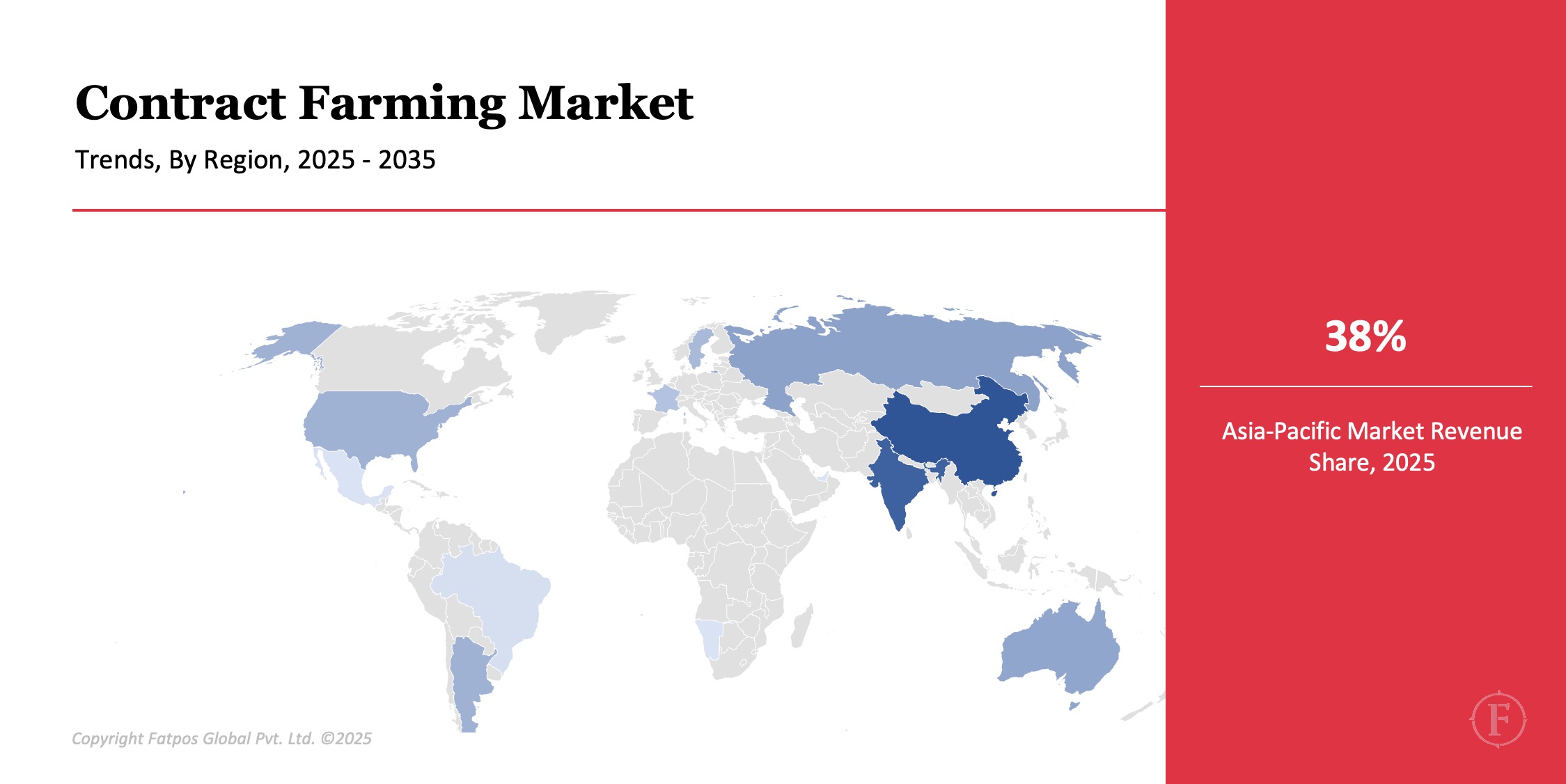
North America holds a significant share of the contract farming market due to large-scale commercial farming, strong agribusiness presence, and advanced supply chain infrastructure. The United States leads adoption across grains, livestock, and processed food crops.
Europe demonstrates steady growth supported by quality compliance standards and traceability requirements. Asia-Pacific is the fastest-growing region, driven by large farmer populations, government-backed contract farming initiatives, and expanding food processing industries in India, China, and Southeast Asia. Latin America and Africa present emerging opportunities in export-oriented agriculture.
Segmentation Highlights
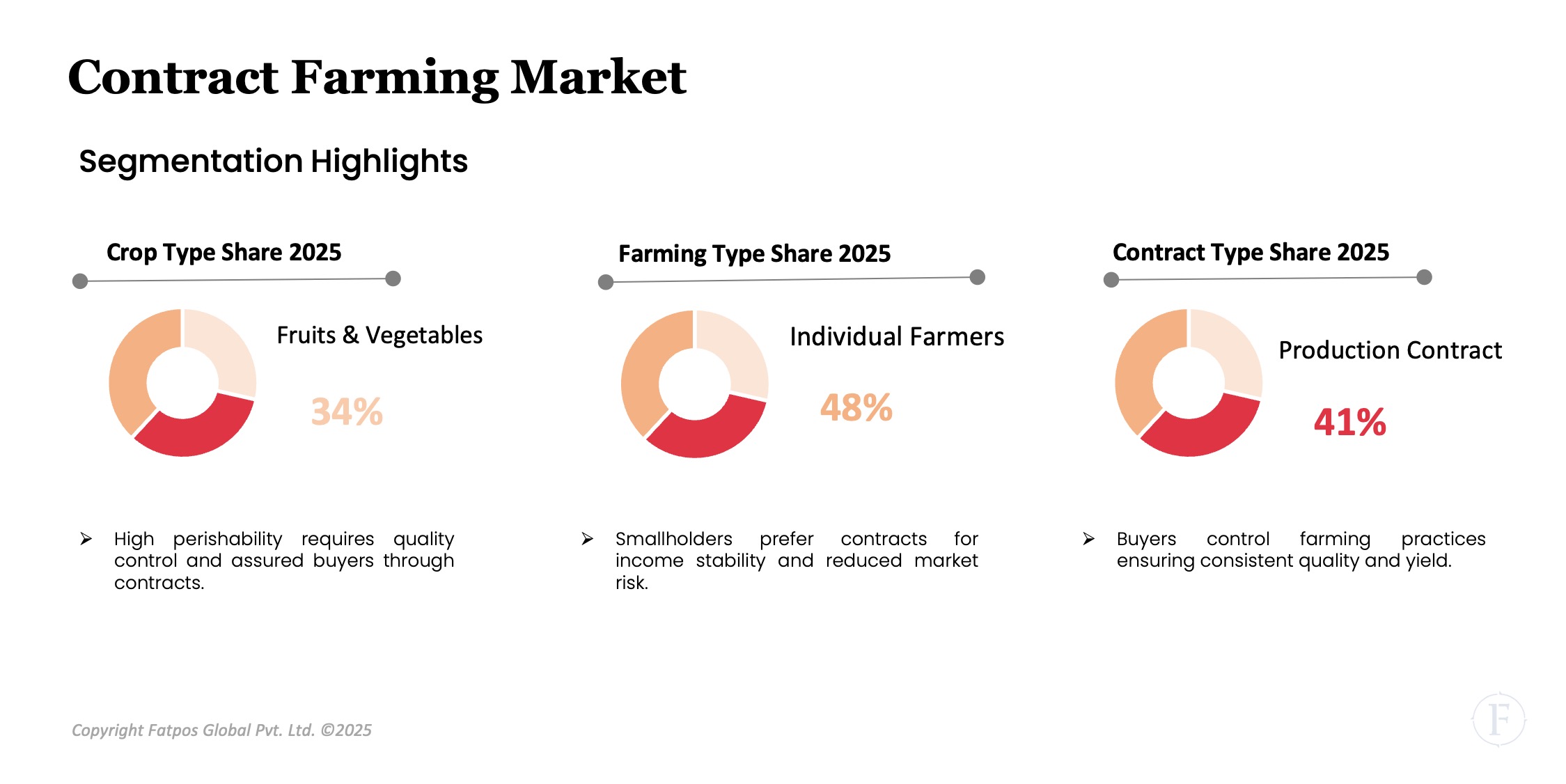
By crop type, fruits & vegetables dominate due to high perishability and quality requirements. By contract type, production contracts hold the largest share as buyers directly control cultivation practices. Food processing companies dominate end-user adoption due to their need for stable raw material supply.
Report Key Elements
|
ATTRIBUTES |
DETAILS |
|
Study Period |
2019–2035 |
|
Base Year |
2024 |
|
Market Size by 2035 |
USD 112.4 Billion |
|
Forecast Period |
2025–2035 |
|
Market CAGR |
7.1% |
|
By Crop Type |
Cereals & Grains, Oilseeds & Pulses, Fruits & Vegetables, Livestock, Others |
|
By Contract Type |
Production Contract, Marketing Contract, Resource-Providing Contract |
|
By Farming Type |
Individual Farmers, Farmer Producer Organizations, Cooperatives |
|
By End User |
Food Processing Companies, Agribusiness Firms, Exporters, Retailers |
|
Contract Farming Market: Key Players |
Cargill, Incorporated, Archer Daniels Midland Company, Olam Group, Louis Dreyfus Company, Nestlé SA |
Global Contract Farming Industry Instances
- Food processing companies expanded contract farming to ensure consistent raw material supply
- Agribusiness firms strengthened farmer linkages through structured production contracts
- Export-oriented agriculture increased adoption of contract farming for quality compliance
- Governments promoted contract farming to stabilize farmer incomes and reduce market risks
Analyst Review
As per our Contract Farming Market Analysis, the market is expected to witness steady growth driven by supply chain integration, income assurance for farmers, and rising demand for quality agricultural produces. Policy support and digital integration will be critical for sustainable market development.
Frequently Asked Questions (FAQ):
Contract farming is a pre-agreed agricultural arrangement where farmers produce crops for buyers under defined pricing, quality, and delivery terms.
Market growth is driven by assured supply chains, farmer income stability, risk reduction, quality control, and rising agribusiness involvement.
Fruits and vegetables dominate due to high demand, perishability management, export orientation, and strong retailer–farmer partnerships.
Asia-Pacific is the fastest-growing region driven by large farming populations, agribusiness investments, food demand growth, and policy support.
The long-term outlook indicates stable growth supported by increasing agribusiness participation, modernization, export opportunities, and organized farming practices.
 Select License Type


.png)


