


Medical Hyperspectral Imaging Market Rsearech, 2034
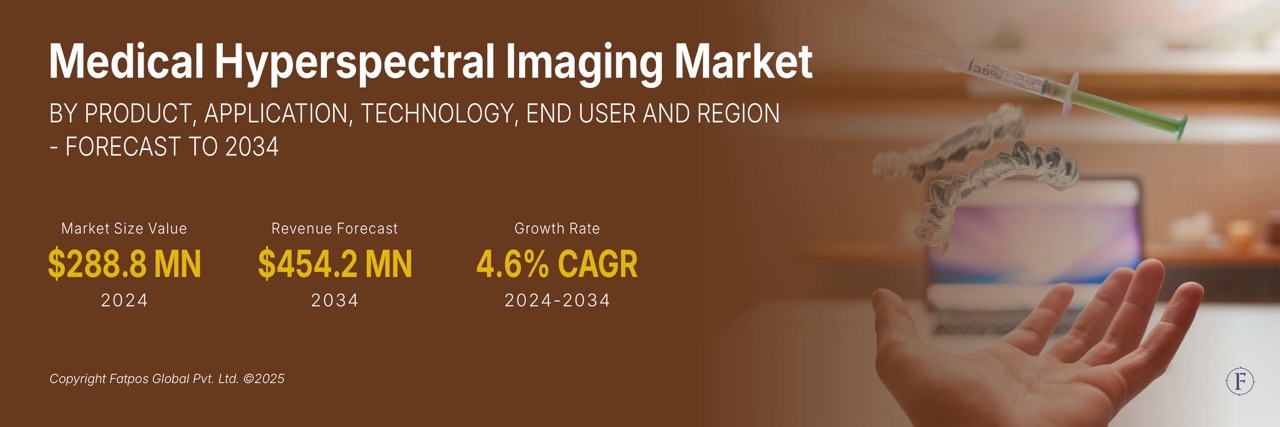
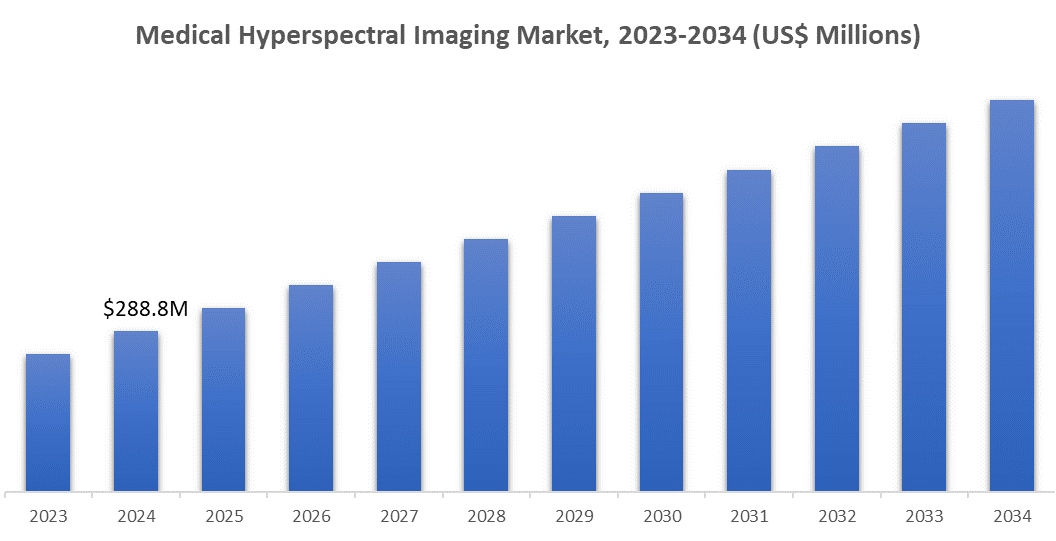
The global medical hyperspectral imaging market is expected to grow steadily at a rate of 4.6% during the forecast period from 2024 to 2034. The market size was valued at US$ 276.2 million in 2023 and is projected to reach US$ 454.2 million by 2034.
Medical Hyperspectral Imaging (HSI) is a sophisticated imaging method that records a wide range of light wavelengths to provide in-depth information about tissues and cells at a molecular scale. HSI, in contrast to traditional imaging, actively uses distinct spectral signatures to distinguish between different types of tissue and identify abnormalities such as tumors, vascular diseases, and inflammation.
This non-invasive method is commonly used in diagnostics, surgery with imaging guidance, and research, providing clinicians with better diagnostic precision. HSI is highly beneficial in the field of oncology since it provides accurate identification of cancer boundaries and tissue description. HSI's ability to capture a significant amount of data in each pixel allows for the early detection of diseases, resulting in better outcomes for patients and the advancement of personalized medicine applications.
Market Highlights
The market is driven by a rising demand for non-invasive diagnostic tools, improvements in imaging technologies, and a growing emphasis on early disease detection. HSI has proven to be beneficial in complex medical fields such as oncology and neurology due to its capability to offer detailed and accurate tissue property images.
The incorporation of AI and ML with HSI has also improved image processing and analysis, making it readily available to healthcare providers. In addition, increased investments in healthcare research and improvements in sensor technology are expected to propel the market forward, enabling broader applications in medical diagnostics and surgeries guided by images.
Market Segmentation:
Hyperspectral cameras are expected to dominate the market, driven by their crucial function in capturing and analyzing hyperspectral data
The market is segmented based on the Product Type into Camera, and Accessories. Cameras tend to hold the dominant position owing to the essential role they play in capturing and analyzing hyperspectral data. HSI cameras help medical professionals detect unique spectral patterns in tissues, crucial for diagnosis, surgery, and research. Healthcare providers are increasingly in the requirements of advanced HSI cameras to improve diagnostic precision, particularly in oncology and vascular imaging.
Advancements in HSI cameras, such as improved spectral resolution, faster data collection, and smaller sizes for easy transport, have increased their overall demand in medical environments. These developments have resulted in a growing demand for HSI cameras in hospitals and research facilities around the globe, establishing them as the primary technology in the hyperspectral imaging market.
Hyperspectral imaging finds its largest application in medical diagnostics, enabling non-invasive tissue analysis
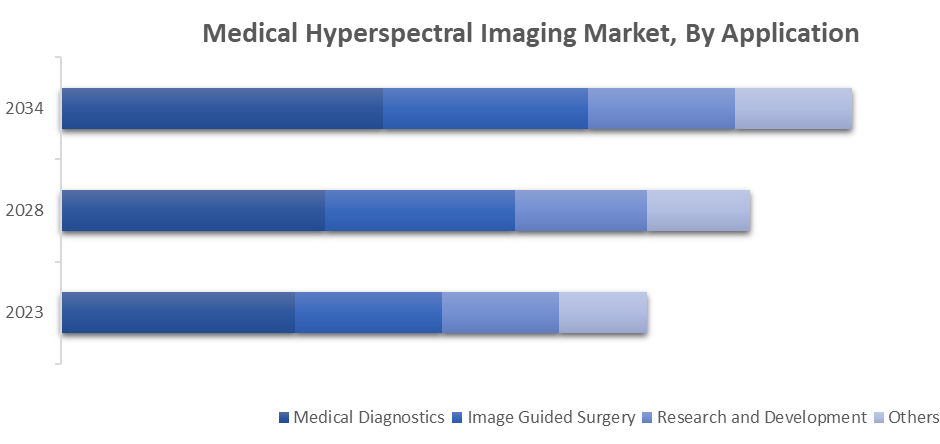
The market is bifurcated based on the Application of Medical Diagnostics, Image-Guided Surgery, Research and Development, and Others. Medical Diagnostics is the leading application of hyperspectral imaging as it tends to offer non-intrusive, thorough information about tissue makeup and organization. HSI is more commonly used to detect illnesses such as cancer, vascular abnormalities, and skin disorders, improving the accuracy of early diagnosis and treatment.
Diagnostics utilize HIS’s capacity to identify slight biochemical alterations in tissue that are not easy to detect by conventional imaging methods, providing several advantages in early detection and personalized treatment strategizing. For example, the use of HSI in cancer treatment to locate tumor edges has been revolutionary, reducing the requirement for invasive procedures. As healthcare systems continue to highlight early detection, the need for HSI in medical diagnostics is expected to increase, strengthening its role as the primary application.
Market Dynamics:
Growth Drivers
Growing Demand for Non-Invasive Diagnostic Tools to Propel Market Growth
The growing demand for non-invasive diagnostic options is a key factor driving the growth of the HSI market, with healthcare providers looking for ways to reduce patient discomfort while improving diagnostic precision. Hyperspectral imaging, a non-invasive technology, facilitates detailed analysis of tissue composition and biochemical markers without the requirement of surgical biopsies or invasive procedures.
This ability is especially important in the diagnosis of cancer and vascular diseases, as detecting them early can greatly enhance the outcomes for patients. HSI provides clinicians with a detailed, multi-spectral look at tissues, enabling the early detection of diseases to improve treatment outcomes and lower healthcare expenses. The increasing focus on non-invasive diagnostics underscores HSI's expanding presence in the healthcare sector.
Advancements in Imaging Technology to Provide Market Expansion Technology
Ongoing developments in hyperspectral imaging technology are driving its incorporation into medical procedures. HSI is becoming more versatile for clinical applications due to advancements in spectral resolution, device miniaturization, and data processing speed. By combining artificial intelligence (AI) with HSI, automatic tissue analysis is made possible, assisting clinicians in quickly making more precise diagnoses.
Moreover, the accessibility for point-of-care diagnostics, especially in emergency and surgical settings, is improved by the advancement of portable HSI devices. With the advancement of imaging technology, the potential applications of HSI expand, ranging from detecting early-stage diseases to guiding surgeries in real-time. These advancements in technology are anticipated to greatly impact the expansion and acceptance of HSI in different medical uses.
Restraints
Complexity in Data Processing and Analysis May Negatively Impact Market
The complexity of processing and analyzing data is a major obstacle to the widespread
use of hyperspectral imaging technology. HSI produces large amounts of data due to the spectral information of each pixel in the image, requiring advanced software and computational infrastructure for accurate analysis. Working with this amount of data can be difficult for numerous healthcare providers, especially smaller hospitals or facilities lacking IT capabilities.
Furthermore, analyzing HSI data necessitates specific expertise and advanced algorithms, rendering the technology less attainable for organizations lacking dedicated resources. The complexity of managing data hinders widespread adoption because institutions may be dissuaded by the extra expenses and resources required to properly support HSI.
Recent Developments
- In 2024, Headwall Photonics acquired inno-spec GmbH, strengthening its position in hyperspectral imaging technologies across diverse applications. The company also partnered strategically with NV5, becoming a value-added provider of NV5's renowned software.
- Between 2023-2024, IMEC International released an upgraded snapshot hyperspectral sensor suitable for handheld medical devices. Additionally, the company collaborated with a European university on HSI-based research for Alzheimer's disease diagnosis.
- Recently, Resonon Inc. introduced the Pika NUV2, an ultraviolet-plus-visible hyperspectral camera featuring pushbroom modality.
- In 2023, Specim launched a hyperspectral camera designed specifically for precision surgical guidance. The company further enhanced its HSI image analysis capabilities through a strategic partnership with a leading imaging software company in 2024.
Key Players:
- Headwall Photonics, Inc.
- IMEC International
- HySpex (Norsk Elektro Optikk AS)
- Resonon, Inc.
- Specim, Spectral Imaging Ltd.
- Bayspec, Inc.
- Corning Incorporated
- Cubert GmbH
- ChemImage Corporation
- Photon etc. Inc.
- Telops, Inc.
- Applied Spectral Imaging
- Diaspective Vision GmbH
- Surface Optics Corporation
- PerkinElmer, Inc.
- Other Prominent Players (Company Overview, Business Strategy, Key Product Offerings, Financial Performance, Key Performance Indicators, Risk Analysis, Recent Development, Regional Presence, SWOT Analysis)
Regional Analysis
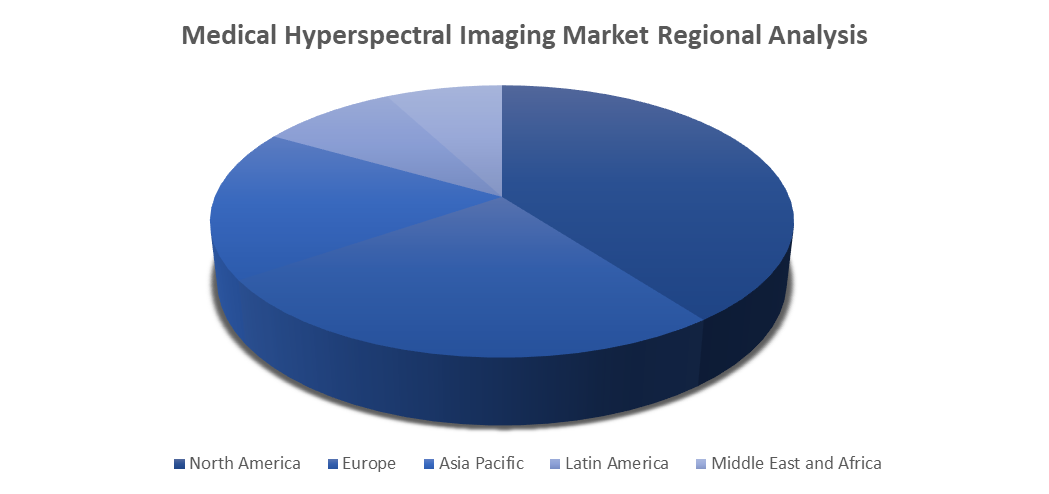
The Global Medical Hyperspectral Imaging Market is divided into five main regions for regional analysis: North America, Latin America, Europe, Asia Pacific, and the Middle East and Africa.
North America is currently at the forefront of the market owing to its advanced healthcare infrastructure, increased spending on healthcare, and the presence of leading market players. The region seems to benefit from the substantial investments in research and development, along with the faster adoption of cutting-edge medical technologies.
The United States has experienced strong growth in the application of HSI for cancer and brain diagnosis, along with significant funding from the government to improve diagnostic tools.
Europe follows North America in terms of total market share, with the growing applications and adoption of HIS technology in nations such as Germany, the United Kingdom, and France, backed by strong healthcare systems.
The Asia-Pacific region being a developing region has experienced strong demand for HIS in recent years, propelled by increasing healthcare investments, especially in nations such as China and Japan.
Even though Latin America and the Middle East & Africa have a smaller market share, the continual advancements in healthcare infrastructure and the rise in government efforts could facilitate expansion in these areas in the future.
Impact of Covid-19 on the Market
The market was impacted in various ways by the COVID-19 pandemic despite the initial negative effects on other industries, resulting in a global economic slowdown. During the initial stages, the pandemic led to setbacks in research projects and temporarily restricted the use of non-essential imaging technologies in healthcare settings as resources were focused on critical COVID-19 care.
Nevertheless, the pandemic highlighted the significance of advanced diagnostic instruments, resulting in a revival of interest and financial support for HSI applications. After the pandemic, healthcare systems shifted focus back to regular tests and elective surgeries, resulting in a rise in the use of HSI technology, particularly for non-invasive diagnostics. Furthermore, the increased focus on technology-based diagnostics has opened up opportunities for the further integration of HSI in studies on infectious diseases, healthcare infrastructure resilience, and preventative diagnostics.
Market is further segmented by region into:
- North America Market Size, Share, Trends, Opportunities, Y-o-Y Growth, CAGR – United States and Canada
- Latin America Market Size, Share, Trends, Opportunities, Y-o-Y Growth, CAGR – Mexico, Argentina, Brazil, and Rest of Latin America
- Europe Market Size, Share, Trends, Opportunities, Y-o-Y Growth, CAGR – United Kingdom, France, Germany, Italy, Spain, Belgium, Hungary, Luxembourg, Netherlands, Poland, NORDIC, Russia, Turkey, and Rest of Europe
- Asia Pacific Market Size, Share, Trends, Opportunities, Y-o-Y Growth, CAGR – India, China, South Korea, Japan, Malaysia, Indonesia, New Zealand, Australia, and Rest of APAC
- Middle East and Africa Market Size, Share, Trends, Opportunities, Y-o-Y Growth, CAGR – North Africa, Israel, GCC, South Africa, and Rest of MENA
Market Scope and Segments:
|
ATTRIBUTE |
DETAILS |
|
Study Period |
2018-2034 |
|
Base Year |
2023 |
|
Forecast Period |
2024-2034 |
|
Historical Period |
2019-2022 |
|
Growth Rate |
CAGR of 4.6% from 2024-2034 |
|
Unit |
Value (US$ Million) |
|
Segmentation |
Main Segments List |
|
By Product Type |
|
|
By Application |
|
|
By Technology |
|
|
By End User |
|
|
By Region |
|
Frequently Asked Questions (FAQ):
The global medical hyperspectral imaging market size was valued at US$ 276.2 million in 2023 and is projected to reach the value of US$ 454.2 million in 2034, exhibiting a CAGR of 4.6% during the forecast period.
The market involves using hyperspectral technology to capture detailed, spatially-resolved spectral data from biological tissues. This non-invasive diagnostic tool enhances disease detection, monitoring, and treatment in Cancer diagnosis, Wound care, Surgical guidance, Ophthalmology, and Dermatology.
The Camera and Medical Diagnostics segment accounted for the largest market share.
Key players in the global medical hyperspectral imaging market include Headwall Photonics, Inc., IMEC International, HySpex (Norsk Elektro Optikk AS), Resonon, Inc., Specim, Spectral Imaging Ltd., Bayspec, Inc., Corning Incorporated, Cubert GmbH, ChemImage Corporation, Photon etc. Inc., Telops, Inc., Applied Spectral Imaging, Diaspective Vision GmbH, Surface Optics Corporation, PerkinElmer, Inc. and Other Prominent Players.
The market is driven by increasing demand for non-invasive diagnostics, advancements in sensor technology, growing applications in cancer, wound care, and surgical guidance, and rising investments in medical imaging research and development.
 Select License Type


.png)


