


In-Vitro Toxicology Testing Market Research, 2034
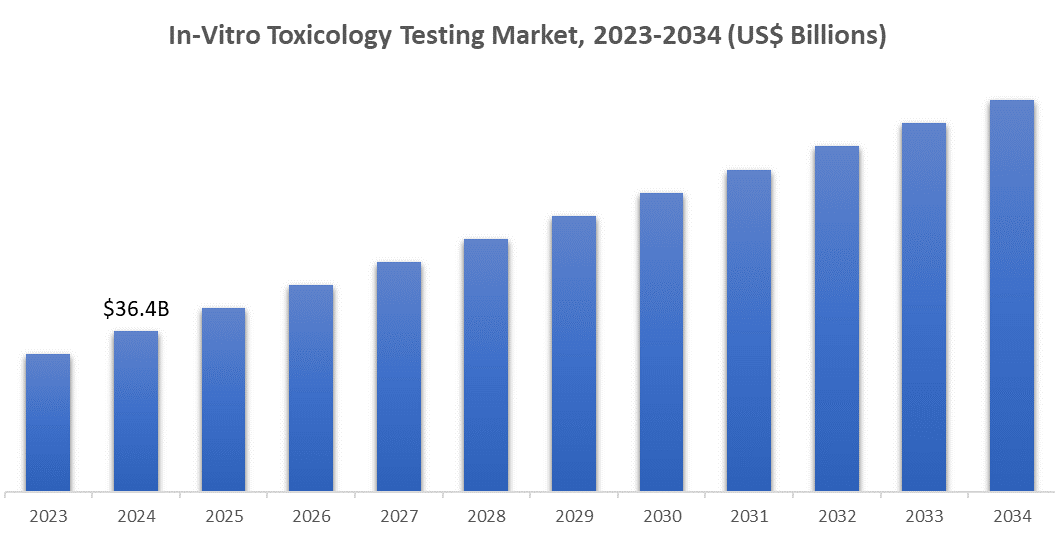
The global in-vitro toxicology testing market is anticipated to grow at a CAGR of 11.5% in the forecast period (2024-2034), with the market size valued at US$ 32.7 billion in 2023 and projected to reach US$ 108.1 billion by 2034.
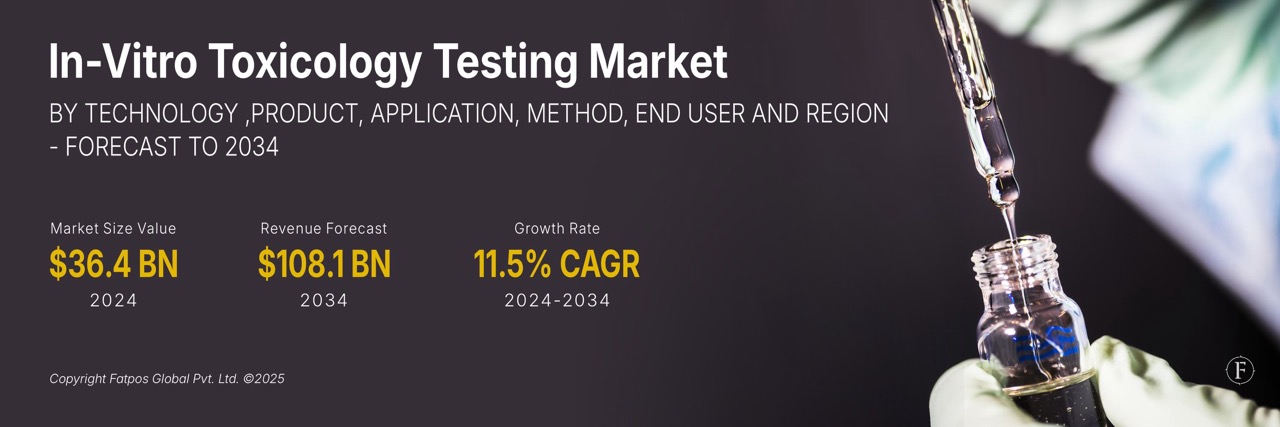
In-vitro toxicology testing utilizes cell cultures, biochemical assays, and computer models to evaluate the toxicity of chemicals, medications, and other substances without animal testing. This method facilitates scientists to notice possible harmful impacts on human cells and tissues within a controlled environment.
Consequently, it offers information that can forecast the toxicity of novel compounds during early development, improving safety and adherence to regulations. In-vitro techniques are more ethical, frequently quicker, and more affordable than conventional animal testing. The testing is utilized in various sectors, such as pharmaceuticals, cosmetics, and chemicals, where safety and compliance play an important role.
Market Highlights
The market is influenced by the increasing regulatory restrictions on animal testing and a heightened focus on ethical research methods. Technological innovations, including high-throughput screening and omics, have improved the precision and effectiveness of toxicity testing. Moreover, the rise in drug development efforts and personalized medicine stimulates the need for testing solutions specific to humans.
The anticipated growth is likely to be propelled by the increasing industrial applications such as cosmetics and home goods, alongside regulatory mandates in North America and Europe promoting alternatives to animal testing. The shift towards sustainable and ethical testing methods sets in-vitro toxicology testing up for ongoing expansion.
Market Segmentation
Cell culture technology dominates the market due to its critical role in replicating human cell environments
The market is segmented based on the Technology into Cell Culture Technology, High Throughput Technology, Cellular Imaging, and OMICS Technology. Cell culture technology dominates the market due to its essential function in simulating human cell conditions. This technology enables scientists and researchers to evaluate the impact of substances directly on cultured human cells, yielding highly pertinent toxicity information for forecasting human reactions.
Ongoing innovations such as the 3D cell cultures and organ-on-chip models have made cell culture technology crucial for uses in pharmaceuticals, cosmetics, and chemicals. Its flexibility and improved precision contribute to its extensive use; particularly as regulatory agencies increasingly mandate non-animal approaches for safety assessments. Cell culture technology is compatible with high-throughput screening, enabling large-scale evaluations for drug discovery and personalized medicine, which boosts its market leadership.
Cellular assays dominate the market due to their ability to emulate in vivo cellular responses
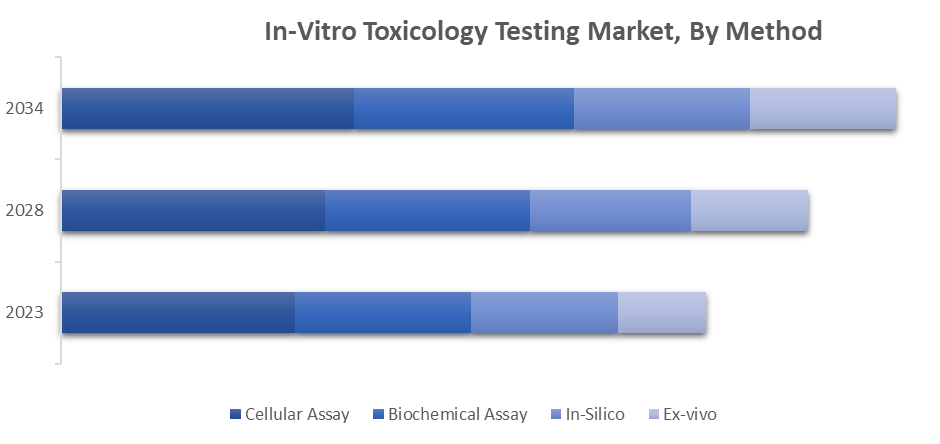
The market is segmented based on the Method into Cellular Assay, Biochemical Assay, In-Silico, and Ex-vivo. Cellular assays are the most commonly used techniques in in-vitro toxicology testing, due to their adaptability and capacity to accurately emulate in vivo cellular reactions. They offer direct information regarding cell survival, growth, and specialization when subjected to different chemicals or medications. Cellular assays facilitate the early assessment of toxicity and support uses such as cytotoxicity and genotoxicity evaluations.
With the ongoing developments in 3D cell cultures, cellular assays are becoming more effective for evaluating intricate toxicological responses in environments that closely mimic human biology. Pharmaceutical firms widely utilize cellular assays in high-throughput formats, facilitating the assessment of hundreds to thousands of samples, which is crucial for drug safety and regulatory adherence. The adaptability and reliability of this method strengthen its leading status in the market.
Market Dynamics
Growth Drivers
Ethical Concerns and Regulatory Push Against Animal Testing to Propel Market Growth
Numerous ethical issues have arisen concerning the use of animal testing practices, resulting in a shift towards alternative testing methods such as in-vitro toxicology, which has experienced significant growth lately. Social influences and regulatory frameworks, especially in Europe and North America, discourage or entirely ban animal testing in sectors such as cosmetics and chemicals.
Regulatory bodies such as the FDA and EPA are progressively promoting in-vitro methods that avoid the use of animal subjects, in response to public appeal and advocacy for compassionate, non-animal testing. This shift is prompting industries to adopt in-vitro toxicology testing, which satisfies regulatory demands and aligns with evolving consumer preferences for cruelty-free goods. The alignment of ethics and regulations is a crucial element in the expansion of in-vitro testing in different industries.
Technological Advancements in Toxicology Screening to Fuel Market Expansion
Strong developments in technologies such as cell culture, molecular imaging, and omics are propelling the market by improving the precision and effectiveness of toxicology assessments. Developments in 3D cell culture models, high-throughput screening, and organ-on-chip technologies enable researchers to replicate human physiological responses more accurately, enhancing the dependability of toxicity information.
Furthermore, omics technologies (such as genomics and proteomics) are providing a comprehensive understanding of cellular reactions to possible toxic substances at the molecular scale. These developments improve testing effectiveness and also improve the accessibility of in-vitro techniques in various industries. Enhanced precision and economic efficiency are anticipated to lead to increased adoption as organizations focus on high-quality, human-relevant data in their toxicology evaluations.
Restraints
High Cost of Advanced In-Vitro Testing Technologies May Restrict Market Growth
A key challenge faced by the market consists of the substantial expenses involved in deploying advanced technologies. Tools for advanced toxicology techniques, including 3D cell cultures, organ-on-chip systems, and high-throughput screening, can be unreasonably costly for smaller companies or research institutions in developing countries. In addition to equipment, specialized reagents and trained personnel who can operate and interpret intricate assays also increase costs.
As a result, although in-vitro testing methods are becoming more popular, financial complications hinder wider market acceptance, particularly in price-sensitive areas. To achieve complete market expansion, it is essential to implement cost reductions or financial assistance programs that enable smaller entities to embrace these technologies and take advantage of non-animal testing techniques.
Recent Developments
- Charles River Laboratories International, Inc. recently acquired Samdi Tech to expand its capabilities in drug discovery and in-vitro testing solutions. The company has actively introduced advanced bioassay services for oncology research, aimed at enhancing circulating tumor cell testing.
- Merck KGaA introduced new cell culture media specifically designed for toxicology testing applications. The company has been expanding its research center in Switzerland, adding resources to support in-vitro toxicology and oncology research.
- Bio-Rad Laboratories introduced a high-sensitivity digital PCR assay for oncology applications and expanded its reagent product line for in-vitro toxicology testing earlier this year.
- QIAGEN N.V. partnered with leading cancer research centers to enhance biomarker testing and released a new version of its QIAseq targeted DNA sequencing kits tailored for cancer detection.
- Eurofins Scientific SE acquired a UK-based toxicology lab to strengthen its market presence in Europe and expanded the scope of its services in cancer research, including circulating tumor cell (CTC) testing for drug development clients.
Key Players:
- Charles River Laboratories International, Inc.
- Merck KGaA
- Bio-Rad Laboratories, Inc.
- QIAGEN N.V.
- Eurofins Scientific SE
- Thermo Fisher Scientific Inc.
- Agilent Technologies, Inc.
- Evotec SE
- GE Healthcare
- Danaher Corporation
- Cyprotex (Evotec)
- Promega Corporation
- Lonza Group Ltd.
- Sartorius AG
- Ascendance Biotechnology Inc.
- Other Prominent Players (Company Overview, Business Strategy, Key Product Offerings, Financial Performance, Key Performance Indicators, Risk Analysis, Recent Development, Regional Presence, SWOT Analysis)
Regional Analysis
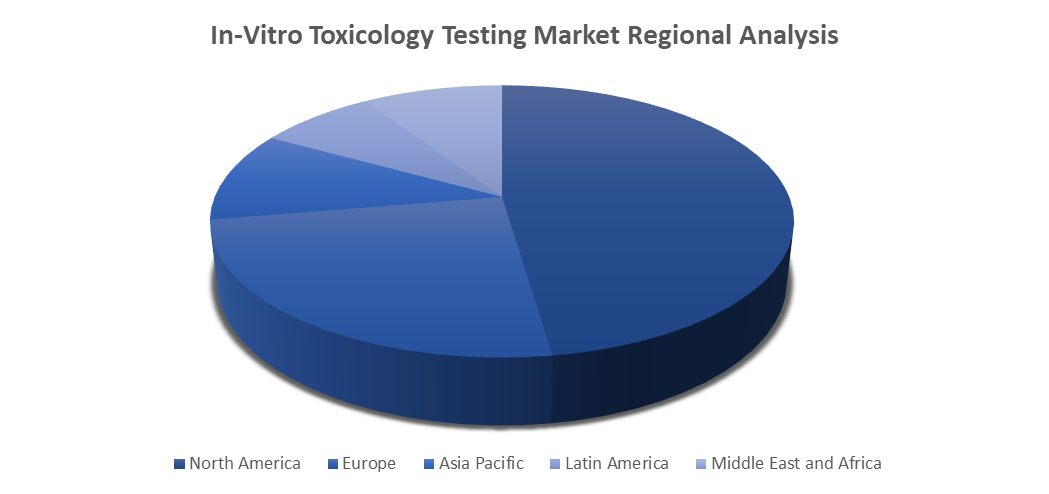
The Global in-vitro toxicology market is segmented based on regional analysis into five major regions: North America, Latin America, Europe, Asia Pacific, and the Middle East and Africa.
North America usually dominates the market attributed to its sophisticated healthcare system, robust R&D funding, and strict regulatory standards for drug and cosmetic safety. The United States, significantly, benefits from the funding it receives from both the government and private sectors, along with the involvement of leading industry participants.
Regulatory agencies such as the FDA and EPA actively encourage alternative testing techniques, enhancing the use of in-vitro technologies. The area's strong encouragement of innovation and commitment to ethical research standards maintains North America's leading position in the market.
Europe holds a considerable market share owing to stringent bans on animal testing, especially within the cosmetics sector, with nations such as Germany and the UK at the forefront.
The Asia-Pacific region is experiencing rapid expansion determined by heightened investments in pharmaceuticals and biotechnology, particularly in China and India.
Nonetheless, the Middle East, Africa, and Latin America are behind, primarily because of insufficient healthcare infrastructure and reduced adoption rates, yet demand is anticipated to rise as awareness and investment in non-animal testing methods increase.
Market is further segmented by region into:
- North America Market Size, Share, Trends, Opportunities, Y-o-Y Growth, CAGR – United States and Canada
- Latin America Market Size, Share, Trends, Opportunities, Y-o-Y Growth, CAGR – Mexico, Argentina, Brazil, and Rest of Latin America
- Europe Market Size, Share, Trends, Opportunities, Y-o-Y Growth, CAGR – United Kingdom, France, Germany, Italy, Spain, Belgium, Hungary, Luxembourg, Netherlands, Poland, NORDIC, Russia, Turkey, and Rest of Europe
- Asia Pacific Market Size, Share, Trends, Opportunities, Y-o-Y Growth, CAGR – India, China, South Korea, Japan, Malaysia, Indonesia, New Zealand, Australia, and Rest of APAC
- Middle East and Africa Market Size, Share, Trends, Opportunities, Y-o-Y Growth, CAGR – North Africa, Israel, GCC, South Africa, and Rest of MENA
Market Scope and Segments:
|
ATTRIBUTE |
DETAILS |
|
Study Period |
2018-2034 |
|
Base Year |
2023 |
|
Forecast Period |
2024-2034 |
|
Historical Period |
2019-2022 |
|
Growth Rate |
CAGR of 11.5% from 2024-2034 |
|
Unit |
Value (US$ Billion) |
|
Segmentation |
Main Segments List |
|
By Technology |
|
|
By Product |
|
|
By Application |
|
|
By Method |
|
|
By End Use |
|
|
By Region |
|
Frequently Asked Questions (FAQ):
The global in-vitro toxicology testing market size was valued at US$ 32.7 billion in 2023 and is projected to reach the value of US$ 108.1 billion in 2034, exhibiting a CAGR of 11.5% during the forecast period.
The in-vitro toxicology testing market refers to the industry segment focused on testing substances' toxicity using cellular or biochemical assays in controlled laboratory settings, mimicking human biology. This market provides alternative methods to animal testing for pharmaceutical, cosmetic, chemical, and food industries, ensuring safety and regulatory compliance.
The Cell Culture Technology and Cellular Assay segment accounted for the largest market share.
Key players in the global in-vitro toxicology testing market include Charles River Laboratories International, Inc., Merck KGaA, Bio-Rad Laboratories, Inc., QIAGEN N.V., Eurofins Scientific SE, Thermo Fisher Scientific Inc., Agilent Technologies, Inc., Evotec SE, GE Healthcare, Danaher Corporation, Cyprotex (Evotec), Promega Corporation, Lonza Group Ltd., Sartorius AG, Ascendance Biotechnology Inc. and Other Prominent Players.
The market is propelled by regulatory demands, technological improvements, animal welfare issues, cost efficiency, and an increasing need for alternative testing approaches.
 Select License Type


.png)


