


General Aviation Market Research, 2034
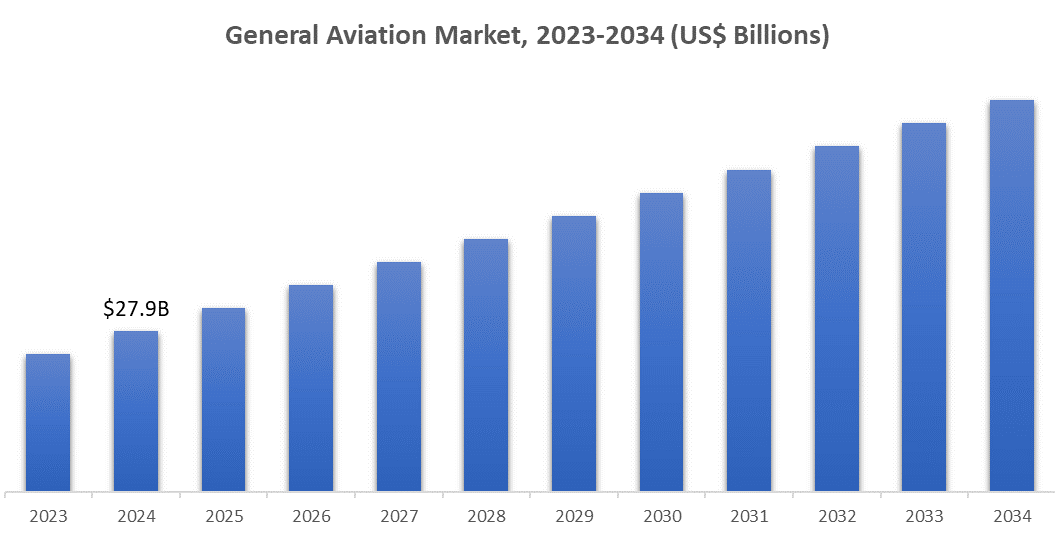
The global general aviation market is expected to achieve a 3.7% CAGR during the forecast period (2024-2034), with a market size of US$ 26.2 billion in 2023, projected to reach US$ 38.9 billion by 2034.
General aviation includes a variety of aircraft operations that are not part of commercial airlines or military aviation. It consists of private aviation, pilot instruction, medical air transport, agricultural flying, and business air travel. General aviation aircraft can range from small planes with piston engines to advanced business jets and helicopters.
This industry is crucial in supplying individual transportation, aiding in business trips, and providing emergency medical care. Furthermore, general aviation plays a role in pilot education and the advancement of new aviation technologies. The industry also has a major impact on the economic development of smaller airports and rural areas, providing access and connectivity to remote regions that are typically lacking services from major airlines.
Market Highlights:
The market influenced by a variety of factors such as increased demand for business travel, offering flexible and efficient transportation options. Rising disposable income among personnel and companies has resulted in increased utilization of private jets and helicopters for personal and professional purposes. Technological developments in avionics, aircraft effectiveness, and safety measures have played a crucial role in the market's growth.
Additionally, the increase in pilot training institutions and the expansion of air ambulance services have increased the overall demand. It is expected that the general aviation market will continue to grow in the future owing to rapid urbanization, advancements in air mobility, and the increasing demand for fast and dependable regional transportation, particularly in developing countries.
Market Segmentation:
Piston fixed-wing aircraft hold the dominant position owing to their affordability and well-established infrastructure
The market is classified based on Aircraft Type into Piston Fixed-Wing Aircraft, Helicopters, Business Jets, Turboprop Aircraft, and Others. Several key factors have been responsible for piston fixed-wing aircraft to remain dominant in the general aviation market. The lower costs of buying and managing these aircraft make them accessible to a large range of consumers, with affordability being a significant factor.
Their ability to be used for multiple purposes is important, as they are utilized for different applications such as personal transportation, flight instruction, aerial photography, and farming. Moreover, their ability to adjust to various flying conditions increases their attractiveness. A reliable system of airports and numerous pilot training programs guarantee steady operations due to the well-developed infrastructure.
Finally, piston airplanes are culturally important, as their extensive history and strong community help in creating a deep passion for aviation enthusiasts.
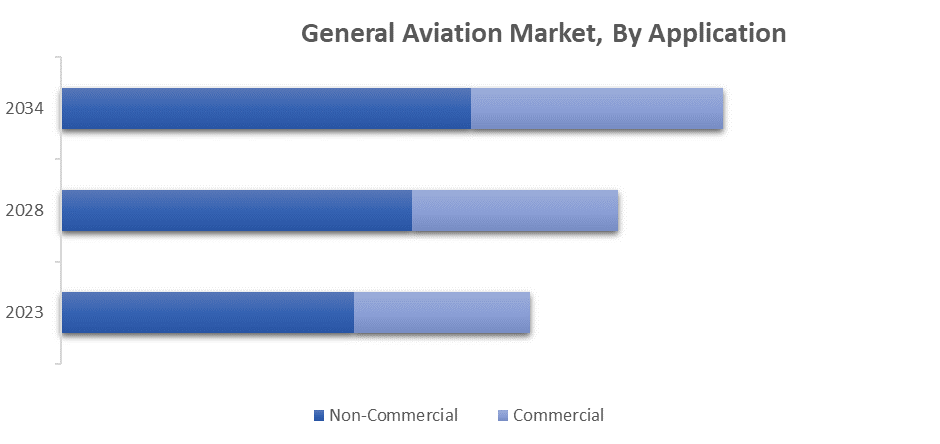
Non-commercial applications have a wider scope than commercial ones, making them the dominant force in the market
The market is segmented based on Application into Commercial, and Non-Commercial variants. The market is primarily driven by non-commercial applications such as personal use and flight training. Numerous general aviation aircraft are used for leisure flying and personal travel, especially in regions where commercial airline services are not easily available.
Furthermore, a large proportion of non-commercial aviation involves flight training, which includes many flight schools and training programs that make use of general aviation planes to teach aspiring pilots. Additionally, experimental and homemade aircraft play a role in this dominance, as aviation enthusiasts create and modify these planes for customized flying experiences and innovation.
Although commercial activities such as aerial surveying and crop dusting are important, the abundance and variety of non-commercial activities, led by personal use, flight training, and experimental aviation, ensure they continue to be the primary drivers in the market.
Market Dynamics:
Growth Drivers
Increased Demand for Business and Personal Aviation to Boost Market Growth
Economic expansion plays an important role in the increased interest in general aviation, especially for corporate and leisure travel. With the growth of global economies, especially in emerging markets, more and more people and companies are relying on aviation for effective travel. Corporate executives and wealthy individuals find business jets and other general aviation aircraft appealing due to their flexibility, privacy, and access to airports not well-serviced by commercial airlines.
Affluent individuals are increasingly turning to personal travel for convenience and time-saving options over commercial flights. In regions where there is limited commercial airline service, general aviation serves as an essential means of transportation, playing a key role in the region's development.
Advancements in Aircraft Designs, Avionics, and Propulsion Systems to Facilitate Market Expansion
Strong growth in the market has been significantly influenced by several technological developments in recent years. Advancements in aircraft design have resulted in lighter, more fuel-efficient airplanes, improving range and performance while reducing operating expenses. Advances in avionics have resulted in improved navigation and communication systems, making flying easier and safer for pilots.
Moreover, there are emerging propulsion technologies like electric and hybrid-electric systems that provide cleaner and more sustainable alternatives for aviation. These developments are expanding access to general aviation, increasing reliability, and promoting environmental friendliness, which is constantly attracting new customers and operators. Moreover, incorporating advanced technologies in cockpit designs has simplified pilot education and airplane operation, strengthening the market's expansion path.
Restraints
High Operating Costs Acts as a Significant Barrier for Potential Buyers
Although the market has shown signs of a strong growth potential, the continued high operating costs are preventing its expansion. Operating and managing an aircraft involves costly tasks such as routine checks, replacing parts, and conducting repairs, which can act as a significant financial burden. The cost of fuel is another important consideration since the price of aviation fuel varies and can make up a significant part of operating costs.
Furthermore, the cost of hiring skilled pilots and crew increases expenses, especially for companies making use of general aviation for corporate trips. The expensive prices discourage potential purchasers and users, particularly small businesses and private individuals, which restricts the market's availability. Despite technological advancements reducing certain expenses, operational costs continue to be a consistent obstacle to market expansion.
Recent Developments
- In 2022, Airbus SE announced the development of the CityAirbus NextGen, an electric vertical take-off and landing (eVTOL) aircraft targeting urban air mobility solutions. This marked their expansion into sustainable aviation. The company has signed multiple partnerships to advance the development of hydrogen-powered aircraft, aiming for a zero-emission future.
- In 2022, Textron expanded its portfolio with the acquisition of Pipistrel, a leader in electric aircraft manufacturing. This move strengthens Textron's commitment to sustainable aviation. In 2023, the company signed a record-breaking agreement with NetJets for up to 1,500 Cessna Citation jets, including the introduction of the new Citation Ascend to the fleet.
- In 2022-23, Pilatus launched the PC-12 NGX, a turboprop aircraft with improved engine performance and avionics. The company has been focusing on expanding its production facility in Stans, Switzerland, increasing capacity for the assembly of the PC-12 and PC-24 aircraft.
- In 2022-23, Embraer S.A. introduced the Phenom 300MED, a medical evacuation variant of the Phenom 300 light jet. The company has also launched Energia, a family of hybrid-electric and hydrogen-powered aircraft, to enter service by 2035, reflecting its focus on sustainable aviation.
- In 2023, Dassault Aviation made strides with its Falcon 10X, scheduled for delivery in 2025, which boasts the largest cabin in its class.
Key Players:
- Airbus SE
- Textron Aviation Inc.
- Pilatus Aircraft Ltd
- Embraer S.A.
- Dassault Aviation
- Gulfstream Aerospace Corporation
- Bombardier Inc.
- Cirrus Aircraft
- Honda Aircraft Company
- Diamond Aircraft Industries
- Beechcraft Corporation
- Cessna Aircraft Company
- Hawker Pacific Aerospace
- Daher Aerospace
- Eclipse Aerospace
- Other Prominent Players (Company Overview, Business Strategy, Key Product Offerings, Financial Performance, Key Performance Indicators, Risk Analysis, Recent Development, Regional Presence, SWOT Analysis)
Regional Analysis
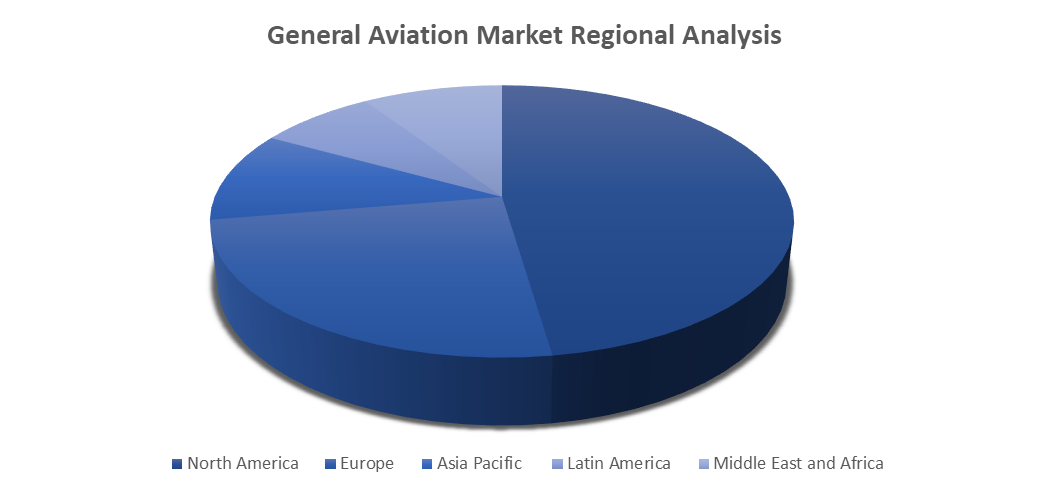
The global market is segmented based on regional analysis into five major regions: North America, Latin America, Europe, Asia Pacific, and the Middle East and Africa.
North America leads the market, with the United States having the largest number of general aviation planes globally. The region benefits from a robust infrastructure, which consists of a wide range of airports, established flight training facilities, and a strong demand for both personal and business aircraft.
Established corporations such as Textron Aviation and Gulfstream Aerospace are based in North America, contributing to the growth of the market. Moreover, its dominance in the market is also supported by economic prosperity, favourable regulations, and a large number of recreational pilots. Meanwhile, Europe, Asia-Pacific, Latin America, and the Middle East, and Africa are experiencing growth but are not advancing as quickly as North America.
Europe possesses a robust business aviation industry but encounters stringent regulatory frameworks.
The Asia-Pacific region is quickly growing because of the growing economy and rising wealth.
Latin America, the Middle East, and Africa display promise, yet their growth is hindered by infrastructure and economic limitations.
Market is further segmented by region into:
- North America Market Size, Share, Trends, Opportunities, Y-o-Y Growth, CAGR – United States and Canada
- Latin America Market Size, Share, Trends, Opportunities, Y-o-Y Growth, CAGR – Mexico, Argentina, Brazil, and Rest of Latin America
- Europe Market Size, Share, Trends, Opportunities, Y-o-Y Growth, CAGR – United Kingdom, France, Germany, Italy, Spain, Belgium, Hungary, Luxembourg, Netherlands, Poland, NORDIC, Russia, Turkey, and Rest of Europe
- Asia Pacific Market Size, Share, Trends, Opportunities, Y-o-Y Growth, CAGR – India, China, South Korea, Japan, Malaysia, Indonesia, New Zealand, Australia, and Rest of APAC
- Middle East and Africa Market Size, Share, Trends, Opportunities, Y-o-Y Growth, CAGR – North Africa, Israel, GCC, South Africa, and Rest of MENA
Market Scope and Segments:
|
ATTRIBUTE |
DETAILS |
|
Study Period |
2018-2034 |
|
Base Year |
2023 |
|
Forecast Period |
2024-2034 |
|
Historical Period |
2019-2022 |
|
Growth Rate |
CAGR of 3.7% from 2024-2034 |
|
Unit |
Value (US$ Billion) |
|
Segmentation |
Main Segments List |
|
By Aircraft Type |
|
|
By Application |
|
|
By Region |
|
Frequently Asked Questions (FAQ):
The global general aviation market size was valued at US$ 26.2 billion in 2023 and is projected to reach the value of US$ 38.9 billion in 2034, exhibiting a CAGR of 3.7% during the forecast period.
General aviation refers to all civil aviation operations that are not commercial air transport. It includes a wide range of activities such as private flying, recreational flying, flight training, and business aviation.
The Piston Fixed-Wing Aircraft and Non-commercial segment accounted for the largest market share.
Key players in the general aviation market include Airbus SE, Textron Aviation Inc., Pilatus Aircraft Ltd, Embraer S.A., Dassault Aviation, Gulfstream Aerospace Corporation, Bombardier Inc., Cirrus Aircraft, Honda Aircraft Company, Diamond Aircraft Industries, Beechcraft Corporation, Cessna Aircraft Company, Hawker Pacific Aerospace, Daher Aerospace, Eclipse Aerospace and Other Prominent Players.
Economic growth, technological advancements, rising disposable income, and urbanization are driving the market.
 Select License Type


.png)


