


EV Charging Module Market Size
EV Charging Module Market, valued at USD 7.1 billion in 2023, is forecasted to expand at a Compound Annual Growth Rate (CAGR) of 17% from 2024 to 2034, potentially reaching USD 35.6 billion by the end of the period.
Product Overview:
An Electric Vehicle Charging Module is a small device designed to facilitate the charging of electric cars. These modules are crucial in EV charging infrastructure as they allow vehicles to connect to the power grid or charging stations through essential interfaces and functionalities. They typically include power conversion units, communication modules for data transfer, safety features such as overcurrent protection, and interfaces for user interaction (e.g., display screens or RFID readers). EV Charging Modules are built to accommodate various vehicle types and charging requirements by supporting multiple charging standards and power levels (AC and DC). They prioritize efficiency, reliability, and compatibility to ensure seamless integration into current and future EV charging systems worldwide.
Market Highlights:
EV Charging Module Market is expected to exhibit a CAGR of 17% during the forecast period, 2024-2034
The EV Charging Module Market is expected to reach USD 35.6 billion, with a projected growth rate of 17% during the forecast period. This growth can be attributed to several significant factors. One of the main reasons behind the increasing use of electric vehicles is growing environmental concerns and government regulations. Government initiatives, financial support, and investments in charging infrastructure are propelling market growth. Technological innovations, such as faster and more efficient charging options, are enhancing user convenience and reducing charging time. Additionally, there is a rising demand for eco-friendly transportation options, which is further driving market expansion. Future advancements, such as the integration of smart grid technology and the development of rapid charging technologies, will continue to fuel the market, ensuring a widespread and accessible charging network to support the shift towards electric transportation.
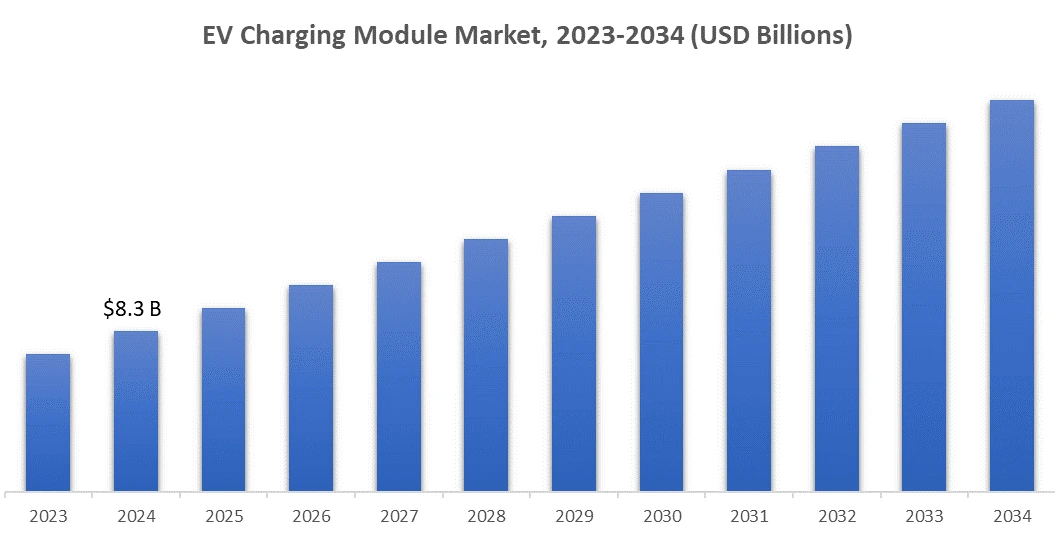
Source: Fatpos Global
EV Charging Module Market Segmentation:
AC charger modules dominate due to their better grid compatibility and cost-effectiveness
EV Charging Module Market is segmented based on Type into AC Charger Module, and DC Charger Module. AC charger modules are currently the primary choice in the EV charging module market accredited to various convincing factors. The main market emphasis is on Level 2 charging, which utilizes AC modules, which makes them perfect for overnight or workplace charging while aligning with the majority of daily EV usage situations. These units are cheaper to manufacture and install compared to DC fast chargers, allowing for wider implementation, particularly in residential and commercial environments. AC modules can be easily connected to the existing AC power grid, eliminating the need for expensive infrastructure updates. Furthermore, the majority of electric vehicles are equipped with built-in chargers that transform AC electricity from the grid into DC electricity to store in the battery, reducing the cost and complexity associated with highly powerful DC converters at charging stations.
Level 2 Chargers to hold a prominent position owing to their wider applications and better grid compatibility
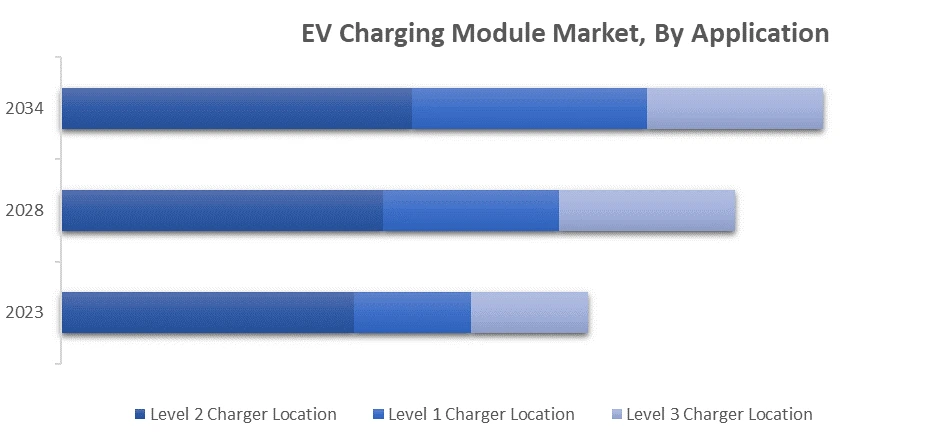
EV Charging Module Market is segmented based on Application into Level 1 Charger Locations, Level 2 Charger Locations, and Level 3 Charger Locations. Level 2 charger stations are the most common in the EV charging module market due to their ability to meet primary charging needs. Level 2 charging is more convenient and faster than Level 1 charging at home. It is also more affordable and accessible than Level 3 fast charging. Level 2 chargers are great for overnight charging at home or during work hours, addressing the most common needs of EV owners. Governments and businesses are expanding Level 2 infrastructure due to its cost-effectiveness and capacity to support more charging points compared to Level 3. Additionally, Level 2 chargers can easily be integrated into the current AC grid with only small infrastructure enhancements needed for widespread use.
Market Dynamics:
Growth Drivers
Increasing Electric Vehicle Adoption Globally to Positively Influence Market Growth
Electric vehicles (EVs) are becoming increasingly popular worldwide due to several key factors. Growing environmental concerns are driving the need for cleaner forms of transportation, as EVs produce no emissions from their tailpipes. The reduced prices of lithium-ion batteries have made electric vehicles more cost-effective and accessible. Advancements in battery technology have extended the range of EVs, reduced charging times, and improved overall performance, alleviating concerns about running out of power. Government initiatives such as tax incentives, refunds, and financial aid are encouraging the adoption of EVs while funding for charging stations is promoting their widespread use. Additionally, operating costs for electric vehicles are lower than those of traditional cars due to more affordable electricity rates and reduced maintenance requirements. These factors make electric vehicles an attractive and environmentally friendly option for consumers.
Government Initiatives and Subsidies to Promote Comprehensive Growth and Expansion
Government efforts and financial support are essential for accelerating the adoption of electric vehicles and promoting a complete electric vehicle environment. Demand-side incentives, such as tax benefits, discounts on purchases, and programs for scrapping old vehicles, reduce the cost of electric vehicles for customers. Incentives on the supply side motivate manufacturers to invest in research, development, and production of EVs by offering subsidies for EV manufacturing plants and battery production. Investments in both public and private charging infrastructures can alleviate range anxiety and promote greater adoption of electric vehicles. Regulatory measures, such as more stringent emission requirements for gas-powered cars and mandates for zero-emission vehicles, encourage the adoption of electric vehicles. Furthermore, government funding for research and development speeds up innovation in battery technology, charging infrastructure, and other key areas, aiding in the overall expansion of the EV market.
Restraints
High Initial Investment Costs for Charging Infrastructure to Create Market Challenges
The EV charging module market faces significant challenges due to the high costs of initial investment in charging infrastructure. The cost of setting up EV charging stations is high due to the costly infrastructure like high-power converters and cooling systems, as well as significant installation expenses such as trenching and electrical upgrades. Obtaining land, particularly in cities, also contributes to costs. Initially, low usage rates may not generate enough revenue to recover investments, discouraging entry into the market. Moreover, widespread deployment requires grid upgrades, introducing more complexity and expenses. These expensive prices hinder the development of infrastructure, impede market expansion, and result in uneven distribution of charging stations. Possible solutions consist of incentives from the government, collaborations between the public and private sectors, as well as the use of new technologies to reduce costs.
Recent Developments
- In February 2023, Texas Instruments (TI) announced a collaboration with a major car manufacturer to develop a reference design for onboard EV chargers using TI's power electronics portfolio. The company further, in June 2024, launched a new series of GaN (Gallium Nitride) chargers for Level 2 and DC fast charging applications.
- In December 2023, Huawei introduced a new wireless charging technology for electric vehicles, aiming to simplify the charging experience and eliminate the need for physical connectors. The company in 2024 entered the European EV charging market with a new line of high-power DC fast chargers.
- In July 2023, Vincotech introduced a new range of compact and efficient DC-DC converters specifically designed for Level 2 charging stations. The company later, in April 2024, acquired a company specializing in silicon carbide (SiC) modules, strengthening Vincotech's position in providing high-performance components for EV charging applications.
- In May 2024, ABB partnered with a utility company to deploy a network of ultra-fast charging stations across a major highway corridor. This project highlights ABB's focus on future-proofing charging infrastructure for next-generation EVs.
- In 2023, Emerson expanded its portfolio of metering and billing solutions for EV charging applications, addressing the need for accurate energy measurement.
EV Charging Module Market: Key Players
- Texas Instruments (TI)
- Huawei
- Vincotech
- ABB
- Emerson
- Delta Electronics
- NXP Semiconductors
- Infineon Technologies
- STMicroelectronics
- Wolfspeed
- Aptiv PLC
- Molex
- Yazaki Corporation
- TE Connectivity
- Wallbox Chargers
- Other Prominent Players (Company Overview, Business Strategy, Key Product Offerings, Financial Performance, Key Performance Indicators, Risk Analysis, Recent Development, Regional Presence, SWOT Analysis)
Regional Analysis
EV Charging Module Market is segmented based on regional analysis into five major regions: North America, Latin America, Europe, Asia Pacific, and the Middle East and Africa. Several factors contribute to the current dominance of the EV charging module market in the Asia-Pacific region. Strong government efforts in nations such as China and India, such as providing subsidies for charging infrastructure, are encouraging the adoption of electric vehicles. The region is witnessing a quick rise in electric car purchases, requiring a rapid increase in charging stations. Having a strong domestic manufacturing presence for electric vehicle charging modules reduces expenses and enhances the availability of this technology. Furthermore, the emphasis on electric vehicles with two wheels, like scooters and motorcycles, that necessitate more basic and affordable charging facilities, continues to propel market expansion.
Other areas are also demonstrating growth potential. Significant funds are being invested in high-power charging stations in North America. In Europe, the rising demand for charging modules is being driven by strict emission regulations and a growing preference for sustainable transportation, leading to increased adoption of EVs.
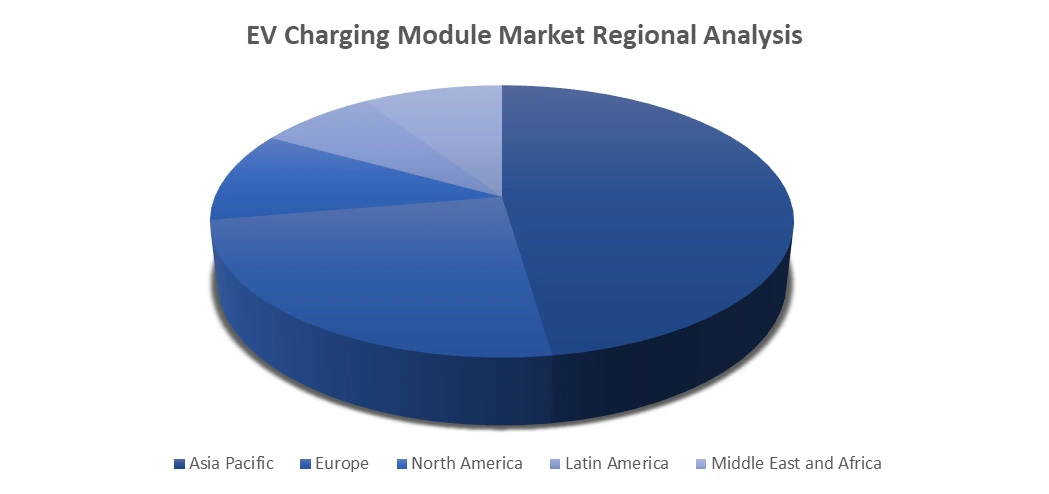
Source: Fatpos Global
Impact of Covid-19 on EV Charging Module Market
The EV charging module market was impacted in various ways by the COVID-19 pandemic. In the short term, there were disruptions in the supply chain due to lockdowns and travel restrictions, which caused delays in the production of crucial components like semiconductors. There was also a temporary decrease in the demand for new charging stations due to lower car sales, including EVs. The construction of new stations was further hindered by delays caused by lockdowns and social distancing measures. However, in the long term, there were some positive developments. The pandemic has led to a greater emphasis on sustainability, which could potentially drive up long-term demand for electric vehicles and charging infrastructure. Government stimulus packages often included funding for environmentally friendly infrastructure, which had a positive impact on the market. Additionally, concerns about using public transportation during the pandemic led to an increase in individuals owning personal vehicles, potentially boosting the adoption of electric cars and aiding in the growth of the market.
EV Charging Module Market is further segmented by region into:
- North America Market Size, Share, Trends, Opportunities, Y-o-Y Growth, CAGR – United States and Canada
- Latin America Market Size, Share, Trends, Opportunities, Y-o-Y Growth, CAGR – Mexico, Argentina, Brazil, and Rest of Latin America
- Europe Market Size, Share, Trends, Opportunities, Y-o-Y Growth, CAGR – United Kingdom, France, Germany, Italy, Spain, Belgium, Hungary, Luxembourg, Netherlands, Poland, NORDIC, Russia, Turkey, and Rest of Europe
- Asia Pacific Market Size, Share, Trends, Opportunities, Y-o-Y Growth, CAGR – India, China, South Korea, Japan, Malaysia, Indonesia, New Zealand, Australia, and Rest of APAC
- Middle East and Africa Market Size, Share, Trends, Opportunities, Y-o-Y Growth, CAGR – North Africa, Israel, GCC, South Africa, and Rest of MENA
EV Charging Module Market Scope and Segments:
|
ATTRIBUTE |
DETAILS |
|
Study Period |
2018-2034 |
|
Base Year |
2023 |
|
Forecast Period |
2024-2034 |
|
Historical Period |
2019-2022 |
|
Growth Rate |
CAGR of 17% from 2024-2034 |
|
Unit |
Value (USD Billion) |
|
Segmentation |
Main Segments List |
|
By Type |
|
|
By Application |
|
|
By Region |
|
Frequently Asked Questions (FAQ):
The EV Charging Module Market size was valued at USD 7.1 billion in 2023 and is projected to reach USD 35.6 billion by 2034, exhibiting a CAGR of 17% during the forecast period.
The EV Charging Module Market encompasses the industry segment focused on the development, production, and deployment of modules and systems that facilitate the charging of electric vehicles. It includes various technologies, from AC and DC chargers to advanced infrastructure solutions, supporting the global shift to electric mobility.
The AC Charger Module and Level 2 Charger Location segment accounted for the largest EV Charging Module Market share.
Key players in the EV Charging Module Market include Texas Instruments (TI), Huawei, Vincotech, ABB, Emerson, Delta Electronics, NXP Semiconductors, Infineon Technologies, STMicroelectronics, Wolfspeed, Aptiv PLC, Molex, Yazaki Corporation, TE Connectivity, Wallbox Chargers and Other Prominent Players.
Factors driving the EV Charging Module Market include increasing eletric vehicle adoption, government incentives, technological advancements in charging infrastructure, and growing environmental awareness.
 Select License Type


.png)


