


.jpg)
Enteral Feeding Devices Market Size
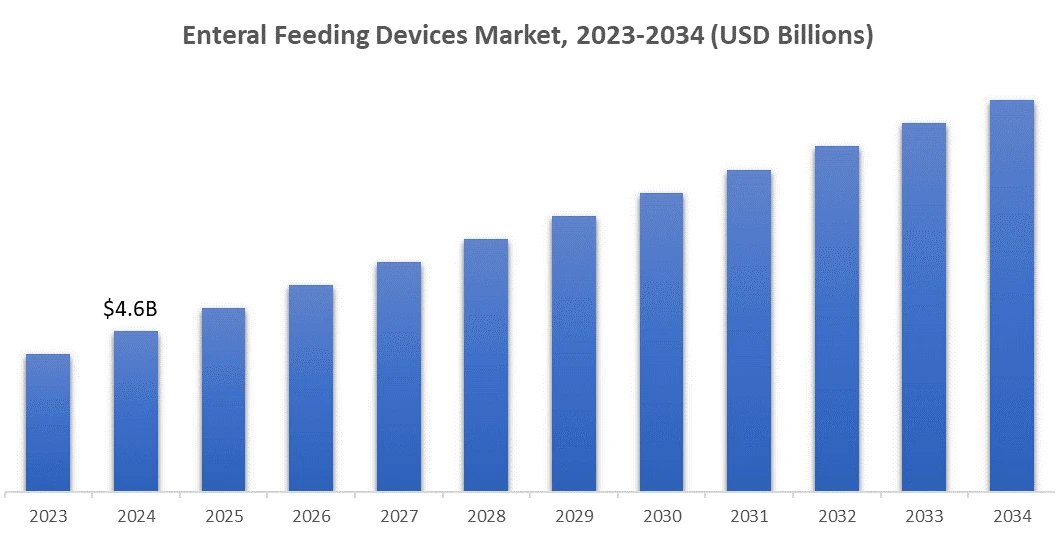
The Enteral Feeding Devices Market is anticipated to grow at a CAGR of 5.5% in the forecast period (2024-2034), with the market size valued at USD 4.3 billion in 2023 and projected to reach USD 7.8 billion by 2034.
Product Overview:
Enteral feeding devices are tools in the medical field that are utilized to provide nutrients directly to the digestive system, usually for individuals who are incapable of consuming food orally owing to several health issues. These devices, such as feeding pumps, tubes, and administration sets, help with various conditions such as neurological disorders, cancer, and gastrointestinal diseases. Enteral feeding is given through tubes inserted into the stomach or small intestine, ensuring patients get the necessary nutrients when they are unable to chew or swallow. This method is commonly applied in hospitals, home care, and long-term care facilities, improving overall patient outcomes through a more efficient focus on their nutritional requirements and encouraging their recovery.
Market Highlights:
Enteral Feeding Devices Market is expected to exhibit a CAGR of 5.5% during the forecast period, 2024-2034
The Enteral Feeding Devices Market is projected to achieve an overall valuation of USD 7.8 billion, with a 5.5% CAGR growth attributed to the rise in chronic diseases such as cancer, neurological disorders, and gastrointestinal illnesses that require extended nutritional help. This demand is also influenced by an increasingly elder global population, as these individuals have a higher probability of requiring enteral feeding solutions. Technological Developments have also contributed, as improvements in pump technology, portable devices, and user-friendly administration systems have made these devices more attractive for home care applications. Furthermore, the increase in value-based healthcare and the surge in home-based care have resulted in market expansion, as enteral feeding devices provide economical options for managing patient nutrition away from medical facilities.
Source: Fatpos Global
Enteral Feeding Devices Market Segmentation:
Enteral feeding pumps dominate the market due to precision, reduced complications, and customizable delivery
The Enteral Feeding Devices Market is segmented based on the Product into Enteral Feeding Tubes, Enteral Feeding Pumps, Enteral Syringes, Administration Sets, and Consumables. Enteral feeding pumps lead the market due to their precise nutrient delivery, lower complication rates, and customizable programming for patient needs. These pumps are commonly used in hospitals, long-term care facilities, and now more often in homes due to several improvements that have been made in their portability and user-friendliness. Their precise control of the feeding rate is highly beneficial for patients with chronic illnesses, making pumps essential in intensive care units and home health care for patients with severe digestive or neurological problems. With an increase in patients receiving care at home, enteral feeding pumps are meeting the need for dependable nutrient delivery, solidifying their position as an essential product in the market.
Due to the high demand for nutritional support among cancer patients, the oncology segment will lead the market
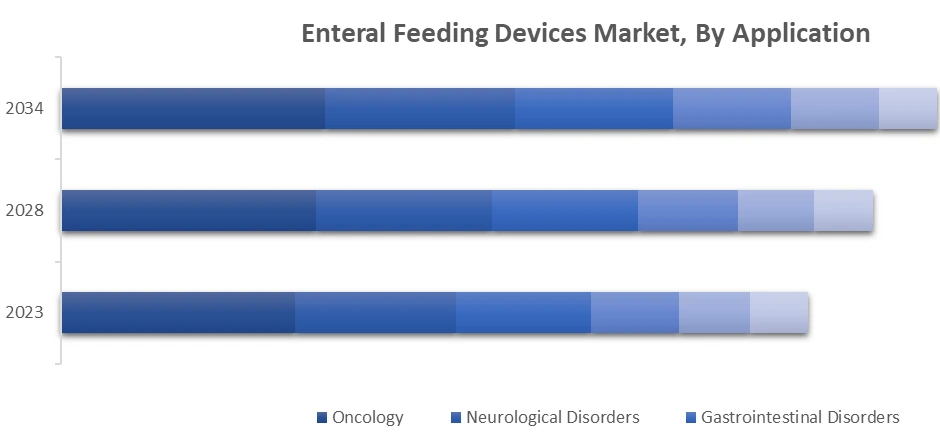
The Enteral Feeding Devices Market is bifurcated based on Application into Oncology, Neurological Disorders, Gastrointestinal Disorders, Diabetes, Hypermetabolism, and Others. Oncology treatments lead the applications of enteral feeding devices since cancer patients require substantial nutritional assistance, dealing with issues such as reduced appetite, swallowing difficulties, and digestive problems. Chemotherapy and radiation treatments for cancer can result in significant nutrient deficiencies, necessitating enteral feeding to maintain patient strength and aid in the recovery process. The significant global occurrence of cancer and rising rates of occurrence are key drivers for the increased demand for enteral feeding in the field of oncology. Additionally, hospitals, home care environments, and long-term care facilities place a high importance on enteral feeding solutions for cancer patients to address complex nutritional requirements, establishing this as the predominant market application.
Market Dynamics:
Growth Drivers
Increasing Prevalence of Chronic Diseases to Drive Feeding Devices Applications
The growing incidence of chronic diseases such as cancer, neurological disorders, and gastrointestinal diseases have been key factors driving growth in the enteral feeding devices market. Patients' ability to ingest nutrients orally is frequently compromised by such conditions, necessitating the use of enteral feeding to sustain health and aid in recuperation. The increasing number of older people worldwide, especially in developed nations, is also increasing the need for enteral feeding support due to their higher risk of chronic diseases. Moreover, hospitals, home care providers, and long-term care facilities are increasingly depending on enteral feeding devices to handle the intricate nutritional requirements of these patients, leading to continuous market expansion fueled by the prevalence of chronic diseases.
Technological Advancements in Feeding Devices to Propel Market Growth
Technological developments in enteral feeding tools have driven market expansion by improving the safety, functionality, and patient comfort of such devices. Modern enteral feeding pumps are equipped with advanced functions such as programmable settings and the ability to be easily carried, enabling patients to utilize them outside of medical facilities, such as in homecare settings. Advances in tube design and disposable administration sets have reduced chances of infection and enhanced patient comfort. The advancement of smart devices for real-time monitoring allows healthcare providers to remotely monitor patient nutrition more effectively, increasing adoption rates and positively impacting market growth, particularly in areas where home healthcare solutions are popular.
Restraints
Stringent Regulatory Requirements May Negatively Impact Market
Meeting regulatory requirements acts as a major obstacle in the enteral feeding devices market, as manufacturers are required to adhere to strict guidelines set by organizations such as the FDA in the US and CE Marking in Europe. These rules aim to guarantee enteral feeding device safety and effectiveness, considering the potential complications such as infections or tube displacement. Although these requirements aid in ensuring patient safety, they can be expensive and time-consuming for manufacturers, leading to delays in product releases and higher production expenses. Smaller businesses, especially, might struggle to understand and comply with these regulations, ultimately hindering innovation and restricting market access. As a result, strict adherence to regulations continues to hinder growth in this industry.
Recent Developments
- Fresenius Kabi AG has expanded its product line with innovative enteral nutrition solutions designed to enhance patient comfort and nutritional delivery in home care settings. Additionally, the company's strategic acquisition of a specialty device manufacturer has bolstered its presence in the enteral feeding market.
- Medtronic has launched a compact, user-friendly enteral feeding pump tailored for home use, addressing the growing demand for home-based nutritional therapy. The company has also formed a strategic alliance with La Poste to develop an advanced digital platform, streamlining patient care coordination and leveraging data analytics for optimized outcomes.
- Cardinal Health has introduced the Kangaroo OMNI Enteral Feeding Pump in the US market. Notably, this system is the first and only attitude-independent enteral feeding solution available in the United States.
- Abbott Laboratories has unveiled an enhanced version of its popular enteral nutrition formula, specifically designed to support digestive health in patients with chronic conditions.
- Boston Scientific Corporation has developed a revolutionary gastrostomy tube that simplifies placement procedures and minimizes infection risks, catering to both hospital and home care settings. The company's strategic acquisition of a European enteral feeding solutions firm has expanded its product portfolio in this market.
Enteral Feeding Devices Market: Key Players
- Fresenius Kabi AG
- Cardinal Health, Inc.
- Abbott Laboratories
- Boston Scientific Corporation
- Moog Inc.
- Medtronic PLC
- OMEX Medical Technology
- Braun Melsungen AG
- Cook Medical, Inc.
- Avanos Medical, Inc.
- Amsino International, Inc.
- Alcor Scientific, Inc.
- Applied Medical Technology, Inc.
- Vygon SA
- Becton, Dickinson and Company
- Other Prominent Players (Company Overview, Business Strategy, Key Product Offerings, Financial Performance, Key Performance Indicators, Risk Analysis, Recent Development, Regional Presence, SWOT Analysis)
Regional Analysis
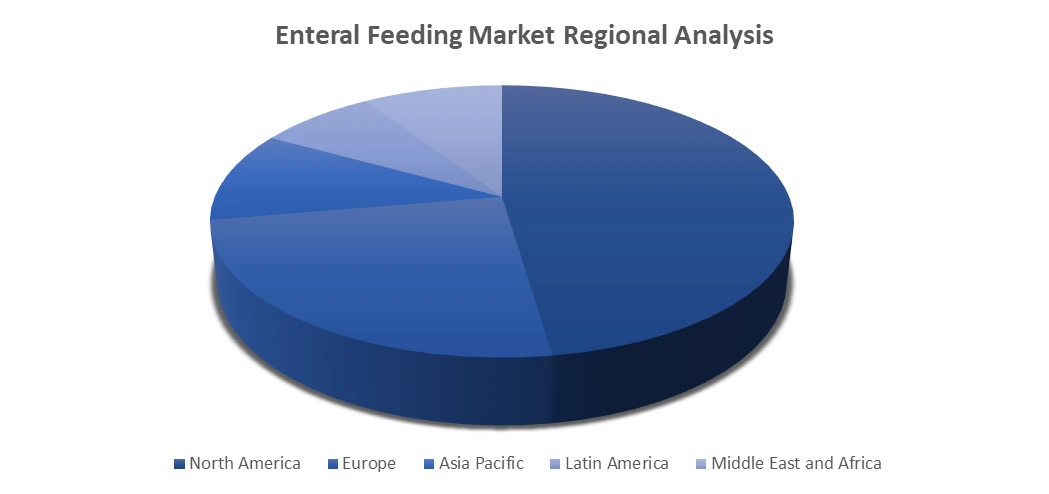
Enteral Feeding Devices Market is segmented based on regional analysis into five major regions: North America, Latin America, Europe, Asia Pacific and the Middle East and Africa. North America maintains a strong influence over the enteral feeding devices market, mainly because of its advanced healthcare system and high rates of chronic illnesses that necessitate enteral nutrition, like cancer and neurological disorders. The area is advantaged by strong healthcare investment, a growing elderly population, and strict regulations that stimulate device advancement and use. The US has a strong home healthcare industry, leading to a higher need for enteral feeding solutions that are portable and easy to use at home.
While North America is in the forefront, Europe and the Asia-Pacific regions also demonstrate significant market activity. The growing elderly population in Europe and healthcare systems drive demand, but strict regulations can hinder the launch of products. Rapid expansion in the Asia-Pacific region is being fuelled by substantial numbers of patients, improvements in healthcare facilities, and increasing knowledge about enteral feeding. On the other hand, Latin America and the Middle East & Africa have lower adoption rates because of economic limitations and limited healthcare infrastructure, despite being emerging markets with growth potential.
Source: Fatpos Global
Impact of Covid-19 on Enteral Feeding Devices Market
The Enteral Feeding Devices Market was significantly impacted by the COVID-19 pandemic since hospitals started focusing on critical patients and started facing supply chain difficulties. The rise in serious COVID-19 cases led to a greater need for enteral feeding in ICUs, as numerous patients needed nutritional assistance throughout prolonged hospitalizations. Nevertheless, disruptions in production and supply chain hindered the accessibility of gadgets. The pandemic accelerated the transition to home care, leading to more patients being released from hospitals early and driving up the need for easy-to-use enteral feeding devices that can be used at home. Although the pandemic presented logistical and regulatory obstacles, it highlighted the significance of enteral feeding devices in critical and long-term care facilities, which could lead to an increase in market growth.
Enteral Feeding Devices Market is further segmented by region into:
- North America Market Size, Share, Trends, Opportunities, Y-o-Y Growth, CAGR – United States and Canada
- Latin America Market Size, Share, Trends, Opportunities, Y-o-Y Growth, CAGR – Mexico, Argentina, Brazil, and Rest of Latin America
- Europe Market Size, Share, Trends, Opportunities, Y-o-Y Growth, CAGR – United Kingdom, France, Germany, Italy, Spain, Belgium, Hungary, Luxembourg, Netherlands, Poland, NORDIC, Russia, Turkey, and Rest of Europe
- Asia Pacific Market Size, Share, Trends, Opportunities, Y-o-Y Growth, CAGR – India, China, South Korea, Japan, Malaysia, Indonesia, New Zealand, Australia, and Rest of APAC
- Middle East and Africa Market Size, Share, Trends, Opportunities, Y-o-Y Growth, CAGR – North Africa, Israel, GCC, South Africa, and Rest of MENA
Enteral Feeding Devices Market Scope and Segments:
|
ATTRIBUTE |
DETAILS |
|
Study Period |
2018-2034 |
|
Base Year |
2023 |
|
Forecast Period |
2024-2034 |
|
Historical Period |
2019-2022 |
|
Growth Rate |
CAGR of 5.5% from 2024-2034 |
|
Unit |
Value (USD Billion) |
|
Segmentation |
Main Segments List |
|
By Product |
|
|
By Age Group |
|
|
By Application |
|
|
By End User |
|
|
By Region |
|
Frequently Asked Questions (FAQ):
Enteral Feeding Devices Market size was valued at USD 4.3 billion in 2023 and is projected to reach the value of USD 7.8 billion in 2034, exhibiting a CAGR of 5.5% during the forecast period.
The Enteral Feeding Devices Market refers to the medical devices and equipment used to deliver nutrients directly into the gastrointestinal tract through a tube, bypassing the mouth. It includes feeding pumps, tubes, syringes, and accessories, catering to patients with swallowing disorders, gastrointestinal issues, or those requiring nutritional support due to illness, injury, or surgery.
The Enteral Feeding Pumps segment and Oncology segment accounted for the largest Enteral Feeding Devices Market share.
Key players in the Enteral Feeding Devices Market include Fresenius Kabi AG, Cardinal Health, Inc., Abbott Laboratories, Boston Scientific Corporation, Moog Inc., Medtronic PLC, OMEX Medical Technology, B. Braun Melsungen AG, Cook Medical, Inc., Avanos Medical, Inc., Amsino International, Inc., Alcor Scientific, Inc., Applied Medical Technology, Inc., Vygon SA, Becton, Dickinson and Company. and Other Prominent Players.
The Enteral Feeding Devices Market is influenced by rising geriatric population, increasing prevalence of chronic diseases, growing demand for home healthcare, advancements in technology, and improving reimbursement policies for enteral nutrition therapy.
 Select License Type


.png)


