


Electrophysiology Catheter Market Research, 2034
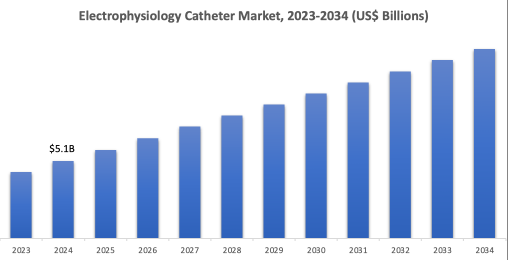
The global electrophysiology catheter market is expected to grow at a CAGR of 8.5% from 2024 to 2034. The market was valued at US$ 4.7 billion in 2023 and is projected to reach US$ 11.5 billion by 2034.
Electrophysiology (EP) catheters are advanced medical tools that are used to identify and manage cardiac arrhythmias by examining the heart's electrical functions. These catheters are intended to chart, gauge, and eliminate abnormal electrical signals in the heart to return it to a normal rhythm. Diagnostic EP catheters are utilized to identify arrhythmias via imaging and electrical mapping, conversely, ablation EP catheters address issues such as atrial fibrillation and ventricular tachycardia by supplying energy (radiofrequency, cryo, or laser) to the impacted tissue.
Commonly utilized in minimally invasive procedures, EP catheters provide accuracy and effectiveness, shortening patient recovery duration. The rising use of these technologies in hospitals, cardiac catheterization labs, and outpatient surgical centers highlights their significance in contemporary cardiac treatment.
Market Highlights:
The global electrophysiology catheter market is projected to achieve a total valuation of US$ 11.5 billion, growing at a CAGR of 8.5% during the forecast period due to the increasing incidence of cardiac arrhythmias, like atrial fibrillation, which significantly drives the need for EP catheters. Growing elderly populations and increasing rates of lifestyle-related issues such as obesity and hypertension have driven this tendency.
Technological developments, such as contact force-sensing and cryoablation catheters, has improved procedural safety and effectiveness, leading to greater adoption. The growing shift toward minimally invasive therapies has also driven market expansion, as EP catheterization provides shorter recovery periods and fewer risks than traditional surgeries. Moreover, the enhancement of healthcare infrastructure in developing nations and increasing investments in cardiac treatment are anticipated to drive growth.
Source: Fatpos Global
Market Segmentation:
Ablation catheters dominate the market for treating atrial fibrillation and ventricular tachycardia
The market is divided by Product Type into Electrophysiology Diagnostic Catheters and Electrophysiology Ablation Catheters. Electrophysiology ablation catheters are predominant because of their essential function in managing cardiac arrhythmias such as atrial fibrillation and ventricular tachycardia. These catheters transmit energy (radiofrequency, cryo, or laser) to eliminate abnormal cardiac tissue, returning the heart to its normal rhythm.
The growing occurrence of arrhythmias, improvements in catheter technologies (such as contact force-sensing), and the rising need for minimally invasive techniques contribute to their prominence. Ablation catheters are very effective and commonly used in therapeutic procedures, which makes them a favoured option for electrophysiologists.
Cardiac arrhythmia treatment dominates due to rising atrial fibrillation cases
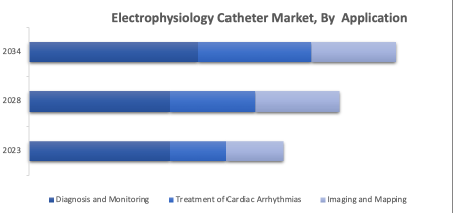
The market is divided by Application into Diagnosis and Monitoring, Treatment of Cardiac Arrhythmias, and Imaging and Mapping. The primary application in the EP Catheter Market is the treatment of cardiac arrhythmias, propelled by the increasing occurrence of atrial fibrillation and various arrhythmias worldwide.
Ablation catheters have emerged as the preferred option for managing these conditions because they effectively alleviate symptoms and enhance patient results. The increasing inclination towards minimally invasive therapies, along with progress in ablation technologies such as cryoablation, has additionally enhanced the demand for this segment.
Source: Fatpos Global
Market Dynamics:
Growth Drivers
Rising Prevalence of Cardiac Arrhythmias to Provide Market Growth Opportunities
The growing incidence of cardiac arrhythmias globally, especially atrial fibrillation, is a major factor propelling the market. Increasing age and lifestyle factors such as obesity, smoking, and high blood pressure heighten the likelihood of arrhythmias. The increasing burden has fueled the demand for EP catheters to identify and manage these conditions. Additionally, significant developments in catheter technologies like cryoablation and contact force sensing have enhanced the safety and effectiveness of procedures. The heightened understanding of arrhythmias and their associated complications, alongside enhancements in healthcare infrastructure, further promotes the use of EP catheters.
Growing Adoption of Minimally Invasive Procedures to Fuel Market Expansion
Minimally invasive electrophysiology methods utilizing catheters have become popular because of their shorter recovery periods, decreased complication rates, and enhanced patient results in comparison to conventional surgeries. The capability to execute accurate ablation using sophisticated instruments such as 3D mapping systems has improved procedural effectiveness, establishing catheter-based procedures as the favored option for managing arrhythmias.
Restraints
Risk of Several Complications May Hinder Growth
Although electrophysiology catheter procedures are effective, they involve risks that hinder their broad adoption. Complications like vascular harm, thromboembolism, and infections may arise during or following methods. These risks are especially worrisome for older patients or individuals with multiple health conditions. Moreover, the intricacy of EP procedures requires advanced skill and knowledge, raising the probability of negative results when handled by those lacking experience. Worries about procedural safety may prevent patients and healthcare professionals from utilizing catheter-based therapies. Tackling these issues via enhanced training, risk management strategies, and technological progress is crucial for the market's ongoing growth.
Recent Developments
- Biosense Webster recently launched the THERMOCOOL SMARTTOUCH SF Catheter, featuring enhanced contact force technology for improved ablation precision. The corporation has also expanded its AI-based cardiac mapping system integration with leading EP labs globally.
- Abbott Laboratories released the TactiFlex Ablation Catheter, which features contact force sensing for the treatment of atrial fibrillation. The company has partnered with leading cardiology centers to advance real-time mapping and navigation systems.
- Boston Scientific Corporation has launched the POLARx Cryoablation Catheter, designed to deliver faster cryoablation procedures. The company has also acquired a startup focused on AI-driven EP diagnostics to enhance its product portfolio.
- Medtronic plc recently introduced the DiamondTemp Ablation Catheter, offering enhanced temperature monitoring for precision ablation.
- Biotron Webster SE & Co. KG has rolled out the Qubic Force Catheter, combining pressure sensing with enhanced diagnostic capabilities.
Key Players:
- Biosense Webster (Johnson & Johnson)
- Abbott Laboratories
- Boston Scientific Corporation
- Medtronic plc
- Biotronik SE & Co. KG
- MicroPort Scientific Corporation
- Acutus Medical, Inc.
- CardioFocus, Inc.
- Stereotaxis, Inc.
- EP Solutions SA
- Baylis Medical Company, Inc.
- Imricor Medical Systems, Inc.
- AngioDynamics, Inc.
- CathRx Ltd.
- Osypka Medical GmbH
- Other Prominent Players (Company Overview, Business Strategy, Key Product Offerings, Financial Performance, Key Performance Indicators, Risk Analysis, Recent Development, Regional Presence, SWOT Analysis)
Regional Analysis
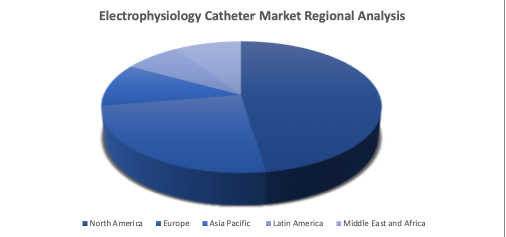
The Global market is divided into five key regions based on regional analysis: North America, Latin America, Europe, Asia Pacific, and the Middle East and Africa. North America dominates the market attributed of its advanced healthcare system, high incidence of cardiac arrhythmias, and considerable funding in medical technologies.
The U.S. significantly benefits from having skilled electrophysiologists and the broad use of minimally invasive heart procedures. Prominent companies such as Abbott Laboratories and Biosense Webster are at the forefront of innovation in this area. Moreover, favorable reimbursement policies and heightened awareness of arrhythmia therapies strengthen market leadership.
Europe trails North America, exhibiting significant adoption rates of advanced EP catheters, especially in nations such as Germany and France.
The Asia-Pacific region is an emerging market, propelled by the growth of healthcare infrastructure in China and India, but it faces a shortage of skilled professionals.
Latin America, the Middle East & Africa show slower growth because of restricted access to advanced medical facilities and financial obstacles. However, governmental efforts are anticipated to enhance adoption rates.
Source: Fatpos Global
Impact of Covid-19 on The Market
The market was initially impacted by the COVID-19 pandemic owing to several delayed elective cardiac procedures and stressed healthcare resources. Hospitals focused on treating COVID-19 patients, postponing electrophysiology procedures such as ablations and diagnostics. Disruptions in the supply chain additionally impacted production and distribution. Nonetheless, the recovery since the pandemic has been strong.
As healthcare systems became stable, there was an increase in postponed procedures, accelerating market growth. The pandemic highlighted the significance of remote monitoring and less invasive treatments, driving advancements in telehealth and AI-driven EP technologies. Government funding aimed at enhancing healthcare infrastructure and tackling gaps in cardiac care has bolstered the market's recovery, setting it up for ongoing growth moving forward.
Market is further segmented by region into:
- North America Market Size, Share, Trends, Opportunities, Y-o-Y Growth, CAGR – United States and Canada
- Latin America Market Size, Share, Trends, Opportunities, Y-o-Y Growth, CAGR – Mexico, Argentina, Brazil, and Rest of Latin America
- Europe Market Size, Share, Trends, Opportunities, Y-o-Y Growth, CAGR – United Kingdom, France, Germany, Italy, Spain, Belgium, Hungary, Luxembourg, Netherlands, Poland, NORDIC, Russia, Turkey, and Rest of Europe
- Asia Pacific Market Size, Share, Trends, Opportunities, Y-o-Y Growth, CAGR – India, China, South Korea, Japan, Malaysia, Indonesia, New Zealand, Australia, and Rest of APAC
- Middle East and Africa Market Size, Share, Trends, Opportunities, Y-o-Y Growth, CAGR – North Africa, Israel, GCC, South Africa, and Rest of MENA
Market Scope and Segments:
|
ATTRIBUTE |
DETAILS |
|
Study Period |
2018-2034 |
|
Base Year |
2023 |
|
Forecast Period |
2024-2034 |
|
Historical Period |
2019-2022 |
|
Growth Rate |
CAGR of 8.5% from 2024-2034 |
|
Unit |
Value (US$ Billion) |
|
Segmentation |
Main Segments List |
|
By Product Type |
|
|
By Application |
|
|
By End Users |
|
|
By Region |
|
Frequently Asked Questions (FAQ):
The global electrophysiology catheter market size was valued at US$ 4.7 billion in 2023 and is projected to reach the value of US$ 11.5 billion in 2034, exhibiting a CAGR of 8.5% during the forecast period.
The market involves medical devices used to diagnose and treat cardiac arrhythmias. EP catheters record electrical activity in the heart, guiding procedures like ablation. The market includes various types of EP catheters and accessories.
The Electrophysiology Ablation Catheters and Treatment of Cardiac Arrhythmias segment accounted for the largest market share.
Key players in the global electrophysiology catheter market include Biosense Webster (Johnson & Johnson), Abbott Laboratories, Boston Scientific Corporation, Medtronic plc, Biotronik SE & Co. KG, MicroPort Scientific Corporation, Acutus Medical, Inc., CardioFocus, Inc., Stereotaxis, Inc., EP Solutions SA, Baylis Medical Company, Inc., Imricor Medical Systems, Inc., AngioDynamics, Inc., CathRx Ltd., Osypka Medical GmbH—and Other Prominent Players.
The market is fueled by the growing incidence of cardiac arrhythmias, a higher demand for minimally invasive techniques, and innovations in catheter technology.
 Select License Type


.png)


