


Electronic Waste Recycling Market Research,2034
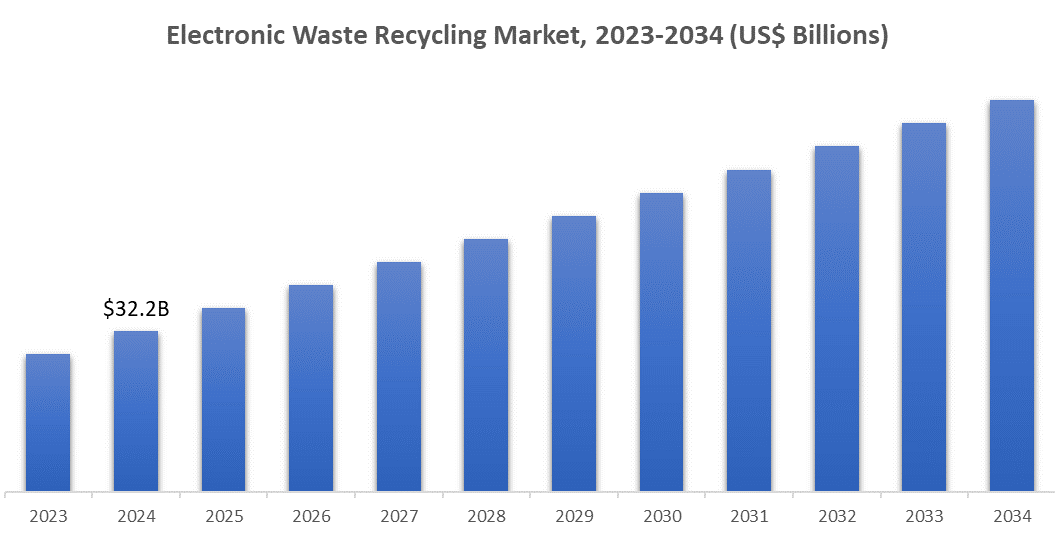
The global electronic waste recycling market is expected to grow at a CAGR of 16% during the forecast period from 2024 to 2034. The market size was valued at US$ 27.8 billion in 2023 and is projected to reach US$ 142.6 billion by 2034.
Recycling electronic waste involves extracting valuable materials from discarded electronic devices to reduce environmental pollution and preserve resources. This includes breaking down, shredding, sorting, and dealing with substances like metals, plastics, and glass from electronic waste such as cell phones, televisions, computers, and home gadgets.
Advanced methods such as electrostatic separation and hydrometallurgical processes are employed for the extraction of valuable metals and rare earth elements. Effective recycling reduces the requirement for extracting raw materials, minimizes the accumulation of waste in landfills, and protects ecosystems from the harmful effects of toxic substances such as mercury and lead. Due to the fast-paced technological developments and rising e-waste production, recycling has turned into a crucial element of sustainable waste management practices globally.
Market Highlights:
The market is growing due to the sudden rise in electronic waste volume resulting from shorter product lifecycles and seamless technological progress. Increasing consumer knowledge regarding environmental sustainability and embracing circular economy principles continues to propel demand. Governments are enforcing strict rules like EPR and recycling mandates to push industries towards sustainable practices.
Moreover, the increasing worth of reclaimed substances such as gold, palladium, and rare earth metals has resulted in recycling becoming financially appealing. Future expansion will be driven by the utilization of innovative recycling technologies and increased funding for electronic waste management infrastructure, particularly in developing countries.
Market Segmentation:
Metals and Chemicals are expected to dominate the market, driven by the high economic value of precious and rare earth metals
The market is bifurcated based on Materials into Metals and Chemicals, Plastic and Glass. Metals and Chemicals lead the market owing to the significant economic worth of valuable and scarce metals such as gold, silver, palladium, and platinum, along with common metals like copper and aluminium.
The recovery of these materials is crucial in manufacturing new electronic devices and industrial applications. Metals also provide considerable environmental advantages by decreasing the need for energy-intensive and environmentally harmful mining activities. Furthermore, improved recycling methods such as hydrometallurgical and pyrometallurgical techniques help maximize the recovery of valuable resources.
The IT and Telecom sector is expected to drive market growth, driven by the increasing adoption of computers, servers, smartphones, and telecom infrastructure
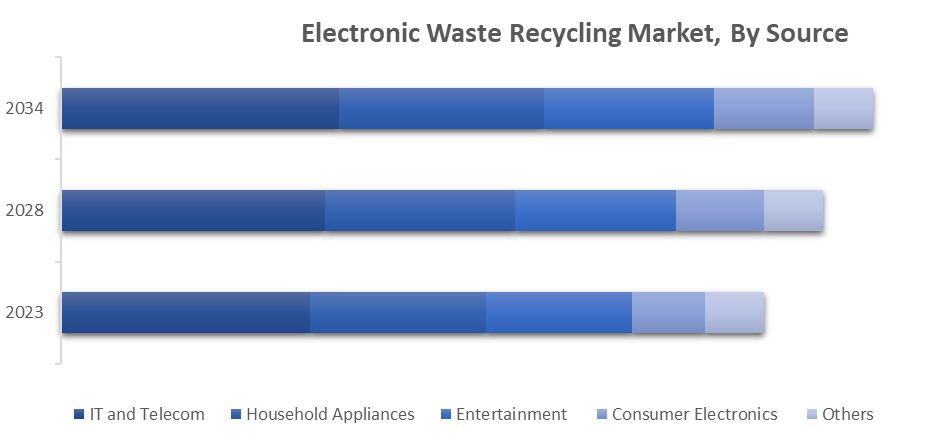
The market is bifurcated based on the Source into Household Appliances, Entertainment and Consumer Electronics, IT and Telecom, Medical Equipment, and Others. The market is primarily dominated by the IT and telecom sector owing to the high volume of computer, server, smartphone, and telecom infrastructure sales. This sector is a top priority for recyclers due to its production of valuable rare earth elements, precious metals, and plastics.
The increasing need for advanced technology in business and consumer environments also enhances the growth of this sector. Moreover, IT companies are being encouraged to responsibly recycle and reuse their end-of-life equipment through regulatory policies such as Extended Producer Responsibility (EPR) and corporate sustainability programs.
Market Dynamics:
Growth Drivers
Rising Volume of E-Waste to Propel Demand for Electronic Waste Recycling
Rapid technological advancements, shorter product lifecycles, and a rising consumer appetite for electronic gadgets are all contributing to the growing amount of e-waste. Electronic devices such as smartphones, laptops, and TVs are often upgraded, resulting in a substantial amount of e-waste accumulation. Moreover, the rising use of Internet of Things (IoT) devices and smart technologies is also adding to the expanding e-waste problem.
Governments and businesses are acknowledging the environmental dangers linked to inadequate disposal and are enforcing more stringent rules and recycling requirements. With increasing awareness of these problems, there is anticipated to be a rise in the need for efficient e-waste recycling options.
Valuable Material Recovery to Create Opportunities for Market Growth
Recycling electronic waste allows for the recovery of important resources like precious metals and rare earth elements which are required for creating new electronic products. Businesses can lessen reliance on mining, a process that is expensive for the environment and financially, by reusing materials such as gold, silver, and palladium.
The increasing need for these materials in sectors such as electronics, renewable energy, and automotive (particularly for electric cars) has emphasized the significance of effective recycling methods. Recycling is also in line with worldwide initiatives to encourage sustainability and decrease environmental harm, which consequently propels market expansion.
Restraints
Inadequate Infrastructure in Developing Regions May Hinder Growth
Insufficient recycling infrastructure in emerging regions significantly hinders the growth of the electronic waste recycling industry. These regions frequently depend on informal recycling methods, which include manual disassembly and open-air incineration, causing inefficiencies and serious environmental risks. A shortage of funding, inadequate government policies, and lack of public awareness deteriorate the issue even more.
Informal recycling results in both resource depletion and health hazards for workers exposed to hazardous materials such as lead and mercury. Developed nations are putting money into high-tech recycling methods, but developing areas are having a hard time setting up the required facilities for collecting, sorting, and processing, causing a significant disparity in global recycling endeavors.
Recent Developments
- In 2024, Sims Limited, a global metal recycling leader, was ranked as the most sustainable corporation in Corporate Knights' Global 100 index. Recently, the company acquired Northeast Metal Traders, a Pennsylvania-based firm, expanding its presence in the market.
- In 2024, Aurubis AG and Talga Group Ltd, an Australian battery materials and technology company, signed a development agreement to create a recycled graphite anode product from lithium-ion batteries. Aurubis AG has also inaugurated a cutting-edge ASPA recycling plant in Belgium.
- Umicore has invested in expanding its battery recycling operations to process electric vehicle batteries. The company has partnered with Samsung SDI to recycle rare earth elements from electronic waste, further enhancing its recycling capabilities.
- Boliden Group has introduced innovative smelting technology to improve metal recovery from e-waste. The company has also acquired a regional recycling facility in Norway, expanding its market presence and strengthening its position in the industry.
- MBA Polymers Inc. has announced significant advancements in plastic recycling technology, enhancing efficiency and productivity. The company has collaborated with European automakers to recycle plastics from end-of-life vehicles, promoting sustainable practices in the industry.
Key Players:
- Sims Limited
- Aurubis AG
- Umicore N.V.
- Boliden Group
- MBA Polymers Inc.
- Electronic Recyclers International, Inc. (ERI)
- Enviro-Hub Holdings Ltd.
- Stena Metall Group
- Global Electric Electronic Processing (GEEP)
- Metech Recycling, Inc.
- Tetronics International
- Veolia Environmental Services
- Kuusakoski Recycling
- Attero Recycling
- Tetronics International Limited
- Other Prominent Players (Company Overview, Business Strategy, Key Product Offerings, Financial Performance, Key Performance Indicators, Risk Analysis, Recent Development, Regional Presence, SWOT Analysis)
Regional Analysis
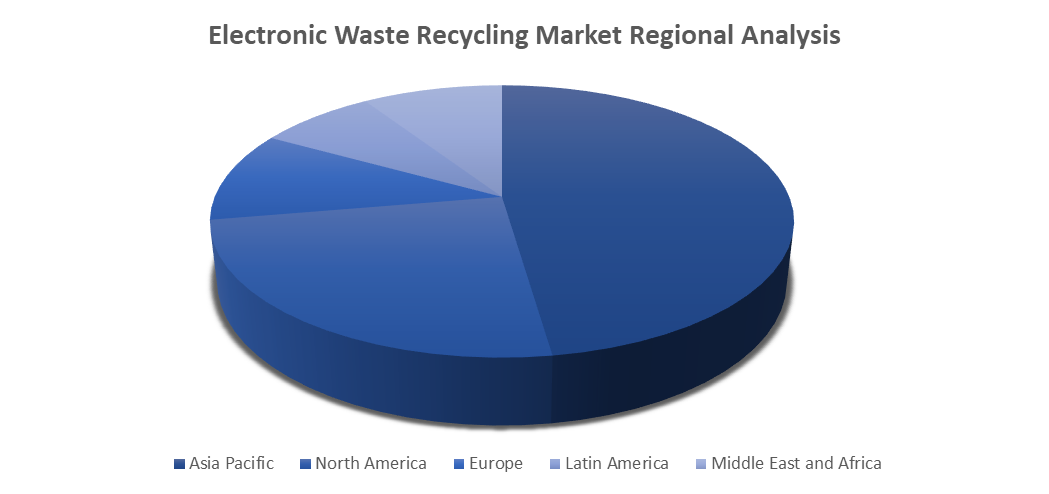
The global electronic waste recycling market is segmented based on regional analysis into five major regions: North America, Latin America, Europe, Asia Pacific, and the Middle East and Africa.
The Asia-Pacific region stands at the forefront of the electronic waste recycling industry, mainly due to the significant amount of e-waste generated there, influenced by the fast-paced adoption of electronics in nations such as China, India, and Japan. The region benefits from its well-established recycling facilities in advanced countries such as Japan and South Korea, as well as increasing government efforts in developing nations. China, being the top e-waste producer, has put in place strict regulations like the Circular Economy Promotion Law to oversee and enhance recycling efforts.
North America and Europe come after Asia-Pacific, taking advantage of established recycling systems, stringent laws, and vigilant consumers. The recycling of waste electrical and electronic equipment in Europe is greatly influenced by the Waste Electrical and Electronic Equipment (WEEE) Directive, which significantly drives recycling.
Limited infrastructure and informal recycling practices hold back Latin America, the Middle East, and Africa. Yet, increasing recognition and financial commitments in these areas indicate possibilities for future expansion.
Impact of Covid-19 on the Market
The market was significantly impacted by the COVID-19 market in multiple ways. Initially, collection and processing activities were significantly decreased due to supply chain disruptions, reduced recycling operations, and lockdown measures. Informal recycling has become more prevalent in developing regions owing to the limited availability of formal recycling facilities.
The increase in remote work and e-learning stimulated a higher demand for electronic devices, resulting in increased e-waste production in the future. Since the pandemic, governments and corporations have started improving recycling systems and implementing digital solutions for improved management. The pandemic highlighted the significance of waste management systems that are resilient and sustainable, leading to increased investment in the industry.
Market is further segmented by region into:
- North America Market Size, Share, Trends, Opportunities, Y-o-Y Growth, CAGR – United States and Canada
- Latin America Market Size, Share, Trends, Opportunities, Y-o-Y Growth, CAGR – Mexico, Argentina, Brazil, and Rest of Latin America
- Europe Market Size, Share, Trends, Opportunities, Y-o-Y Growth, CAGR – United Kingdom, France, Germany, Italy, Spain, Belgium, Hungary, Luxembourg, Netherlands, Poland, NORDIC, Russia, Turkey, and Rest of Europe
- Asia Pacific Market Size, Share, Trends, Opportunities, Y-o-Y Growth, CAGR – India, China, South Korea, Japan, Malaysia, Indonesia, New Zealand, Australia, and Rest of APAC
- Middle East and Africa Market Size, Share, Trends, Opportunities, Y-o-Y Growth, CAGR – North Africa, Israel, GCC, South Africa, and Rest of MENA
Market Scope and Segments:
|
ATTRIBUTE |
DETAILS |
|
Study Period |
2018-2034 |
|
Base Year |
2023 |
|
Forecast Period |
2024-2034 |
|
Historical Period |
2019-2022 |
|
Growth Rate |
CAGR of 16% from 2024-2034 |
|
Unit |
Value (US$ Billion) |
|
Segmentation |
Main Segments List |
|
By Material |
|
|
By Source |
|
|
By Recycling Process |
|
|
By Technology |
|
|
By Region |
|
Frequently Asked Questions (FAQ):
The global electronic waste recycling market size was valued at US$ 27.8 billion in 2023 and is projected to reach US$ 142.6 billion in 2034, exhibiting a CAGR of 16% during the forecast period.
Industrial controllers are systems and devices that oversee and regulate machinery and processes in industries. They automate, monitor, and optimize production lines, ensuring safety, efficiency, and quality in sectors like manufacturing and energy. These controllers blend hardware and software to boost productivity and maintain industry standards.
The Metals and Chemicals and IT & Telecom segment accounted for the largest market share.
Key players in the global electronic waste recycling market include Sims Limited, Aurubis AG, Umicore N.V., Boliden Group, MBA Polymers Inc., Electronic Recyclers International, Inc. (ERI), Enviro-Hub Holdings Ltd., Stena Metall Group, Global Electric Electronic Processing (GEEP), Metech Recycling, Inc., Tetronics International, Veolia Environmental Services, Kuusakoski Recycling, Attero Recycling, Tetronics International Limited and Other Prominent Players.
The market is driven by factors such as stringent government regulations, increasing electronic waste generation, growing demand for recycled materials, and rising awareness about environmental sustainability.
 Select License Type


.png)


