


Circulating tumor cells market research, 2034
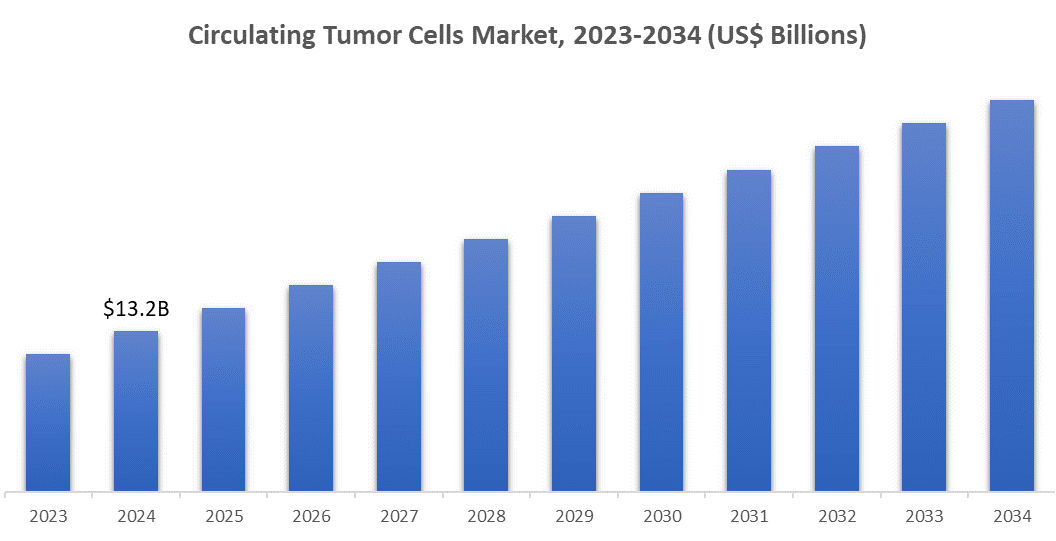
The global circulating tumor cells market is expected to grow at a CAGR of 12.1% from 2024 to 2034, with a market size valued at US$ 11.8 billion in 2023 and projected to reach US$ 41.5 billion by 2034.
Circulating Tumor Cells (CTCs) are cancerous cells that separate from a primary tumor and move through the bloodstream. They act as indicators for cancer, offering important information regarding cancer development, spread, and patient outlook. CTCs play a crucial role in liquid biopsy, which is a non-invasive diagnostic method that identifies cancer via blood samples, providing an option to conventional biopsies.
Examining CTCs can reveal genetic and molecular characteristics of cancer, assisting in selecting treatments and tracking therapy effectiveness in real-time. Developments in detection and isolation methods, including microfluidics, immunomagnetic separation, and polymerase chain reaction (PCR), have improved the overall accuracy of CTC testing, promoting its applications in personalized medicine and advancing cancer treatment.
Market Highlights:
The market is primarily influenced by the growing numbers of cancer patients worldwide, as timely detection and monitoring play a vital role in effective cancer management. CTC analysis provides a non-invasive and dependable approach to identify and monitor cancer development, addressing the increasing need for liquid biopsies. Advancements in CTC detection techniques, such as microfluidics and next-generation sequencing, have improved test precision and efficiency, leading to greater adoption among hospitals, research facilities, and pharmaceutical firms.
Moreover, the focus on personalized medicine has increased the attention on CTCs, as they provide real-time information about a patient’s cancer, facilitating customized treatment strategies and enhancing future market expansion as precision oncology advances.
Market Segmentation:
CTC detection and enrichment methods are at the forefront of cancer research, enabling the isolation of rare CTCs from blood
The market is segmented based on the Technology into CTC Detection and Enrichment Methods, CTC Direct Detection Methods, and CTC Analysis. CTC detection and enrichment techniques lead the market, constituting over 60% of the revenue. Techniques like immunocapture, size-based separation, and density-based separation are essential for extracting rare CTCs from the blood for subsequent examination.
Their extensive application is due to their exceptional sensitivity and capacity to improve the purity, crucial for precise downstream analysis in diagnostics and research. Innovations in microfluidics and nanotechnology have improved these techniques, enabling more accurate separation and increased yield of viable CTCs, which is crucial for clinical applications and cancer research.
Clinical/Liquid biopsy is poised to dominate the market, driven by increasing demand for non-invasive diagnostics
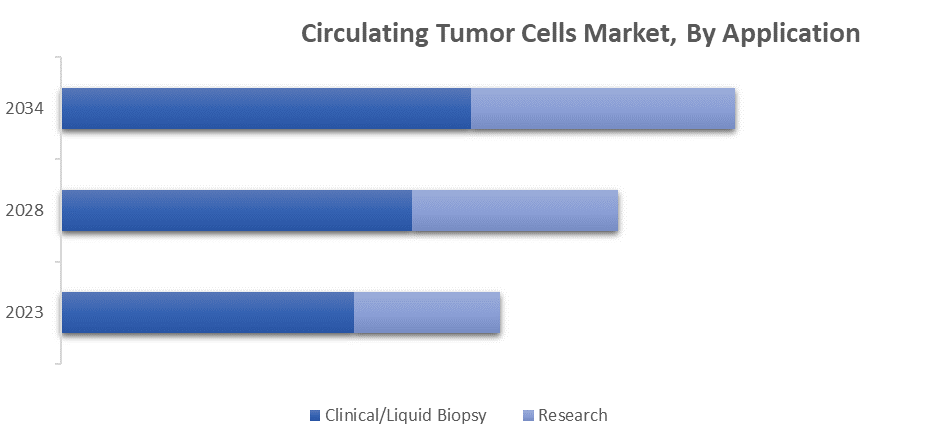
The market is bifurcated based on the Application of Clinical/Liquid Biopsy, and Research. Clinical or liquid biopsy applications lead the CTC market, mainly due to the increasing demand for non-invasive diagnostic methods. Liquid biopsy facilitates the real-time observation of cancer advancement, assisting doctors in their decision-making processes and assessing treatment responses without requiring invasive tissue biopsies.
Since liquid biopsy can identify cancer biomarkers in blood, it is particularly useful for recognizing metastatic risks and modifying treatment strategies. Moreover, progress in personalized medicine has heightened interest in CTC-based liquid biopsy, which aids in delivering customized treatments by evaluating the molecular profile of cancer. This ease of use and accuracy position clinical applications as the top segment in the CTC market.
Market Dynamics:
Growth Drivers
Rising Cancer Prevalence Fuels the Demand for Cutting-edge Solutions, including Circulating Tumor Cells (CTCs)
The 21st century has experienced a notable increase in cancer occurrences globally, becoming a primary issue in the healthcare sector. This has greatly increased the need for advanced diagnostics such as CTCs. These cells offer important insights into cancer development, particularly in identifying metastasis.
CTC-based tests provide a non-invasive way to detect and monitor cancer, enabling doctors to evaluate and modify treatments on the spot. Initial intervention through CTC analysis has demonstrated the potential to enhance patient results by halting disease progression, leading to an increased demand for CTC technologies in clinical and research environments.
Growing Demand for Non-Invasive Diagnostics to Fuel Market Growth
There has been a growing demand for non-invasive diagnostics which has led patients and healthcare providers to actively look for safer, less invasive options compared to traditional biopsies. CTC-driven liquid biopsies address this requirement, providing a safer and more convenient approach to cancer surveillance.
This less invasive method is especially advantageous for elderly or critically unwell patients and facilitates continuous observation, improving treatment effectiveness. As precision medicine advances, there is anticipated increased demand for CTC diagnostics in both healthcare and research fields.
Restraints
Technical and Clinical Limitations May Hinder Market Expansion
Even with current technological developments, CTC analysis encounters restrictions that hinder its wider implementation in the medical field. Concerns such as inadequate sensitivity for specific cancers, challenges in isolating rare cells, and the absence of standardized protocols impact reliability. These concerns introduce inconsistency in outcomes, affecting clinical decision-making.
Moreover, certain tumor types show minimal CTC presence, restricting the efficacy of CTC-based diagnostic processes. Although studies seek to tackle these technical obstacles, including improved enrichment techniques, these issues presently limit the growth of the CTC market, particularly in various clinical applications.
Recent Developments
- Menarini Silicon Biosystems has launched an upgraded version of its CELLSEARCH system, enhancing accuracy and sensitivity in circulating tumor cell (CTC) detection. The company has also expanded its partnership with a leading cancer research institute to develop customized CTC assays for clinical research in advanced cancers.
- QIAGEN N.V. has introduced a CTC enrichment kit compatible with automated workflows, increasing throughput for clinical laboratories. Additionally, the company has acquired a diagnostic company specializing in CTC liquid biopsy technology to broaden its oncology portfolio.
- Bio-Techne Corporation has released a novel CTC detection reagent designed for high sensitivity in metastatic cancer studies. The company has also established a joint venture with a biotechnology firm to advance molecular profiling tools for CTCs, focusing on targeted cancer therapies.
- ApoCell, Inc. has launched a new CTC enumeration platform catering to clinical trials and academic research needs. Furthermore, the company has partnered with a major pharmaceutical company to provide CTC-based analytical services for drug development in oncology.
- Hoffmann-La Roche Ltd. has introduced a liquid biopsy assay that integrates CTC detection with genetic analysis, providing a comprehensive view of cancer progression. The company has also collaborated with academic centers to explore CTCs in immuno-oncology, focusing on immune response biomarkers.
Key Players:
- Illumina, Inc.
- QIAGEN N.V.
- Bio-Techne Corporation
- Menarini Silicon Biosystems
- Hoffmann-La Roche Ltd.
- ApoCell, Inc.
- Epic Sciences
- Biocept, Inc.
- Ikonisys Inc.
- Cynvenio Biosystems, Inc.
- Fluxion Biosciences, Inc.
- AVIVA Biosciences
- Advanced Cell Diagnostics, Inc.
- Greiner Bio-One International GmbH
- Sysmex Corporation
- Other Prominent Players (Company Overview, Business Strategy, Key Product Offerings, Financial Performance, Key Performance Indicators, Risk Analysis, Recent Development, Regional Presence, SWOT Analysis)
Regional Analysis
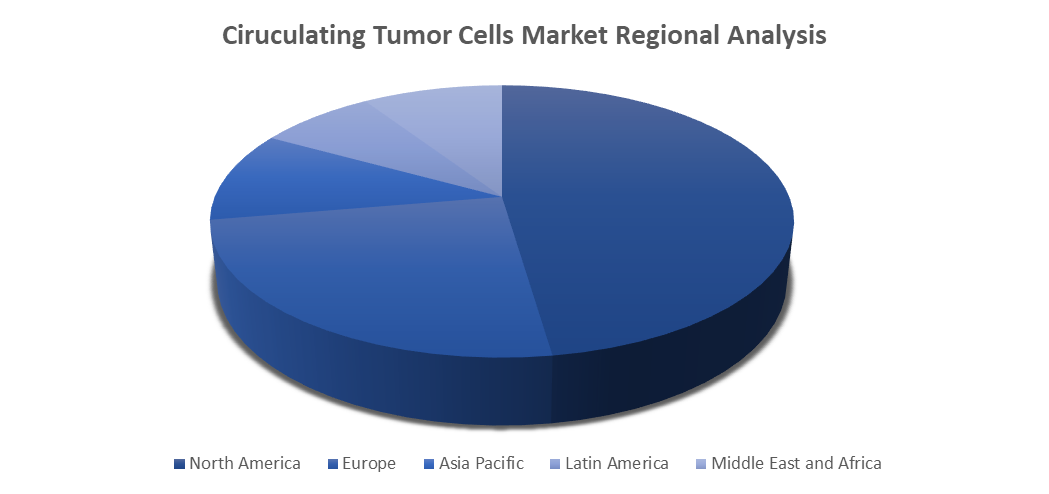
The global circulating tumor cells market is segmented based on regional analysis into five major regions: North America, Latin America, Europe, Asia Pacific, and the Middle East and Africa.
North America leads the CTC market owing to the substantial investment done in cancer research, advanced healthcare infrastructure, and the significant occurrence of cancer.
The U.S. has been focusing on precision oncology strongly, backed by substantial financial support for research organizations and biotech firms to create cutting-edge cancer diagnostic tools. Regulatory bodies such as the FDA are progressively acknowledging liquid biopsy and CTC-based tests, which is boosting market expansion. Furthermore, the existence of prominent companies and robust partnerships between academic institutions and industry drive North America as a crucial area for CTC market growth.
Europe represents a major portion of the market, with growing research initiatives and beneficial healthcare regulations promoting CTC testing.
In the Asia-Pacific region, increasing cancer prevalence, improvements in healthcare, and heightened awareness are driving market expansion, particularly in nations such as China and Japan.
While Latin America, the Middle East, and Africa have contributed to smaller market shares due to inadequate infrastructure and elevated expenses, they offer promise as developing markets. Enhanced healthcare systems, along with government programs, are anticipated to drive CTC market expansion in these areas in the upcoming years.
Market is further segmented by region into:
- North America Market Size, Share, Trends, Opportunities, Y-o-Y Growth, CAGR – United States and Canada
- Latin America Market Size, Share, Trends, Opportunities, Y-o-Y Growth, CAGR – Mexico, Argentina, Brazil, and Rest of Latin America
- Europe Market Size, Share, Trends, Opportunities, Y-o-Y Growth, CAGR – United Kingdom, France, Germany, Italy, Spain, Belgium, Hungary, Luxembourg, Netherlands, Poland, NORDIC, Russia, Turkey, and Rest of Europe
- Asia Pacific Market Size, Share, Trends, Opportunities, Y-o-Y Growth, CAGR – India, China, South Korea, Japan, Malaysia, Indonesia, New Zealand, Australia, and Rest of APAC
- Middle East and Africa Market Size, Share, Trends, Opportunities, Y-o-Y Growth, CAGR – North Africa, Israel, GCC, South Africa, and Rest of MENA
Market Scope and Segments:
|
ATTRIBUTE |
DETAILS |
|
Study Period |
2018-2034 |
|
Base Year |
2023 |
|
Forecast Period |
2024-2034 |
|
Historical Period |
2019-2022 |
|
Growth Rate |
CAGR of 12.1% from 2024-2034 |
|
Unit |
Value (US$ Billion) |
|
Segmentation |
Main Segments List |
|
By Technology |
|
|
By Specimen |
|
|
By Product |
|
|
By Application |
|
|
By End User |
|
|
By Region |
|
Frequently Asked Questions (FAQ):
The global circulating tumor cells market size was valued at US$ 11.8 billion in 2023 and is projected to reach the value of US$ 41.5 billion in 2034, exhibiting a CAGR of 12.1% during the forecast period.
The market includes advanced solutions for the isolation, detection, and analysis of circulating tumor cells in blood, enabling liquid biopsy, cancer research, and targeted therapies, revolutionizing oncology diagnosis and treatment.
The CTC Detection and Enrichment Methods and Clinical/Liquid Biopsy segment accounted for the largest market share.
Key players in the global circulating tumor cells market include Illumina, Inc., QIAGEN N.V., Bio-Techne Corporation, Menarini Silicon Biosystems, F. Hoffmann-La Roche Ltd., ApoCell, Inc., Epic Sciences, Biocept, Inc., Ikonisys Inc., Cynvenio Biosystems, Inc., Fluxion Biosciences, Inc., AVIVA Biosciences, Advanced Cell Diagnostics, Inc., Greiner Bio-One International GmbH, Sysmex Corporation. and Other Prominent Players.
Key drivers of the market include rising cancer incidence, technological advancements, growing demand for precision medicine, and increasing adoption of liquid biopsy.
 Select License Type


.png)


