


_(4).jpg)
Biosimulation Market Size
Biosimulation Market Research - 2034
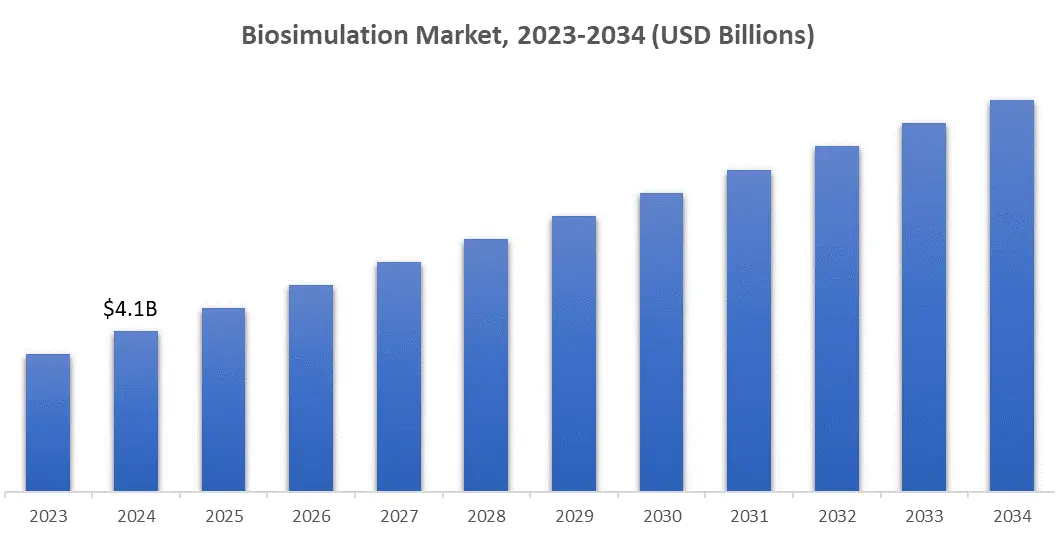
The Biosimulation market is expected to grow at a CAGR of 19.7% from 2024 to 2034, starting with a market size of USD 3.4 billion in 2023 and projected to reach USD 24.1 billion by 2034.
The term biosimulation describes the applications of computer models to emulate biological processes, allowing scientists to forecast the actions of medications, illnesses, and physiological systems in simulated settings. It combines mathematical modeling with pharmacokinetics (PK) and pharmacodynamics (PD) to simplify the overall drug discovery and development procedures. Biosimulation tools help to evaluate drug effectiveness, optimize doses, and forecast possible side effects without heavy reliance on animal or human testing. The uses of applications vary from drug discovery and disease modeling to personalized medicine. Advanced biosimulation platforms utilize AI and machine learning to improve predictive accuracy, playing a vital role in accelerating pharmaceutical R&D and cutting down on expenses. As model-based data gains adoption by regulatory bodies, biosimulation is becoming more necessary in modern healthcare and pharmaceutical research.
Market Highlights:
Biosimulation Market is expected to exhibit a CAGR of 19.7% during the forecast period, 2024-2034
The Biosimulation Market is expected to reach USD 24.1 billion, with a 19.7% CAGR, influenced by the rising complexity of drug development and demand for cost-effective solutions. Biosimulation reduces the necessity for costly and lengthy physical experiments, providing a quicker understanding of drug effectiveness and safety. The rising incidence of long-term illnesses and the demand for individualized medication encourage use, as biosimulation allows for customized drug treatments. The improved scalability and accuracy of biosimulation models, through technologies such as AI and cloud-based platforms, improve their accessibility to a broader audience. Regulatory agencies such as the FDA endorsing biosimulation data contribute to market expansion while developing economies are embracing these tools as healthcare systems advance.
Biosimulation Market by Segmentation:
Software is anticipated to dominate the market, fueled by its capacity to facilitate advanced simulations of biological phenomena
The Biosimulation Market is segmented based on the Product into Software, and Services. Software often dominates the market because of its crucial function in facilitating complicated simulations of biological phenomena. PK/PD modeling, PBPK modeling, and molecular simulations are essential tools in the process of discovering and developing drugs. Software platforms offer versatility, enabling researchers to experiment with different situations, lessen dependence on actual experiments, and accelerate R&D schedules. Advanced functionalities like AI incorporation and cloud deployment improve accessibility and scalability. Continuous updates and the option to customize for particular uses such as disease modeling and toxicology evaluations also enhance this superiority.
Biosimulation Market by Apllication:
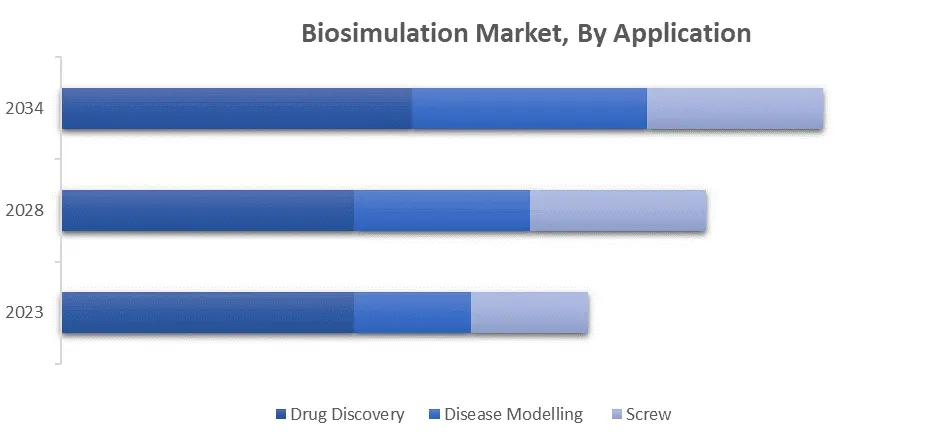
Drug discovery leads the market, owing to its widespread adoption by pharmaceutical companies seeking to minimize costs and enhance outcomes
The Biosimulation Market is bifurcated based on the Application into Drug Discovery, Disease Modelling, and Others. Drug discovery is the primary focus in the market for pharmaceutical companies looking to cut costs and enhance the success rates of initial research stages. Biosimulation speeds up lead identification, target validation, and optimization, allowing for effectual allocation of resources. By simulating therapeutic effects and modeling drug interactions, it lessens the requirement for expensive physical trials. AI-boosted biosimulation tools improve forecasts, facilitating quicker decisions during preclinical testing. This emphasis is in line with the increasing funding for new treatments, especially in the fields of cancer and uncommon medical conditions.
Market Dynamics:
Growth Drivers
Increasing Demand for Predictive Modeling in Drug Development to Propel Market Growth
Predictive modeling is changing the way drug discovery and development are conducted, allowing researchers to replicate drug interactions in virtual settings, ultimately leading to time and cost savings. Biosimulation effectively forecasts pharmacokinetics (PK) and pharmacodynamics (PD), decreasing reliance on animal experimentation and clinical trials. This is especially important for recognizing possible safety issues and fine-tuning doses before clinical trials. The increasing complexity of drug development, notably due to biologics and personalized medicine, has led to widespread adoption of biosimulation among pharmaceutical and biotech companies, as it can streamline R&D processes and enhance success rates.
Technological Advancements in Biosimulation Software to Fuel Market Expansion
Improvements in biosimulation software, including AI, machine learning, and cloud-based options, have greatly improved its precision and availability. AI algorithms increase the accuracy of predictions, as machine learning allows for ongoing improvement of models using data from the real world. Cloud computing enables researchers to utilize advanced biosimulation tools without the need for expensive hardware, promoting cooperation among teams and locations. These advancements have made biosimulation an essential tool for tackling complex biological challenges, leading to its use in various applications such as drug development, disease modeling, and regulatory compliance.
Restraints
Data Validation and Integration Issues May Hinder Market Growth
High-quality data is essential for accurate predictions in biosimulation models. Yet, unreliable, insufficient, or incorrect datasets may hinder the trustworthiness of simulations, resulting in possible mistakes in drug development or treatment planning. Challenges in integration also occur when data from various sources such as clinical trials, lab studies, and patient records into one model. These problems may hinder the acceptance, especially in companies lacking data management knowledge. Dealing with these obstacles necessitates strong validation procedures for data, standards for interoperability, and funding for specialized training, all of which can be costly, particularly for smaller businesses or developing economies.
Recent Developments
- Cetara, Inc. launched the Simcyp Simulator, integrating AI to enhance PK/PD modeling capabilities. The company has partnered with regulatory authorities to develop biosimulation models for rare diseases.
- Simulation Plus, Inc. has released ADMET Predictor 11, focusing on AI-enhanced drug property predictions. The company has acquired a niche biosimulation software company to expand its oncology-focused portfolio.
- Schrödinger, Inc. has recently introduced its LiveDesign Platform 2024, enabling collaborative drug discovery with real-time biosimulation. The company has formed a strategic partnership with a pharmaceutical giant to co-develop AI-driven biosimulation tools.
- Dassault Systèmes has improved its BIOVIA platform with cloud-based capabilities for multi-scale modeling. The company has collaborated with academic institutions to advance biosimulation in precision medicine.
- Advanced Chemistry Development (ACD/Labs) has launched Percepta 2024, a predictive analytics tool for chemical toxicity assessment. The company has also partnered with CROs to integrate biosimulation into early-phase drug testing.
Biosimulation Market: Key Players:
- Certara, Inc.
- Simulation Plus, Inc.
- Schrödinger, Inc.
- Dassault Systèmes
- Advanced Chemistry Development (ACD/Labs)
- Rosa & Co. LLC
- Chemical Computing Group ULC
- Genedata AG
- Insilico Biotechnology AG
- Evidera, Inc.
- Leadscope, Inc.
- BioSimulation Consulting Inc.
- Nuventra Pharma Sciences
- CertusBio
- Physiomics PLC
- Other Prominent Players (Company Overview, Business Strategy, Key Product Offerings, Financial Performance, Key Performance Indicators, Risk Analysis, Recent Development, Regional Presence, SWOT Analysis)
Regional Analysis
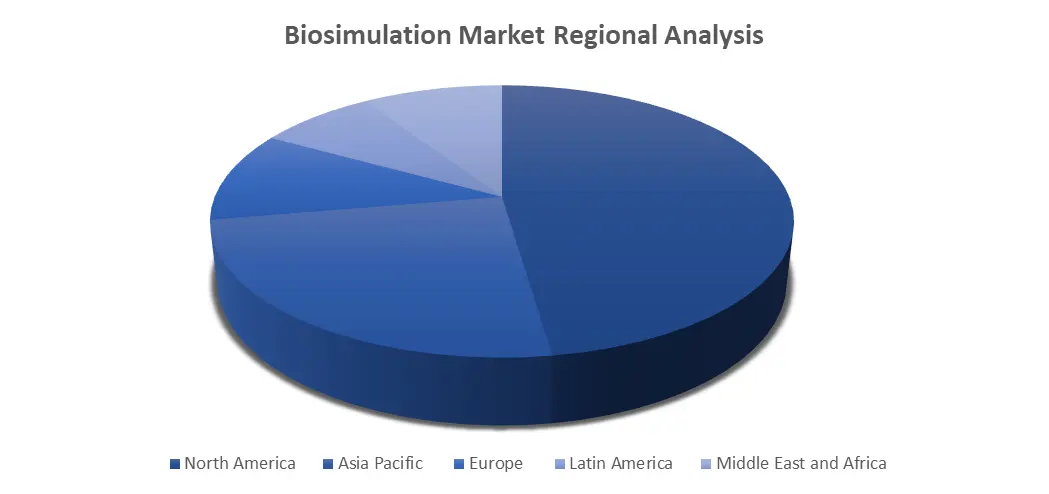
The Biosimulation Market is segmented based on regional analysis into five major regions: North America, Latin America, Europe, Asia Pacific, Middle East, and Africa. North America stands at the forefront of the market attributed of its strong pharmaceutical and biotechnology industries, significant investments in research and development, and early implementation of cutting-edge technologies. Key players such as Certara, Simulation Plus, and Schrödinger have significantly contributed to the development of a strong supply chain and innovation ecosystem. Positive regulatory climates, like the FDA's approval of biosimulation data, also promote acceptance. Moreover, the region's control is further strengthened by the increasing popularity of personalized medicine and the high number of chronic diseases.
The Asia-Pacific region on the other end is experiencing fast growth due to higher healthcare expenditures, growing pharmaceutical sectors, and increasing recognition of the advantages of biosimulation. Europe is closely narrowing the gap with constant research with robust government backing. Limited infrastructure and expertise are causing Latin America and the Middle East & Africa to experience slower growth, but adoption is slowly getting better in these regions.
Source: Fatpos Global
Impact of Covid-19 on Biosimulation Market
The emergence of COVID-19 led to a rapid increase in the use of biosimulation tools by pharmaceutical companies and researchers who were looking for quicker and more affordable ways to develop vaccines and drugs. During lockdowns, biosimulation was commonly utilized for modeling the effectiveness and safety of possible treatments for COVID-19, minimizing the demand for physical trials. The pandemic has highlighted the significance of virtual tools for maintaining research consistency and has hastened investments in cloud-based biosimulation platforms. Yet, progress in non-COVID-related biosimulation projects was temporarily hindered by interruptions in the supply chain and the shift of R&D funds towards COVID-19 initiatives. After the pandemic, the market has surged back, with a greater understanding of biosimulation's importance in quickly addressing future health emergencies.
Biosimulation Market is further segmented by region into:
- North America Market Size, Share, Trends, Opportunities, Y-o-Y Growth, CAGR – United States and Canada
- Latin America Market Size, Share, Trends, Opportunities, Y-o-Y Growth, CAGR – Mexico, Argentina, Brazil, and Rest of Latin America
- Europe Market Size, Share, Trends, Opportunities, Y-o-Y Growth, CAGR – United Kingdom, France, Germany, Italy, Spain, Belgium, Hungary, Luxembourg, Netherlands, Poland, NORDIC, Russia, Turkey, and Rest of Europe
- Asia Pacific Market Size, Share, Trends, Opportunities, Y-o-Y Growth, CAGR – India, China, South Korea, Japan, Malaysia, Indonesia, New Zealand, Australia, and Rest of APAC
- Middle East and Africa Market Size, Share, Trends, Opportunities, Y-o-Y Growth, CAGR – North Africa, Israel, GCC, South Africa, and Rest of MENA
Biosimulation Market Scope and Segments:
|
ATTRIBUTE |
DETAILS |
|
Study Period |
2018-2034 |
|
Base Year |
2023 |
|
Forecast Period |
2024-2034 |
|
Historical Period |
2019-2022 |
|
Growth Rate |
CAGR of 19.7% from 2024-2034 |
|
Unit |
Value (USD Billion) |
|
Segmentation |
Main Segments List |
|
By Type |
|
|
By Application |
|
|
By Therapeutic Area |
|
|
By Deployment Mode |
|
|
By Pricing Model |
|
|
By End User |
|
|
By Region |
|
Frequently Asked Questions (FAQ):
Biosimulation Market size was valued at USD 3.4 billion in 2023 and is projected to reach the value of USD 24.1 billion in 2034, exhibiting a CAGR of 19.7% during the forecast period.
The Biosimulation Market involves using computer-aided simulations to model and study biological systems, processes, and behaviors. It requires using mathematical and computational methods to forecast the results of pharmaceutical, biotechnological, and medical treatments.
The Software and Drug Discovery segment accounted for the largest Biosimulation Market share.
Key players in the Biosimulation Market include Certara, Inc., Simulation Plus, Inc., Schrödinger, Inc., Dassault Systèmes, Advanced Chemistry Development (ACD/Labs), Rosa & Co. LLC, Chemical Computing Group ULC, Genedata AG, Insilico Biotechnology AG, Evidera, Inc., Leadscope, Inc., BioSimulation Consulting Inc., Nuventra Pharma Sciences, CertusBio, Physiomics PLC. and Other Prominent Players.
The Biosimulation Market is driven by the increasing adoption of biosimulation software, the growing need for cost-effective drug development, the rising demand for personalized medicine, and advancements in artificial intelligence and machine learning technologies.
 Select License Type


.png)


