


Biodegradable Batteries Market Size
The global biodegradable batteries market valued at USD 178.3 million in 2023, and is expected to expand at a CAGR of 12.3% over the forecast period from 2024 to 2034, reaching an estimated market size of USD 637.2 million by 2034.
Product Overview:
Biodegradable batteries offer a new way to store energy sustainably, aiming to reduce the environmental impacts of conventional battery technologies. These batteries are made from materials that naturally degrade over time, reducing their impact on the environment and improving the way they are disposed of at the end of their life cycle. They encompass various types such as paper, graphene, and redox flow batteries, each providing unique benefits in terms of biodegradability and performance. Innovations in biodegradable battery research are propelled by technologies such as bio-electrochemical systems (BES), enzymatic biofuel cells, microbial fuel cells, and plant-based bio-batteries, which apply to various fields ranging from healthcare to consumer electronics.
Market Highlights:
Biodegradable Batteries Market is expected to exhibit a CAGR of 12.3% during the forecast period, 2024-2034
Biodegradable Batteries Market is expected to reach a value of USD 637.2 million, with a growth rate of 12.3% throughout the projected timeframe. This growth is attributed to increasing environmental concerns, strict regulations advocating for sustainable behaviours, and a growing demand for eco-friendly products among consumers. These batteries provide a remedy for the ecological impacts of regular batteries by using materials that break down naturally, cutting down on waste and pollution. Advancements in biodegradable materials and battery technology improve market attractiveness by boosting performance and reliability. As various sectors such as healthcare and consumer electronics place greater emphasis on sustainability, the biodegradable batteries market is set to grow even further.
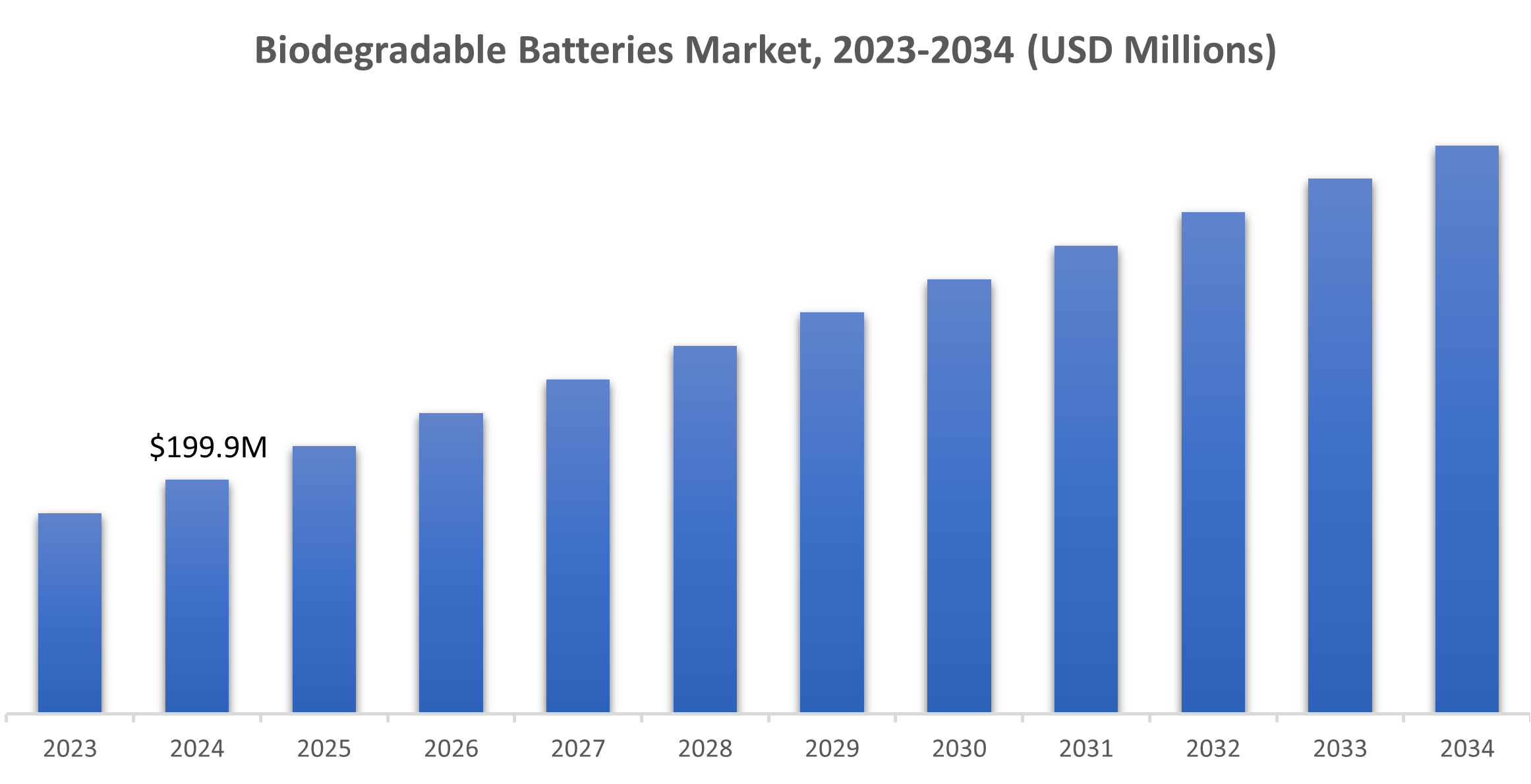
Source: Fatpos Global
Biodegradable Batteries Market Segmentation:
Redox Flow Battery holds the prominent position due to high energy density and better scalability
Biodegradable Batteries Market is classified based on Battery Type into Paper Battery, Graphene Battery, Redox Flow Battery, and Others. The dominance of the Redox Flow Battery segment in the Biodegradable Batteries Market stems from several key factors. Firstly, these batteries offer high energy density, storing more energy per unit volume than alternatives such as paper batteries and some other categories. This characteristic makes them suitable for applications like grid storage and remote area power supply, where high power output and storage capacity are crucial. Moreover, redox flow batteries can easily scale up by adding additional electrolyte tanks, adapting effectively to fluctuating energy demands. Additionally, redox flow battery technology is more developed and established compared to paper and other emerging options. This maturity ensures reliability and profitability, bolstering their adoption in current market scenarios. These factors collectively position redox flow batteries as the leading choice in the biodegradable batteries landscape, addressing diverse industrial and sustainability needs effectively.
Biodegradable batteries' better compatibility and reduced need for surgical intervention make them dominant in the healthcare segment
Biodegradable Batteries Market is divided based on Application into Healthcare, Consumer Electronics, and Others. In the present market environment, the healthcare sector is leading in the biodegradable batteries market owing to several benefits. Biodegradable batteries are made from materials that reduce the chances of rejection or causing adverse tissue reactions when inserted into the body, making them biocompatible. This quality makes them perfect for providing energy to pacemakers, medication dispensers, and other devices that can be implanted in the body. Furthermore, some medical devices with traditional batteries need surgery to be removed when they run out. On the other hand, biodegradable batteries decompose naturally in the body, avoiding the necessity of additional surgery. Furthermore, eco-friendly batteries are typically smaller and lighter than traditional ones, enhancing patient satisfaction. Their inherent degradation process also reduces the possibility of battery leakage or the emission of harmful substances, improving patient safety.
Source: Fatpos Global
Market Dynamics:
Growth Drivers
Increasing Demand for Sustainable Energy Sources to Provide Comprehensive Growth Opportunities
Growing awareness of the environmental impacts caused by traditional energy sources is fuelling the rising need for sustainable energy sources. Biodegradable batteries provide a more environmentally friendly option in numerous ways. Firstly, biodegradable batteries decrease electronic waste by breaking down naturally after use, reducing the environmental problems linked to conventional batteries that frequently wind up in landfills. Furthermore, biodegradable batteries are created using plant-based materials or other sustainable resources, reducing dependence on non-renewable resources and the processes involved in extracting them. Finally, these batteries present less of a danger of causing environmental pollution than regular batteries that have harmful substances, making it simpler and safer to dispose of them when they are no longer usable. Biodegradable batteries are an essential part of transitioning to sustainable energy solutions.
Technological Advancements in Biodegradable Materials and Battery Technologies
Advancements in materials science and battery technology are essential for the expansion of the biodegradable batteries market. Researchers are consistently creating improved biodegradable materials with better qualities like increased energy density, enhanced conductivity, and quicker degradation rates. These developments enable biodegradable batteries to operate more similarly to conventional batteries in terms of power and longevity. Furthermore, advancements in battery technology designed specifically for biodegradable materials are crucial. This involves creating innovative electrolytes and electrode layouts that enhance performance and functionality while using biodegradable materials. These advances in technology allow biodegradable batteries to fulfill the requirements of different uses, promoting their acceptance as eco-friendly energy options.
Restraints
High Cost Compared to Traditional Batteries to Create Growth Challenges
Several factors contribute to the limited adoption of biodegradable batteries, including their higher cost. To begin with, since it is a new technology, production methods are not as efficient as those for standard batteries, resulting in increased costs for manufacturing. Furthermore, utilizing and handling biodegradable materials may come with a higher cost and greater complexity. The limited market share of biodegradable batteries also results in reduced economies of scale, making it difficult to reduce production costs per unit. This barrier of cost creates challenges for consumers who are hesitant to pay high prices, low market penetration, and slower market growth. Dealing with this challenge requires continuous research and development to enhance production and find cost-efficient materials, attain economies of scale as the market expands, and obtain government incentives to help cover initial expenses.
Recent Developments
- In 2023-24, Better Battery Co. launched a new line of graphene-based biodegradable batteries, offering enhanced energy density and a longer lifespan. The company also partnered with a major consumer electronics brand to integrate their biodegradable batteries into a new line of sustainable gadgets.
- In 2023-24, Nexus Power acquired a startup specializing in bio-electrochemical systems (BES) technology to strengthen its portfolio of biodegradable battery solutions. The company is further aiming to collaborate with a leading healthcare provider to develop biodegradable batteries for medical devices, focusing on reducing environmental impact.
- In 2023, CMBlu Energy AG developed a pilot project for a large-scale redox flow biodegradable battery system for grid-scale energy storage. The company also entered into a joint venture with a renewable energy company to commercialize biodegradable batteries for off-grid applications in remote regions.
- In 2023, KEMIWATT introduced a new generation of plant-based bio-batteries capable of storing higher capacities for longer durations. The company also expanded its manufacturing facilities to scale up the production of biodegradable batteries, aiming to meet growing market demand.
- In 2023-24, Stora Enso launched a subsidiary focusing on sustainable materials for battery components, including biodegradable packaging for batteries.
Biodegradable Batteries Market Key Players:
- Better Battery Co.
- Nexus Power
- CMBlu Energy AG
- KEMIWATT
- Stora Enso
- Bioenzymatic Fuel Cells
- XL Batteries
- Sony Group Corporation
- Battery Solutions LLC
- Felis Leo Ventures Private Limited
- Doe Run Company
- Bloom Energy
- Ecozen Solutions
- ZincFive
- BioVolt
- Other Prominent Players (Company Overview, Business Strategy, Key Product Offerings, Financial Performance, Key Performance Indicators, Risk Analysis, Recent Development, Regional Presence, SWOT Analysis)
Regional Analysis
Biodegradable Batteries Market is segmented based on regional analysis into five major regions: North America, Latin America, Europe, Asia Pacific, and the Middle East and Africa. Several key factors contribute to the dominance of the biodegradable batteries market in the Asia-Pacific region. Government activities in nations such as China, Japan, and South Korea have placed stringent environmental regulations that support sustainability, fostering a favourable atmosphere for the advancement and acceptance of biodegradable batteries. Significant investment in research and development throughout Asia-Pacific ensures that the region maintains a leading position in technological innovation. Moreover, the region's role as a key center for electronics production and usage creates a substantial need for biodegradable batteries in consumer electronics.
On the other hand, North America and Europe, as pioneers with well-established rules, have relatively smaller market sizes. Latin America and the Middle East/Africa are in the initial phases of adoption, needing more awareness and infrastructure development to achieve substantial growth.
Impact of Covid-19 on Biodegradable Batteries Market
Biodegradable batteries market was both positively and negatively affected by the COVID-19 pandemic. Global lockdowns and travel restrictions had a negative impact by disrupting supply chains for raw materials and components, resulting in production slowdowns and possible shortages. Financial pressure shifted focus away from research and development, causing a delay in technological progress. Furthermore, consumer electronics faced reduced demand due to lockdowns and economic uncertainties in the short term. The pandemic increased attention to environmental concerns, possibly boosting future interest in eco-friendly items such as biodegradable batteries. Consumers might start to be more aware of their environmental footprint, leading to an increase in investment in biodegradable battery technology to support resilient supply chains and eco-friendly practices. Despite facing temporary obstacles, the biodegradable batteries market still has a favourable long-term perspective.
Biodegradable Batteries Market is further segmented by region into:
- North America Market Size, Share, Trends, Opportunities, Y-o-Y Growth, CAGR – United States and Canada
- Latin America Market Size, Share, Trends, Opportunities, Y-o-Y Growth, CAGR – Mexico, Argentina, Brazil, and Rest of Latin America
- Europe Market Size, Share, Trends, Opportunities, Y-o-Y Growth, CAGR – United Kingdom, France, Germany, Italy, Spain, Belgium, Hungary, Luxembourg, Netherlands, Poland, NORDIC, Russia, Turkey, and Rest of Europe
- Asia Pacific Market Size, Share, Trends, Opportunities, Y-o-Y Growth, CAGR – India, China, South Korea, Japan, Malaysia, Indonesia, New Zealand, Australia, and Rest of APAC
- Middle East and Africa Market Size, Share, Trends, Opportunities, Y-o-Y Growth, CAGR – North Africa, Israel, GCC, South Africa, and Rest of MENA
Biodegradable Batteries Market Scope and Segments:
|
ATTRIBUTE |
DETAILS |
|
Study Period |
2018-2034 |
|
Base Year |
2023 |
|
Forecast Period |
2024-2034 |
|
Historical Period |
2019-2022 |
|
Growth Rate |
CAGR of 12.3% from 2024-2034 |
|
Unit |
Value (USD Million) |
|
Segmentation |
Main Segments List |
|
By Battery Type |
|
|
By Battery Technology |
|
|
By Capacity |
|
|
By Application |
|
|
By Region |
|
Frequently Asked Questions (FAQ):
Biodegradable Batteries Market size was valued at USD 178.3 million in 2023 and is projected to reach the value of USD 637.2 million in 2034, exhibiting a CAGR of 12.3% during the forecast period.
The Biodegradable Batteries Market refers to the global industry focused on eco-friendly energy storage solutions. These batteries are crafted from materials that naturally degrade over time, minimizing environmental impact. The market caters to various sectors including healthcare, consumer electronics, and renewable energy, driven by increasing environmental awareness and regulatory support.
The Redox Flow Battery segment and Healthcare segment accounted for the largest Biodegradable Batteries Market share.
Key players in the Biodegradable Batteries Market include Better Battery Co., Nexus Power, CMBlu Energy AG, KEMIWATT, Stora Enso, Bioenzymatic Fuel Cells, XL Batteries, Sony Group Corporation, Battery Solutions LLC, Felis Leo Ventures Private Limited, Doe Run Company, Bloom Energy, Ecozen Solutions, ZincFive, BioVolt. and Other Prominent Players.
Rising environmental concerns and demand for sustainable energy sources are driving the biodegradable batteries market.
 Select License Type


.png)


