


Airport Baggage Handling System Market Research, 2034
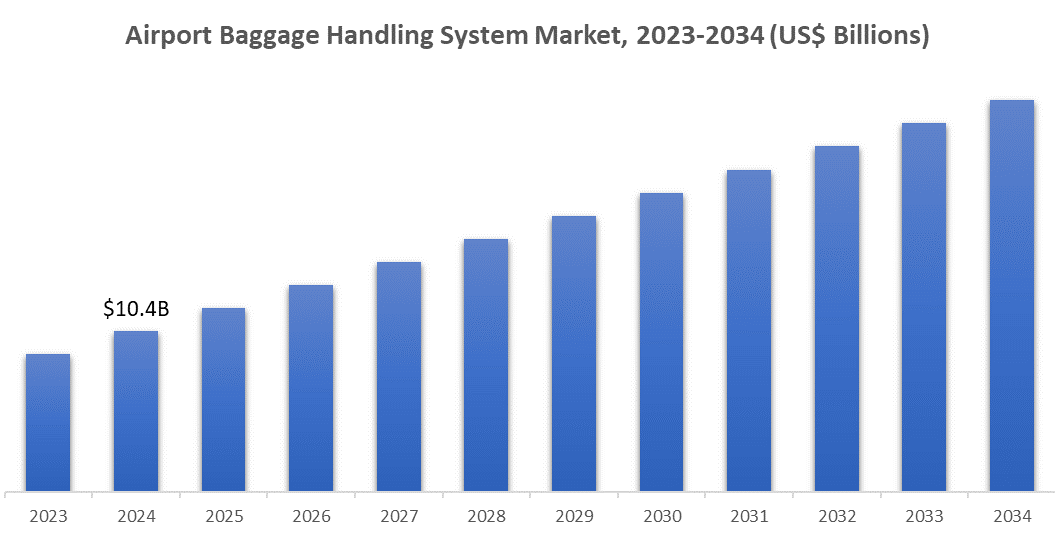
The global airport baggage handling market is expected to grow at a CAGR of 6.4% in the forecast period (2024-2034), with the market size valued at US$ 9.8 billion in 2023 and projected to reach US$ 19.5 billion by 2034.
Airport baggage handling system is a complex system of conveyor belts, scanners, and sorting machines that manages the flow of bags from check-in to aircraft loading, and vice versa. When a passenger checks in their luggage, it is tagged with a unique identifier, that allows the system to trace its progress.
The luggage is then routed via a series of conveyor belts for security screening and sorting based on destination. Automated systems use barcode or RFID technology to ensure precise routing. At the destination airport, the procedure is reversed, with luggage sorted and directed to the proper baggage claim area for passengers to retrieve. A well-designed and properly working baggage handling system is vital for guaranteeing seamless operations, minimizing delays, and enhancing passenger satisfaction at airports globally.
Market Highlights
The market is growing due to the rise in demand for better efficient baggage and logistics sorting systems, due to increased air traffics in major airports worldwide. With increased globalization and urbanization, there is a growing demand for efficient transportation infrastructure, specifically in airports. Furthermore, technological improvements are improving the efficiency and reliability of baggage handling systems, resulting in better customer experiences and greater operational effectiveness for airlines.
Additionally, significant security rules and the necessity for efficient baggage processing drive market expansion. Moving forward, expanding number of low-cost carriers, rising tourism, and emerging markets are expected to maintain the growth trajectory of airport baggage handling systems for the foreseeable future.
Market Segmentation
Conveyors to keep dominating the market due to substantial baggage handling capacity
The market based on Type is segmented into Conveyors, Destination Coded Vehicles, Sorting, Screening and Others. The Conveyors Segment dominates the market due to its remarkable adaptability to effortlessly fit into various airport settings, whether being applicable to small sized national airports or large sized international airports. Compared to destination coded vehicles or sorting methods, the conveyor comes out as a more cost-effective method due to its low installation and management costs.
Conveyors usually consist of in-built sorting and screening systems, which directly helps in minimizing processes. Ongoing developments and innovations within the conveyor segment contribute to its increased competitiveness within the market. Manufacturers are increasingly introducing efficient energy solutions and intelligent control systems, ensuring that they remain prevalent in the market atmosphere.
Airports with more than 40 million capacities to influence total market growth
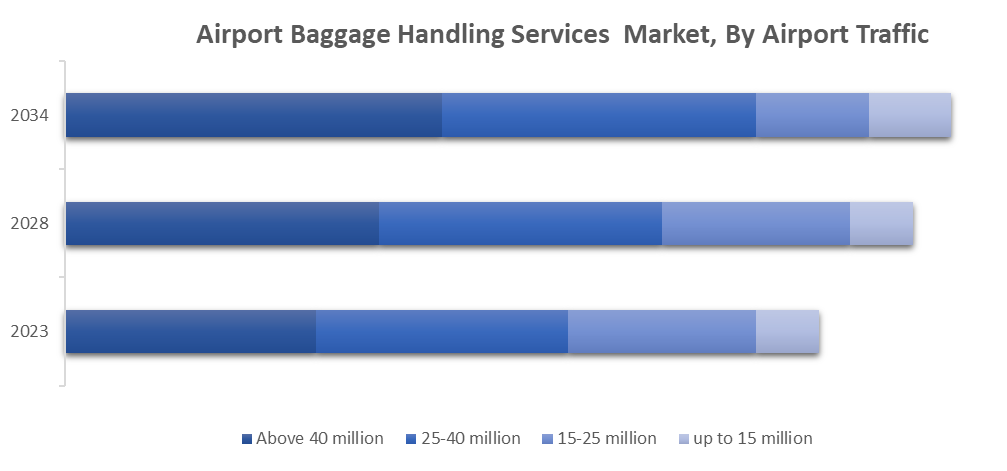
The market, based on Capacity is segmented into 15 million, 15-25 million, 25-40 million and above 40 million variants. The above 40 million segment dominates and influences the whole market in terms of revenue generation and size. Airports which have 40 million plus passengers visiting each year come with large volume of luggage, which in-turn increases the demand for high-capacity baggage handling systems, large airports require high speed conveyor belt and advanced sorting system.
Automated robots and efficient systems help in handling baggage transfer efficiently, reducing manual labour. The handling systems require large upfront investments for software maintenance and installation. As a result, mega airports contribute towards the overall investments required. Dubai International Airport and Beijing Daxing International Airport are some examples of large airports dominating the sector.
Market Dynamics
Growth Drivers
Increasing Air Passenger Traffic to Influence the Growth for Airport Baggage Market
As the number of passengers increases, so does the volume of luggage, placing immense pressure on airports to provide safe security checks and handle baggage procedures efficiently. To manage with rising air traffic, airports and governments are increasingly investing in expanding existing infrastructure. This directly provides better opportunities for companies offering automation solutions, advanced systems, and capacity upgrades.
Large airports can handle the influx of passengers by providing higher-quality services, but they require high-end baggage handling systems to efficiently execute the screening process for millions of arriving passengers. The increased demand for better-equipped airport baggage systems is driving overall production and creating positive future prospects for the market.
Rising Demand for Baggage Safety and Tracking will drive overall market growth
In today’s travel landscape, passengers are increasingly focused on gaining knowledge about their luggage, seeking safety and assurance. The threat of potential loss or theft of their baggage has highlighted the demand for enhanced tracking systems. Real-time luggage tracking systems and biometric identification for baggage collection emerge as essential solutions to address these concerns.
These technologies help provide operational efficiency and reduce accidents. Airlines like Lufthansa have given passengers the ability to track their baggage in real-time using mobile or web-based applications. The combination of passenger concerns and technological innovations provides a transformational shift in the travel industry, maintaining both security and customer satisfaction.
Restraints
Cybersecurity concerns regarding connected baggage system may impact market growth
Increased connection in baggage systems presents a serious cybersecurity risk to the industry. Airports and technology service providers are becoming potential targets for cybercriminals as attacks on passenger data and system control functions grow in frequency. Such issues are encountered on a larger scale, requiring an active search for solutions. To reduce risk, businesses must invest in safety measures.
Failure to address these concerns might have serious consequences, such as data breaches, system outages, and harm to airport technology providers. As a result, an active approach to cybersecurity is required to maintain success in the changing travel business. Implementing effective cybersecurity measures will not only protect critical data, but will also ensure that airport operations run smoothly, increasing passenger trust and industry resilience.
Recent Developments
- In 2023, SITA partnered with Microsoft to develop AI based baggage tracking solution. The Company also launched BaggageConnect+, a cloud-based platform for real-time baggage information sharing across airlines and ground handlers.
- In 2023, Beumer group exposed their new EcoLine conveyor belt that promises to reduce energy usage by 50%. While the company also acquired Sortimat, a specialist in baggage sorting system.
- In 2023, Daifuku Co., Ltd developed AI-powered “SmartSorter”, which is capable of adapting dynamic bag flows. Also formed and essential partnership with logistics giants DHL and Emirates Sky Cargo.
- In 2023, Vanderlande Industries BV introduced Vanderlande Innovative Baggage system which utilizes automated vehicles for baggage transportation.
- In 2023, Pteris Global Limited launched “eBAG” system, enabling self-service baggage tagging and secured major funding for new cloud based baggage management software.
Key Players
- SITA
- BEUMER Group
- Daifuku Co., Ltd.
- Siemens AG
- Vanderlande Industries B.V.
- G&S Airport Conveyor
- Pteris Global Limited
- Fives Group
- Grenzebach Maschinenbau GmbH
- Logplan LLC
- BCS Group
- Babcock Airports Ltd.
- CASSIOLI Airport Division S.p.A.
- Alstef Automation S.A.
- CIMC IT Co., Ltd.
- Other Prominent Players (Company Overview, Business Strategy, Key Product Offerings, Financial Performance, Key Performance Indicators, Risk Analysis, Recent Development, Regional Presence, SWOT Analysis)
Regional Analysis
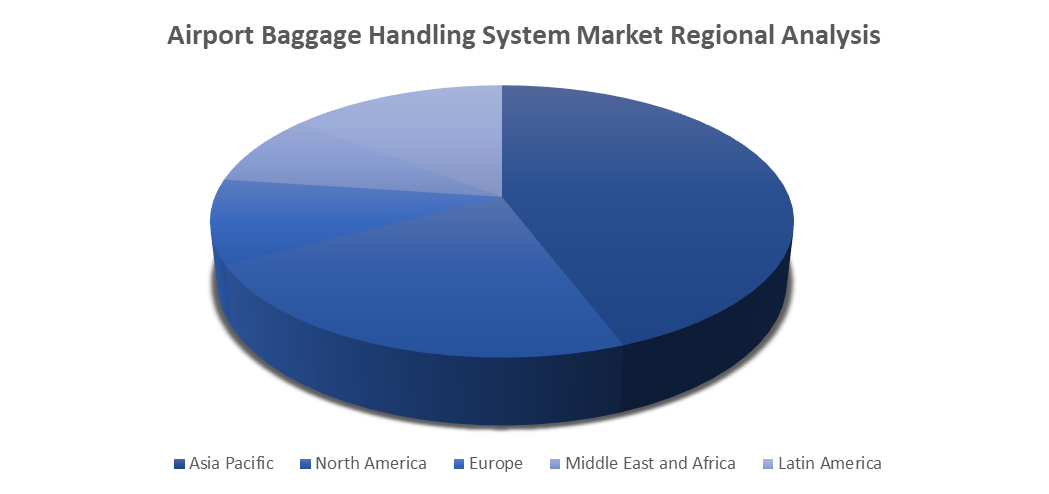
The global airport baggage handling services market is segmented based on regional analysis into five major regions: North America, Latin America, Europe, Asia Pacific and the Middle East and Africa.
The Asia Pacific region dominated and was the largest market for airport baggage handling system, driven by growth in the developing countries like China, India and South Korea. The region accounted for more than 40% of the global market share.
Rapid urbanization, rising disposable income, and growing air travel demand in these countries have fuelled the demand for improved airport infrastructure and efficient baggage handling technologies. As a result, manufacturers and service providers are more focusing on meeting the changing needs of this ever changing market, utilizing the region's enormous growth potential and promoting innovation in the airport technology industry.
Latin America and Middle East & Africa are set to witness high growth in the market due to increased infrastructure investments in countries like UAE, Saudi Arabia, Brazil and others.
North America and Europe are leaders in adapting advance technologies and producing advance baggage system.
Market is further segmented by region into:
- North America Market Size, Share, Trends, Opportunities, Y-o-Y Growth, CAGR – United States and Canada
- Latin America Market Size, Share, Trends, Opportunities, Y-o-Y Growth, CAGR – Mexico, Argentina, Brazil, and Rest of Latin America
- Europe Market Size, Share, Trends, Opportunities, Y-o-Y Growth, CAGR – United Kingdom, France, Germany, Italy, Spain, Belgium, Hungary, Luxembourg, Netherlands, Poland, NORDIC, Russia, Turkey, and Rest of Europe
- Asia Pacific Market Size, Share, Trends, Opportunities, Y-o-Y Growth, CAGR – India, China, South Korea, Japan, Malaysia, Indonesia, New Zealand, Australia, and Rest of APAC
- Middle East and Africa Market Size, Share, Trends, Opportunities, Y-o-Y Growth, CAGR – North Africa, Israel, GCC, South Africa, and Rest of MENA
Market Scope and Segments:
|
ATTRIBUTE |
DETAILS |
|
Study Period |
2018-2034 |
|
Base Year |
2023 |
|
Forecast Period |
2024-2034 |
|
Historical Period |
2019-2022 |
|
Growth Rate |
CAGR of 6.4% from 2024-2034 |
|
Unit |
Value (US$ Billion) |
|
Segmentation |
Main Segments List |
|
By Type |
· Conveyors · Destination Coded Vehicles · Sorting · Screening · Others |
|
By Airport Capacity |
· Up to 15 million
|
|
By Region |
|
Frequently Asked Questions (FAQ):
The global airport baggage handling system market size was valued at US$ 9.8 billion in 2023 and is projected to reach the value of US$ 19.5 billion in 2034, exhibiting a CAGR of 6.4% during the forecast period.
The market consists of those activities which helps in providing various solutions regarding sorting and transportation of luggage in airports. Airport Baggage System consists of conveyor belts which help in efficient passage of baggage from the ticketing counters to the aircrafts, these systems come with various sorting devices and screening systems.
The Conveyor and above 40 million segment accounted for the largest market share.
Key players in the global airport baggage handling system market include ITA, BEUMER Group, Daifuku Co., Ltd., Siemens AG, Vanderlande Industries B.V., G&S Airport Conveyor, Pteris Global Limited, Fives Group, Grenzebach Maschinenbau GmbH, Logplan LLC, BCS Group, Babcock Airports Ltd., CASSIOLI Airport Division S.p.A., Alstef Automation S.A., CIMC IT Co., Ltd. and Other Prominent Players.
Rise in automation demand and incorporation of advanced technologies in the baggage screening are the factors driving the demand for market.
 Select License Type


.png)


