


_(1).jpg)
4D LiDAR Market Size
4D LiDAR Market is anticipated to grow at a CAGR of 15.7% in the forecast period (2024-2034), with the market size valued at USD 1.1 billion in 2023 and projected to reach USD 5.5 billion by 2034.
Product Overview:
4D LiDAR, also known as four-dimensional Light Detection and Ranging, is a sophisticated sensing technology crucial for autonomous vehicles, robotics, and industrial automation. In contrast to conventional 3D LiDAR systems that only calculate distance and spatial dimensions, the 4D LiDAR includes the additional factor of time. This allows it to not only record stationary objects but also their actions and changes over a period, which is essential for dynamic settings such as roads or industrial areas. 4D LiDAR improves safety, navigation, and decision-making in autonomous systems by creating precise 3D maps and tracking objects in real time. Its uses range from allowing self-driving vehicles to navigate safely in traffic to directing robots in warehouses and supervising industrial operations with increased effectiveness.
Market Highlights:
4D LiDAR Market is expected to exhibit a CAGR of 15.7% during the forecast period, 2024-2034
4D LiDAR Market is anticipated to reach USD 5.5 billion, growing at a CAGR of 15.7% during the forecast period. The market is expanding due to its capacity to offer essential, real-time information needed for autonomous vehicles, robotics, and industrial automation. In contrast to traditional LiDAR, 4D LiDAR incorporates the element of time, allowing for accurate monitoring of mobile entities and dynamic environments. This technology improves safety, navigation, and decision-making abilities in complex scenarios. As industries place a greater emphasis on efficiency and safety, the importance of 4D LiDAR in allowing autonomous systems to accurately perceive and respond to their environment makes it a critical technology for the future of smart cities, logistics, and other fields
2.webp)
Source: Fatpos Global
4D LiDAR Market Segmentation:
4D LiDAR for Autonomous Driving Level 2 dominates the market owing to its enhanced safety features and wider adoption
4D LiDAR Market is categorized based on Type into Autonomous Driving Level 1, Autonomous Driving Level 2, and Autonomous Driving Level 3. In the present market sphere, Level 2 ADAS systems dominate the 4D LiDAR market for several strong reasons. Firstly, automakers and consumers have widely embraced these systems due to their proven safety advantages. Many vehicles currently come equipped with Level 2 features, establishing it as a widely accepted technology. In terms of technology, 4D LiDAR improves Level 2 systems by providing crucial, real-time environmental information necessary for object detection, distance calculation, and continuous monitoring. This enables the integration of 4D LiDAR into mass-produced vehicles feasibly and cost-effectively. Furthermore, Level 2 ADAS systems that have 4D LiDAR technology improve safety by offering advanced functions such as collision prevention and pedestrian detection, which increases consumer trust in autonomous technologies. Regulatory frameworks and industry standards are playing a crucial role in increasing adoption rates by guaranteeing compliance and reliability, highlighting Level 2 ADAS with 4D LiDAR as essential for both present and future automotive safety and autonomy.
Autonomous driving applications currently lead the market due to their high growth potential and focus on safety
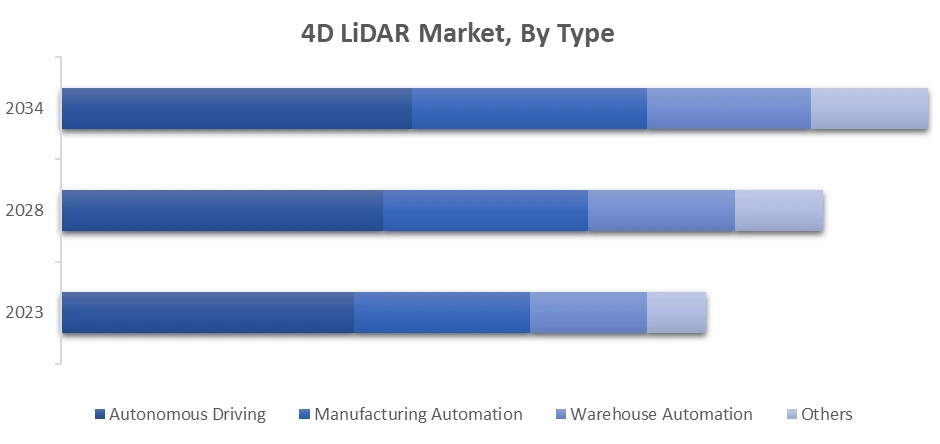
4D LiDAR Market is categorized based on Application into Autonomous Driving, Manufacturing Automation, Warehouse Automation, and Others. Under current market conditions, autonomous driving holds the market lead, due to numerous convincing factors. To start with, the autonomous vehicle sector is expanding quickly due to significant investments and advancements in technology, leading to an increased need for LiDAR sensors. These sensors are essential for delivering precise, long-distance sensing abilities needed to safely navigate intricate surroundings. The capability of 4D LiDAR to provide precise, instant 3D data on the environment allows self-driving cars to accurately identify objects and make well-informed choices, improving safety overall. This ability helps build confidence in self-driving technology among both consumers and regulators, strengthening its position as the market leader.
Market Dynamics:
Growth Drivers
Increasing Demand for Autonomous Vehicles and Driver Assistance Systems to Provide Comprehensive Growth Opportunities
The rising demand for self-driving cars and driver assistance systems (ADAS) is a major factor driving the growth of the 4D LiDAR market. 4D LiDAR is crucial in autonomous vehicle navigation as it offers precise 3D data necessary for safety. Its better performance in difficult weather and poor visibility situations improves safety and reliability in comparison to conventional sensors such as cameras and radars. Furthermore, 4D LiDAR improves advanced ADAS features like automatic emergency braking and lane departure warning, strengthening the capabilities of these systems. The increasing need for 4D LiDAR sensors is pushing for large-scale production, resulting in lower manufacturing expenses and widespread availability of the technology. With the development of autonomous vehicle technology, there will be an increasing demand for improved 4D LiDAR sensors that have better range, resolution, and processing abilities, driving market growth.
Rising Adoption of LiDAR Technology in Robotics and Industrial Automation to Assist with Market Development
The increasing utilization of 4D LiDAR technology in robotics and industrial automation is bringing about significant changes in these industries. 4D LiDAR allows robots to safely navigate complex industrial environments and perform tasks more accurately by offering precise 3D mapping and object recognition capabilities. Automating tasks like material handling and quality control improves operational efficiency and productivity. Crucially, LiDAR guarantees secure cooperation between robots and human employees, avoiding crashes and allowing smooth communication in industrial environments. As robotics plays a bigger role in various fields, the need for custom 4D LiDAR sensors designed for robot use is growing. This trend stimulates progress in LiDAR technology, encouraging the creation of specialized solutions for various industrial requirements and boosting expansion in the wider 4D LiDAR market.
Restraints
High Cost of 4D LiDAR Sensors Compared to Traditional Technologies
The substantial expenses of 4D LiDAR sensors present significant challenges regarding their widespread adoption in diverse industrial settings. The reason for this high cost is due to the complicated technology involved, including expensive components such as powerful lasers, specialized detectors, and advanced signal processing algorithms. The small production scale also hinders cost reduction through economies of scale, resulting in higher prices compared to traditional sensors such as cameras and radars. Integration into vehicles or robots increases expenses due to calibration and software development. Hence, the adoption of 4D LiDAR in markets beyond autonomous vehicles and price-sensitive developing countries is limited. To tackle this issue, ongoing efforts are focused on technological improvements, standardizing components, and investigating alternative technologies such as solid-state LiDAR to potentially reduce production expenses and improve market entry.
Recent Developments
- In 2024, Aeva introduced its next-generation 4D LiDAR sensor, which boasts extended range, improved resolution, and a smaller form factor compared to previous models. The company announced partnerships with several major automotive manufacturers to integrate their 4D LiDAR technology into next-generation vehicles, showcasing growing industry adoption.
- In 2023, TetraVue introduced a new 4D LiDAR specifically designed for short-range, high-precision applications in indoor environments, targeting applications like warehouse automation and robotics.
- In 2023, Unitree Robotics launched a new series of robots equipped with integrated 4D LiDAR sensors, enhancing their navigation and obstacle avoidance capabilities in various industrial settings. The company partnered with a leading LiDAR manufacturer to co-develop customized 4D LiDAR solutions for their robotic platforms.
- In 2023, Luminar Technologies introduced their Iris LiDAR, a long-range, high-resolution sensor specifically designed for autonomous vehicles, aiming to achieve superior performance in challenging weather conditions.
- In 2023, Velodyne Lidar released a new line of cost-effective 3D LiDAR sensors targeting budget-conscious applications, potentially expanding their market reach.
4D LiDAR Market: Key Players:
- Aeva
- TetraVue
- Unitree
- LuminWave
- Velodyne Lidar, Inc.
- Makalu
- Infoworks
- Luminar Technologies, Inc.
- Innoviz Technologies Ltd.
- Ouster, Inc.
- Cepton Technologies, Inc.
- Quanergy Systems, Inc.
- Valeo S.A.
- Continental AG
- Denso Corporation
- Other Prominent Players (Company Overview, Business Strategy, Key Product Offerings, Financial Performance, Key Performance Indicators, Risk Analysis, Recent Development, Regional Presence, SWOT Analysis)
Regional Analysis
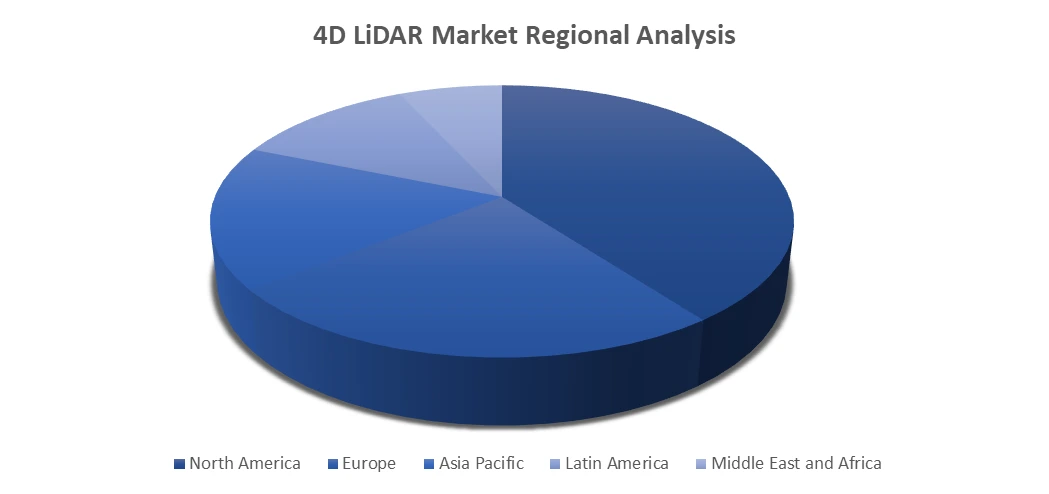
4D LiDAR Market is segmented based on regional analysis into five major regions: North America, Latin America, Europe, Asia Pacific, and the Middle East and Africa. Currently, North America is at the forefront of the 4D LiDAR market due to its early adoption and strong environment for self-driving cars. Nations such as the US are leading the way in autonomous vehicle advancement through significant investments and backing from the government, creating a need for 4D LiDAR as a crucial technology in autonomous vehicles. The region benefits from a well-developed automotive sector, encouraging strong partnerships between top car makers and tech suppliers. Furthermore, supportive regulatory conditions in certain North American nations encourage the examination and rollout of self-driving vehicles, establishing a favorable market for 4D LiDAR technology.
In the future, Europe is strongly positioned for robust expansion accredited to its focus on automotive safety and technological advancement. Significant growth in the 4D LiDAR market is anticipated due to rapid economic development, governmental support for autonomous vehicles, and a growing automotive sector, particularly in China, in the Asia-Pacific region. Both Latin America and the Middle East & Africa are up-and-coming markets, on track for expansion with the increasing focus on smart city projects and the advancement of autonomous vehicle technology.
Source: Fatpos Global
Impact of Covid-19 on 4D LiDAR Market
The Covid-19 pandemic had a two-fold effect on the 4D LiDAR Market. On one hand, lockdowns and travel restrictions disrupted global supply chains, causing delays in component availability and impacting sensor production and project timelines. Economic downturns also led to tighter budgets and lower investments in research and development, potentially hindering market growth temporarily. Labor shortages further restricted manufacturing capacities. On the other hand, the pandemic accelerated the need for automation in various sectors, potentially increasing the demand for robotics and industrial automation, which are crucial for 4D LiDAR. Remote work trends also indirectly benefited the market by sparking interest in technologies such as autonomous delivery and remote monitoring systems that utilize LiDAR sensors. Additionally, government support through stimulus packages for autonomous vehicle development or smart city initiatives significantly boosted market growth.
4D LiDAR Market is further segmented by region into:
- North America Market Size, Share, Trends, Opportunities, Y-o-Y Growth, CAGR – United States and Canada
- Latin America Market Size, Share, Trends, Opportunities, Y-o-Y Growth, CAGR – Mexico, Argentina, Brazil, and Rest of Latin America
- Europe Market Size, Share, Trends, Opportunities, Y-o-Y Growth, CAGR – United Kingdom, France, Germany, Italy, Spain, Belgium, Hungary, Luxembourg, Netherlands, Poland, NORDIC, Russia, Turkey, and Rest of Europe
- Asia Pacific Market Size, Share, Trends, Opportunities, Y-o-Y Growth, CAGR – India, China, South Korea, Japan, Malaysia, Indonesia, New Zealand, Australia, and Rest of APAC
- Middle East and Africa Market Size, Share, Trends, Opportunities, Y-o-Y Growth, CAGR – North Africa, Israel, GCC, South Africa, and Rest of MENA
4D LiDAR Market Scope and Segments:
|
ATTRIBUTE |
DETAILS |
|
Study Period |
2018-2034 |
|
Base Year |
2023 |
|
Forecast Period |
2024-2034 |
|
Historical Period |
2019-2022 |
|
Growth Rate |
CAGR of 15.7% from 2024-2034 |
|
Unit |
Value (USD Billion) |
|
Segmentation |
Main Segments List |
|
By Type |
· Autonomous Driving Level 1 · Autonomous Driving Level 2 · Autonomous Driving Level 3 |
|
By Application |
· Autonomous Driving · Manufacturing Automation · Warehouse Automation · Others |
|
By Region |
· North America o U.S. o Canada · Europe o Germany o U.K. o France o Rest of Europe · Asia Pacific o China o Japan o India o Australia o Southeast Asia o Rest of Asia Pacific · Latin America o Brazil o Mexico o Rest of Latin America · Middle East & Africa o GCC o South Africa o Rest of Middle East & Africa |
Frequently Asked Questions (FAQ):
The 4D LiDAR Market size was valued at USD 1.1 billion in 2023 and is projected to reach USD 5.5 billion by 2034, exhibiting a CAGR of 15.7% during the forecast period.
The 4D LiDAR market involves the application of this technology in providing precise, real-time 3D mapping and object detection capabilities. It supports various industries, including autonomous vehicles, robotics, and industrial automation, by enhancing navigation, safety, and operational efficiency through advanced sensing and data processing capabilities.
The Autonomous Driving Level 2 and Autonomous Driving segment accounted for the largest 4D LiDAR Market share.
Key players in the 4D LiDAR Market include Aeva, TetraVue, Unitree, LuminWave, Velodyne Lidar, Inc., Makalu, Infoworks, Luminar Technologies, Inc., Innoviz Technologies Ltd., Ouster, Inc., Cepton Technologies, Inc., Quanergy Systems, Inc., Valeo S.A., Continental AG, Denso Corporation and Other Prominent Players.
The 4D LiDAR market is driven by surging demand for autonomous vehicles, robotics, and industrial automation requiring high-precision 3D environmental perception.
 Select License Type


.png)


