


Train Communications Systems Market Research, 2034
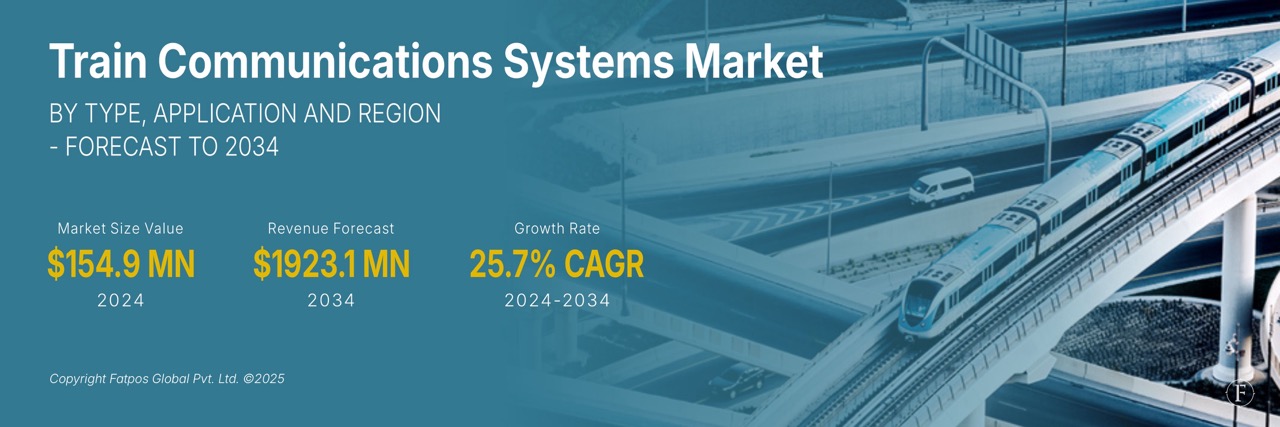
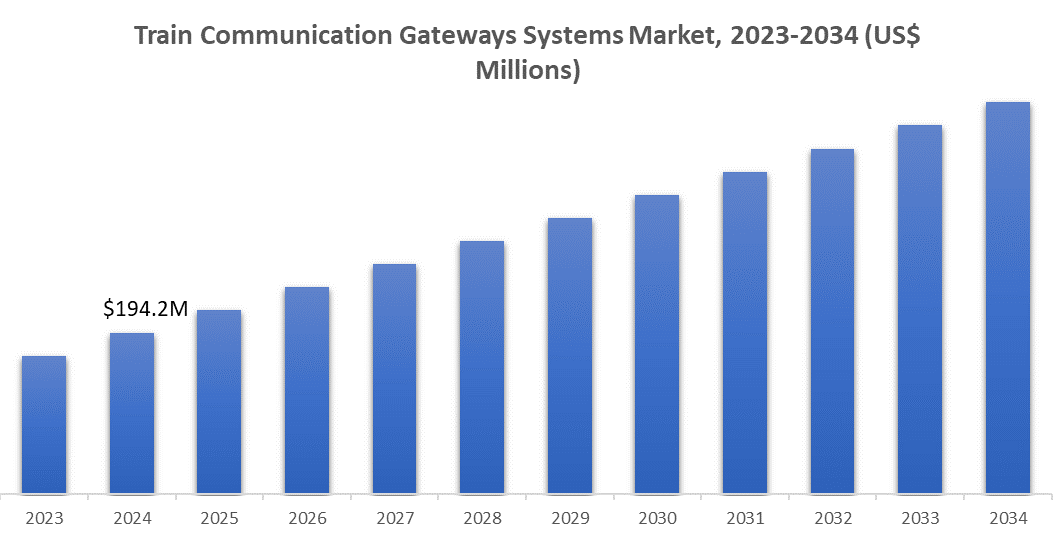
The global train communication gateways systems market is anticipated to grow at a compound annual growth rate (CAGR) of 25.7% from 2024 to 2034. The market was valued at US$ 154.9 million in 2023 and is projected to reach US$ 1923.1 million by 2034.
Train communication ateways Systems are advanced networking solutions that enable smooth communication among different subsystems in a train, including propulsion, braking, and passenger information systems. These gateways function as intermediaries, facilitating data transfer between protocols such as Wire Train Bus (WTB) and Multifunction Vehicle Bus (MVB).
They guarantee interoperability, on-the-spot monitoring, and effective administration of train operations, improving safety, dependability, and performance. These systems are essential for contemporary railways, aiding traditional and high-speed transit networks by merging various technologies into a cohesive communication structure.
Market Highlights
The market is fuelled by the rising need for efficient, safe, and automated railway operations. The emergence of intelligent rail systems, the integration of IoT, and the demand for real-time data analysis are significant elements. Governments around the globe are investing in the modernization of railways, focusing on sustainability and energy efficiency.
Moreover, the growth of urban transportation systems and high-speed rail networks in developing nations drives market expansion. Future developments in 5G, AI, and edge computing will continue to improve these systems, rendering them essential for next-generation rail infrastructure.
Market Segmentation
Multifunction Vehicle Bus (MVB) is expected to dominate the market, driven by its widespread adoption in modern rail vehicles
The market is divided by Product Type into Wire Train Buses (WTB), Multifunction Vehicle Bus (MVB) Category, and Others. The Multifunction Vehicle Bus (MVB) category leads the Train Communication Systems Market owing to its extensive use in contemporary rail vehicles. MVB is extremely dependable, facilitates real-time data transfer, and works with multiple subsystems such as braking, propulsion, and passenger information systems.
Its capacity to manage high-speed communication and work with other protocols makes it a favored option for traditional and fast transit rail systems. The growing need for sophisticated train control systems and IoT integration reinforces MVB's leading position in the industry.
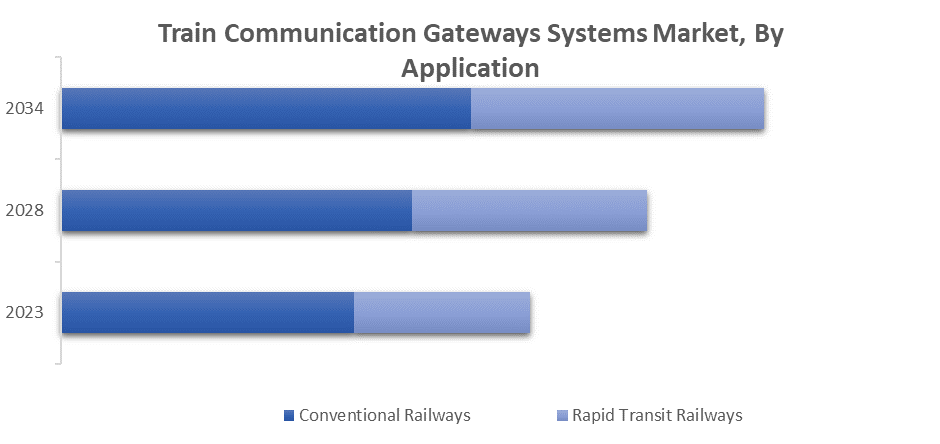
Rapid Transit Railways dominate the market, driven by urbanization and increasing demand for efficient metro transportation
The market is divided by Application into Conventional Railways and Rapid Transit Railways. Rapid Transit Railways dominate the market because of increasing urbanization and the need for effective public transport in urban centers. These systems need sophisticated communication gateways for real-time oversight, security, and smooth functioning of high-frequency trains.
The combination of IoT, AI, and predictive maintenance in metro and subway networks promotes the use of communication gateways even more. Governments across the globe are making substantial investments in urban transportation initiatives, positioning this sector as the primary driver of market expansion.
Market Dynamics
Growth Drivers
Demand for Intelligent Transport Systems (ITS) to Drive Market Growth
The increasing demand for Intelligent Transport Systems (ITS) is a significant catalyst for the growth of the Train Communication Systems Market. ITS incorporates cutting-edge technologies such as IoT, AI, and big data analytics to improve operational efficiency, safety, and the passenger experience.
Communication gateways are essential for facilitating real-time data transfer, predictive maintenance, and automated control systems. As global railways upgrade to achieve sustainability objectives and enhance service quality, the implementation of ITS-compatible communication systems is speeding up, and propelling market expansion.
Expansion of High-Speed Rail Networks to Fuel Market Expansion
The overall global growth of the high-speed rail systems is another significant factor. High-speed trains need strong and dependable communication systems to guarantee safe and efficient functioning. Communication gateways enable real-time data transfer between subsystems, allowing for accurate control and oversight.
Nations such as China, Japan, and various European countries are making substantial investments in high-speed rail initiatives, leading to a considerable need for sophisticated communication technologies. This pattern is anticipated to persist, boosting market expansion even more.
Restraints
High Implementation Costs May Hinder Market Growth
High implementation expenses serve as a significant restraint for the Train Communication Systems Market. Sophisticated communication gateways demand considerable investment in hardware, software, and integration with current systems.
Small and medium enterprises, along with rail operators in developing areas, frequently encounter financial limitations that restrict their capacity to implement these technologies. Furthermore, the necessity for proficient staff and continuous upkeep raises the overall ownership costs, obstructing market expansion.
Recent Developments
- Duagon has recently launched a next-generation train communication gateway that supports 5G and IoT integration. The company has partnered with a leading European rail operator to deploy advanced MVB-based gateways for high-speed trains.
- Hitachi Rail introduced an AI-powered communication gateway for predictive maintenance. The company acquired a software firm specializing in railway data analytics to enhance its gateway solutions.
- Siemens unveiled a modular communication gateway for urban systems. The corporation collaborated with a European consortium to develop cybersecurity solutions for train communication systems.
- Ansaldo STS introduced a gateway with integrated edge computing for faster decision-making. The corporation partnered with a Middle Eastern rail operator to modernize its communication infrastructure.
Key Players
- Duagon
- Hitachi Rail
- Siemens
- SYS TEC electronic
- Ansaldo STS
- Alstom
- CRRC Corporation Limited
- Knorr-Bremse
- Wabtec Corporation
- Hyundai Rotem
- Mitsubishi Electric
- Toshiba Infrastructure Systems & Solutions
- Voith
- Stadler Rail
- Other Prominent Players (Company Overview, Business Strategy, Key Product Offerings, Financial Performance, Key Performance Indicators, Risk Analysis, Recent Development, Regional Presence, SWOT Analysis)
Regional Analysis
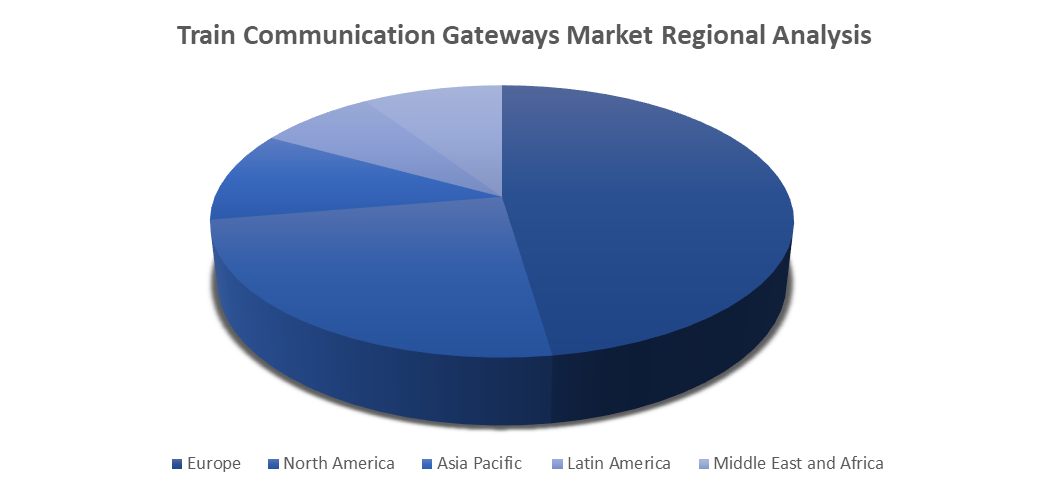
The Global Train Communication Gateways Systems Market is divided into five key regions based on regional analysis: North America, Latin America, Europe, Asia Pacific, and the Middle East and Africa.
Europe presently leads the market because of its sophisticated railway infrastructure, strong focus on sustainability, and substantial investments in high-speed rail and urban transit networks. Nations such as Germany, France, and the UK are leading the way, with firms like Siemens and Alstom at the helm of innovation. The area's strict safety regulations and implementation of IoT-based solutions reinforce its supremacy.
Although North America and Asia-Pacific are expanding, they fall short of Europe's market share. North America is slowly embracing these systems, propelled by the modernization of freight rail.
The Asia-Pacific region, driven by China and India, is experiencing swift growth fueled by urbanization and government programs such as "Make in India" and China’s Belt and Road Initiative.
Latin America, the Middle East & Africa continue to be underdeveloped because of inadequate infrastructure and financing, yet they possess opportunities for future expansion.
Impact of Covid-19 on the Market
The COVID-19 pandemic influenced the Train Communication Gateway Systems market in various ways. At first, interruptions in supply chains and a drop in passenger rail traffic caused several disruptions and lowered investments. Nonetheless, as economies recovered, there was an increased emphasis on improving public transport systems to guarantee safety and effectiveness.
The pandemic has highlighted the necessity of real-time communication and monitoring systems for ensuring operational continuity and adjusting to evolving passenger needs, thus propelling the uptake of advanced gateway systems in the post-pandemic period.
Market is further segmented by region into:
- North America Market Size, Share, Trends, Opportunities, Y-o-Y Growth, CAGR – United States and Canada
- Latin America Market Size, Share, Trends, Opportunities, Y-o-Y Growth, CAGR – Mexico, Argentina, Brazil, and Rest of Latin America
- Europe Market Size, Share, Trends, Opportunities, Y-o-Y Growth, CAGR – United Kingdom, France, Germany, Italy, Spain, Belgium, Hungary, Luxembourg, Netherlands, Poland, NORDIC, Russia, Turkey, and Rest of Europe
- Asia Pacific Market Size, Share, Trends, Opportunities, Y-o-Y Growth, CAGR – India, China, South Korea, Japan, Malaysia, Indonesia, New Zealand, Australia, and Rest of APAC
- Middle East and Africa Market Size, Share, Trends, Opportunities, Y-o-Y Growth, CAGR – North Africa, Israel, GCC, South Africa, and Rest of MENA
Market Scope and Segments
|
ATTRIBUTE |
DETAILS |
|
Study Period |
2018-2034 |
|
Base Year |
2023 |
|
Forecast Period |
2024-2034 |
|
Historical Period |
2019-2022 |
|
Growth Rate |
CAGR of 25.7% from 2024-2034 |
|
Unit |
Value (US$ Million) |
|
Segmentation |
Main Segments List |
|
By Product Type |
|
|
By Application |
|
|
By Region |
|
Frequently Asked Questions (FAQ):
The global train communication gateways systems market size was valued at US$ 154.9 million in 2023 and is projected to reach the value of US$ 1923.1 million in 2034, exhibiting a CAGR of 25.7% during the forecast period.
The market refers to the industry segment focused on designing, manufacturing, and integrating communication gateway systems for trains. These systems enable efficient data exchange between onboard systems, wayside systems, and the cloud, enhancing safety, reliability, and passenger experience.
The Multifunction Vehicle Bus (MVB) Segment and Rapid Transit Railways segment accounted for the largest market share.
Key players in the global train communication gateways systems market include Duagon, Hitachi Rail, Siemens, SYS TEC electronic, Ansaldo STS, Alstom, CRRC Corporation Limited, Knorr-Bremse, Wabtec Corporation, Hyundai Rotem, Mitsubishi Electric, Toshiba Infrastructure Systems & Solutions, Voith, Stadler Rail and Other Prominent Players.
The market is driven by increasing demand for secure and reliable communication systems, growing adoption of IoT and automation technologies, and rising investments in high-speed rail networks.
 Select License Type


.png)


