


Delivery Drones Market Research 2035
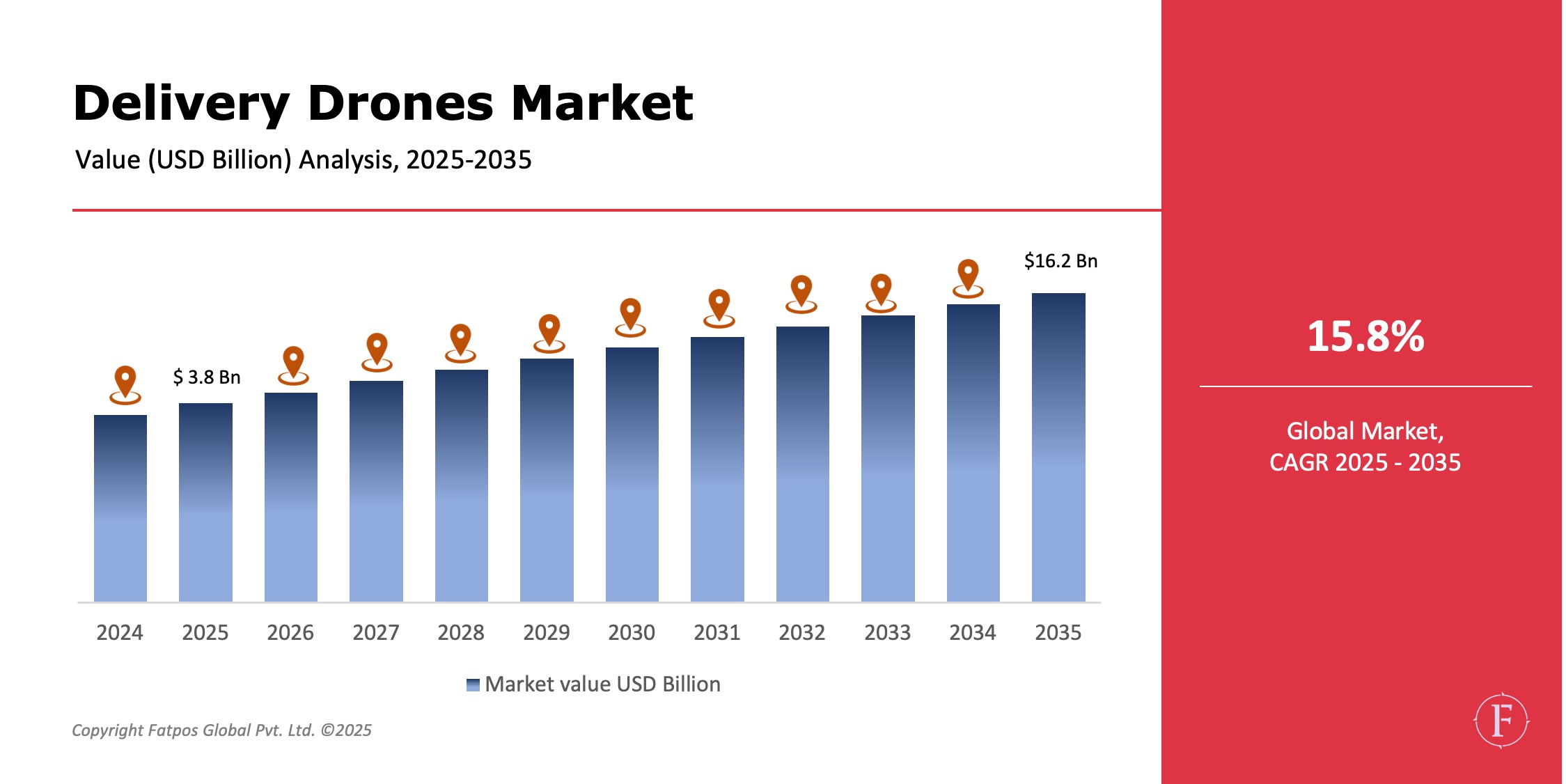
The Delivery Drones Market was valued at approximately USD 3.8 billion in 2025 and is projected to reach USD 16.2 billion by 2035, expanding at a CAGR of 15.8% during the forecast period. Demand is driven by rapid growth in e-commerce, increasing demand for last-mile delivery efficiency, logistics modernization, and advancements in autonomous flight technologies.
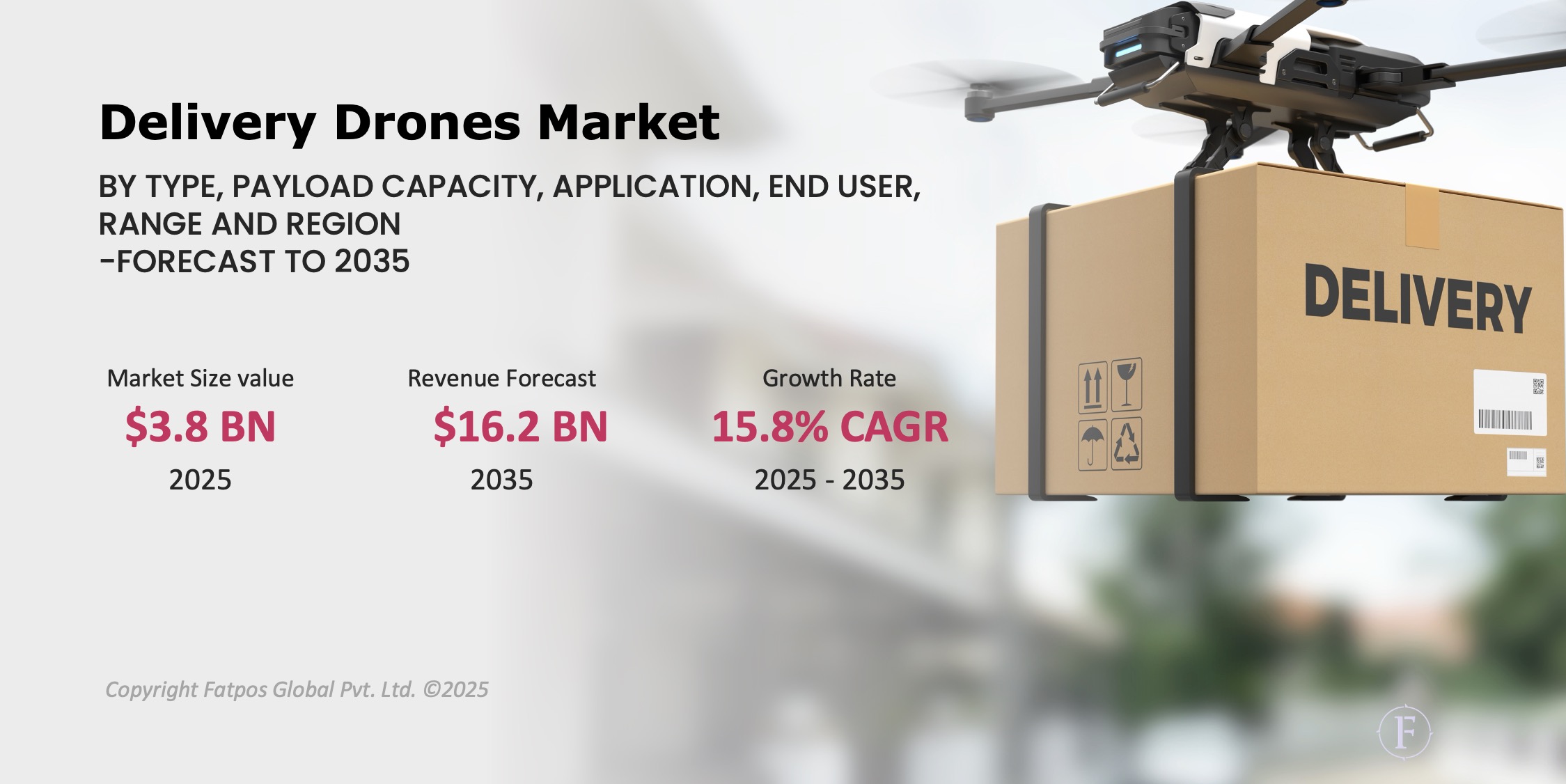
Delivery drones are unmanned aerial vehicles (UAVs) designed to transport parcels, food, medical supplies, and other goods from point A to point B with minimal human intervention. Rising investments, supportive government regulations for drone operations, and breakthroughs in battery, navigation, and payload technologies continue to fuel adoption globally.
Product Overview
Delivery drones enable fast, efficient, and cost-effective transportation of goods — especially in urban congestion and time-critical deliveries such as healthcare supplies. Fixed-wing drones are ideal for long-range missions, while rotary-wing drones offer vertical take-off and landing (VTOL) flexibility for short-range and urban applications. Hybrid designs combine strengths of both.
Payload capacity categories help tailor drones to use cases — from lightweight shipments to heavier package delivery. Applications span parcel delivery, food delivery, healthcare logistics (eg, blood, vaccines), and specialized industrial use cases. End users include e-commerce players, logistics companies, food & beverage platforms, and healthcare providers.
Key Takeaways :
- Delivery Drones Market expected to grow at ~15.8% CAGR through 2035
- Rotary-wing drones master owing to flexible VTOL operations
- ≤2 kg payload category holds largest share
- Parcel delivery remains the top application segment
- E-Commerce accounts for the highest end-user demand
- Asia-Pacific projected to be the fastest-growing regional market
Market Dynamics
Drivers
Rapid expansion of e-commerce has dramatically increased the need for efficient last-mile delivery solutions. Delivery drones offer reduced delivery times, lower operating costs, and greater reach in congested urban environments. Logistics & transportation companies are investing in autonomous systems to enhance competitiveness. In healthcare, drones are used for urgent delivery of medical supplies, vaccines, and blood, improving access in remote or disaster-hit areas.
Technological advancements in battery life, flight stability, and AI-enabled path planning further support commercial viability. Government initiatives and relaxed airspace regulations in several regions are further accelerating the deployment of delivery drone networks at scale.
Restrictions
Regulatory and airspace management challenges continue to restrain rapid market adoption. Many countries lack mature unmanned traffic management (UTM) frameworks for safe, large-scale drone operations, especially beyond visual line of sight (BVLOS). Privacy and security concerns over aerial data collection and unauthorized flight paths also limit commercial deployments. Technical limitations such as limited battery endurance, payload capacity, and weather vulnerability restrict operational effectiveness.
High initial development and infrastructure costs pose barriers for small and mid-sized logistics players. Integration with existing delivery networks and the need for specialized training for operators further complicate implementation.
Opportunities
Healthcare delivery offers substantial opportunities, particularly for urgent medical logistics, disaster response, and remote-area healthcare access. Innovation in swappable batteries, vertiport charging stations, and hybrid propulsion systems could significantly extend flight range and reduce downtime. Partnerships between regulatory bodies, technology providers, and logistics firms can accelerate safe BVLOS operations. Urban air mobility (UAM) concepts — such as drone corridors and rooftop delivery zones — present systemic opportunities for commercial expansion.
Emerging markets with expanding e-commerce penetration and limited road infrastructure are fertile grounds for drone-based delivery. Additionally, drone-assisted smart city logistics ecosystems create auxiliary opportunities in data analytics, AI navigation, and automated fleet management.
Challenges
The Delivery Drones Market faces several operational, regulatory, and technical challenges. Regulatory uncertainty and lack of standardized unmanned traffic management systems limit large-scale commercial deployment, especially for beyond visual line of sight operations. Safety concerns related to mid-air collisions, system failures, and falling payloads remain critical. Limited battery life and payload capacity restrict range and delivery volumes. Weather sensitivity, including wind, rain, and extreme temperatures, affects reliability. Privacy and data security concerns also hinder public acceptance.
Additionally, high initial investment, infrastructure requirements, and integration with existing logistics networks pose significant challenges for widespread adoption.
Delivery Drones Market Trends
The important trend is the integration of AI and autonomous navigation for real-time obstacle avoidance and optimal routing. Use of hybrid VTOL drones combines vertical take-off flexibility with fixed-wing range efficiency. Partnerships between postal services and tech startups are expanding commercial fleet deployments.
There's growing interest in urban vertiport infrastructure and drone-friendly air traffic systems. Sustainable energy sources, including solar-assist and rapid swappable battery systems, are enhancing operational uptime. Lastly, use in healthcare cold chain logistics — especially for vaccines and remote diagnostics — is emerging as a key revenue driver.
Key Players in the Global Delivery Drones Industry
- DJI
- Zipline International
- Wing Aviation LLC
- Amazon Prime Air
- UPS Flight Forward
- Flytrex
- Volansi
- Wingcopter
- Matternet
- Skydio
Regional & Country Analysis
North America holds a prominent share of the Delivery Drones Market due to advanced logistics infrastructure, strong e-commerce penetration, and supportive regulatory pilots. The United States leads regional adoption with extensive testing for last-mile and healthcare deliveries, while Canada benefits from drone usage in remote and low-density regions. Europe shows steady growth supported by emerging unified drone regulations and smart city initiatives. Countries such as the United Kingdom, Germany, and France are actively deploying delivery drones for postal, retail, and medical logistics applications.
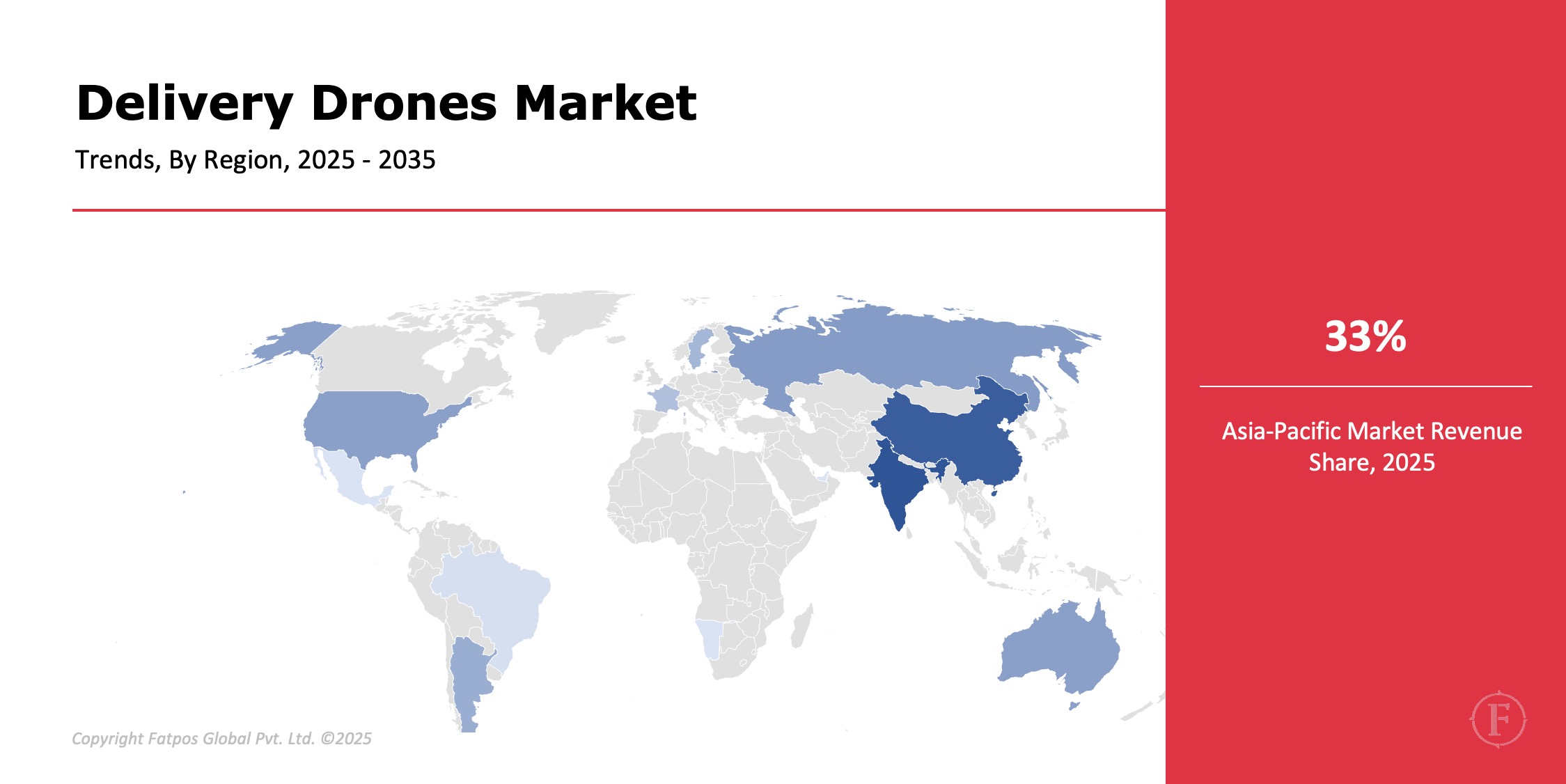
Asia-Pacific is the fastest-growing region, driven by rapid digital commerce expansion, high urban density, and government-backed drone programs. China dominates with large-scale commercial deployments, while India and Japan show rising adoption for healthcare and rural logistics. Latin America presents emerging opportunities, particularly in Brazil and Mexico, where infrastructure gaps favor aerial delivery. The Middle East & Africa remain nascent but demonstrate potential through healthcare logistics and smart city projects.
Segmentation Highlights
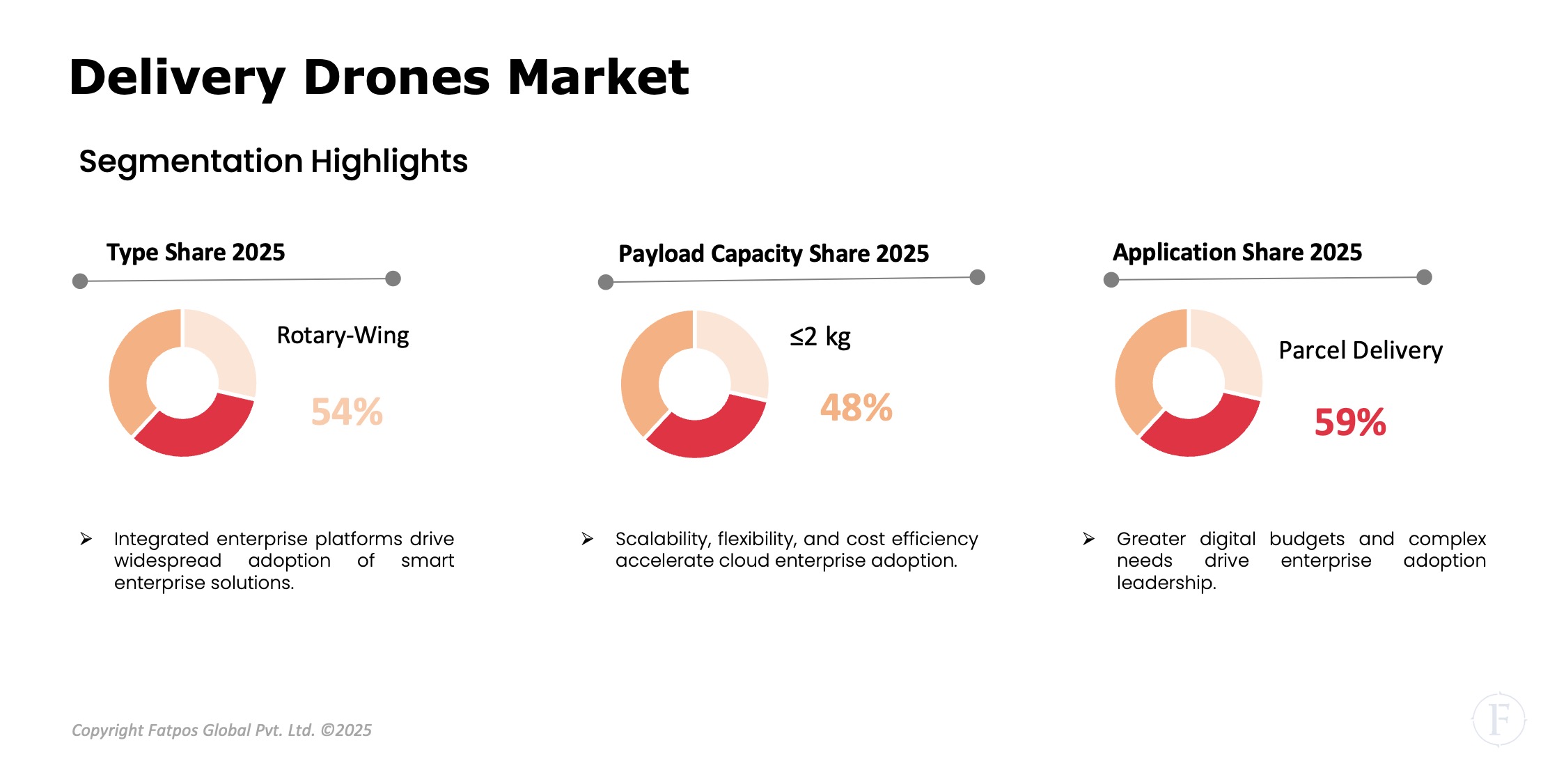
The Delivery Drones Market is segmented by type, payload capacity, application, end user, range, and region. By type, rotary-wing drones dominate due to vertical take-off capability and urban maneuverability.
By payload capacity, drones carrying ≤2 kg hold the largest share, driven by lightweight parcel deliveries. Parcel delivery leads applications, supported by rapid e-commerce growth. E-commerce companies represent the largest end-user segment, leveraging drones for last-mile efficiency. Short-range drones account for the highest share as urban deliveries remain the primary use case.
Report Key Elements
|
ATTRIBUTES |
DETAILS |
|
Study Period |
2019–2035 |
|
Base Year |
2024 |
|
Forecast Period |
2025–2035 |
|
Market Size by 2035 |
USD 16.2 Billion |
|
Market CAGR |
15.8% |
|
By Type |
Fixed-Wing, Rotary-Wing, Hybrid |
|
By Payload Capacity |
≤2 kg, 2–5 kg, >5 kg |
|
By Application |
Parcel Delivery, Food Delivery, Healthcare Delivery, Others |
|
By End User |
E-Commerce, Logistics & Transportation, Food & Beverage, Healthcare, Others |
|
By Range |
Short Range (150 km) |
|
By Region |
North America, Europe, Asia-Pacific, Latin America, MEA |
|
Delivery Drones Market: Key Players |
DJI, Zipline International, Wing Aviation LLC, Amazon Prime Air, UPS Flight Forward, Flytrex |
Global Delivery Drones Industry Instances
- E-commerce giants launched pilot drone delivery programs in major cities
- Logistics providers deployed rotary-wing fleets for rapid last-mile shipments
- Healthcare agencies used drones for vaccine and medical supply distribution
- Postal services partnered with drone tech firms for automated drops
Analyst Review
As per our Delivery Drones Market Analysis, the market is expected to experience strong and sustained growth driven by e-commerce expansion, logistics automation, and healthcare delivery demand. While regulatory and technical challenges remain, continuous advancements in autonomous navigation, battery technology, and airspace management are accelerating commercial deployment. Strategic partnerships and supportive policies will further strengthen long-term market adoption globally.
Frequently Asked Questions (FAQ):
Delivery drones are unmanned aerial vehicles used to transport goods such as parcels, food, and medical supplies via autonomous or semi-autonomous flight.
Growth is driven by rising e-commerce demand, logistics automation, last-mile delivery challenges, and advancements in autonomous navigation and energy storage systems.
Rotary-wing drones dominate due to vertical takeoff flexibility and urban delivery capabilities.
Parcel delivery leads as e-commerce platforms adopt drones for fast shipment.
The market is expected to grow rapidly, supported by technology, regulation evolution, and expanding commercial use cases.
 Select License Type


.png)


