


Mobility Scooter Market Research, 2035
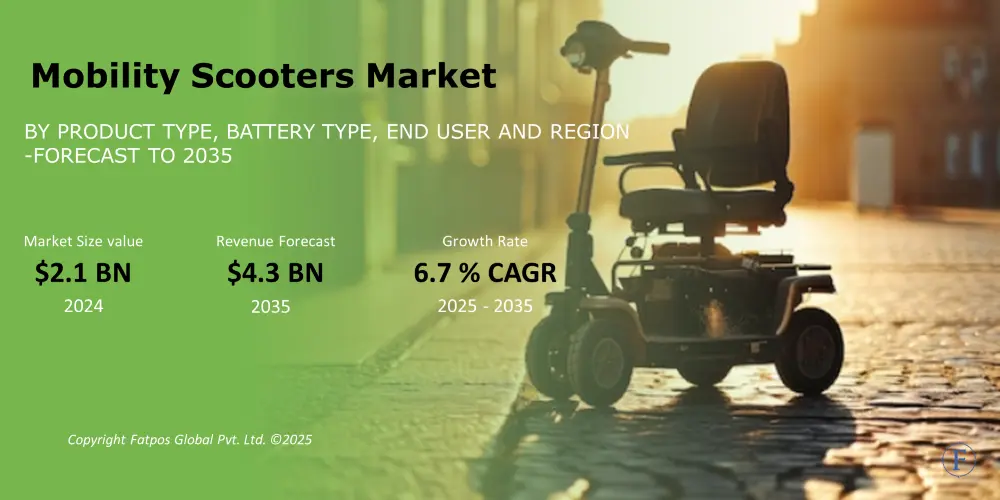
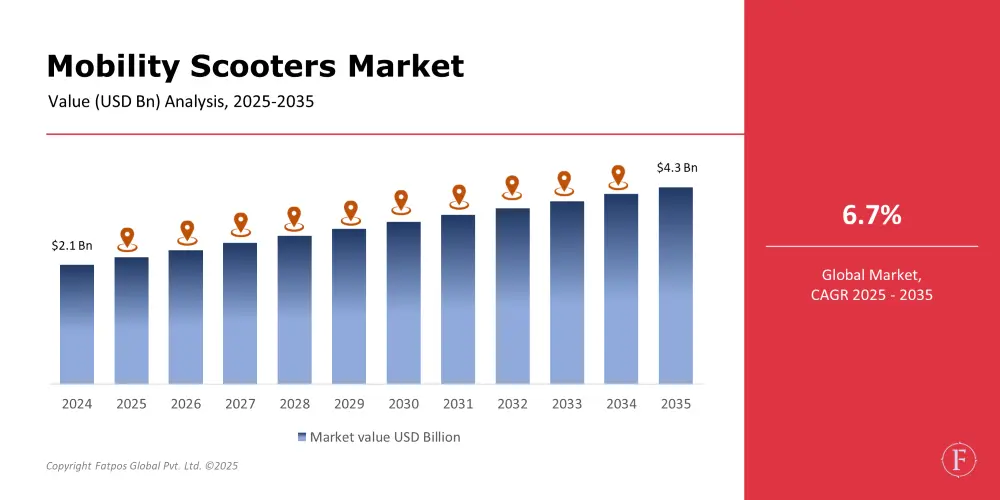
The global Mobility Scooter Market was valued at USD 2.1 billion in 2024 and is projected to reach USD 4.3 billion by 2035, growing at a CAGR of 6.7% from 2025–2035.
The market's expansion is strongly tied to the growing elderly population, increasing chronic disease burden, evolving mobility technologies, and rising emphasis on independent living. Additionally, government-backed reimbursement schemes and healthcare funding—particularly in the US, UK, Germany, Japan, Canada, and Australia—are driving adoption of personal mobility devices at an unprecedented rate.
Product Overview
Mobility scooter is battery-powered personal mobility devices designed to support individuals with limited mobility. These scooters provide comfort, stability, and independence for elderly individuals, patients recovering from orthopedic conditions, and users with chronic mobility impairments. Modern mobility scooter integrates advanced lithium-ion batteries, ergonomic seating, intelligent braking systems, foldable frames, and IoT-enabled tracking features. They are widely used across hospitals, rehabilitation centers, elderly homes, airports, malls, and public infrastructure. As the global population continues to age and healthcare systems shift toward home-based care and self-assisted mobility, the demand for mobility scooter is expected to accelerate significantly.
The Mobility Scooters Market Growth is driven by increasing global aging populations, rising chronic disease prevalence, and expanding investments in healthcare accessibility. Government subsidies, disability reimbursements, and supportive insurance policies further propel market expansion. However, high product costs, battery replacement expenses, and inadequate infrastructure in developing economies remain restraints. Emerging opportunities include the rise of smart mobility scooter, IoT-enabled diagnostics, and fast-expanding rental mobility ecosystems. Challenges persist in the form of safety concerns, limited public awareness, and competition from electric wheelchairs and advanced robotic mobility devices.
 Key Takeaways
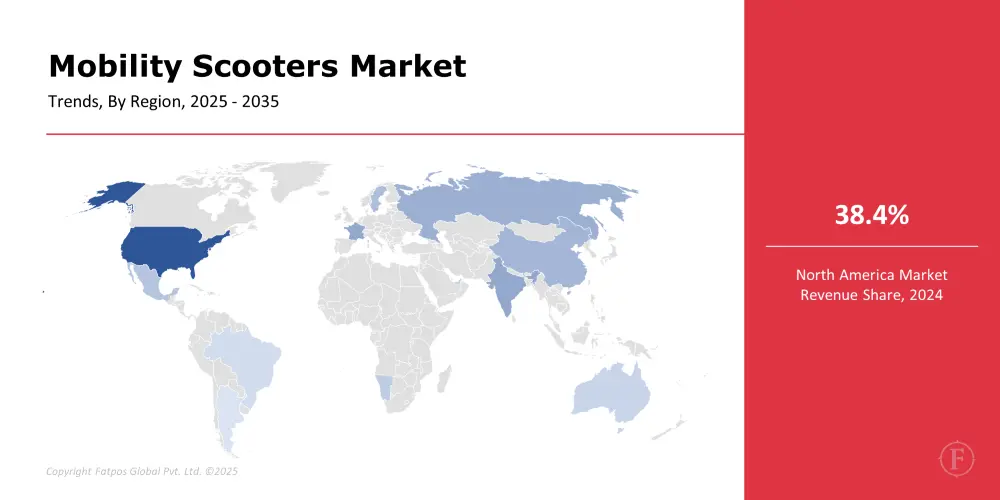
- North America accounted for over 38.4% of the Mobility Scooter Market share in 2024, supported by high healthcare spending and insurance coverage.
- Asia-Pacific is projected to grow at the fastest CAGR of 7.5% from 2025–2035 due to rapid population aging in China, Japan, and South Korea.
- Japan's mobility scooter market is witnessing accelerated adoption, driven by its super-aged demographic and strong robotics ecosystem.
- The United States Mobility Scooter Market Size grew significantly, supported by Medicare reimbursements and expanding elderly care infrastructure.
- By product type, boot scooter dominated the market, supported by rising demand for lightweight, foldable mobility solutions.
- By battery type, lithium-ion scooter captured more than 55% share in 2024, driven by long battery life and lightweight design.
- By end-user, personal mobility accounted for the majority share, reflecting global preference for independent living.
Market Dynamics
Drivers
The mobility scooters market is propelled by a global aging population in nations like Japan, Italy, Germany, South Korea, and the US, where seniors increasingly seek independence through accessible, safe devices, evolving them from medical aids to lifestyle essentials. With the elderly population projected to exceed 1 billion by 2035, demand emerges steadily. Complementing this, healthcare investments and reimbursements in the US, UK, Canada, Germany, and Australia—via subsidies, insurance, and facility purchases—enhance affordability and adoption. The market, valued at around USD 2.3-3.3 billion in 2025, anticipates 6-8% CAGR through 2033.
Restrictions
High costs of advanced mobility scooter market, which feature smart technology, long-range batteries, and orthopedic seating, create affordability barriers, limiting adoption in middle- and low-income countries. Additionally, developing regions like parts of India, Southeast Asia, Latin America, and Africa face infrastructure challenges such as poorly maintained sidewalks and limited accessible transportation options. These factors reduce the practicality and use of mobility scooter, restraining market growth in these areas. Lack of proper urban accessibility and charging infrastructure further hinders the widespread acceptance and usability of these scooters in mobility scooter emerging market.
Opportunities
Technological advancements in mobility scooter offer significant opportunities through smart innovations like IoT-enabled diagnostics, long-lasting lithium batteries, GPS tracking, geofencing, foldable airline-friendly frames, and AI-enhanced stability systems, appealing to younger mobility-impaired users and travels mobility scooter market.
Additionally, the rapid expansion of rental services at hospitals, airports, tourist spots, shopping complexes, and elderly homes is boosting revenue, with strong growth in the US, UK, UAE, Japan, and Europe; The global mobility scooter rental market reached USD 1.24 billion in 2024 and is projected to hit USD 2.93 billion by 2033 at a 9.8% CAGR.
Challenges
Safety concerns with mobility scooter are escalating due to rising accident reports, particularly among elderly users facing risks from over-speeding, improper handling, and uneven pathways, which erode consumer confidence through negative publicity. In the UK alone, 2022 saw nine fatalities and 270 injuries from road collisions involving scooter users.
Competition intensifies from advanced electric wheelchairs, exoskeletons, and robotic devices, as evolving robotics draws users toward more compact, automated alternatives over traditional scooter.
Regional Analysis
North America dominates the mobility scooter market with over 38% global revenue share, led by the US due to robust insurance, healthcare infrastructure, and elderly care; Canada's universal policies boost adoption. Europe ranks second, fueled by aging populations and subsidies in Germany, UK, and France with elder-friendly infrastructure. Asia-Pacific grows fastest, driven by Japan's high demand, China's production, and South Korea's tech (24% share). Latin America (Brazil, Mexico) and Middle East/Africa (UAE, Saudi Arabia) see rising adoption via healthcare upgrades and tourism rentals .
Segmentation Analysis
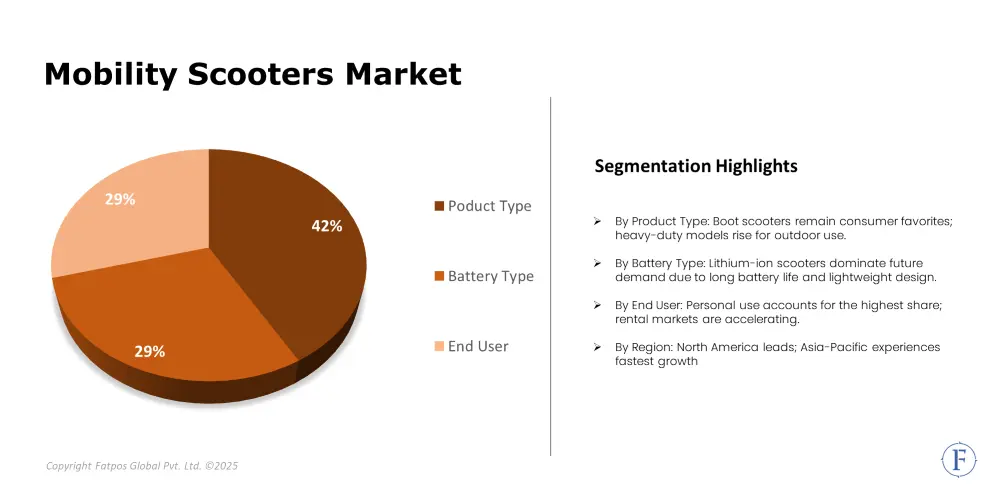
Boot scooter lead the market due to their lightweight, foldable, and travel-friendly design, making them the preferred choice for personal use. Lithium-ion battery-powered scooter see the fastest adoption because of their long battery life, reduced weight, quick charging, and enhanced safety features. The personal use segment dominates the market, driven by elderly individuals and patients with chronic diseases preferring home-based mobility aids. Meanwhile, hospitals and elderly care homes are fast-growing segments, supported by increasing healthcare investments. These factors together shape product preferences and industry growth in the mobility scooter market.
Key Players Featured in the Report
The global Mobility Scooter Industry includes several leading manufacturers producing innovative mobility devices, such as:
- Pride Mobility
- Invacare
- DeVilbiss Drive
- Golden Technologies
- Sunrise Medical
- Shoprider
- Afikim Electric Vehicles
- TGA Mobility
- Green Power Mobility
- FreeRider
- Amigo Mobility
- Metro Mobility
- Hoveround
- E-Wheels Mobility
- Quingo Mobility
- Other Prominent Players
Report Key Elements
|
Report Key Elements |
Details |
|
Study Period |
2024–2035 |
|
Market Size by 2035 |
USD 4.3 billion |
|
Market CAGR |
6.7% |
|
By Product Type |
Boot, Mid-size, Heavy-duty |
|
By Battery Type |
SLA, Lithium-Ion |
|
By End-User |
Personal, Hospitals, Elderly Homes, Mobility Rentals |
|
By Region |
North America, Europe, Asia-Pacific, Latin America, Middle East & Africa |
|
Key Market Players |
Pride Mobility, Invacare, Drive DeVilbiss, Golden Technologies, and others |
Key Developments
- Pride Mobility unveiled a lightweight lithium-ion mobility scooter with enhanced range and portability in 2024.
- Invacare launched a next-generation mobility device with upgraded suspension and safety features.
- TGA Mobility partnered with healthcare facilities across Europe to expand rental fleets.
- Afikim introduced an all-terrain heavy-duty scooter for outdoor mobility.
- In 2023, Golden Technologies expanded its manufacturing operations to meet rising demand across North America.
- In 2022, Shoprider launched a smart travel scooter featuring enhanced foldability.
- In 2024, Sunrise Medical introduced a lithium-based scooter targeting active seniors.
Analyst Review
The Mobility Scooters Market Analysis highlights strong growth potential driven by demographic trends, supportive insurance policies, and technological advancements. Analysts emphasize that lithium-ion scooters, smart mobility solutions, and rental fleets will shape the next decade of mobility innovation. Manufacturers that invest in lightweight engineering, digital integration, and ergonomic designs will maintain strong competitive positioning. The long-term Mobility Scooters Market Forecast remains highly positive, with sustained demand from elderly consumers and healthcare ecosystems.
Frequently Asked Questions (FAQ):
The market is projected to grow from USD 2.1 billion in 2024 to USD 4.3 billion by 2035, at a CAGR of 6.7%, driven by aging populations, healthcare investments, and technological innovations.
North America holds over 38% of the global market share due to strong insurance coverage, healthcare infrastructure, and growing elderly care investments.
Boot scooter hold the largest share due to their lightweight, foldable design and convenience for personal use.
Lithium-ion mobility scooter are experiencing the highest growth because of their durability, lighter weight, fast charging, and long operating ranges.
Manufacturers, component suppliers, healthcare providers, rental mobility operators, investors, consultants, and government agencies involved in elderly care and assistive mobility solutions.
 Select License Type


.png)


