


Structured Finance Market Research 2035
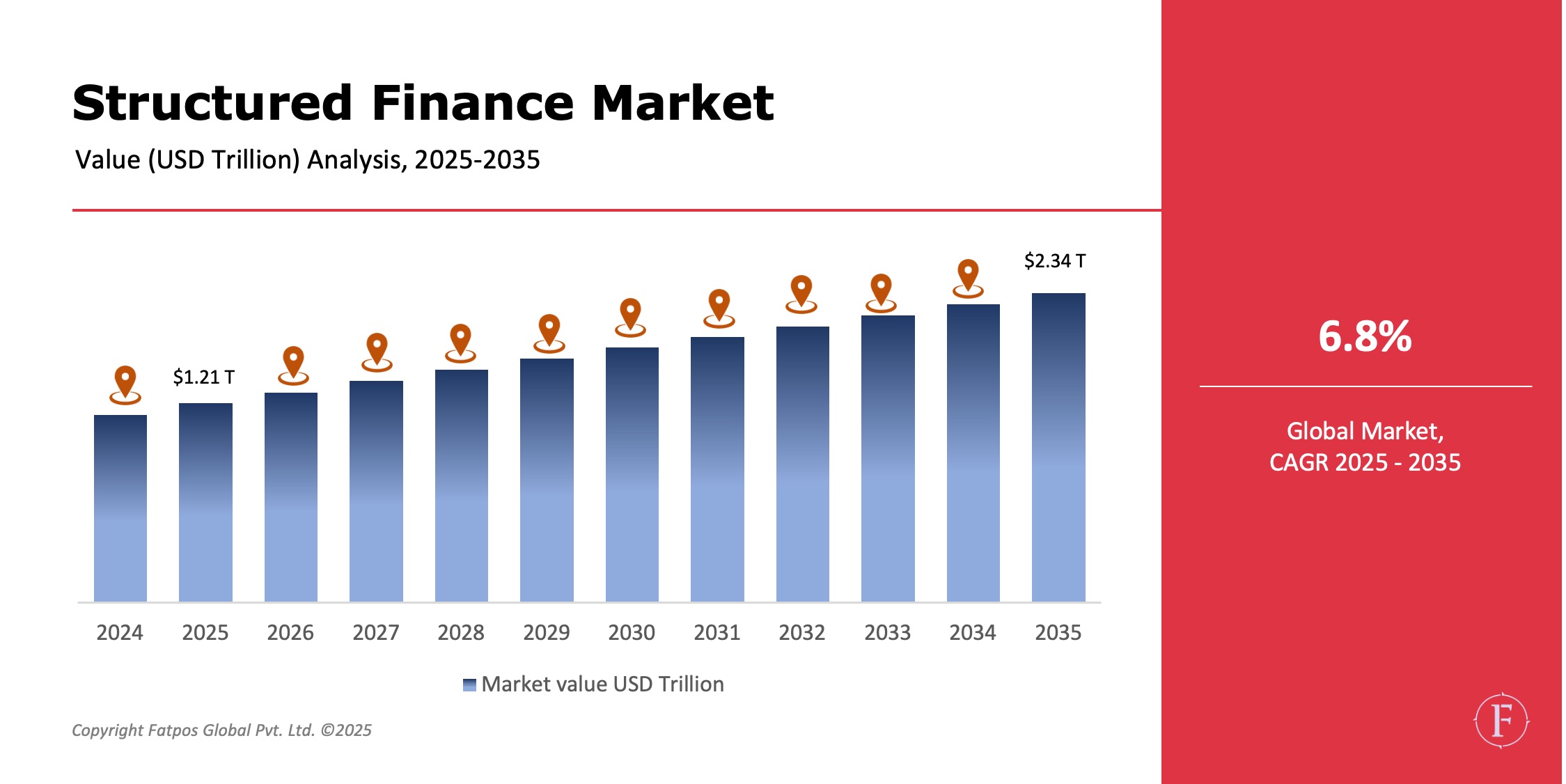
The Structured Finance Market was valued at approximately USD 1.21 trillion in 2025 and is projected to reach USD 2.34 trillion by 2035, registering a CAGR of 6.8% during the forecast period. Market growth is driven by rising demand for customized risk-transfer solutions, balance sheet optimization, and increasing institutional investor participation across global capital markets.

Structured finance instruments enable the pooling, tranching, and redistribution of financial risks associated with loans, receivables, and other income-generating assets. These structures enhance liquidity, improve capital efficiency, and provide tailored return profiles for investors with varying risk appetites. Increasing regulatory capital requirements for banks and growing demand for yield-enhancing products continue to strengthen the role of structured finance globally.
Product Overview
Structured finance refers to complex financial instruments created through securitization, credit enhancement, and derivative integration. Common products include asset-backed securities (ABS), mortgage-backed securities (MBS), collateralized loan obligations (CLOs), and collateralized debt obligations (CDOs). These instruments are backed by pools of underlying assets such as mortgages, corporate loans, consumer receivables, and commercial credits.
Structured finance products are primarily issued by financial institutions and distributed to institutional investors, hedge funds, insurance companies, and asset managers. Credit enhancement mechanisms, including subordination, overcollateralization, and guarantees, are used to manage default risk and improve credit ratings. The market plays a critical role in capital formation, risk diversification, and financial system liquidity.
Key Takeaways:
- Structured Finance Market expected to grow at 6.8% CAGR through 2035
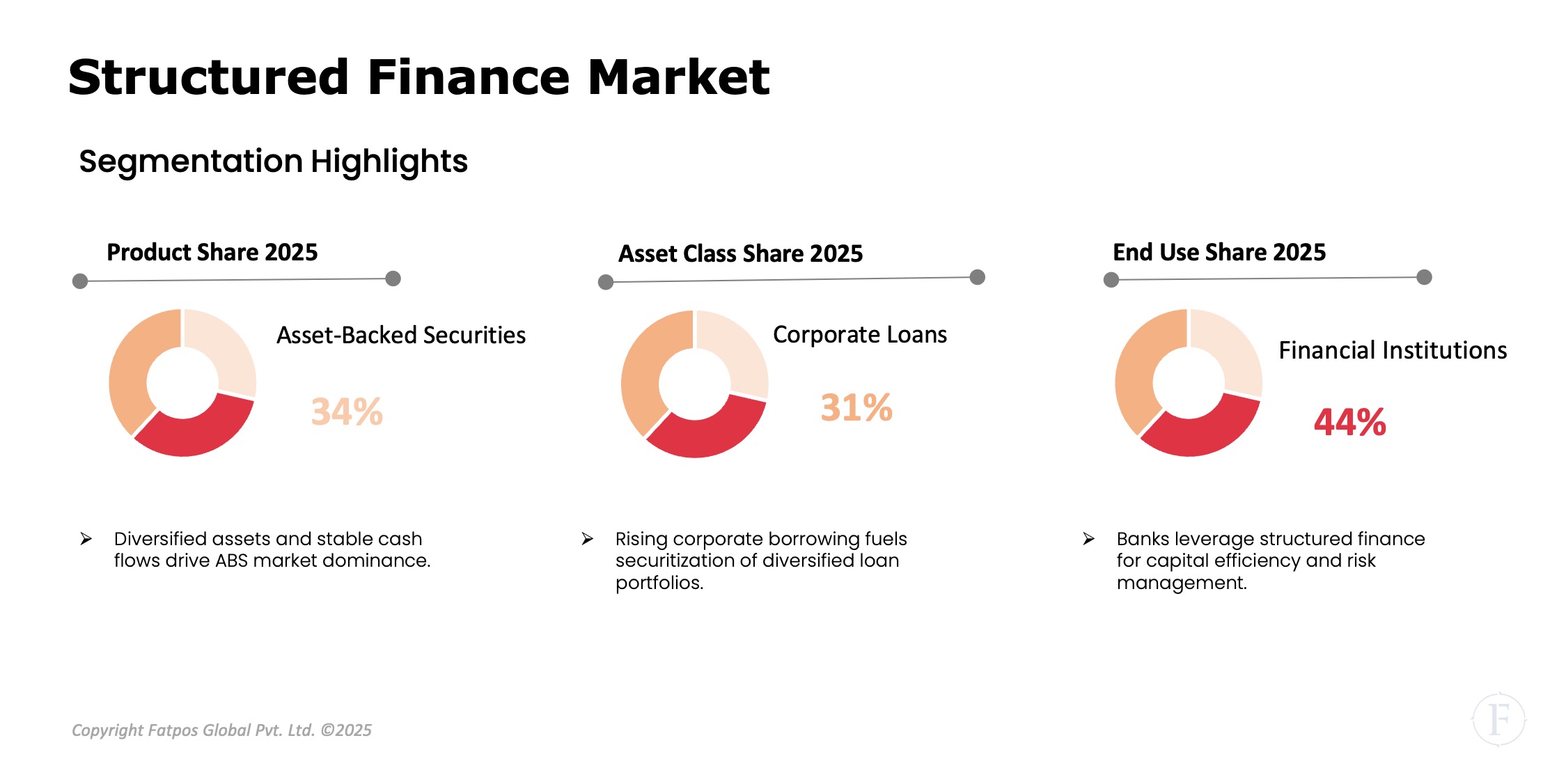
- Asset-backed securities dominate the product type segment
- Corporate loans represent the largest asset class
- Financial institutions remain the primary end users
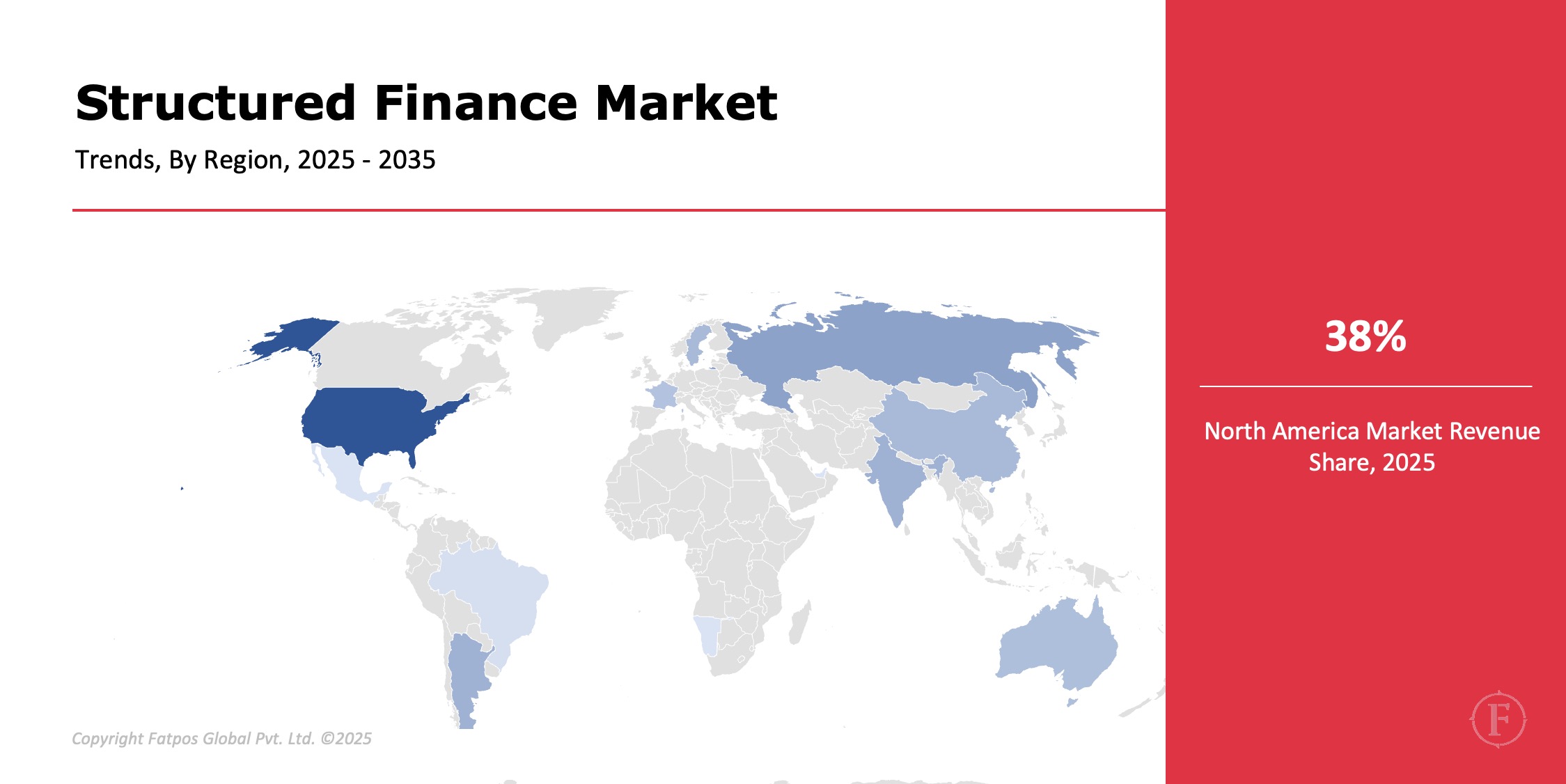
- North America leads due to advanced securitization frameworks
Market Dynamics
Drivers
The Structured Finance Market is driven by increasing demand for capital efficiency and risk management among financial institutions. Banks and lenders use securitization to free up balance sheet capacity and meet regulatory capital requirements. Growing institutional investor appetite for yield-enhancing and diversified investment products further accelerates market growth.
Low interest rate environments and expanding private credit markets have increased reliance on structured finance instruments. Rising corporate borrowing and consumer credit expansion also contribute to a growing asset pool for securitization. Technological advancements in data analytics and credit modeling are improving asset evaluation and deal structuring efficiency.
Restraints
Despite strong demand, structured finance adoption is restrained by product complexity and limited transparency. Highly customized deal structures require advanced risk assessment capabilities, restricting participation by smaller investors. Regulatory scrutiny following past financial crises has increased compliance costs and lengthened approval timelines.
Market volatility and macroeconomic uncertainty can impact asset performance and investor confidence. Inconsistent regulatory frameworks across regions further complicate cross-border structured finance transactions, limiting scalability for global issuers.
Opportunities
Emerging markets offer significant opportunities for structured finance expansion as financial systems mature and credit penetration increases. Growth in private credit, infrastructure financing, and SME lending is creating new securitization opportunities. ESG-linked structured products and green securitization are gaining traction as sustainability becomes a key investment criterion.
Digital platforms, blockchain-based securitization, and automated compliance tools are improving transparency and operational efficiency. These innovations reduce issuance costs and expand access to structured finance products across diverse investor segments.
Challenges
The Structured Finance Market faces challenges related to valuation complexity, regulatory compliance, and risk transparency. Complex deal structures make accurate pricing and risk assessment difficult. Regulatory requirements vary significantly across regions, increasing compliance costs and operational burden. Market downturns can rapidly deteriorate asset performance, impacting tranche stability.
Limited standardization, lengthy documentation, and reliance on credit rating agencies further complicate market operations. Strengthening disclosure practices, improving data quality, and enhancing regulatory harmonization remain key challenges for sustainable market growth.
Structured Finance Market Trends
The market is witnessing increased adoption of collateralized loan obligations supported by expanding private credit markets. Automation in deal structuring and AI-driven credit analytics are improving efficiency and risk assessment accuracy. Demand for ESG-compliant structured products is rising, driven by institutional sustainability mandates.
Banks are increasingly partnering with fintech firms to digitize securitization processes. Additionally, private placements and bespoke structured solutions are gaining popularity among institutional investors seeking customized exposure and enhanced returns.
Key Players in the Global Structured Finance Industry
- JPMorgan Chase & Co.
- Goldman Sachs Group
- Morgan Stanley
- Citigroup Inc.
- Bank of America
- Barclays PLC
- BNP Paribas
- HSBC Holdings
- Deutsche Bank
- UBS Group
Regional & Country Analysis
North America dominates the structured finance market due to advanced capital markets, strong investor participation, and well-established securitization regulations. The United States leads global issuance, supported by deep private credit and mortgage markets. Europe holds a significant share, driven by structured credit demand and regulatory reforms supporting transparency.
Asia-Pacific is the fastest-growing region, fueled by expanding credit markets in China, India, and Southeast Asia. Latin America and the Middle East & Africa present emerging opportunities as financial infrastructure and regulatory frameworks improve.
Segmentation Highlights
The Structured Finance Market is segmented by product type, asset class, end user, and region. Asset-backed securities dominate due to diversified underlying assets and predictable cash flows. Corporate loans represent the largest asset class, supported by rising corporate financing needs. Financial institutions lead end-user adoption, utilizing structured finance for capital optimization. Regionally, North America maintains leadership due to regulatory maturity and investor depth.
Report Key Elements
|
ATTRIBUTES |
DETAILS |
|
Study Period |
2019–2035 |
|
Base Year |
2024 |
|
Forecast Period |
2025–2035 |
|
Market Size by 2035 |
USD 2.34 Trillion |
|
Market CAGR |
6.8% |
|
By Product Type |
ABS, MBS, CLOs, CDOs, Others |
|
By Asset Class |
Residential Mortgages, Commercial Mortgages, Corporate Loans, Consumer Loans, Others |
|
By End User |
Financial Institutions, Investment Funds, Corporates |
|
By Region |
North America, Europe, Asia-Pacific, Latin America, MEA |
|
Structured Finance Market: Key Players |
JPMorgan Chase & Co., Goldman Sachs Group, Morgan Stanley, Citigroup Inc., Bank of America |
Global Structured Finance Industry Instances
- Banks expanded CLO issuance to support growing private credit markets
- Asset managers increased ESG-linked structured product offerings
- Fintech platforms automated securitization and compliance workflows
- Regulators strengthened transparency requirements across structured finance transactions
Analyst Review
As per our Structured Finance Market analysis, the market will witness sustained growth through 2035 driven by rising securitization demand, institutional investment, and regulatory-driven capital optimization. While complexity and compliance remain challenges, technological advancements and product innovation will strengthen long-term market resilience.
Frequently Asked Questions (FAQ):
Structured finance involves complex financial instruments that redistribute risk through securitization and credit enhancement.
Growth is driven by capital efficiency needs, investor demand for yield, and expanding credit markets.
Asset-backed securities dominate due to diversified asset pools and predictable returns.
Financial institutions are the primary users for balance sheet and risk management.
North America leads due to mature capital markets and advanced securitization regulations.
 Select License Type


.png)


