



Algorithmic Trading Market Research, 2034
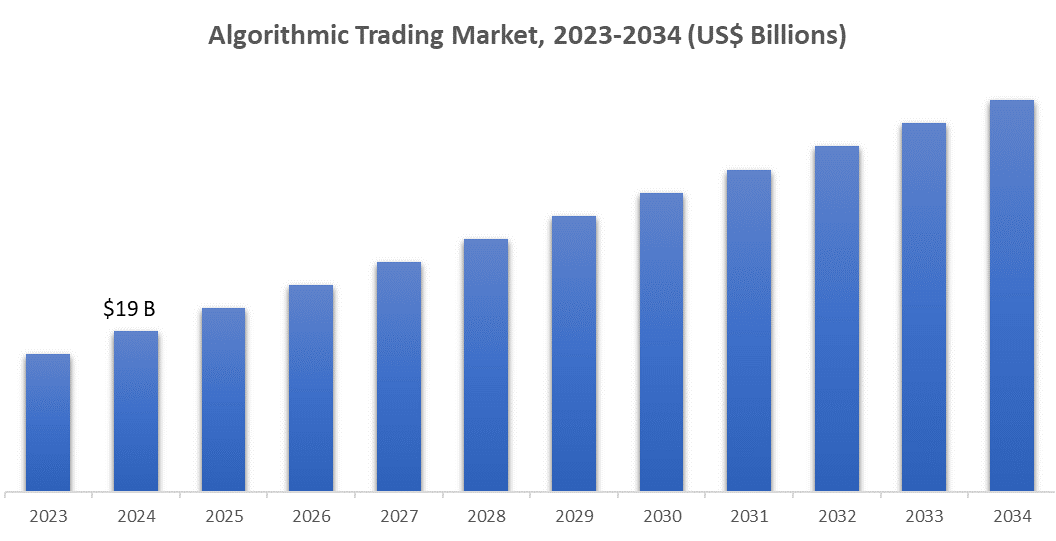
The global algorithmic trading market size is anticipated to grow at a CAGR of 12.1% in the forecast period (2024-2034), with the market size valued at US$ 16.19 billion in 2023 and projected to reach US$ 59.8 billion by 2034.
Algorithmic trading, also known as automated trading, is the process of implementing trading orders or instructions based on a well-defined computer program. This program follows pre-made instructions to place orders or execute trades. Amongst the growing financial sector, algorithmic trading is the most popular trading and investing tool in the 21st century.
Algorithmic Trading is widely used by Mutual Funds, Investment Bankers, Crypto Investors, Pension Funds, Hedge Funds, and ETF Managers. However, it is also available for private investors interested in the Financial Markets. Algorithmic Trading helps investors and traders by executing trading orders automatically once given a clear set of instructions to follow. Algorithmic trading tools can be accessed through various cloud-based brokerage and trading software provided by various financial companies.
Market Highlights
The market is growing due to the increasing use of smart algorithms and techniques in the trading patterns and software used by Investors, Hedge Funds Investment Bankers and Others. The further integration of algorithmic trading in various financial spaces such as crypto markets and forex trading helps investors and traders conduct predictive analysis using mathematical models.
These models predict future prices or ranges that can be attained while trading, enabling investors to take various risk measures and appropriate steps to maximize earnings in the markets. The expansion and development of new algorithmic models will help boost growth in the market in the future.
Market Segmentation
Increased Participation in Stock Market will drive future market growth
The market based on Type is categorized into Stock Market, Commodity Market, Forex (Foreign Exchange), Bonds, ETF and others. The stock market segment dominates the category due to its higher market cap and widespread participation from major traders, investment companies, and houses. Algorithmic mathematical models and programs, when applied to stock market indices and individual stocks, facilitate the examination of historical prices and uncover hidden trading patterns through predictive analysis.
This not only saves costs but also time for investors. In other investment markets such as forex, and bonds, algorithmic trading has shown sustainable growth. The main advantage of algorithmic trading lies in its ability to implement trading strategies at a faster speed, thus reducing potential losses for users. This efficiency and accuracy make algorithmic trading an increasingly popular choice among investors across various financial markets.
Short-term investors will fuel the growth of the Market
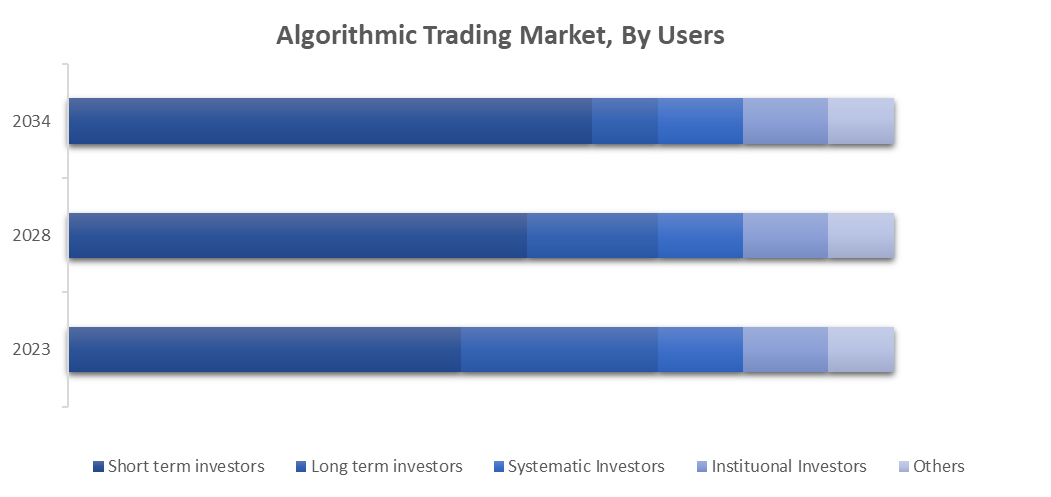
The market based on Users is segmented into Long Term Investors, Short Term Investors, Systematic Investors, Institutional Investors and Others. Short-term investors and traders rely heavily on algorithmic trading models and patterns to capitalize on short time periods and maximize earnings. These algorithms excel at analyzing short-term price movements around equities and forecasting them accordingly. Short-term investors can use algorithmic trading to implement complicated strategies, allowing them to carry out several large deals with efficiency and precision.
While algorithmic trading can be used by long-term and institutional investors, it is less popular among them. Long-term investors often prioritize aspects such as corporate profitability and earnings multiples when making investment decisions, which may differ from the tactics used by computational models. Nonetheless, algorithmic trading remains an effective tool for short-term traders looking to capitalize on market inefficiencies and price volatility.
Market Dynamics:
Growth Drivers
Increased Automation Demand is surging the growth for the Market
The growing demand for automation in financial markets has pushed up the popularity of algorithmic trading. Investment banks, hedge funds, and individual investors are increasingly relying on algorithm-based solutions to complete trading orders quickly and reliably. Automation not only lowers errors, but it also ensures that stocks are delivered on time and enables precise implementation of sophisticated trading techniques.
As financial markets evolve and become more efficient, the use of automation becomes critical to remain competitive. This trend is driving the growth of the market, as market participants see the benefits of using technology to improve trading efficiency and capitalize on market opportunities. As automation becomes more integrated into financial operations, algorithmic trading is expected to play an even greater role in shaping the markets future.
Approval and Encouragement for the use of Algorithmic Trading by Global Market Regulators
Governments and regulators throughout the world are increasingly supportive of algorithmic trading, implementing rules to encourage its growth. Algorithmic trading provides various benefits, including better order execution and a faster flow of information, resulting in a more transparent market. Governments can promote algorithmic trading on a global scale, raising the creation of stronger frameworks for cross-border international trade.
This not only inspires increased market involvement but also helps to reduce the risks connected with trading operations. Furthermore, the use of algorithmic trading can improve market liquidity and price discovery procedures, leading to increased market efficiency and stability. As authorities continue to embrace algorithmic trading and its potential benefits, it opens the door to a more interconnected and resilient global financial ecosystem.
Restraints
Technological Risks Can have a Negative Influence the Algorithmic Trading Industry
Technological advancements are essential to algorithmic trading, but they also carry similar hazards. Excessive reliance on technology for complex arrangements can lead to technical issues, system failures, and cyber threats. Such risks may result in financial losses and reduce public interest in algorithm-based trading. As a result, ongoing cybersecurity investments and compliance to regulatory-mandated safety standards are essential.
Market players can reduce the potential hazards associated with algorithmic trading by prioritizing cybersecurity measures and adhering to regulatory rules. This preventive approach not only protects investor interests, but also creates trust and confidence in algorithm-based trading, ensuring its continued expansion and viability in the financial markets.
Recent Developments
- In 2023, Virtu Financial acquired KGC Holdings, a leading financial technology company for $ 5.4 billion, in order to expand its presence in the electronic trading market.
- In 2023, Tradetron Launched its AI tool that uses artificial intelligence for developing algorithmic and trading strategies for traders. They have collectively focused on building educational resources or tutorials to help users understand and implement algorithmic trading strategies.
- In 2023, Renaissance Technologies filed a patent for developing a new machine learning method that trade on market volatility which can develop new strong trading strategies.
- In 2023, Tower Research launched Tower Capital Quantum, a trading platform that uses quantitative computing to develop and trade with the help of algorithmic strategies.
- In 2023, Two Sigma Investments Acquired RiskMetrics, a provider of risk management services for financial institutions.
- In 2023, Jump Trading remains a major market player using sophisticated algorithms to provide liquidity across various asset classes. There have been industry reports suggesting Jump Trading's investment in artificial intelligence (AI) for their trading algorithms. This is likely an ongoing trend for many algorithmic trading firms.
Key Players
- Virtu Financial
- Citadel Securities
- Tradetron
- Renaissance Technologies
- Jump Trading
- De Shaw & Co
- Tower Research Capital
- Two Sigma Investments
- Optiver
- Market Factory
- XTX Markets
- IMC Financial Markets
- Quantlab
- Teza Technologies
- Numerai
- Other Prominent Players (Company Overview, Business Strategy, Key Product Offerings, Financial Performance, Key Performance Indicators, Risk Analysis, Recent Development, Regional Presence, SWOT Analysis)
Regional Analysis
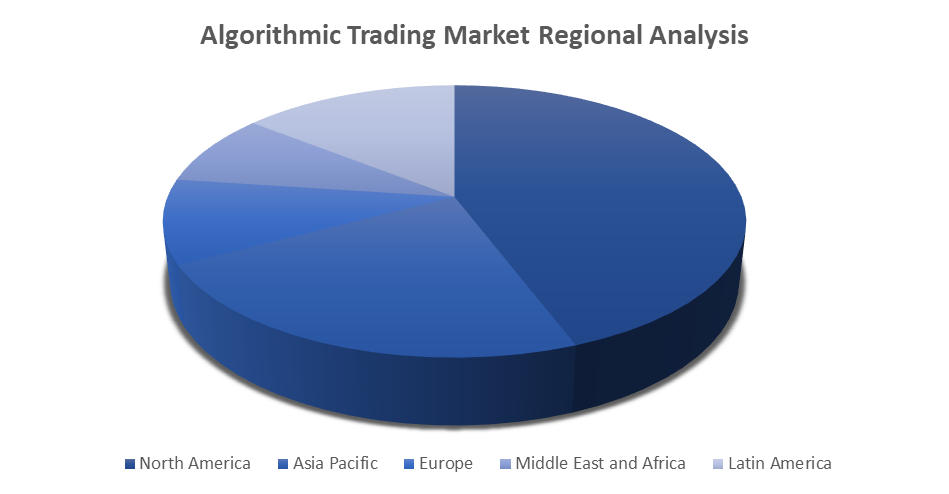
The global algorithmic trading market is segmented based on regional analysis into five major regions: North America, Latin America, Europe, Asia Pacific and the Middle East and Africa.
The North American region dominates the market due to the region’s well-developed financial sector, large number of financial institutions and financial literacy among the population. Major algorithmic trading firms around the globe are situated in countries like USA and Canada.
Europe and Asia Pacific region have a substantial and growing market for the Algorithmic Trading Segment, with increasing investment in technology, growing financial sector and increasing education about algorithm trading is helping the region to grow at a decent rate. The United Kingdom and Germany hold the largest share in the European Region, while China and India are the predominant forces in the Asia-Pacific Region.
Market is further segmented by region into:
- North America Market Size, Share, Trends, Opportunities, Y-o-Y Growth, CAGR – United States and Canada
- Latin America Market Size, Share, Trends, Opportunities, Y-o-Y Growth, CAGR – Mexico, Argentina, Brazil, and Rest of Latin America
- Europe Market Size, Share, Trends, Opportunities, Y-o-Y Growth, CAGR – United Kingdom, France, Germany, Italy, Spain, Belgium, Hungary, Luxembourg, Netherlands, Poland, NORDIC, Russia, Turkey, and Rest of Europe
- Asia Pacific Market Size, Share, Trends, Opportunities, Y-o-Y Growth, CAGR – India, China, South Korea, Japan, Malaysia, Indonesia, New Zealand, Australia, and Rest of APAC
- Middle East and Africa Market Size, Share, Trends, Opportunities, Y-o-Y Growth, CAGR – North Africa, Israel, GCC, South Africa, and Rest of MENA
Market Scope and Segments
|
ATTRIBUTE |
DETAILS |
|
Study Period |
2018-2034 |
|
Base Year |
2023 |
|
Forecast Period |
2024-2034 |
|
Historical Period |
2019-2022 |
|
Growth Rate |
CAGR of 12.1% from 2024-2034 |
|
Unit |
Value (US$ Billion) |
|
Segmentation |
Main Segments List |
|
By Type |
|
|
By End User |
|
|
By Deployment |
|
|
By Region |
|
Frequently Asked Questions (FAQ):
The global algorithmic trading market size was values at US$ 16.19 billion in 2023 and is projected to reach the value of US$ 59.8 billion in 2034, exhibiting a CAGR of 12.1% during the forecast period.
The market refers to the sector of financial trading where algorithms are utilized to execute high-speed and automated trades based on pre-programmed instructions, strategies, and mathematical models, aimed at optimizing trading efficiency and profitability.
The Stock Market segment and the Short-Term Investors accounted for the largest market share.
Key players in the global algorithmic trading market include Citadel Securities, De Shaw & Co, IMC Financial Markets, Jump Trading, Market Factory, Numerai, Optiver, Quantlab, Renaissance Technologies, Teza Technologies, Tower Research Capital, Tradetron, Two Sigma Investments, Virtu Financial, and XTX Markets and Other Prominent Players.
Growing adoption of automation and algorithm-based models in financial sector is driving the growth for the market.
 Select License Type


.png)


