


Natural Disaster Insurance Market Research 2035
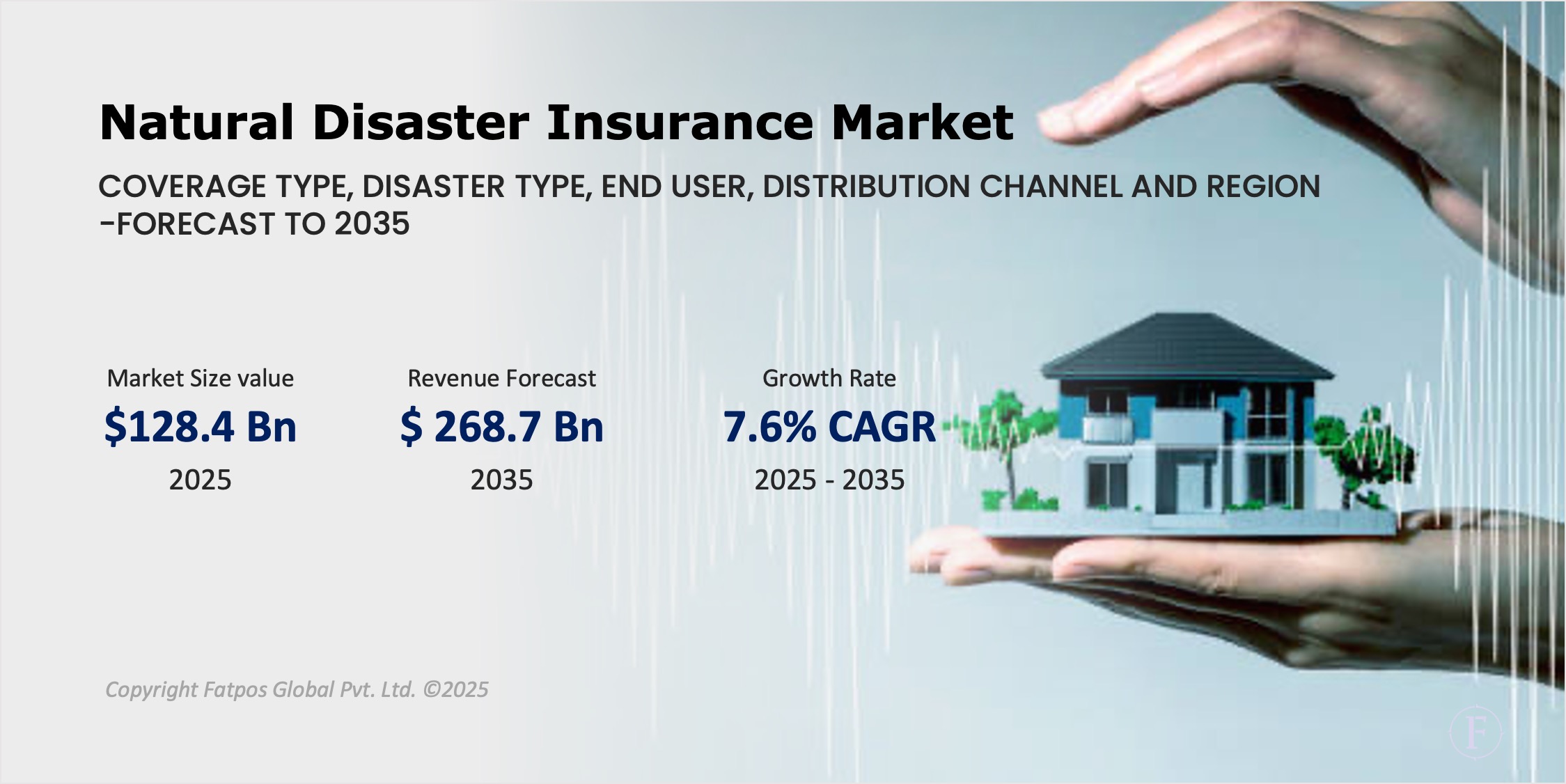
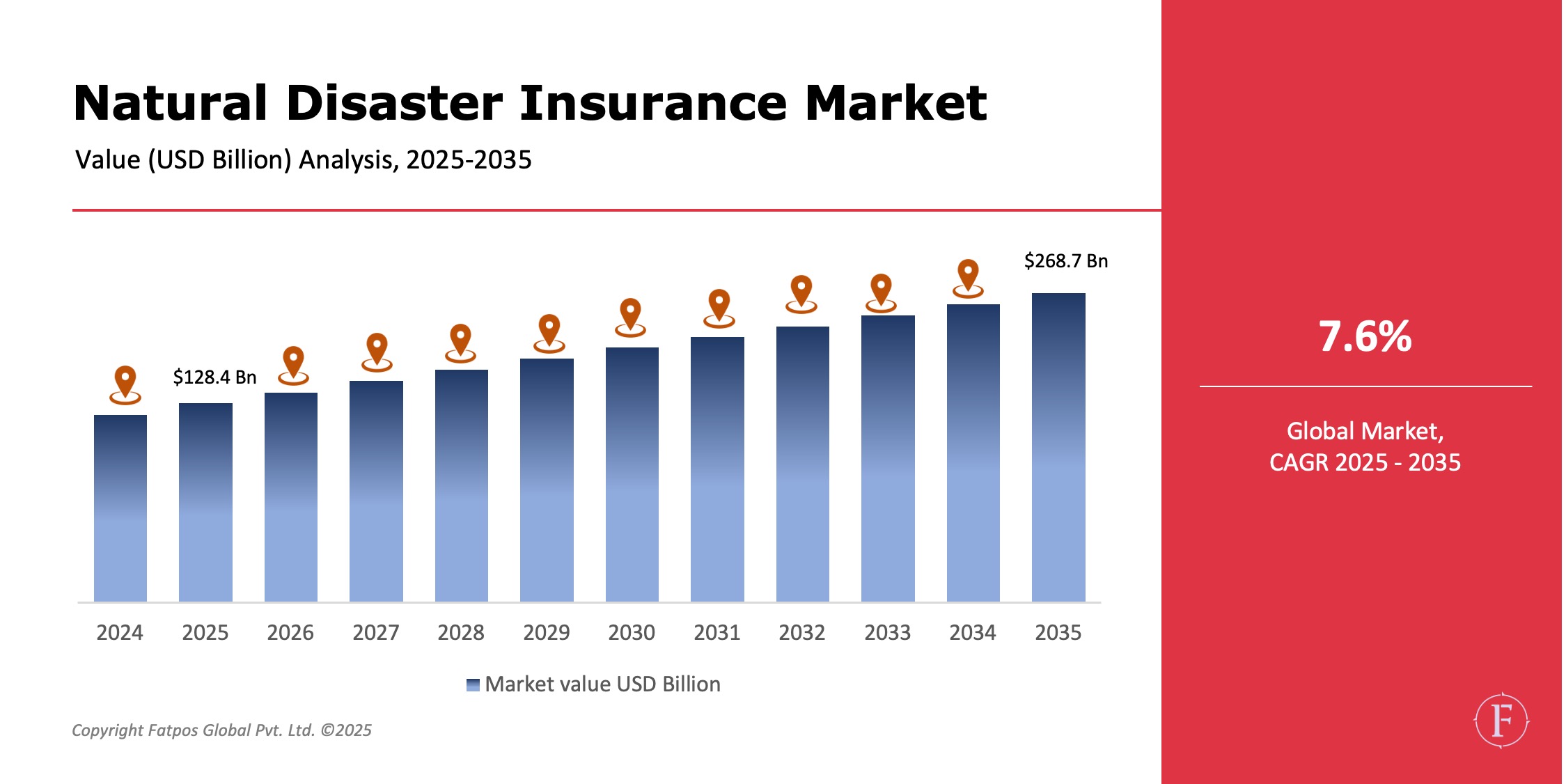
The Natural Disaster Insurance Market was valued at approximately USD 128.4 billion in 2025 and is projected to reach USD 268.7 billion by 2035, registering a CAGR of 7.6% during the forecast period. Market growth is primarily driven by increasing frequency and severity of natural disasters, rising economic losses, and growing awareness of financial risk protection.
Natural disaster insurance provides financial coverage against losses caused by catastrophic events such as earthquakes, floods, hurricanes, wildfires, and storms. Climate change, urbanization in high-risk zones, and expanding asset values are significantly increasing insured losses, prompting governments, businesses, and individuals to seek comprehensive insurance solutions. Insurers are also leveraging advanced risk modeling and data analytics to improve underwriting accuracy and premium pricing.
Product Overview
Natural disaster insurance includes specialized insurance products designed to cover property damage, business interruption, agricultural losses, and infrastructure damage caused by natural catastrophes. Coverage can be offered as standalone policies or bundled within broader property and casualty insurance products.
Policies typically compensate for repair costs, income loss, crop failure, and reconstruction expenses. Governments often support disaster insurance markets through public-private partnerships, reinsurance mechanisms, and mandatory insurance schemes. Advances in satellite imagery, catastrophe modeling, and climate risk analytics are improving claims assessment and loss forecasting, enhancing market efficiency and insurer resilience.
Key Takeaways:
- Natural Disaster Insurance Market expected to grow at 7.6% CAGR through 2035
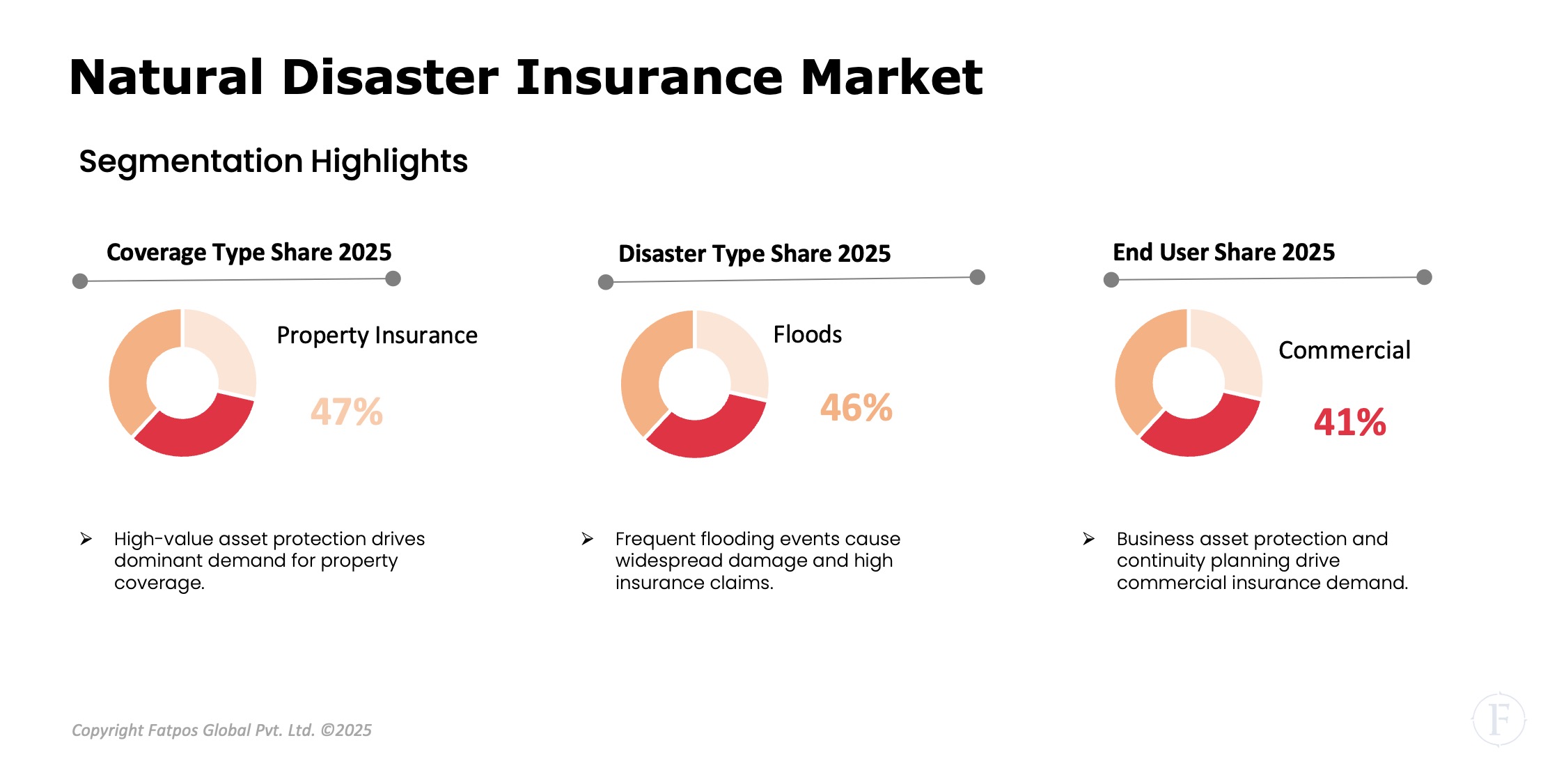
- Property insurance dominates coverage type segmentation
- Floods represent the largest insured disaster category
- Commercial sector accounts for the highest end-user share
- Brokers and agents remain the leading distribution channel
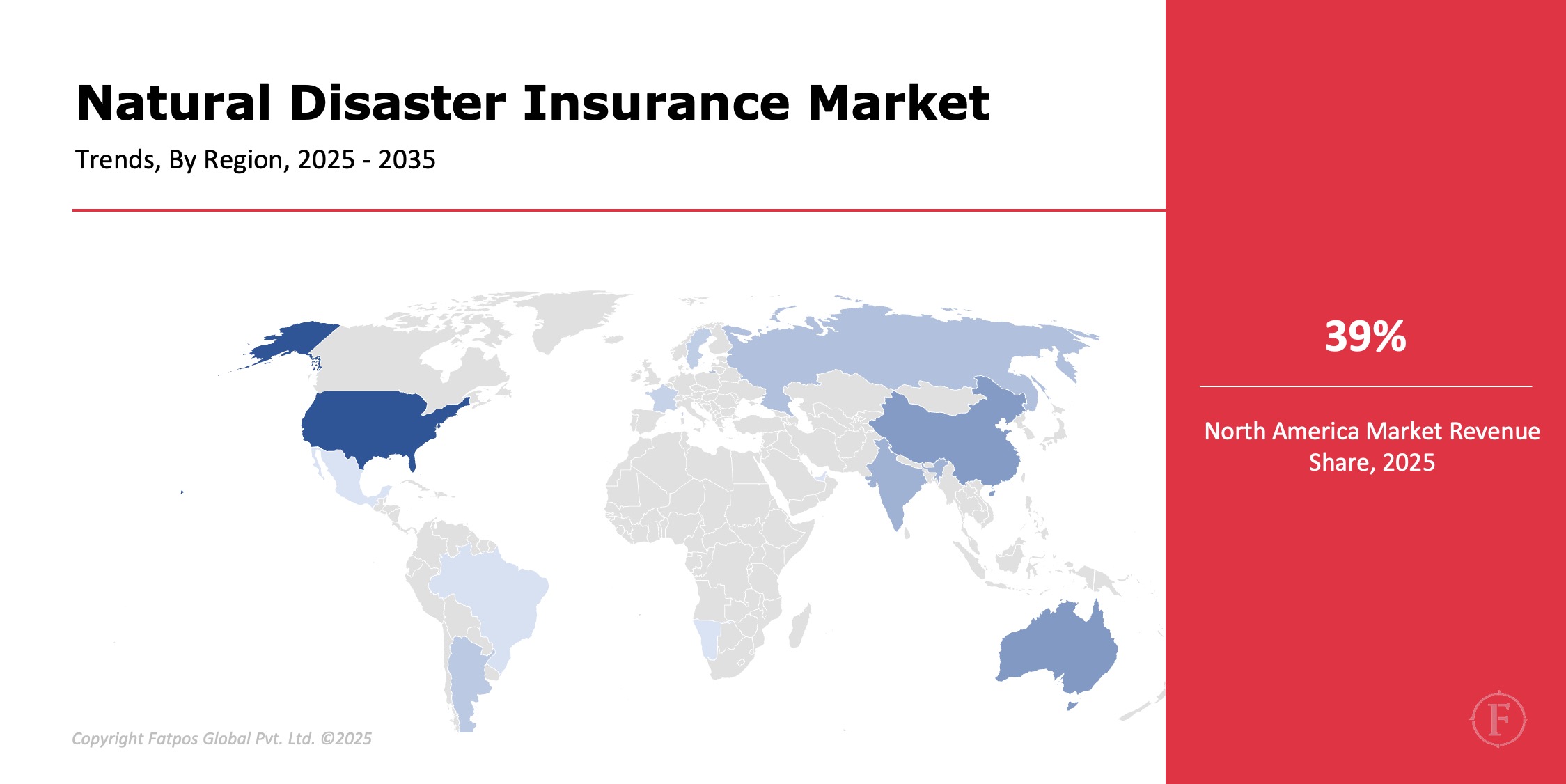
- North America leads the global market
Market Dynamics
Drivers
The Natural Disaster Insurance Market is driven by the rising frequency and intensity of climate-related disasters globally. Increasing urban development in disaster-prone regions significantly elevates insured asset exposure. Governments and regulatory bodies are mandating disaster risk coverage, particularly for floods and earthquakes.
Growing awareness among businesses regarding business interruption risks further boosts demand. Technological advancements in catastrophe modeling, satellite monitoring, and AI-based risk assessment are enabling insurers to better price risks and expand coverage offerings. Additionally, reinsurance support and global risk pooling mechanisms enhance insurer capacity to underwrite large catastrophe risks.
Restraints
High premium costs in disaster-prone regions restrain insurance adoption, particularly among low-income households and small businesses. Limited insurance penetration in developing economies remains a significant challenge. Insurers face difficulties in accurately pricing extreme weather risks due to climate uncertainty.
Coverage exclusions, complex policy terms, and lengthy claims settlement processes also reduce consumer trust. In some regions, lack of historical data and weak regulatory enforcement further restrict market expansion. High capital requirements for insurers and reliance on reinsurance increase operational constraints.
Opportunities
The market presents strong growth opportunities through expanding insurance penetration in emerging economies. Government-backed disaster insurance schemes and public-private partnerships are increasing affordability and coverage reach. Parametric insurance products offer faster payouts based on predefined disaster triggers, improving customer satisfaction.
Digital insurance platforms and mobile-based distribution channels are expanding access, particularly in rural areas. Integration of climate analytics and real-time monitoring enables customized risk solutions. Agricultural and crop insurance expansion in climate-vulnerable regions further strengthens long-term market opportunities.
Challenges
The Natural Disaster Insurance Market faces challenges related to climate uncertainty, affordability, and risk concentration. Increasing disaster frequency makes long-term risk modeling difficult, affecting premium stability. High exposure concentration in coastal and seismic zones raises insurer solvency risks. Limited affordability and low awareness restrict adoption in developing regions.
Regulatory differences across countries complicate cross-border insurance coverage. Delayed claims processing and disputes following large-scale disasters damage customer trust. Ensuring sufficient reinsurance capacity while maintaining profitability remains a major challenge for insurers operating in high-risk markets.
Natural Disaster Insurance Market Trends
The market is witnessing increased adoption of parametric insurance solutions offering rapid payouts. Insurers are integrating AI, satellite imagery, and geospatial analytics to improve underwriting and claims management. Climate risk disclosure and ESG integration are becoming standard practices.
Governments are expanding mandatory disaster insurance programs, particularly for flood and earthquake risks. Digital platforms and insurtech partnerships are streamlining policy issuance and claims processing. Reinsurance markets are evolving with alternative risk transfer mechanisms such as catastrophe bonds gaining traction.
Key Players in the Global Natural Disaster Insurance Industry
- Munich Re
- Swiss Re
- Allianz SE
- AXA Group
- Zurich Insurance Group
- Berkshire Hathaway Specialty Insurance
- Lloyd’s of London
- Tokio Marine Holdings
- Chubb Limited
- AIG
Regional & Country Analysis
North America dominates the Natural Disaster Insurance Market due to high insurance penetration, advanced risk modeling, and frequent climate-related events in the United States and Canada. Europe follows, supported by strong regulatory frameworks and public-private insurance schemes.
Asia-Pacific is the fastest-growing region, driven by increasing disaster exposure and expanding insurance awareness in countries such as Japan, China, and India. Latin America shows emerging growth supported by government-backed insurance programs. The Middle East & Africa region experiences gradual expansion, constrained by low penetration but supported by increasing infrastructure investments.
Segmentation Highlights
Property insurance holds the largest share due to extensive residential and commercial asset coverage. Flood insurance dominates disaster-type segmentation due to recurring global flood events. Commercial end users lead adoption to protect assets and business continuity. Broker-led distribution remains dominant due to complex underwriting requirements. North America continues to lead regional market share.
Report Key Elements
|
ATTRIBUTES |
DETAILS |
|
Study Period |
2019–2035 |
|
Base Year |
2024 |
|
Forecast Period |
2025–2035 |
|
Market Size by 2035 |
USD 268.7 Billion |
|
Market CAGR |
7.6% |
|
By Coverage Type |
Property, Business Interruption, Crop, Others |
|
By Disaster Type |
Earthquakes, Floods, Hurricanes, Wildfires, Others |
|
By End User |
Individuals, Commercial, Government |
|
By Distribution Channel |
Direct, Brokers & Agents, Online |
|
By Region |
North America, Europe, Asia-Pacific, Latin America, MEA |
|
Natural Disaster Insurance Market: Key Players |
Munich Re, Swiss Re, Allianz SE, AXA Group, Zurich Insurance Group |
Global Natural Disaster Insurance Industry Instances
- Insurers launched parametric disaster insurance products
- Governments expanded public-private catastrophe insurance programs
- Reinsurers issued catastrophe bonds for risk diversification
- Insurtech firms improved claims processing using satellite analytics
Analyst Review
As per our Natural Disaster Insurance Market analysis, the market will witness sustained growth through 2035 driven by climate risk escalation and regulatory support. While affordability and modelling challenges persist, innovation in parametric insurance, digital platforms, and risk analytics will significantly enhance market resilience and coverage reach.
Frequently Asked Questions (FAQ):
Natural disaster insurance provides financial protection against losses from floods, earthquakes, storms, and other catastrophic events.
Rising disaster frequency, climate change, asset exposure, and regulatory mandates drive demand.
Property insurance dominates due to extensive residential and commercial asset coverage.
Commercial users lead due to business continuity and asset protection requirements.
North America leads due to high insurance penetration and disaster exposure.
 Select License Type


.png)


