


MICE Market Research 2035
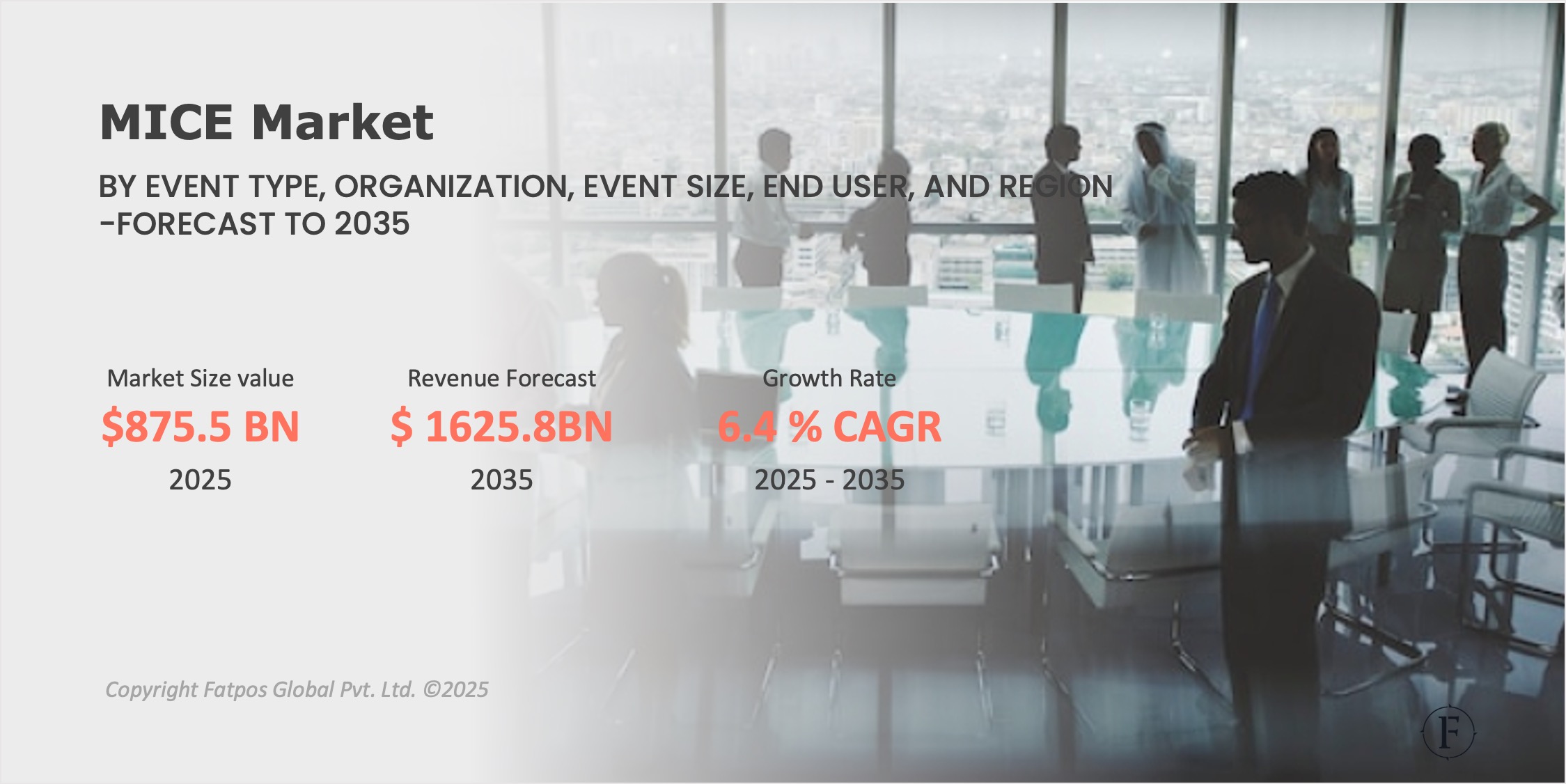
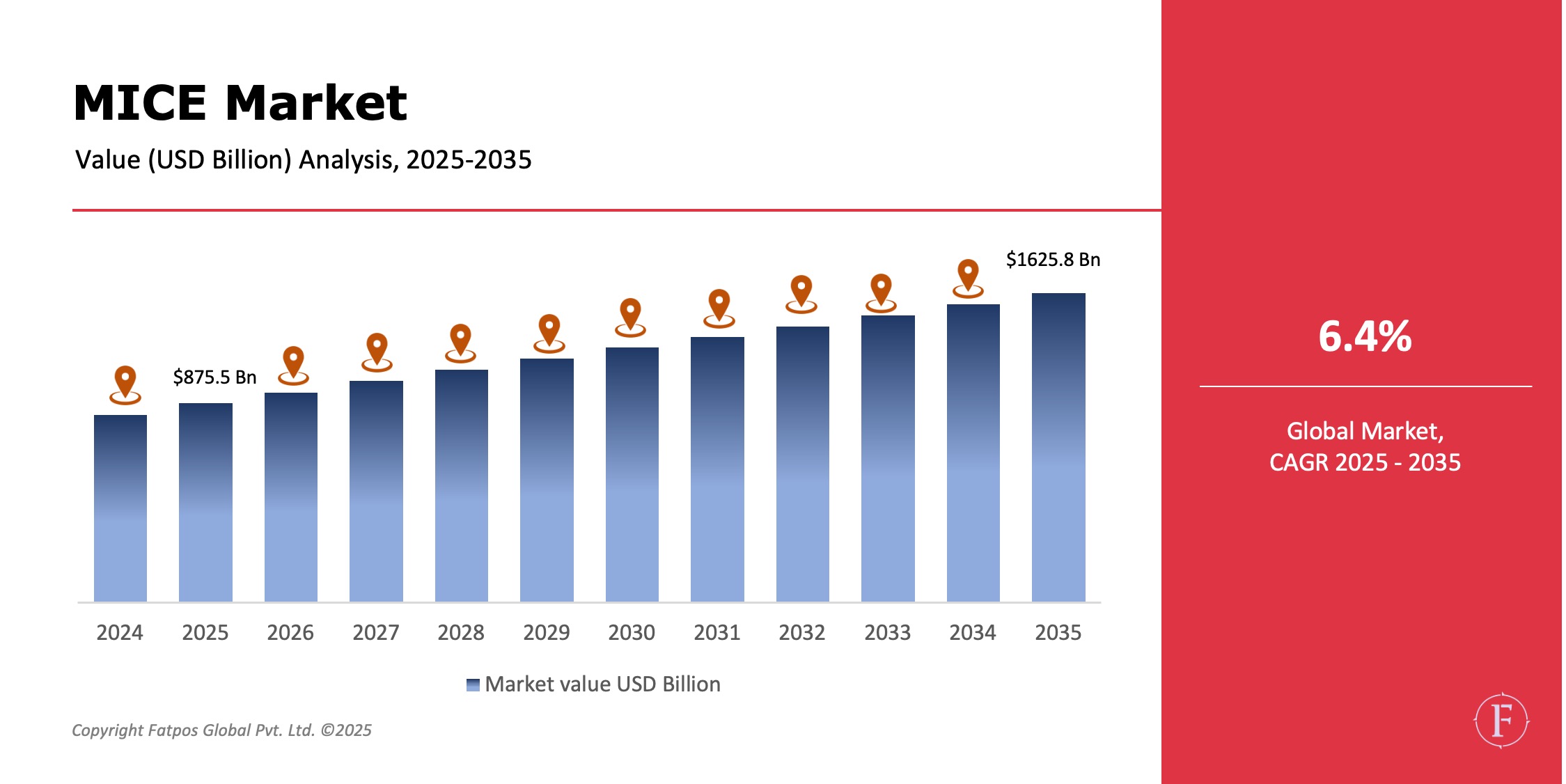
The MICE Market Size was USD 875.5 billion in 2025 and is projected to reach USD 1625.8 billion by 2035, registering a CAGR of 6.4% . Market growth is supported by rising business travel, increasing globalization of enterprises, expansion of international trade fairs, strong demand for corporate networking platforms, and recovery of the global travel and tourism industry.
The MICE industry plays a critical role in facilitating business networking, knowledge exchange, brand promotion, and economic development, contributing significantly to hospitality, transportation, tourism, and allied services.
Product Overview
MICE services involve the comprehensive planning, organization, and management of professional events spanning diverse industries. Categorized by event type, they include meetings such as corporate board sessions and training programs; incentives through rewarding travel experiences for employee performance; conferences as large-scale professional and academic gatherings; and exhibitions like trade shows, expos, and industry displays. By organization type, MICE covers corporate-driven business events, those hosted by industry, trade, and professional associations, as well as government-led public sector conferences, summits, and exhibitions. This structured approach ensures tailored, high-impact event solutions.
Key Takeaways :
- The MICE Market is expected to grow at ~6.4% CAGR through 2035.
- Meetings and conferences account for the largest market share.
- Hybrid and digital-enabled events are reshaping event formats.
- Asia-Pacific is the fastest-growing region.
- Corporate enterprises dominate demand.
- Sustainability and experiential events are key industry trends.
Market Dynamics
Drivers
Global business travel is rebounding strongly, fueled by surging demand for face-to-face networking and collaboration that virtual tools cannot fully replace. The expansion of multinational corporations and global trade intensifies travel needs for deal-making and partnerships, while exhibition and trade fair participation grows, drawing exhibitors and buyers to showcase innovations and forge connections. Governments worldwide reinforce this momentum through robust support for tourism and convention infrastructure, including new venues, subsidies, and marketing campaigns to attract high-value MICE events and stimulate economic activity. These factors drive collectively sustained industry growth.
Restrictions
High event organization and travel costs pose significant hurdles for MICE operators, driven by surging airfares, venue fees, and logistics amid inflation and supply chain strains. Economic uncertainty further erodes corporate travel budgets, prompting budget cuts, selective event prioritization, and hybrid shifts to mitigate financial risks in volatile markets. Environmental concerns surrounding large-scale events intensify scrutiny over carbon emissions from flights, waste generation, and energy use, pushing organizers toward greener practices like virtual components and sustainable sourcing to address stakeholder and regulatory pressures.
Opportunities
Hybrid and virtual MICE events are experiencing rapid growth, enabling broader participation, cost savings, and resilience against disruptions through integrated platforms blending in-person and digital experiences. Emerging destinations like India, Dubai, and Southeast Asian hubs are expanding with smart convention centers equipped with advanced tech infrastructure, high-speed connectivity, and sustainable designs to capture global events. Demand for sustainable and green events emerges as organizers prioritize carbon-neutral practices, eco-friendly venues, and waste reduction to meet corporate ESG goals and attendee expectations. Technology integration, especially AI-driven event management and analytics, optimizes personalization, real-time insights, attendance forecasting, and seamless operations.
Challenges
Managing logistics for large-scale international events requires coordinated planning of transportation, accommodations, and on-site operations to handle diverse attendee needs across time zones and borders. Ensuring health, safety, and security compliance involves rigorous risk assessments, emergency protocols, medical support, and adherence to international standards like ISO 45001 amid evolving threats and pandemics. Intense competition among destinations and organizers heightens pressure to offer unique value through innovative venues, cost efficiencies, and superior experiences, as hubs like Dubai and Singapore come with established markets for high-profile MICE events.
MICE Market Trends
The MICE industry is undergoing transformative shifts driven by technological and sustainability imperatives. Rapid adoption of hybrid event formats allows seamless blending of in-person and virtual participation, expanding global reach while cutting costs and enhancing accessibility for diverse audiences. Increasing use of event management software and analytics streamlines planning, from attendee personalization via AI matchmaking to real-time ROI tracking and predictive insights for optimized outcomes. Focus on sustainable, carbon-neutral events prioritizes eco-venues, zero-waste practices, and emissions offsetting to meet ESG demands from 50%+ of corporate buyers. Rising demand for experiential and personalized events emphasizes immersive AR/VR, tailored networking, and memorable activations to increase engagement and loyalty. Strategic investments in convention centers, like India's Yashobhoomi expansions, equip emerging destinations with smart tech and scalable infrastructure for competitive edge.
Key Players in the Global MICE Industry
- Maritz Global Events
- BCD Meetings & Events
- CWT Meetings & Events
- Reed Exhibitions
- Informa Markets
- MCI Group
- Eventbrite
- Freeman Company
- GL events
- Tarsus Group
- Messe Frankfurt
- Hyve Group
Regional & Country Analysis
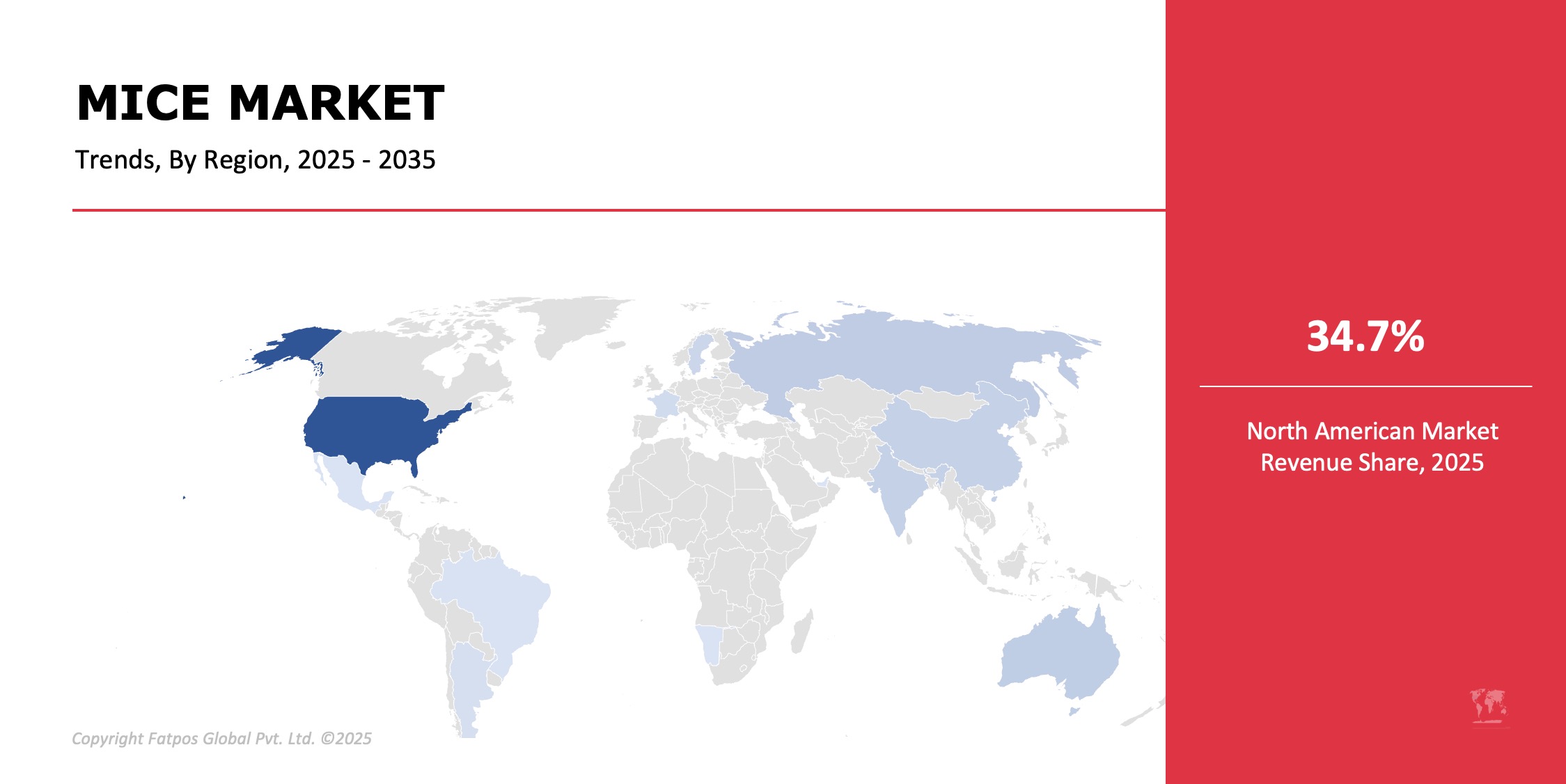
North America dominates the global MICE market, bolstered by robust corporate hubs in the US and Canada, world-class convention centers like Las Vegas and Orlando, and high business travel volumes from multinationals. Europe exhibits strong growth through iconic international exhibitions in Germany and France, association-driven conferences, and government-backed summits across the UK and Scandinavia. Asia-Pacific emerges as the fastest-growing region, propelled by China's megacities, India's new venues like Yashobhoomi, Singapore's seamless infrastructure, and Thailand's tourism push. Latin America sees rising MICE activity via trade shows in Brazil and Mexico, fueled by regional integration and hospitality upgrades. The Middle East & Africa emerges with ambitious growth from Dubai's mega-exhibitions, Saudi summits, and African hospitality investments.
Segmentation Highlights
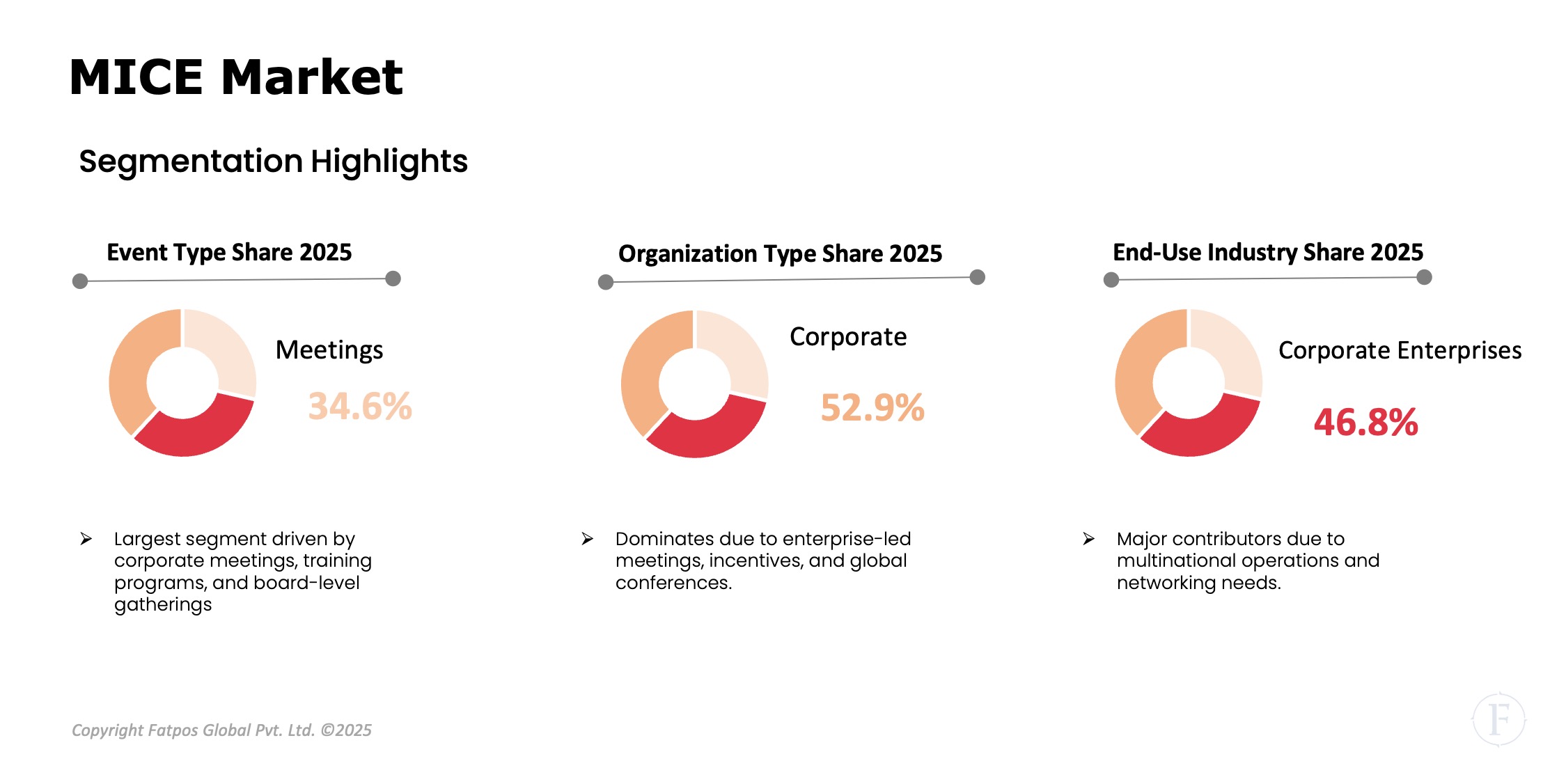
In the MICE industry, meetings claim the largest share by event type, comprising over 40% of activity due to frequent corporate and training needs, followed by conferences at around 30% for knowledge exchange, and exhibitions at 25% for trade displays. By organization type, the corporate sector dominates with 50-60% market share, driven by business incentives and internal events, outpacing associations and government bodies. Medium and large events fuel the bulk of revenues, as they attract 70%+ of spending through scalable infrastructure and sponsorships, while small events focus on niche gatherings. Corporate enterprises lead end-user demand at 55%, with associations trailing at 25-30% for professional summits.
Report Key Elements
|
ATTRIBUTES |
DETAILS |
|
Study Period |
2019–2035 |
|
Base Year |
2024 |
|
Forecast Period |
2025–2035 |
|
Market Size by 2035 |
USD 1625.8 billion |
|
Market CAGR |
6.4% |
| By Event Type | Meetings, Incentives, Conferences, Exhibitions |
|
By Organization Type |
Corporate, Association, Government |
|
By Event Size |
Small, Medium, Large |
|
By End User |
Corporate Enterprises, SMEs, Associations, Government Bodies |
|
By Region |
NA, Europe, APAC, LATAM, MEA |
|
MICE Market: Key Players |
Maritz Global Events, BCD Meetings & Events, CWT Meetings & Events, Reed Exhibitions, Informa Markets |
Global MICE Industry Instances
- Corporations adopted hybrid conferences to expand global reach.
- Governments invested in mega convention and exhibition centers.
- Event organizers deployed AI-powered attendee engagement tools.
- Destinations promoted sustainable and eco-friendly MICE tourism.
Analyst Review
As per our MICE Market analysis report, market is witnessing a strong resurgence driven by renewed business travel and demand for in-person engagement. While hybrid formats continue to complement physical events, face-to-face interactions remain central to networking and deal-making. Companies and destinations that invest in technology, sustainability, and differentiated experiences are expected to capture significant market share through 2035.
Frequently Asked Questions (FAQ):
Meetings, Incentives, Conferences, and Exhibitions.
Business travel recovery, globalization, and corporate networking needs.
Meetings and conferences.
Asia-Pacific.
Steady growth supported by hybrid events and tourism investments.
 Select License Type


.png)


