


Gaming Desktop Market Research 2035
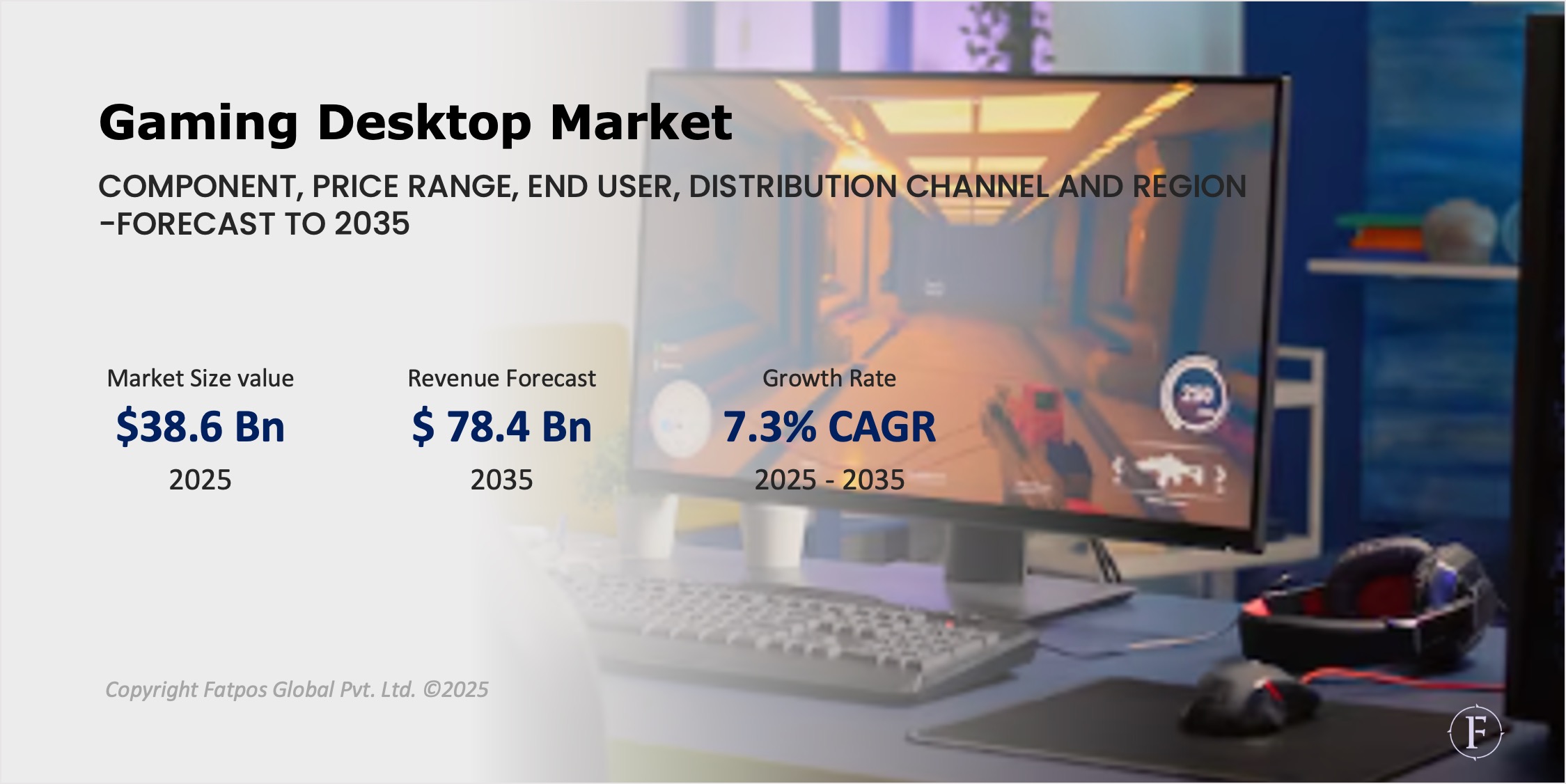
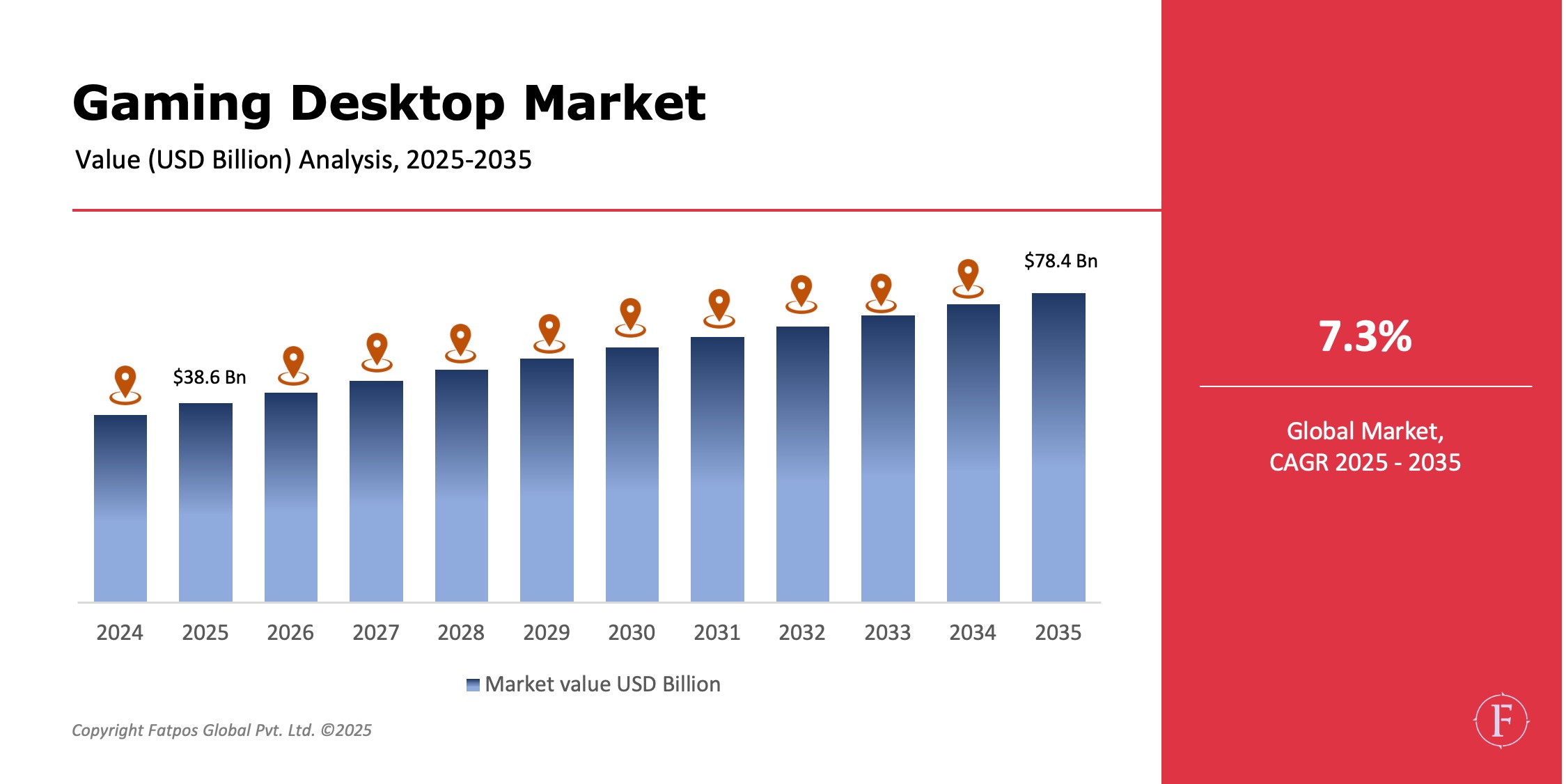
The Gaming Desktop Market was valued at approximately USD 38.6 billion in 2025 and is projected to reach USD 78.4 billion by 2035, growing at a CAGR of 7.3% during the forecast period. Growth is driven by rising popularity of PC gaming, rapid expansion of esports, and continuous innovation in graphics and processing technologies.
Gaming desktops are high-performance personal computers optimized for immersive gaming experiences. Increasing demand for ultra-high-definition graphics, virtual reality compatibility, and competitive gaming performance continues to boost market adoption. Strong consumer interest in customization and upgradability further supports long-term market growth.
Product Overview
Gaming desktops are designed with powerful processors, advanced graphics cards, high-speed memory, and efficient cooling systems to support demanding gaming applications. Unlike standard PCs, gaming desktops emphasize performance, customization, and visual aesthetics, including RGB lighting and modular designs.
Manufacturers focus on enhancing frame rates, reducing latency, and supporting emerging technologies such as ray tracing and AI-powered graphics. The ability to upgrade components over time makes gaming desktops a preferred choice for serious gamers and esports professionals. Integration of liquid cooling and compact form factors is also gaining popularity.
Key Takeaways:
- Gaming Desktop Market to grow at 7.3% CAGR through 2035
- GPUs represent the most critical component segment
- Mid-range desktops account for the largest price segment
- Casual gamers dominate end-user demand
- Online retail is the fastest-growing distribution channel
- North America leads the global gaming desktop market
Market Dynamics
Drivers
The Gaming Desktop Market is driven by the global expansion of PC gaming culture and the rising popularity of esports tournaments and live-streaming platforms. Increasing disposable income among young consumers and advancements in gaming hardware fuel frequent system upgrades.
Technological innovations such as ray tracing, AI-enhanced graphics, and VR-ready systems continue to raise performance expectations. The growth of multiplayer online games and competitive gaming further drives demand for high-performance desktops. Additionally, strong brand ecosystems and gaming communities contribute to sustained market growth.
Restraints
High initial costs of gaming desktops, particularly high-end systems, restrict adoption among price-sensitive consumers. Frequent hardware upgrades increase total ownership costs. Competition from gaming laptops and consoles presents an alternative for space-constrained users.
Supply chain disruptions and fluctuating prices of GPUs and semiconductor components can impact product availability. Additionally, high power consumption and thermal management challenges add operational complexity for users.
Opportunities
Opportunities lie in expanding demand for customizable and modular gaming desktops. Growth of esports infrastructure and professional gaming organizations supports premium system sales. Emerging markets in Asia-Pacific and Latin America offer strong growth potential due to increasing internet penetration and gaming awareness.
Integration of AI-driven performance optimization, cloud gaming support, and sustainable energy-efficient designs presents future growth avenues. Partnerships between hardware manufacturers and game developers can further enhance product differentiation.
Challenges
The Gaming Desktop Market faces challenges related to rapid technological obsolescence and high upgrade frequency. Maintaining cost competitiveness while integrating advanced components is difficult for manufacturers. Semiconductor shortages and GPU price volatility disrupt supply chains. Managing power efficiency and heat dissipation remains a technical challenge, especially for compact systems.
Environmental concerns related to electronic waste and energy consumption add regulatory pressure. Additionally, competition from gaming consoles and cloud gaming services poses a long-term challenge to traditional desktop gaming adoption.
Gaming Desktop Market Trends
Key trends include growing demand for high-refresh-rate gaming systems and ray-tracing-enabled GPUs. Custom-built and DIY gaming desktops are gaining popularity among enthusiasts. RGB lighting, aesthetic customization, and compact gaming PCs are trending.
Online sales channels are expanding rapidly, supported by configuration tools and direct-to-consumer models. Sustainability-focused designs and energy-efficient components are emerging as differentiators. Integration with streaming and content creation tools is becoming standard in gaming desktops.
Key Players in the Global Gaming Desktop Industry
- Dell Technologies
- HP Inc.
- Lenovo
- ASUS
- Acer
- MSI
- Corsair
- CyberPowerPC
- iBUYPOWER
- Origin PC
Regional & Country Analysis
North America dominates the Gaming Desktop Market due to its well-established PC gaming culture, high disposable income, and strong presence of esports leagues and gaming content creators in the United States and Canada. The region benefits from early adoption of advanced gaming hardware, frequent system upgrades, and strong brand loyalty toward premium gaming desktops. Europe follows as a significant market, supported by competitive gaming communities and growing demand across countries such as Germany, the United Kingdom, and France, where PC gaming remains popular among both casual and professional players.
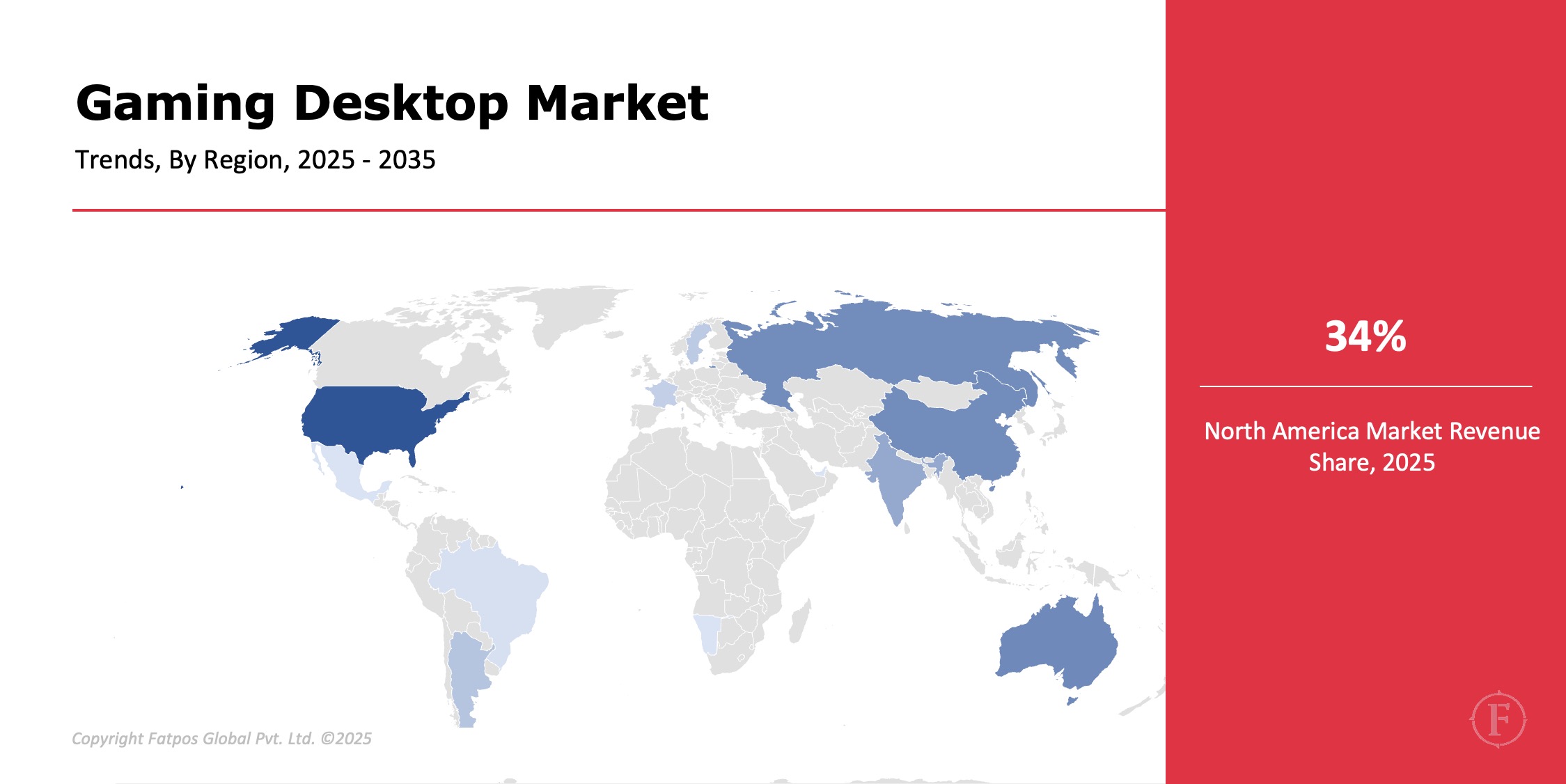
Asia-Pacific represents the fastest-growing region, driven by a rapidly expanding gamer population, rising esports investments, and increasing consumer spending power in China, South Korea, and Japan. Government support for digital infrastructure and esports development further accelerates growth. Latin America and the Middle East & Africa exhibit steady expansion, supported by improving internet connectivity, rising youth engagement in gaming, and growing awareness of competitive gaming platforms.
Segmentation Highlights
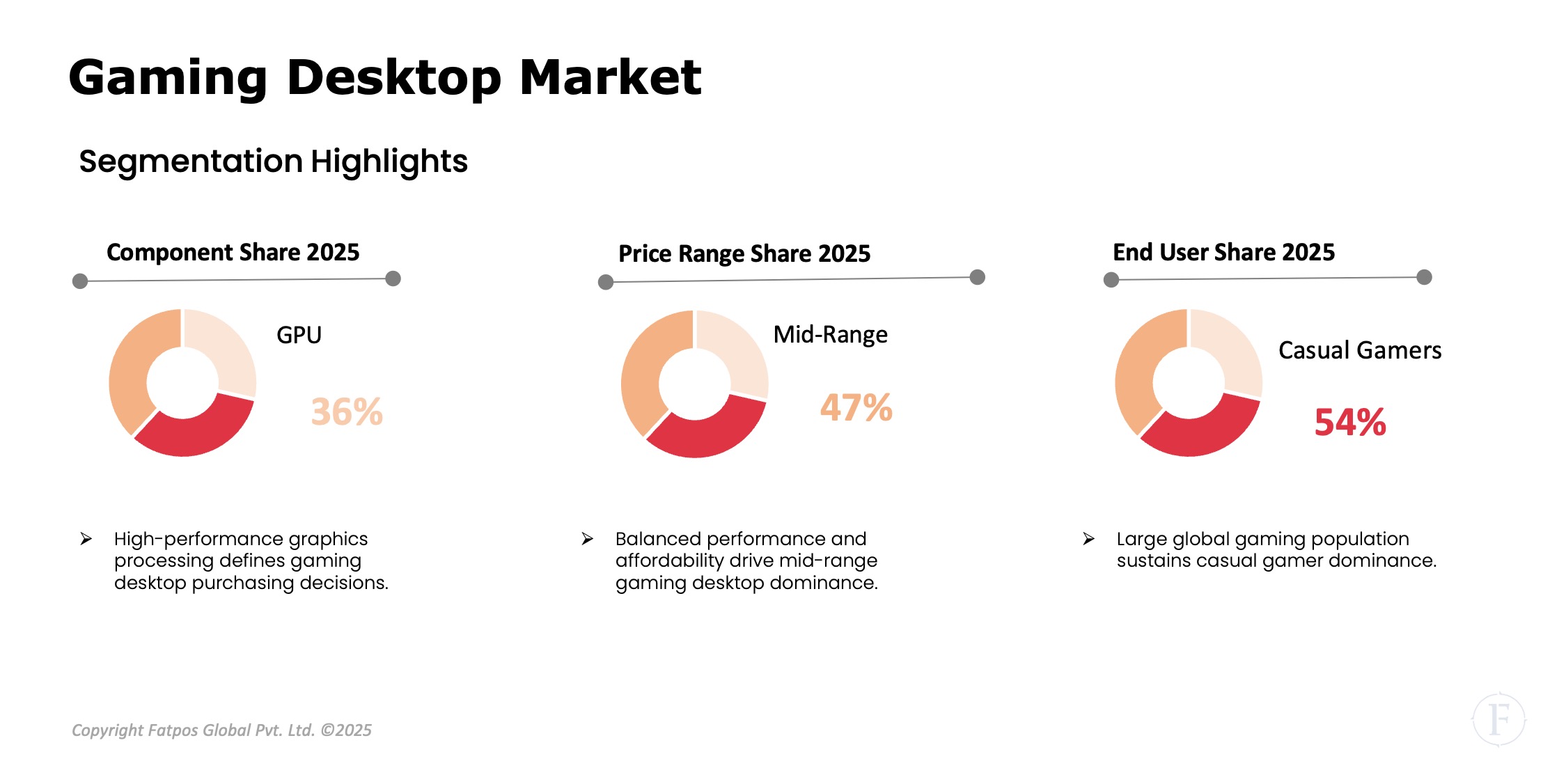
GPUs dominate component segmentation due to performance importance. Mid-range desktops lead price segmentation. Casual gamers account for the largest end-user share. Online retail channels are expanding rapidly. North America remains the leading regional market.
Report Key Elements
|
ATTRIBUTES |
DETAILS |
|
Study Period |
2019–2035 |
|
Base Year |
2024 |
|
Forecast Period |
2025–2035 |
|
Market Size by 2035 |
USD 78.4 Billion |
|
Market CAGR |
7.3% |
|
By Component |
CPU, GPU, Memory, Storage |
|
By End User |
Casual, Professional, Esports |
|
By Distribution Channel |
Online, Specialty Stores |
|
Market Size by 2035 |
USD 78.4 Billion |
|
By Region |
North America, Europe, Asia-Pacific, Latin America, MEA |
|
Gaming Desktop Market: Key Players |
Dell Technologies, HP Inc., Lenovo, ASUS, Acer |
Global Gaming Desktop Industry Instances
- Manufacturers launched ray-tracing-enabled gaming desktops
- Esports teams adopted high-refresh-rate gaming systems
- Brands expanded direct-to-consumer online sales platforms
- Component makers improved energy-efficient GPU architectures
Analyst Review
As per our Gaming Desktop Market analysis, the market will witness sustained growth through 2035 driven by rising esports participation, expanding PC gaming communities, and continuous advancements in graphics and processor technologies. Increasing consumer preference for high-performance, customizable systems supports sustained demand across both casual and professional gaming segments. The mid-range desktop category remains dominant due to its balance of affordability and performance, while premium systems benefit from growing interest in competitive and immersive gaming experiences. Online distribution channels are reshaping purchasing behavior through direct-to-consumer models. Asia-Pacific presents notable growth opportunities, supported by a rapidly expanding gamer base and esports investments, while innovation and component availability will remain critical competitive factors.
Frequently Asked Questions (FAQ):
A gaming desktop is a high-performance personal computer designed to handle intensive gaming workloads with advanced graphics and processing power.
Market growth is driven by esports expansion, continuous hardware innovation, increasing PC gaming popularity, and demand for immersive gaming experiences.
GPUs dominate the market due to their crucial role in rendering graphics, enhancing frame rates, and delivering high-quality gaming performance.
Casual gamers represent the largest end-user segment because of widespread PC ownership, diverse gaming preferences, and affordable entry-level systems.
North America leads the market due to strong gaming culture, high disposable incomes, advanced infrastructure, and high consumer spending.
 Select License Type


.png)


