


Inertial Navigation Systems Market Size
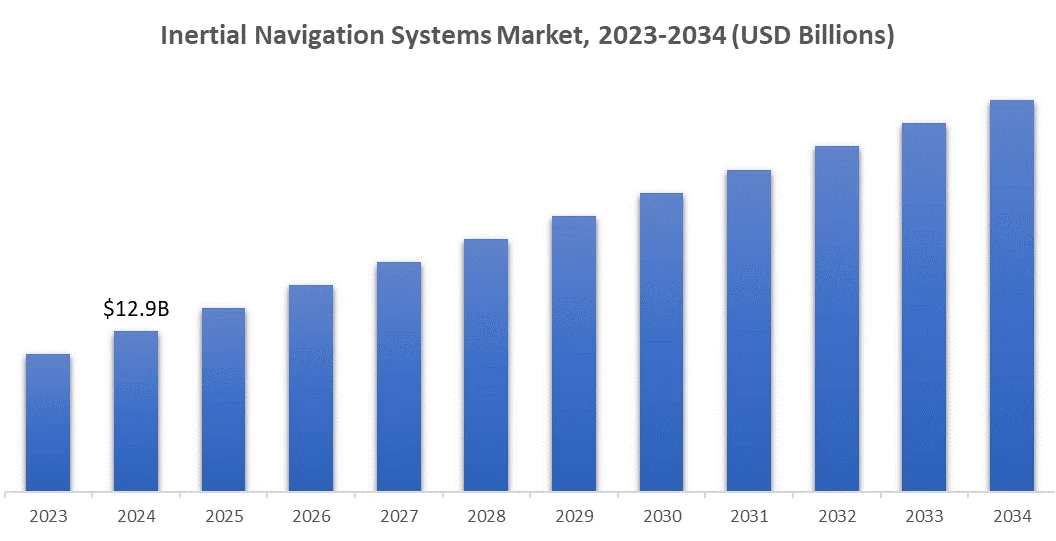
Inertial Navigation Systems Market is expected to experience a Compound Annual Growth Rate (CAGR) of 6.2% during the forecast period from 2024 to 2034. The market size, valued at USD 12.1 billion in 2023, is projected to reach USD 23.6 billion by 2034.
Product Overview:
Inertial Navigation Systems is a self-contained navigation mechanism that calculates the position, orientation, and velocity of a moving object using accelerometers and gyroscopes without needing outside references. It operates by precisely measuring the accelerations and rotations of the object, and then combining this data over a period to calculate variations in speed, location, and orientation. INS is commonly utilized in a diverse range of applications, such as aeronautics, marine navigation, guided munitions, and robotics, where precise positioning and navigation are essential, particularly in environments where external signals like GPS may not be accessible or dependable. Even though INS requires initial calibration, it offers a highly accurate and independent navigation solution, making it a crucial technology in modern navigation systems.
Market Highlights:
Inertial Navigation Systems Market is expected to exhibit a CAGR of 6.2% during the forecast period, 2024-2034
Inertial Navigation Systems (INS) Market is projected to reach USD 23.6 billion, with a CAGR of 6.2% during the forecast period. This growth is driven by various factors such as the increasing demand for precise navigation in military and aerospace sectors, as well as technological advancements that have significantly improved the use of INS. The rise in unmanned vehicles and autonomous systems across industries like defense, commercial aviation, and marine is contributing to the expansion of the market. Additionally, the growth of space exploration and the need for reliable navigation systems in GPS-blocked environments are further strengthening the prospects of the INS market. Anticipated future expansion will be fueled by technological advancements that improve INS precision and integration features to meet evolving industry needs.
Source: Fatpos Global
Inertial Navigation Systems Market Segmentation:
Gyroscopes lead the market race owing to their faster rotation and better angular velocity
Inertial navigation systems market is classified based on Components into Accelerometers, Gyroscopes, Algorithms & Processors, and Wireless variants. Under current market conditions, Gyroscopes tend to dominate the Inertial Navigation System (INS) market owing to their crucial function in precisely determining the orientation and angular velocity of an object. These sensors are vital for stabilizing and directing different applications, including aircraft and missiles as well as marine and unmanned vehicles. Gyroscopes provide the exact rotational information needed to ensure precise navigation for long periods, particularly in settings with unreliable or absent GPS signals. Significant developments in gyroscope technology, like fiber optic and MEMS gyroscopes, have greatly improved their performance, dependability, and cost-effectiveness. As a result, the increased need for precise gyroscopes plays a crucial role in the overall expansion and dominance of this component in the INS market.
Fiber Optic Gyros' high precision and durability have positioned them as the dominant market segment
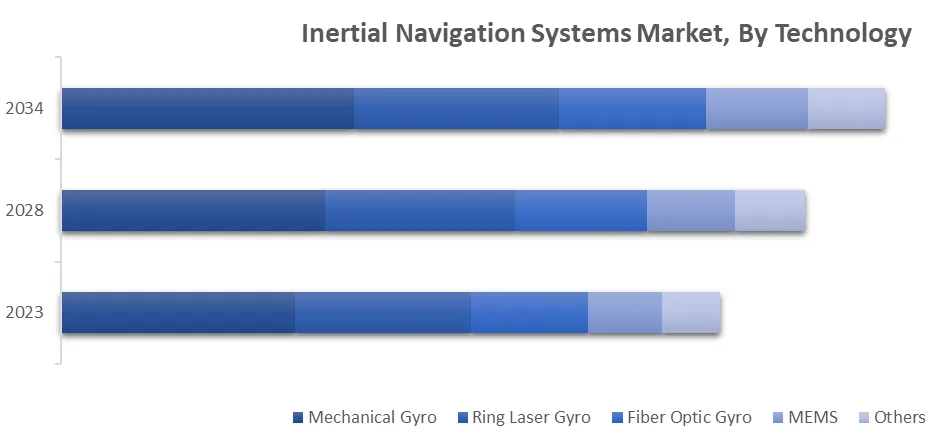
Inertial navigation systems (INS) market is classified by technology into Mechanical Gyro, Ring Laser Gyro, Fiber Optic Gyro, MEMS, and others. Currently, Fiber Optic Gyroscopes (FOGs) dominate the market due to their high precision, reliability, and durability. Unlike conventional mechanical gyroscopes, FOGs measure angular rotation using light, which eliminates mechanical wear and tear and reduces maintenance needs. This technology provides excellent precision and reliability, essential for industries such as aerospace, defense, and marine, which require accurate navigation and orientation. FOGs are ideal for critical systems over extended periods due to their resilience in harsh environmental conditions and lack of moving parts. Furthermore, ongoing advancements in fiber optic technology have improved efficiency and reduced costs, increasing their adoption and solidifying their stronghold in the INS sector.
Market Dynamics:
Growth Drivers
Increased Adoption of Unmanned Vehicles in Military Applications is Expected to Drive Market Growth
There has been a significant rise in the use of unmanned vehicles (such as drones, UAVs, and UGVs) in military activities influencing the Inertial Navigation Systems (INS) market. Military drones frequently function in complex settings dealing with GPS jamming or restricted satellite coverage. INS offers dependable navigation and positioning information that is essential for the success of missions, even in the absence of GPS. Accurate navigation allows for more precise autonomous or remote-controlled actions, improving target tracking, surveillance, and payload distribution. Military use necessitates a range of INS options, from advanced RLGs for important operations to affordable MEMS-based INS for drones or training, expanding the market. Moreover, the rise in military spending globally is boosting the development of high-tech unmanned vehicles with INS technology, leading to further expansion of the market.
Technological Advancements in Inertial Navigation Systems Have Been Beneficial for Market Development
Continuous improvement of Inertial Navigation Systems (INS) technology plays a vital role in market expansion. Improved precision and dependability in INS units are achieved through improvements in sensor technology (MEMS), algorithms, and processing power, resulting in heightened accuracy and performance, expanding possibilities for new uses, and improving the existing ones. The use of MEMS technology allows for smaller, lighter, and cheaper INS options, expanding their feasibility for various unmanned vehicles and consumer electronics. Incorporating LiDAR and cameras into the mix strengthens navigation systems, improving situational awareness and autonomous capabilities. These developments also open up opportunities for new uses in autonomous logistics, search and rescue missions, and agricultural automation, further expanding the overall market potential.
Restraints
High Cost of Advanced INS Systems to Impede Market Growth
The high cost of advanced Inertial Navigation Systems (INS) is a key factor holding back the market and preventing more widespread use. Costly high-precision INS systems utilizing Ring Laser Gyros (RLGs) are limited to applications like military and high-end aerospace due to their price. Industries with limited budgets, such as agriculture or consumer electronics, may find it hard to justify their overall expenditure. This slows down market penetration and obstructs the progress and creation of new technologies. Factors that contribute include the complexity of high-precision gyroscope technology, restricted production volume, and strict quality control. Possible options involve utilizing MEMS technology for cheaper alternatives, establishing standardized components, and improving manufacturing methods to lower expenses while upholding precision and dependability.
Recent Developments
- In early 2023, Honeywell International launched the HGuide MN40 inertial navigation system for commercial and military unmanned aerial vehicles, featuring enhanced positioning accuracy and reliability.
- In late 2023, Northrop Grumman Corporation, introduced a next-generation fiber-optic gyro-based inertial navigation system for precision-guided munitions, offering improved performance and size/weight reduction. They entered into a joint venture KVH Industries in early 2024 to develop inertial navigation solutions for autonomous maritime platforms.
- In mid-2023, Safran Electronics & Defense introduced the DRIOS-III inertial measurement unit, designed for tactical-grade navigation in demanding environments. The company acquired a majority stake in Italian firm Inginion Technologies in early 2024, expanding its inertial sensor development capabilities.
- In 2023, Thales Group launched the NavRing DUAN-X dual-antenna GPS/INS system for naval applications, enhancing anti-jamming and spoofing protection.
- In 2023, Teledyne Technologies Incorporated released the HURIcane INS/GPS micro-navigator, a compact and cost-effective solution for size-constrained applications. They acquired Siliconix Integrated Systems, a fabless semiconductor company, in mid-2024 to bolster MEMS inertial sensor development.
Inertial Navigation Systems Market, Key Players:
- Honeywell International Inc.
- Northrop Grumman Corporation
- Safran Electronics & Defense
- Thales Group
- Teledyne Technologies Incorporated
- LORD MicroStrain Sensing Systems
- Gladiator Technologies, Inc.
- VectorNav Technologies
- KVH Industries, Inc.
- TASC-GTE
- Trimble Navigation Limited
- Raytheon Technologies
- L3Harris Technologies, Inc.
- Rockwell Collins, Inc.
- Atlantic Inertial Systems
- Other Prominent Players (Company Overview, Business Strategy, Key Product Offerings, Financial Performance, Key Performance Indicators, Risk Analysis, Recent Development, Regional Presence, SWOT Analysis)
Regional Analysis
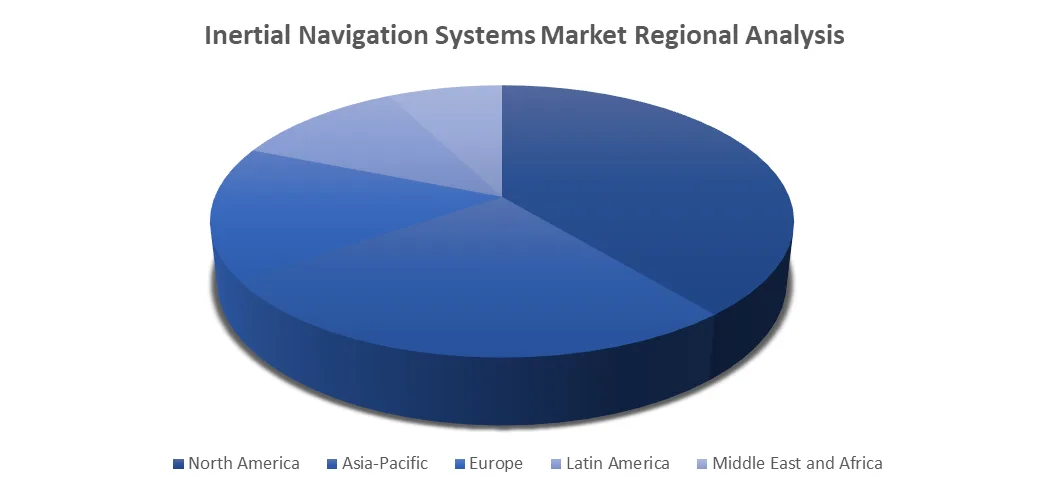
The Inertial Navigation Systems Market is segmented based on regional analysis into five major regions: North America, Latin America, Europe, Asia Pacific, and the Middle East and Africa. The North American region currently holds a prominent market position, owing to several reasons. The United States, holds a significant influence in North America, with a global military presence, creating a need for cutting-edge INS technology in military uses like missiles, drones, and military vehicle navigation systems. Moreover, North America hosts top companies that specialize in INS research, development, and manufacturing, promoting innovation and the development of state-of-the-art solutions. Additionally, sectors in North America like aerospace and automotive are quick to embrace new technologies, leading to a high demand for INS and driving market expansion.
The INS market landscape in the Asia-Pacific region is undergoing significant changes. Factors such as rising military spending, a growing focus on domestic technology development, and a flourishing automotive industry are driving this growth in Asia-Pacific. As countries in Asia-Pacific invest more in research and development, they are closing the gap with North American technological advancements, leading to increased competition that could challenge North America's dominance in the future.
Source: Fatpos Global
Impact of Covid-19 on Inertial Navigation Systems Market
Covid-19 pandemic had a diverse impact on the Inertial Navigation Systems Market. Even though initially the market suffered from supply chain disruptions, reduced demand in industries such as aviation and automotive, and budget limitations caused by responses to the pandemic, there were also favorable outcomes. During the pandemic, there was a greater emphasis on military preparedness which increased investment in advanced INS for defense purposes. Furthermore, the rapid use of unmanned systems for duties such as distribution and disinfection increased the demand for INS in drones and unmanned ground vehicles. Furthermore, concerns about supply chain vulnerabilities encouraged certain countries to prioritize domestic production of essential technology such as INS components, thereby benefiting local manufacturers in the long term.
Inertial Navigation Systems Market is further segmented by region into:
- North America Market Size, Share, Trends, Opportunities, Y-o-Y Growth, CAGR – United States and Canada
- Latin America Market Size, Share, Trends, Opportunities, Y-o-Y Growth, CAGR – Mexico, Argentina, Brazil, and Rest of Latin America
- Europe Market Size, Share, Trends, Opportunities, Y-o-Y Growth, CAGR – United Kingdom, France, Germany, Italy, Spain, Belgium, Hungary, Luxembourg, Netherlands, Poland, NORDIC, Russia, Turkey, and Rest of Europe
- Asia Pacific Market Size, Share, Trends, Opportunities, Y-o-Y Growth, CAGR – India, China, South Korea, Japan, Malaysia, Indonesia, New Zealand, Australia, and Rest of APAC
- Middle East and Africa Market Size, Share, Trends, Opportunities, Y-o-Y Growth, CAGR – North Africa, Israel, GCC, South Africa, and Rest of MENA
Inertial Navigation Systems Market Scope and Segments:
|
ATTRIBUTE |
DETAILS |
|
Study Period |
2018-2034 |
|
Base Year |
2023 |
|
Forecast Period |
2024-2034 |
|
Historical Period |
2019-2022 |
|
Growth Rate |
CAGR of 6.2% from 2024-2034 |
|
Unit |
Value (USD Billion) |
|
Segmentation |
Main Segments List |
|
By Component |
|
|
By Technology |
|
|
By Grade |
|
|
By Application |
|
|
By End-User |
|
|
By Region |
|
Frequently Asked Questions (FAQ):
Inertial Navigation Systems Market size was valued at USD 12.1 billion in 2023 and is projected to reach the value of USD 23.6 billion in 2034, exhibiting a CAGR of 6.2% during the forecast period.
Inertial Navigation Systems (INS) Market refers to the industry that manufactures and supplies self-contained navigation systems that use accelerometers and gyroscopes to determine the position, orientation, and velocity of moving objects without relying on external references. These systems find applications across various sectors, including aerospace, defense, automotive, and marine industries.
The Gyroscopes segment and Fiber Optic Gyro segment accounted for the largest Inertial Navigation Systems Market share.
Key players in the Inertial Navigation Systems Market include Honeywell International Inc., Northrop Grumman Corporation, Safran Electronics & Defense, Thales Group, Teledyne Technologies Incorporated, LORD MicroStrain Sensing Systems, Gladiator Technologies, Inc., VectorNav Technologies, KVH Industries, Inc., TASC-GTE, Trimble Navigation Limited, Raytheon Technologies, L3Harris Technologies, Inc., Rockwell Collins, Inc., Atlantic Inertial Systems and Other Prominent Players.
Increasing demand for precision navigation, technological advancements, and the growing use of unmanned vehicles are the key factors behind the growth of the Inertial Navigation Systems Market.
 Select License Type


.png)


