


Laser Technology Market Research 2035
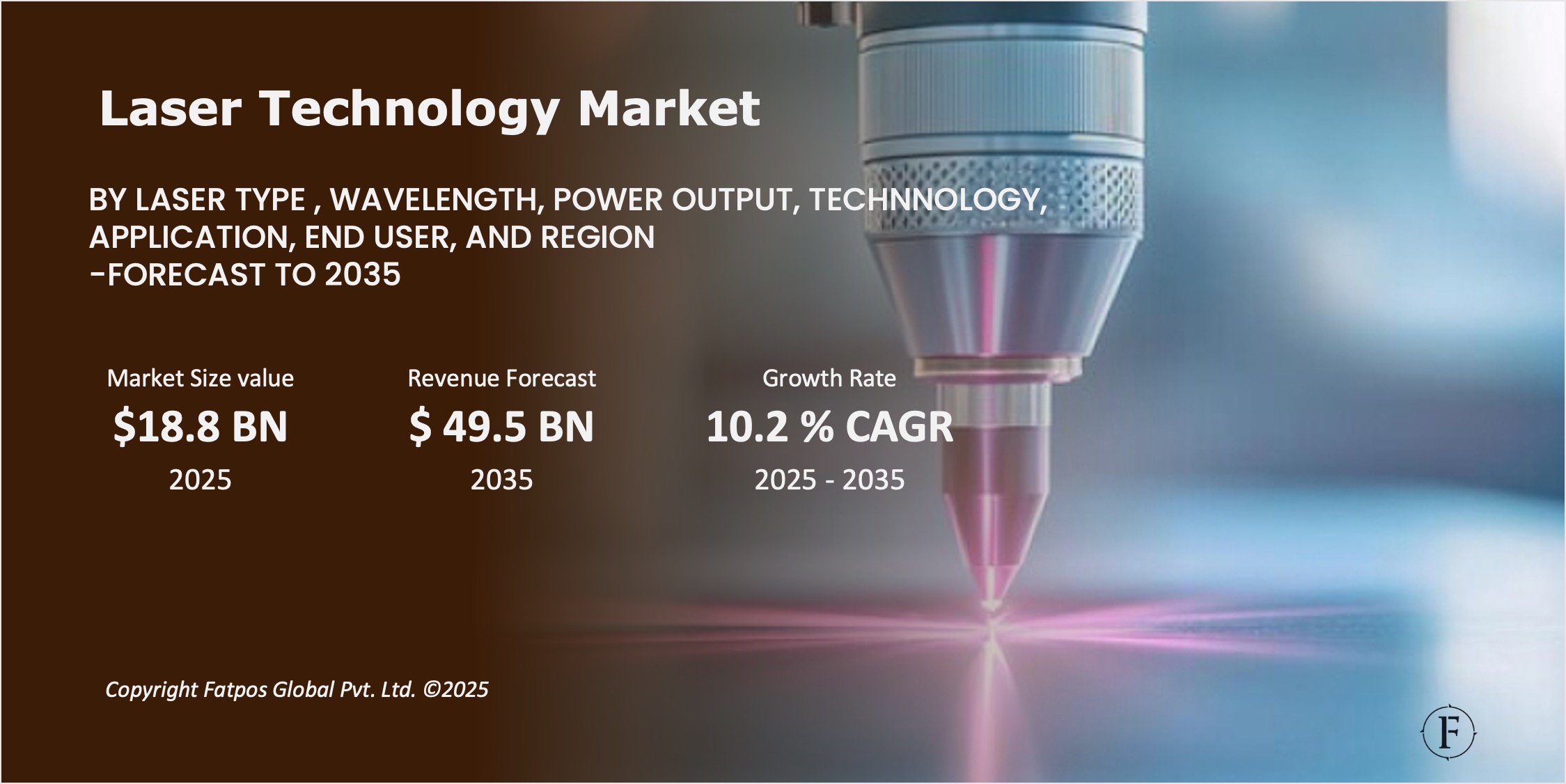
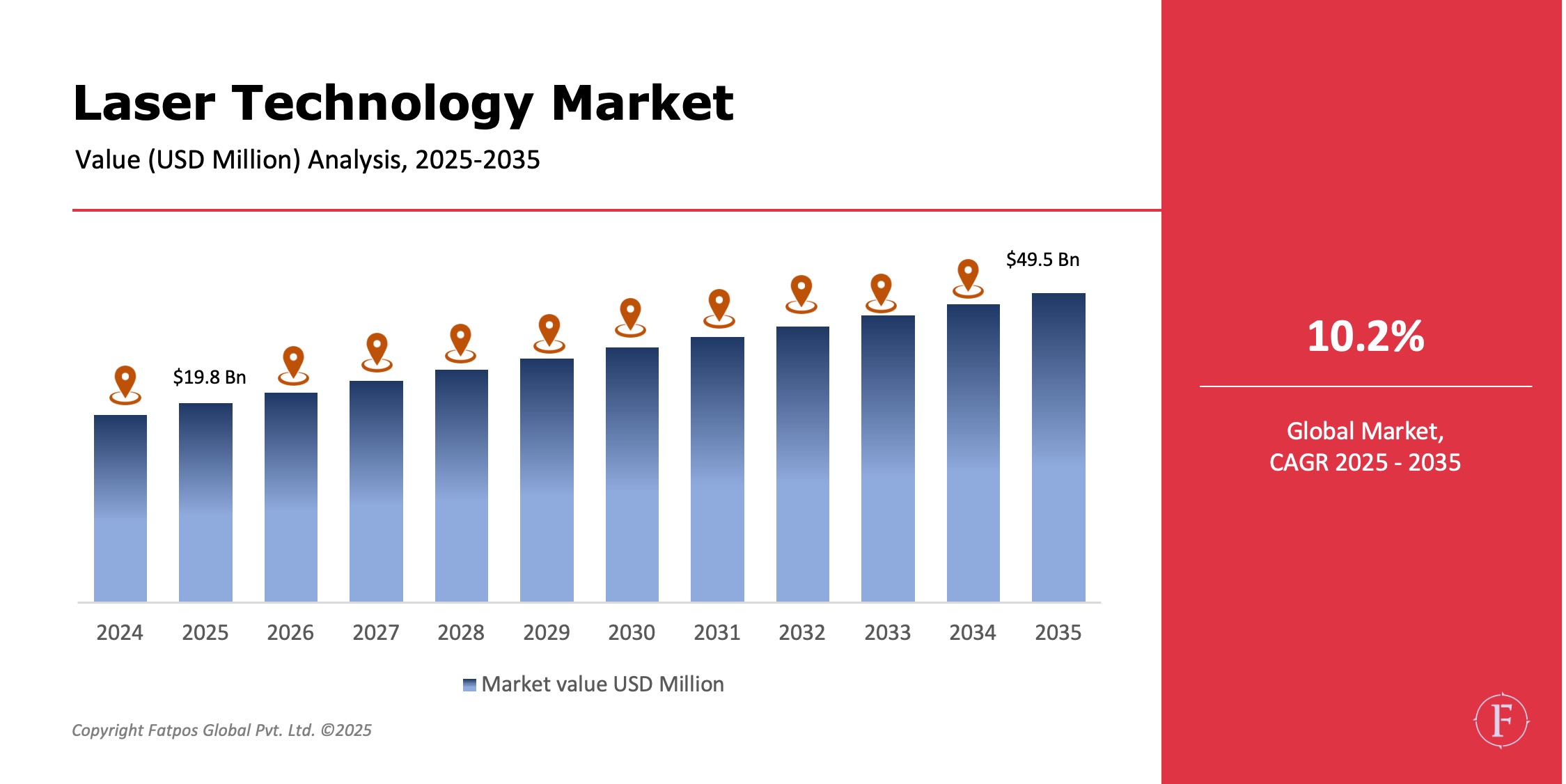
The Laser Technology Market Size was USD 18.8 billion in 2025 and is projected to reach USD 49.5 billion by 2035, registering a CAGR of 10.2%, The market growth is accelerated from popular adoption of laser manufacturing, medical/aesthetic systems, semiconductor production, and defense/communication applications. High-precision, non-contact processing via fiber, ultrafast, diode and AI-enhanced lasers drives efficiency across industries. Industry 4.0 automation and miniaturized electronics further boost demand for superior beam quality and cost-effective solution.
Product Overview
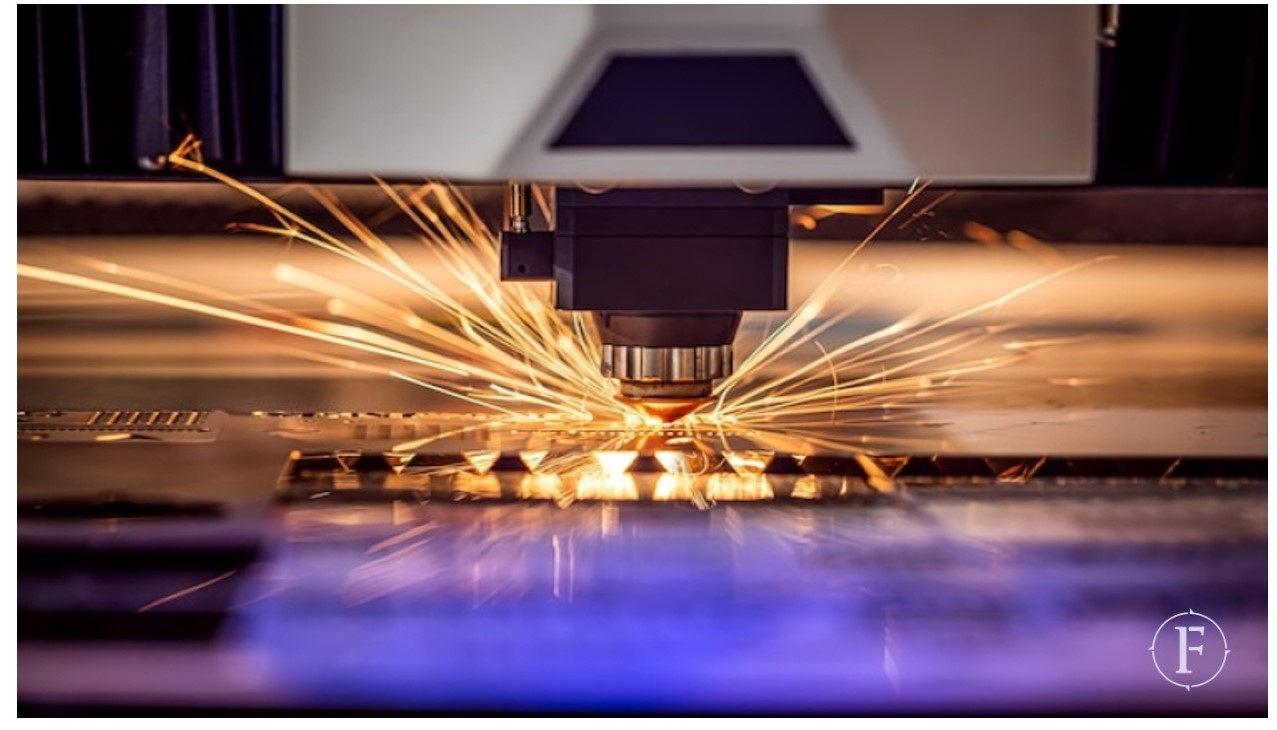
Laser technology generates coherent, high-intensity light beams essential for cutting, welding, marking, sensing, imaging, communication, and medical treatments. Fiber lasers dominate industrial applications with high efficiency and long lifespan, while solid-state lasers support medical, defense, and research needs; gas lasers like CO₂ and excimer excel in material processing, surgery, and micro-fabrication; semiconductor/diode lasers provide compact, energy-efficient solutions for telecom, electronics, and automotive LiDAR. Infrared wavelengths prevail in industrial and defense uses, visible lasers serve diagnostics, displays, and alignment, and ultraviolet enables precision semiconductor lithography and micromachining.
Key Takeaways :
- Market expected to grow at 10.2% CAGR through 2035.
- Fiber lasers dominate industrial manufacturing applications.
- Medical & aesthetic lasers represent a fast-growing revenue segment.
- Electronics & semiconductor applications drive demand for UV and ultrafast lasers.
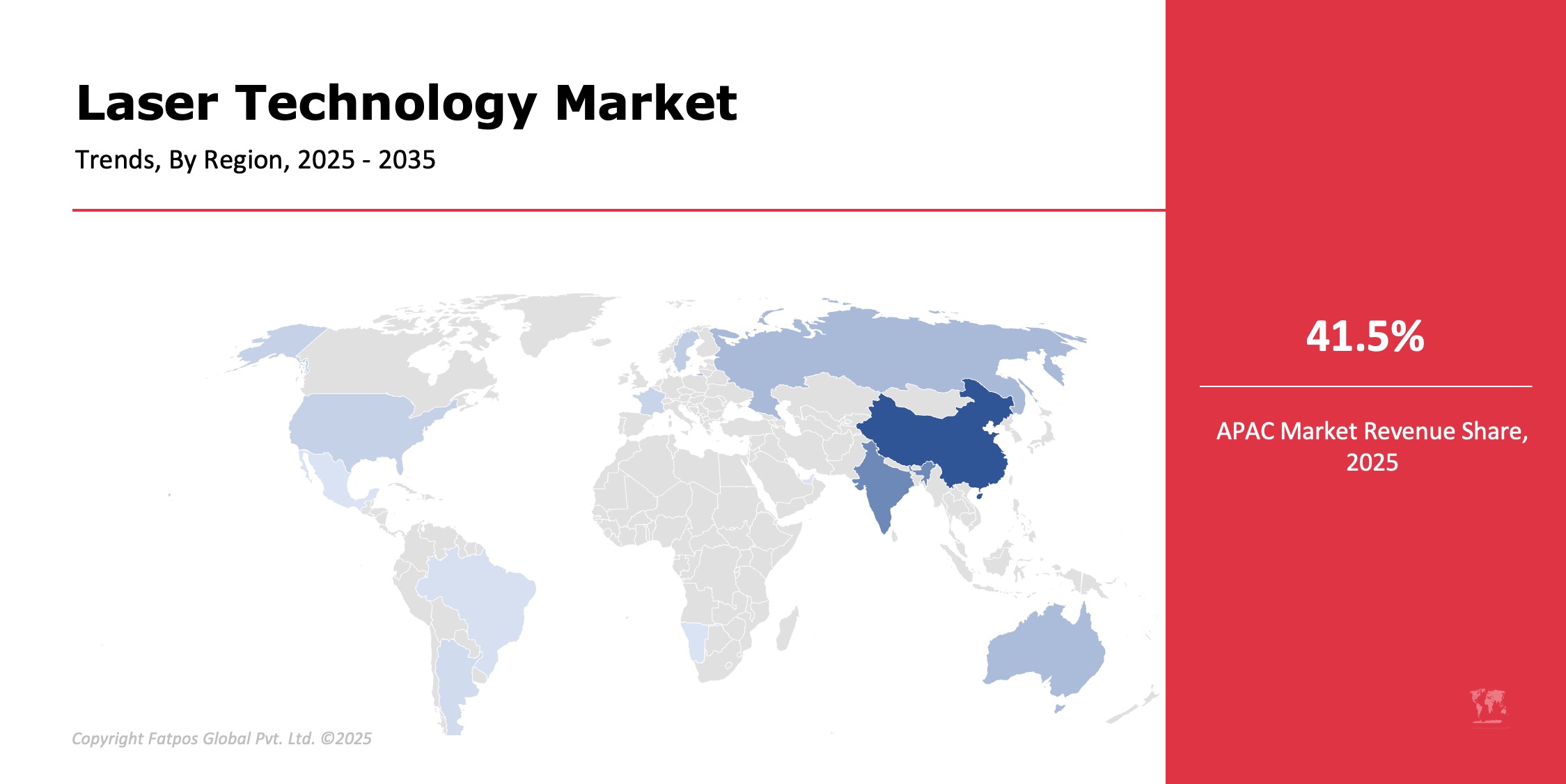
- Asia-Pacific leads market growth due to manufacturing expansion.
- Continuous innovation in ultrafast and high-power lasers is reshaping applications.
Market Dynamics
Drivers
Rising adoption of laser-based cutting, welding and additive manufacturing increases precision manufacturing efficiency. Semiconductor and electronics growth demands ultraviolet lasers for lithography and diode lasers for LiDAR. Medical diagnoses, surgery and cosmetics increasingly rely on solid-state and gas lasers for minimally invasive procedures. Defense modernization deploys high-power lasers for weapons and sensing, while Industry 4.0 automation integrates fiber and AI-enabled systems across factories.
Restrictions
High initial investment costs for advanced laser systems hinder small-scale adoption, despite long-term efficiency gains. Skilled workforce shortages complicate integration and operation of complex fiber, solid-state and diode lasers across industries. Safety risks from high-intensity beams and stringent regulatory compliance further challenge implementation in manufacturing, medical and defense applications.
Opportunities
Expansion of ultrafast lasers drives precision micromachining and advanced medical imaging applications. LiDAR growth accelerates autonomous vehicle sensing with compact diode lasers. AI integration enhances smart control in fiber and solid-state laser platforms for Industry 4.0. Laser additive manufacturing emerges in aerospace and healthcare for complex, lightweight components.
Challenges
Managing thermal effects challenges laser performance in high-power cutting and welding, requiring advanced cooling for material compatibility. Rapid technological obsolescence affects fiber and solid-state systems as ultrafast and AI-integrated lasers emerge. Cost pressures burden price-sensitive manufacturing sectors adopting expensive diode and gas lasers amid automation demands.
Laser Technology Market Trends
Fiber and diode lasers dominate due to superior efficiency, low maintenance and compact designs, displacing traditional gas systems in cutting, welding and telecom. Ultrafast femtosecond/picosecond lasers arise in micromachining, medical imaging and precision surgery for minimal thermal damage. Laser additive manufacturing/3D printing expands in aerospace/healthcare for complex components; medical aesthetics please minimally invasive cosmetic treatments. AI-enabled adaptive systems optimize real-time control, boosting Industry 4.0 integration across defense and electronics.
Key Players in the Global Laser Technology Industry
- Coherent Corp.
- IPG Photonics
- Trump Group
- Lumentum Holdings
- Jenoptik AG
- nLIGHT, Inc.
- ROFIN-SINAR Technologies
- Han's Laser Technology Industry Group
- Beloved Miyachi
- Laserline GmbH
- Thorlabs, Inc.
- MKS Instruments
Regional & Country Analysis
North America leads the global laser market with robust demand from aerospace, defense, medical technology, and semiconductor manufacturing, where the US excels in R&D and high-end applications. Europe experiences steady growth fueled by automotive production, industrial automation, and precision engineering, particularly in Germany, France, and the UK. Asia-Pacific emerges as the fastest-growing region, propelled by China, Japan, South Korea, and Taiwan's expanding electronics, semiconductor manufacturing, and automotive sectors. Latin America sees moderate expansion through industrial automation and vehicle production, while the Middle East and Africa show emerging adoption in defense, energy, and medical fields.
Segmentation Highlights
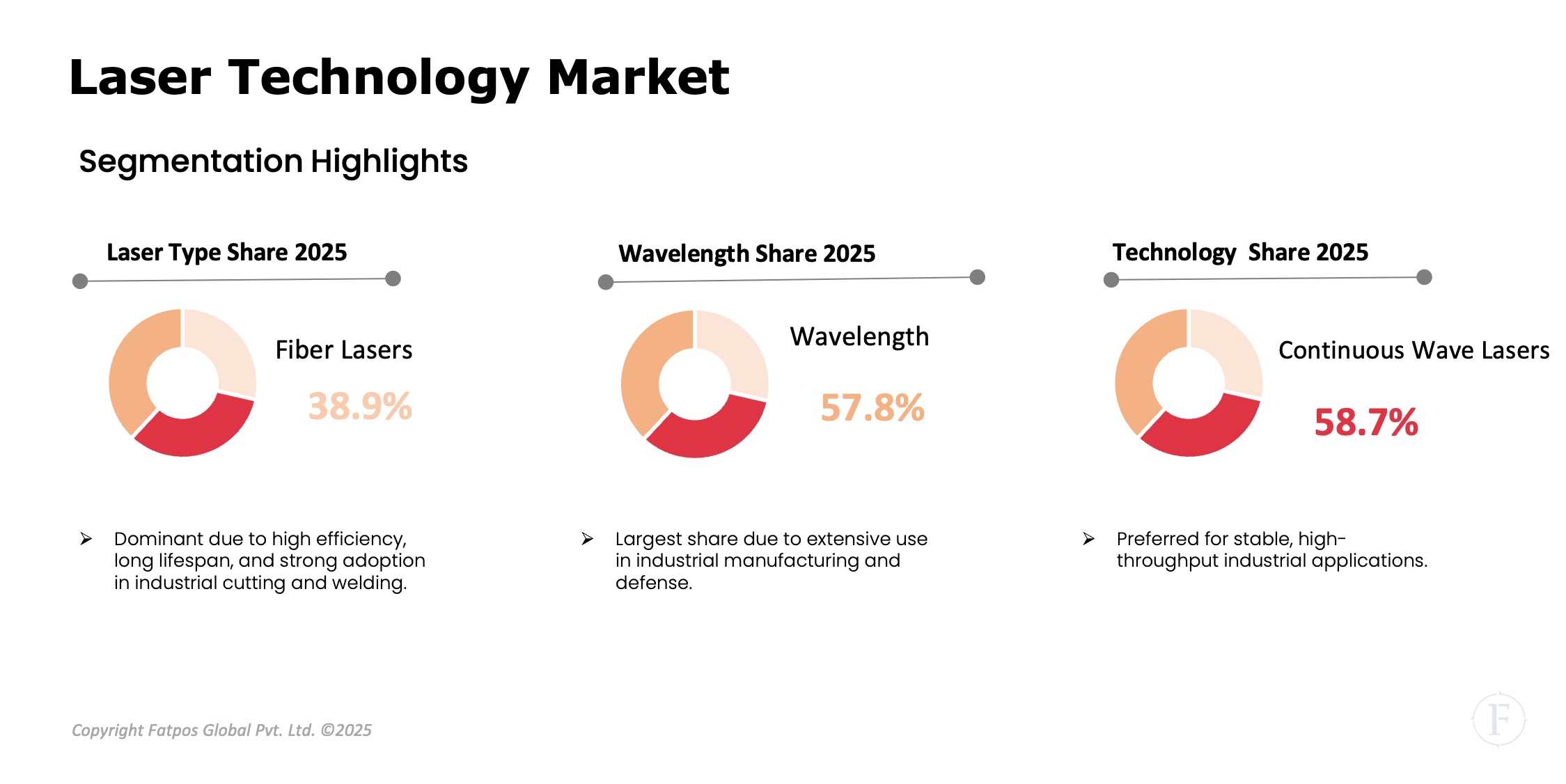
Laser market segmentation reveals fiber lasers dominating due to their superior efficiency and versatility in cutting, welding, and marking. Infrared lasers hold the largest wavelength share, powering most industrial and defense applications. Medium- and high-power lasers experience strong demand for material processing in manufacturing. Electronics and manufacturing sectors lead end-use, with Asia-Pacific commanding volume growth via semiconductor fabs while North America excels in premium, high-value systems.
Report Key Elements
|
ATTRIBUTES |
DETAILS |
|
Study Period |
2019–2035 |
|
Base Year |
2024 |
|
Laser Technology Market Forecast Period |
2025–2035 |
|
Laser Technology Market Size by 2035 |
USD 49.5 billion |
|
Market CAGR |
10.2% |
| By Laser Type | Solid-State Lasers, Gas Lasers, Fiber Lasers, Semiconductor/Diode Lasers, Excimer Lasers |
|
By Wavelength |
Infrared, Visible, Ultraviolet |
|
By Power Output |
Low Power 6 kW |
|
By Technology |
Continuous Wave, Pulsed Lasers |
|
By Application |
Industrial Manufacturing, Medical & Aesthetics, Telecommunications, Defense & Security, Electronics & Semiconductor, Research & Scientific |
|
By End User |
Manufacturing, Healthcare, Automotive, Aerospace & Defense, Electronics, Energy, Research Institutions |
|
By Region |
NA, Europe, APAC, LATAM, MEA |
|
Key Market Players |
Coherent Corp., IPG Photonics, Trumpf Group, Lumentum Holdings, Jenoptik AG, nLIGHT, Inc., ROFIN-SINAR Technologies, Han's Laser Technology Industry Group, |
Global Laser Technology Industry Instances
- Automotive OEMs adopted fiber lasers for lightweight body welding.
- Semiconductor fabs expanded use of UV and excimer lasers.
- Hospitals deployed laser-based minimally invasive surgical systems.
- Defense agencies tested directed-energy laser systems for threat neutralization.
Analyst Review
As per our Laser Technology Market analysis report, market is positioned for strong long-term growth as precision manufacturing, healthcare innovation, and digital transformation accelerate globally. Fiber, diode, and ultrafast lasers will continue to dominate due to efficiency, scalability, and adaptability across applications. Vendors investing in smart laser platforms, AI integration, and next-generation wavelengths will gain competitive advantage through 2035.
Frequently Asked Questions (FAQ):
Industrial automation, semiconductor expansion, and medical laser adoption.
Fiber lasers due to efficiency and durability.
Medical & aesthetic laser applications.
Asia-Pacific in volume; North America in high-value systems.
Strong growth driven by ultrafast lasers, AI integration, and advanced manufacturing.
 Select License Type


.png)


