


Global Bitumen Market Research, 2035
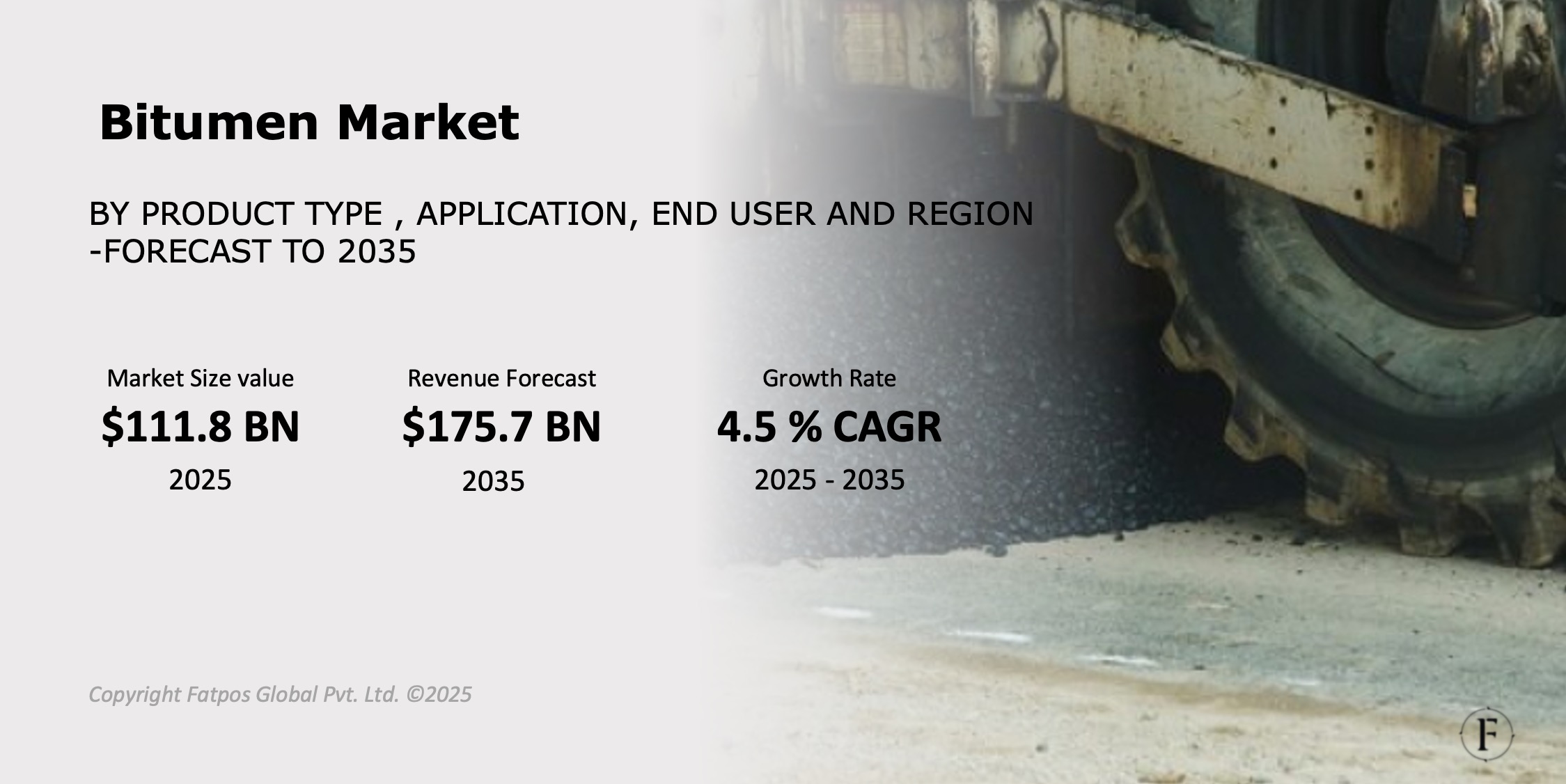
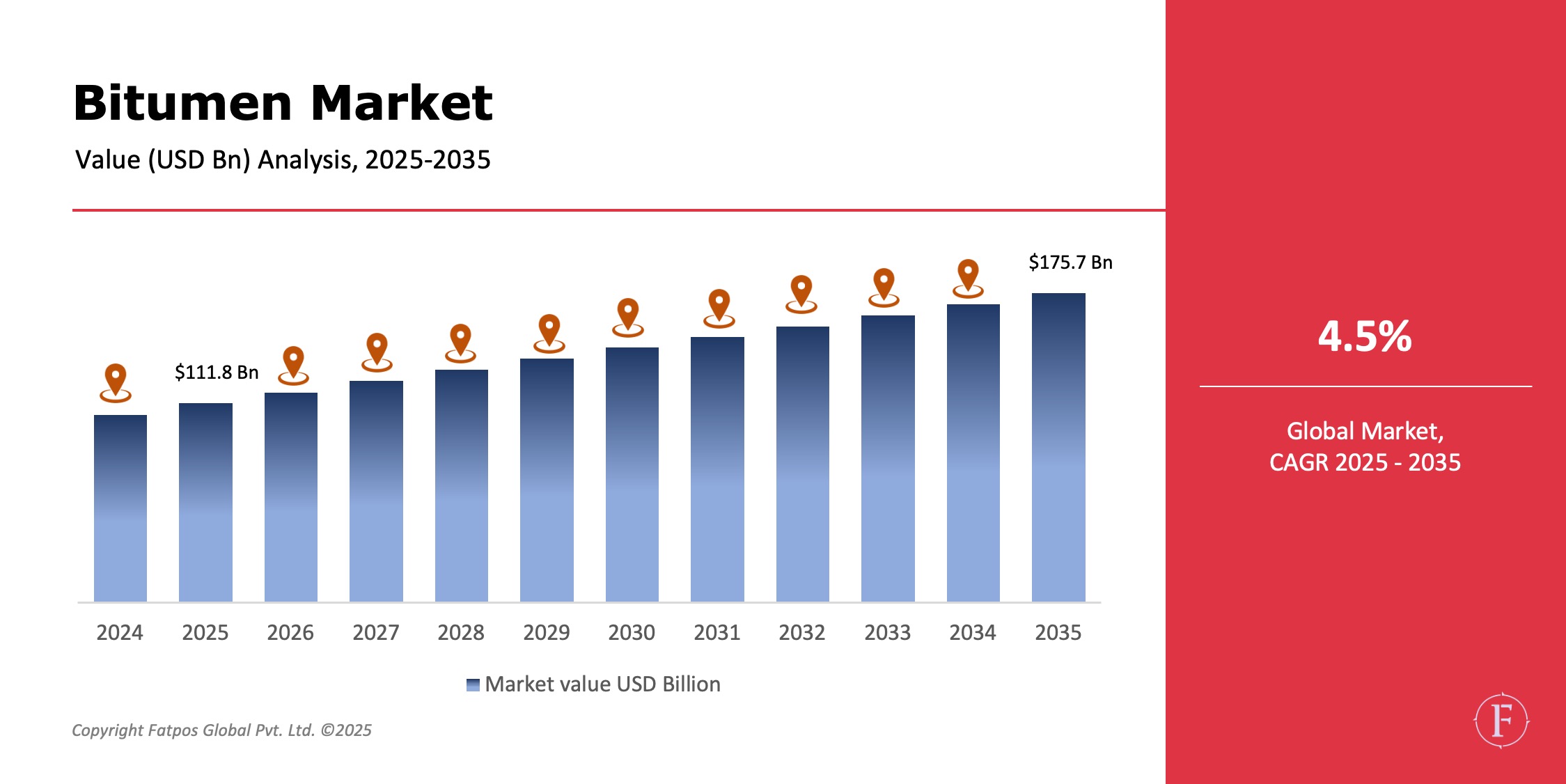
The global bitumen market, valued at USD 111.8 billion in 2025, is projected to reach USD 175.7 billion by 2035 at a 4.5% CAGR. Infrastructure expansion, highway upgrades, urban mobility, and waterproofing demand drive growth. Polymer-modified bitumen and emulsions gain traction for enhanced durability in pavements, runways, bridges, and roofing.
Product Overview
Bitumen, a viscous hydrocarbon from crude oil or natural deposits, is widely used in road surfacing, roofing, waterproofing, and coatings due to its adhesion, durability, moisture resistance, and temperature flexibility. Key types include paving, oxidized, polymer-modified (PMB), cutback, and emulsified variants. Modern innovations like high-modulus binders, anti-stripping agents, warm-mix tech, and recycled asphalt enhance fatigue resistance and lifecycle savings for pavements, buildings, and infrastructure.
Key Takeaways
- The Bitumen Market will grow from USD 112.8 billion in 2025 to USD 176.4 billion by 2035 at a CAGR of 4.6%.
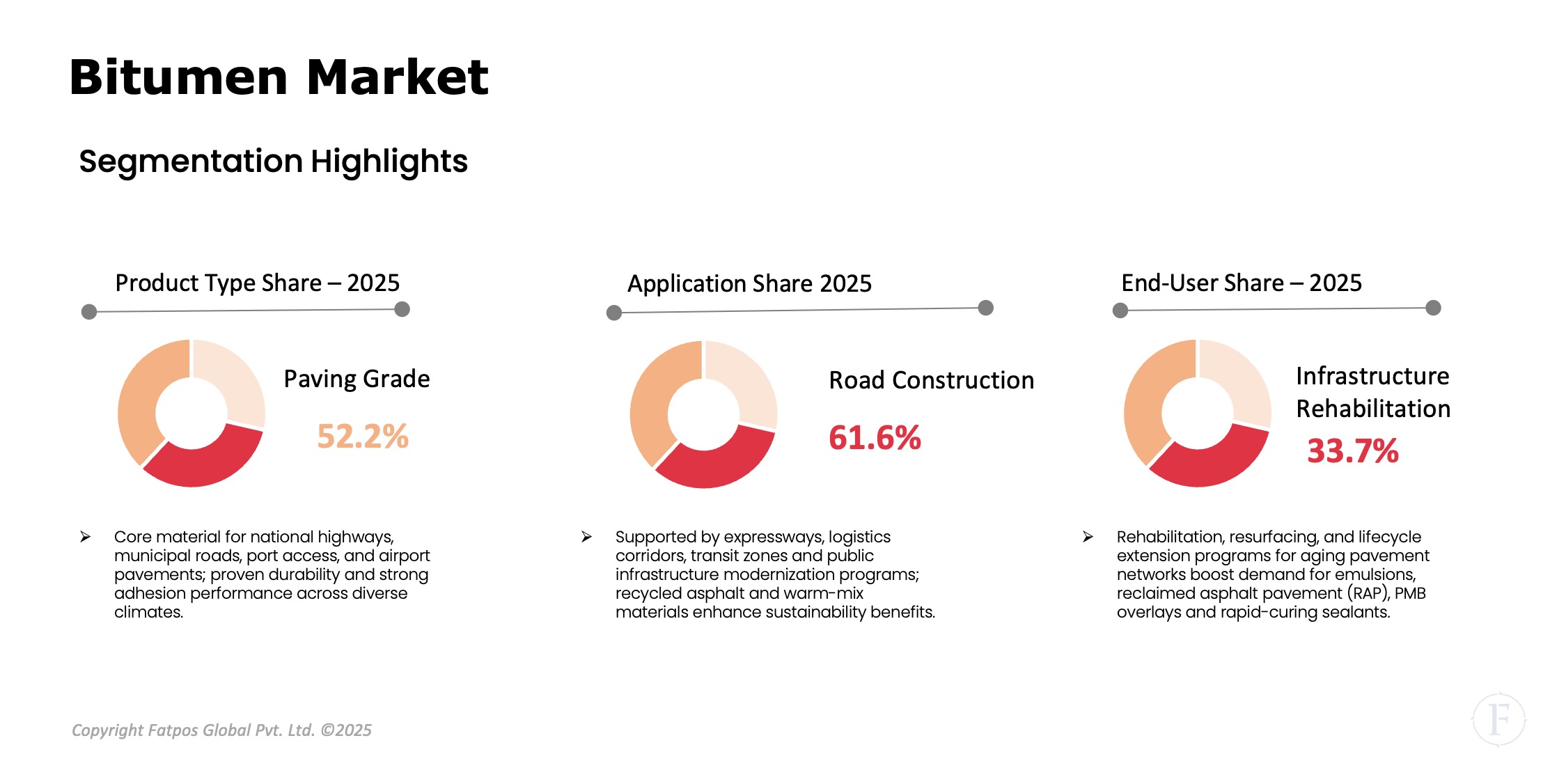
- Paving-grade bitumen remains the largest product segment, supported by continuous infrastructure spending and national road expansion.
- Road construction dominates global demand, followed by roofing and waterproofing for commercial and industrial structures.
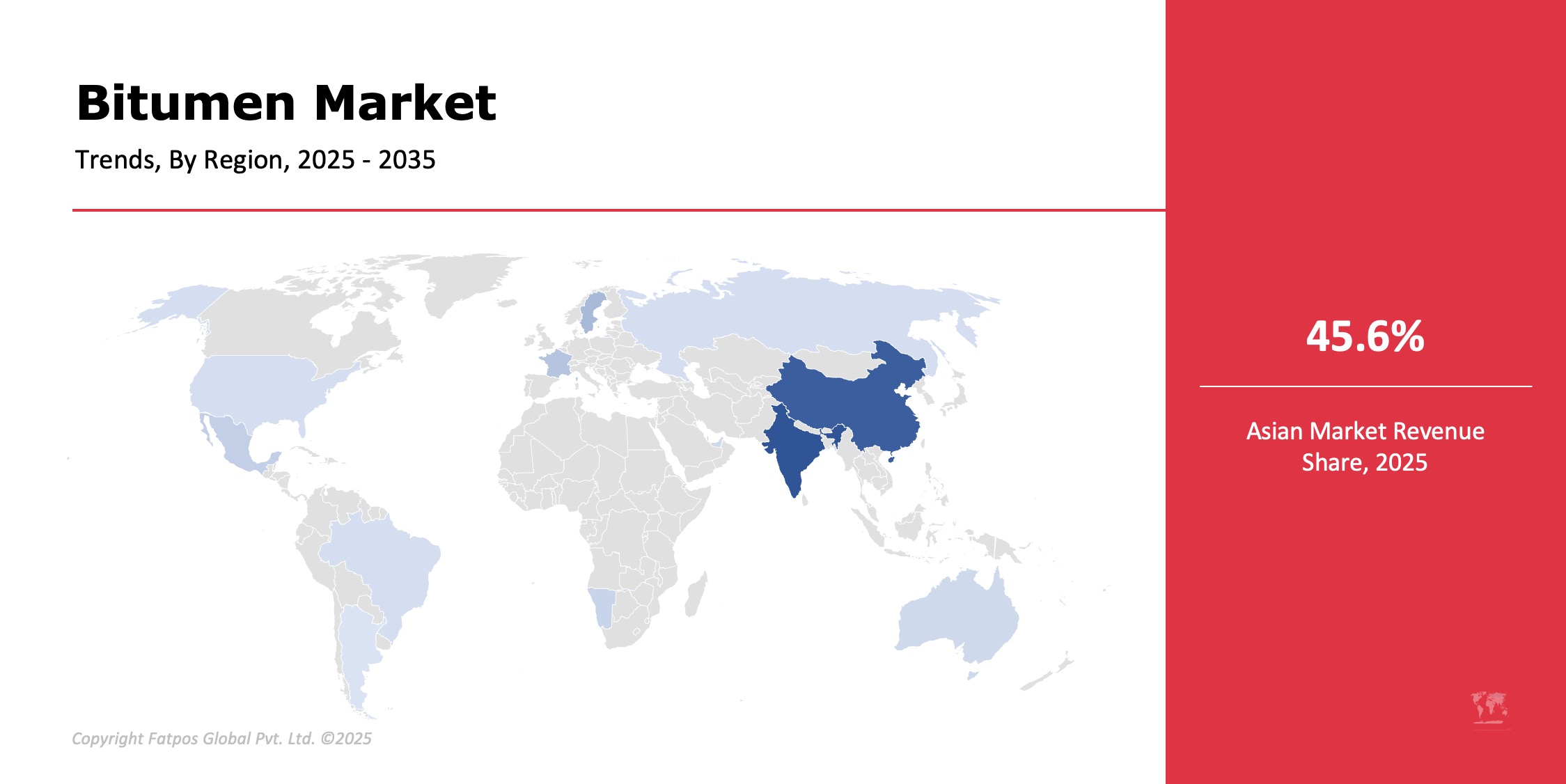
- Asia-Pacific holds the largest Bitumen market share, driven by aggressive infrastructure investments, urban road capacity expansion, housing development and industrialization.
- Polymer-modified and emulsion-based bitumen technologies gain rapid adoption due to better elasticity, low-temperature resistance, improved fatigue strength and superior pavement lifecycle.
Market Dynamics
Drivers:
Infrastructure spending, highway modernization, urban transit, roofing projects, and road connectivity initiatives drive bitumen demand. Smart cities, logistics development, expressways, and runway rehabilitation boost consumption. Enhanced formulations improve mechanical stability, weather tolerance, and crack resistance for superior pavement performance and lower maintenance costs.
Restraints:
Crude oil price volatility raises bitumen production costs, disrupting supply and project budgets. Environmental regulations, construction demand fluctuations, and hot-mix emissions pose sustainability challenges. Storage, transport, and safety needs further complicate procurement and increase handling expenses for industrial use.
Opportunities:
Polymer-modified bitumen, warm-mix asphalt, nano-reinforced binders, and synthetic additives offer growth potential. Sustainability programs favor emulsions and recycled asphalt. High-performance roofing membranes and waterproof coatings drive demand in real estate, warehousing, manufacturing, ports, utilities, and energy infrastructure.
Challenges:
Bitumen quality varies by crude source, while extreme heat, freeze-thaw cycles, and heavy traffic cause pavement cracking and fatigue. Consistent mixing, advanced compaction, skilled labor, and safe handling are critical. Environmental exposure, disposal issues, and sustainability regulations push manufacturers toward low-emission processing and recyclable additives.
Bitumen Market Trends
Growth in polymer-modified asphalt, high-elasticity binders, recycled asphalt pavement (RAP), warm-mix technologies, and advanced emulsion systems are redefining material use in urban road construction and roofing. Bitumen demand is shifting toward pre-mixed formulations, geo-synthetic reinforcements, reflective and anti-skid formulations, enabling superior fatigue resistance, rutting performance, thermal stability and reduced maintenance cost. Construction of smart cities, energy corridors, industrial parks, highway connectivity projects and large commercial complexes are accelerating global adoption.
Key Players Featured in the Report
The global Bitumen Industry report includes several leading manufacturers, such as:
- Shell Bitumen
- ExxonMobil
- TotalEnergies
- Indian Oil Corporation Ltd. (IOCL)
- BP
- Nynas AB
- Valero Energy
- Marathon Petroleum
- Eni
- JX Nippon Oil & Energy
Regional Analysis
Asia-Pacific dominates the bitumen market, fueled by massive infrastructure, expressways, urban upgrades, roofing, and industrialization in China, India, Indonesia, and Southeast Asia. North America and Europe maintain steady demand via highway rehab, smart pavements, and roofing modernization. Middle East, Africa, and Latin America grow through road connectivity, ports, industrial corridors, tourism, and metro projects.
Segmentation Analysis
Paving-grade bitumen leads due to heavy use in highways, runways, and infrastructure upgrades. Polymer-modified bitumen grows fastest with superior elasticity, fuel resistance, and weather durability. Road construction dominates applications, followed by roofing and waterproofing. Demand tracks public infrastructure spending, climate needs, construction tech, and housing growth.
Report Key Elements
|
Report Key Elements |
Details |
|
Study Period |
2025-2035 |
|
Bitumen Market Size by 2035 |
USD 175.7 billion |
|
Market CAGR |
4.5% |
|
By Product Type |
Paving Grade, Oxidized, PMB, Emulsion, Cutback |
|
By End User |
Government Infrastructure Agencies, Construction Contractors, Real Estate Developers, Industrial Facility Owners, Municipal Bodies |
|
By Application |
Road Construction, Roofing, Waterproofing, Industrial Uses, Adhesives & Sealants |
|
By Region |
Europe, North America, Asia-Pacific, Latin America, Middle East & Africa |
|
Key Market Players |
Shell, ExxonMobil, TotalEnergies, IOCL, BP, Nynas, Eni |
Bitumen Industry Instances
- Leading refiners expanded polymer-modified bitumen capacity for premium highway and airport projects.
- Emulsion-based bitumen demand increased due to low-temperature mixing, reduced fuel consumption, and faster field application.
- National transport ministry programs across Asia scaled road rehabilitation using warm-mix asphalt and recycled pavement technologies.
- Roofing system manufacturers introduced enhanced waterproofing membranes and reflective bitumen coatings for industrial structures and warehouses.
Analyst Review
As per our Bitumen Market analysis, the market shows steady demand from infrastructure modernization, industrial real estate, and road rehabilitation. Specialty formulations like polymer-modified, rubberized, and emulsions outperform standard binders with better durability and lifecycle economics. As green construction advances, warm-mix asphalt and recycled pavement technologies gain adoption, cutting carbon and costs.
Frequently Asked Questions (FAQ):
The market is expected to grow from USD 112.8 billion in 2025 to USD 176.4 billion by 2035, at a CAGR of 4.6%, supported by sustained infrastructure investments, national road expansions, and industrial waterproofing demand.
Asia-Pacific leads due to rapid urbanization, government-funded roadway capacity expansion, commercial roofing and industrial corridor development.
Paving-grade bitumen remains the largest product segment, followed by polymer-modified and emulsified bitumen for performance-focused applications.
Road construction and rehabilitation remain the fastest-growing segments, supported by smart mobility projects, bond financing, and lifecycle extension programs.
Road construction companies, infrastructure developers, roofing system manufacturers, industrial contractors, government agencies, refineries, additive suppliers, smart-city planners, and building system consultants seeking actionable insight into material innovation, project economics and regional infrastructure demand.
 Select License Type


.png)


