



Aviation Analytics Market Research 2035
The Aviation Analytics Market Size was USD 5.27 billion in 2025 and is projected to reach USD 19.3 billion by 2035, registering a CAGR of 12.6%. Growth is propelled by digital transformation across airlines, airports, and MROs to improve efficiency, fuel optimization, maintenance automation, passenger experience, and safety. Airlines adopt AI-driven predictive maintenance, real-time flight and fuel analytics, crew optimization, segmentation, and dynamic pricing engines, while airports use analytics for airside operations, baggage flow, capacity forecasting, runway and noise management, and passenger movement. Rising IoT-enabled aircraft, EFB analytics, cloud platforms, zero-delay operations, safety automation, and emission reduction further boost demand.

Product Overview
Aviation analytics uses AI/ML, big data, IoT sensors, and cloud platforms to turn data from aircraft, airports, passengers, crews, and MRO into real-time insights. It spans flight and fuel optimization, predictive maintenance, passenger and revenue management, workforce scheduling, airport operations, and safety and compliance monitoring to improve efficiency, reliability, and profitability.
Key Takeaways:
- Market is forecasted to grow at 12.6% CAGR from 2025–2035.
- Airlines increasingly adopt predictive maintenance, fuel efficiency tools, and dynamic pricing engines.
- Airports invest in airside management, passenger flow analytics, and baggage automation.
- Cloud-based aviation platforms drive the fastest growth as carriers pursue scalable data ecosystems.
- AI, ML, IoT, and predictive analytics remain core technologies powering digital aviation.
- Asia-Pacific remains the fastest-growing region, while North America leads in adoption of advanced analytics platforms.

Market Dynamics
Drivers
Aviation analytics demand is rising as airlines seek fuel optimization amid volatile prices, stronger on-time performance, and faster turnarounds. It is propelled by IoT-enabled aircraft streaming real-time telemetry, enabling predictive maintenance that cuts AOG events and costs. Passenger personalization needs deep behavioral analytics, while regulators push safety automation, FOQA, and robust compliance reporting.
Restraints
Restraints in aviation analytics adoption include rising data privacy, cybersecurity, and regulatory compliance risks, which complicate large-scale data sharing. High integration costs with legacy IT and avionics systems further slow projects, especially for smaller players. The sector also faces a shortage of aviation-focused data science talent and limited digital maturity among small and mid-sized carriers, constraining implementation depth.
Opportunities
Aviation analytics opportunities include the adoption of cloud-native airline operating platforms that simplify deployment and scaling for carriers of all sizes. Emerging markets are modernizing airports with advanced operational analytics and digital twins for aircraft, terminals, and MRO facilities to simulate performance and reduce downtime. Blockchain is being explored for tamper-proof aircraft records, parts tracking, and secure data exchange, while rapid air cargo and e-commerce growth increases demand for powerful load management and route optimization analytics.
Challenges
Aviation analytics faces several challenges, including managing massive volumes of unstructured flight, sensor, and operational data and making these datasets usable for timely insights. Ensuring interoperability among airlines, airports, OEMs, MROs, and regulators across regions is complex, especially with differing systems and standards. Real-time analytics depend on stable, high-bandwidth connectivity, which is not always available, while significant implementation and licensing costs create adoption barriers for low-cost carriers.
Aviation Analytics Market Trends
Aviation analytics is advancing through AI-powered maintenance using health monitoring systems and real-time, integrated operational dashboards spanning flight, cockpit, ground, and airport systems. Digital twins increasingly optimize aircraft lifecycles and airport operations, while AI-driven passenger personalization, predictive supply chain analytics, blockchain-based maintenance records, and 5G-enabled aircraft and airports enable low-latency, secure, data-rich aviation ecosystems.
Key Players in the Aviation Analytics Industry
- IBM
- Accenture
- Oracle
- SAP SE
- Ramco Systems
- Boeing AnalytX
- Airbus Skywise
- Collins Aerospace
- Honeywell Aerospace
- SAS Institute
- GE Aerospace Digital Group
- Lufthansa Systems
- Palantir Technologies
- Capgemini
- Hitachi Vantara
Regional & Country Analysis
North America
North America leads with maximum Aviation Analytics Market share, driven by large fleets, advanced airports, and early adoption of predictive maintenance and digital platforms. Europe focuses on safety compliance, fuel efficiency, and green aviation with strong investment in airside and ATC analytics. Asia-Pacific is the fastest-growing region, propelled by rising traffic, new airports, and rapid airline digitization in China, India, and Southeast Asia. Latin America and Middle East/Africa grow through ATC modernization, flight analytics, and GCC premium airport automation.

Segmentation Highlights
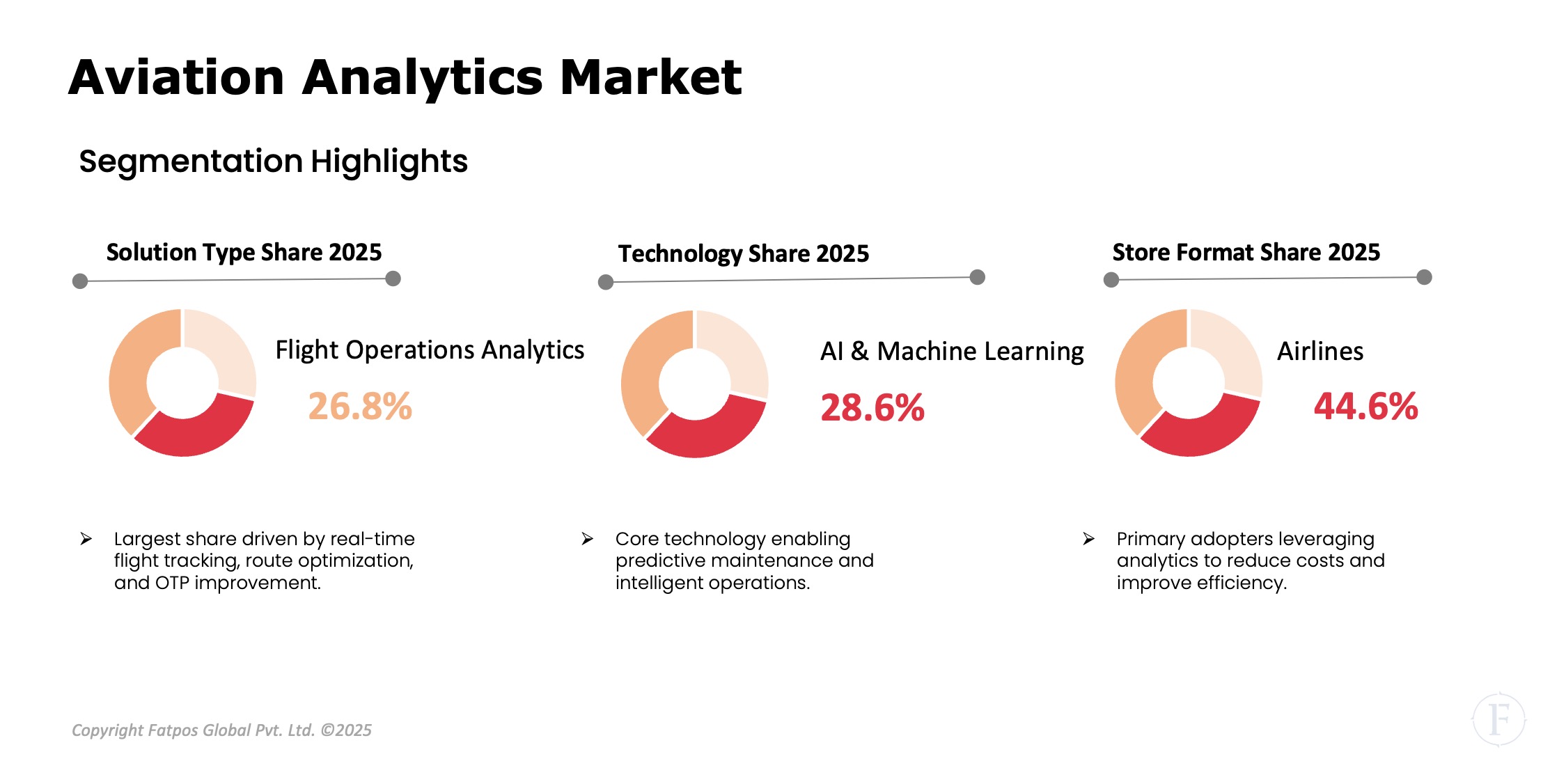
The Aviation Analytics Market is segmented by solution, technology, component, deployment mode, and end user. By solution, flight operations and fuel management analytics dominate due to their direct impact on cost reduction and on-time performance, while MRO and predictive maintenance analytics are the fastest growing as airlines seek to minimize AOG events. By technology, AI & machine learning and big data analytics lead adoption, supported by IoT-enabled aircraft data. Cloud-based deployments are expanding rapidly for scalability and real-time insights. By end user, airlines hold the largest share, followed by airports and MRO providers.
Report Key Elements
|
ATTRIBUTES |
DETAILS |
|
Study Period |
2019–2035 |
|
Base Year |
2024 |
|
Aviation Analytics Market Forecast Period |
2025–2035 |
|
Aviation Analytics Market Size by 2035 |
USD 198.7 billion |
|
Market CAGR |
12.6% |
|
By Component |
Solutions, Services |
|
By Deployment Mode |
On-Premise, Cloud |
|
By Technology |
AI/ML, Big Data, IoT, Blockchain, Predictive Analytics, Cloud |
|
By Application |
Flight Operations, Fuel Management, Fleet Management, Revenue Management, Inventory Management, Crew Management, Customer Analytics, Safety & Compliance, MRO Analytics |
|
By End User |
Airlines, Airports, MROs, OEMs, Air Cargo, ATC/ANSPs) |
|
By Region |
NA, Europe, APAC, LATAM, MEA |
|
Key Market Players |
Amazon IBM, Accenture, Oracle, SAP SE, Ramco Systems, Boeing AnalytX, Airbus Skywise, Collins Aerospace, Honeywell Aerospace, SAS Institute, GE Aerospace Digital Group, Lufthansa Systems |
Aviation Analytics Industry Instances
- Leading airlines deploy AI-powered fuel efficiency dashboards, reducing fuel burn by 3–5%.
- MRO providers adopt predictive maintenance models, reducing AOG events by up to 40%.
- Airports implement computer vision systems for queue prediction and gate allocation.
- Air cargo operators use analytics to optimize load planning and routing, improving turnaround time.
- Cloud-native airline operations platforms achieve 20–30% faster decision cycles.
Analyst Review
As per our Aviation Analytics Market Analysis report, s transitioning from basic data reporting to full AI-driven operational intelligence, reshaping flight operations, MRO, safety, and customer experience. Increasing aircraft digitalization, next-gen fleet deliveries, and rising pressure to reduce operating costs ensure sustained long-term aviation analytics market growth. Despite challenges around integration, cybersecurity, and digital maturity, the shift toward predictive, automated aviation operations will continue to accelerate adoption through 2035.
Frequently Asked Questions (FAQ):
The market is expected to reach USD 19.4 billion by 2035.
Predictive maintenance & fuel analytics show the highest growth due to strong ROI.
North America leads, while Asia-Pacific grows fastest.
Airlines, airports, MROs, OEMs, air cargo operators, and air navigation service providers.
AI/ML, big data, IoT, blockchain, cloud platforms, and predictive models.
 Select License Type


.png)


