


Automotive Instrumentation Display Market Size
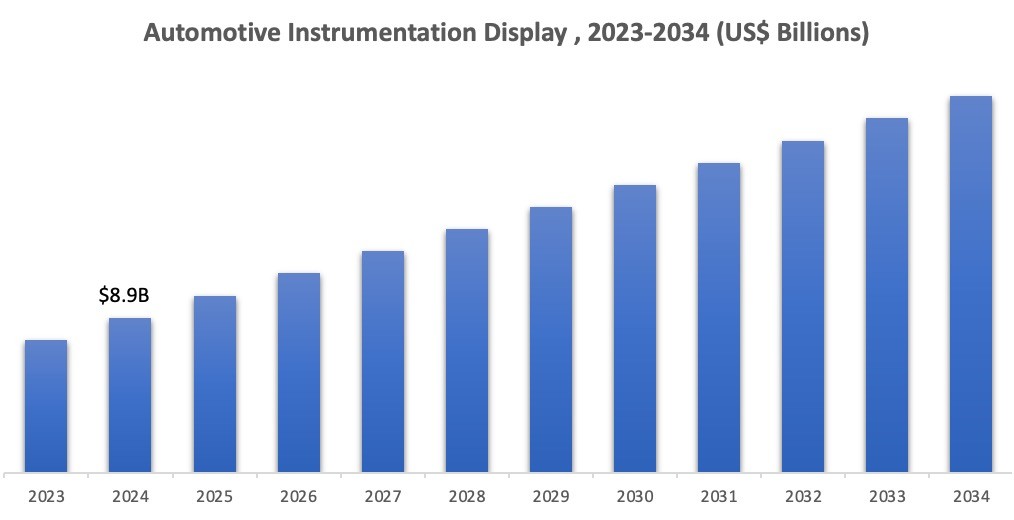
The global automotive instrumentation display market size was estimated at USD 8.9 billion in 2025 and is projected to reach USD 19.3 billion by 2035, growing at a CAGR of 8.10% from 2025 to 2035.
The Automotive Instrumentation Display is a critical component of a car's dashboard, providing essential information to the driver. It typically includes gauges and display that indicate speed, engine RPM, fuel level, and temperature. Instrument display come in various formats, including analog, digital, and hybrid combinations. Modern display often feature advanced technologies such as LCD, OLED, or TFT screens, offering additional functionality like navigation, driver assistance alerts, and customizable options.
These features enhance driving safety by providing real-time updates and visual warnings, contributing to the vehicle's overall performance and user satisfaction. As automotive technology continues to evolve, instrument display are incorporating more intelligent features and connectivity options.
Market Highlights:
Global Automotive Instrumentation Display Market is expected to achieve a value of US$ 19.1 billion, with a growth rate of 7.9% over the forecast period, propelled by the growing usage of advanced driver assistance systems (ADAS) and increasing consumer preference for digital and customizable display. Improvements in display technologies such as LCD, OLED, and TFT-LCD improve clarity and functionality. The increase in car manufacturing and global sales drives the need for advanced instrument display.
The anticipated growth is expected due to the integration of connected vehicle technologies, such as real-time data and infotainment systems, and advancing safety regulations requiring more advanced and informative display. Developments in automotive technology will lead to the ongoing development of instrument display, thereby expanding the market even more.
Source: Fatpos Global
Market Segmentation:
Cost-effective hybrid instruments dominate the market, balancing traditional and modern solutions
Market is divided based on display Type into Analog, Digital, and Hybrid. Hybrid instrument display hold the leading position in the automotive market due to their ability to combine conventional analog gauges with cutting-edge digital display effectively. This balance caters to traditional drivers and tech enthusiasts alike, offering a blend of familiar elements with the flexibility of digital information.
Hybrid display are an economical option, blending digital capabilities while avoiding the increased expenses of fully digital display. They collectively support the industry's shift towards electrification and advanced driver assistance systems (ADAS) by integrating new features without completely altering familiar components. Moreover, hybrid display provide options for different vehicle models and driver preferences, especially for individuals who prioritize analog gauge feedback and desire customizable layouts.
Passenger Vehicles’ higher production volume and diverse range cement their position as the leading segment
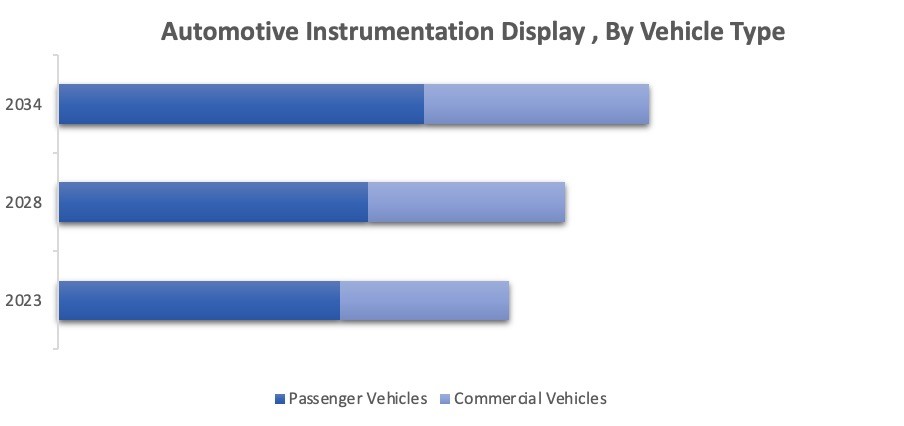
Market is divided based on Vehicle Type into Commercial Vehicles, and Passenger Vehicles. Passenger vehicles tend to dominate the automotive instrumentation display market accredited to several compelling factors. To begin with, the global production and sales of passenger cars significantly exceed that of commercial vehicles, resulting in an increased need for instrument display. The wide variety of passenger vehicles, ranging from small cars to high-end SUVs, each with unique display needs, also increases the demand.
Automobiles for passengers are also at the forefront of technological progress, with advanced driver assistance systems (ADAS) and entertainment systems that depend on complex instrument panels. Moreover, the design of instrument display in passenger vehicles is greatly impacted by consumer preferences for aesthetics, comfort, and technology. Regular updates to models in this sector lead to increased turnover of instrument display, further solidifying their position in the market.
Source: Fatpos Global
Market Dynamics:
Growth Drivers
Increasing Demand for Advanced Driver Assistance Systems (ADAS) to Bolster Market Growth
The increasing popularity and fast integration of Advanced Driver Assistance Systems (ADAS) is a major factor driving the growth of advanced instrument display. Advanced display are essential for providing real-time information and alerts to drivers for ADAS features like lane departure warnings, adaptive cruise control, and collision avoidance systems. These systems improve vehicle safety and driver convenience, requiring instrument display that have high-resolution screens, easy-to-use interfaces, and smooth integration with other vehicle systems.
The increasing use of ADAS in vehicles is directly resulting in a higher demand for advanced instrument display that can meet the complexity and data visualization requirements of these technologies. This pattern becomes more noticeable as car makers focus on safety and automation due to consumer demand and regulations.
Rising Production and Sales of Vehicles Globally Lead to Higher Demand for Instrument Display
The increase in vehicle manufacturing and sales globally is another important factor contributing to the expansion of the advanced instrument display market. As car manufacturers boost their manufacturing to satisfy rising consumer needs, particularly in developing countries, there is also a growing requirement for advanced dashboard display in new cars.
This demand spans across different categories, from budget-friendly to high-end cars, each requiring distinct instrument display features and designs. Furthermore, with the growing demand for cars with cutting-edge technology, car manufacturers must incorporate advanced, customizable, and visually attractive instrument panels to improve the driving experience. This pattern is anticipated to persist as automotive sales increase globally, continuing to fuel market growth.
Restraints
High Cost of Advanced Instrument Display to Restrict Market Growth Opportunities
The higher costs linked with advanced digital technologies and hybrid instrument display present major obstacles, especially for budget-friendly vehicles. Integrating modern technologies like high-res screens, intricate software, and advanced materials increases production costs. Shifting these expenses to customers can reduce the competitiveness of entry-level vehicles in price-conscious markets for manufacturers.
Furthermore, the cost increases due to the requirement for specific components and the challenge of incorporating these display with other vehicle systems. Automakers might be hesitant to add these advanced display to cheaper models, which could restrict their use to mid-range and luxury vehicles. This cost barrier can restrict the extensive adoption of advanced instrument display in all vehicle categories, especially in developing markets.
Recent Developments
- In 2023-24, Bosch Limited launched its new "Virtual Cockpit" instrument display, featuring advanced driver assistance system (ADAS) integration and customizable display for enhanced driver information. The company also invested in developing advanced display technologies and integration solutions to support next-generation electric and autonomous vehicles.
- In 2023-24, Continental AG introduced its "Smart Cockpit" solution, a modular instrument display system that offers high-resolution display and real-time vehicle data integration. The company formed a joint venture with ZF Friedrichshafen AG to develop advanced cockpit electronics, focusing on integrating digital instrument display with advanced driver assistance systems.
- In 2023-24, Denso Corporation introduced a new digital instrument display with augmented reality (AR) capabilities to enhance driver safety and navigation. The company acquired a stake in a startup specializing in advanced display technologies to bolster its capabilities in developing next-gen instrument display.
- In 2023-24, Harman International launched its "Harman Cloud-Based Instrument Display," which integrates cloud connectivity to provide real-time data and vehicle diagnostics. The company has strongly focused on enhancing its instrument display with artificial intelligence (AI) for improved driver interaction and personalized experiences.
- In 2023-24, NXP Semiconductors introduced a new series of automotive processors designed for high-performance digital instrument display, improving processing power and display quality.
Key Players:
- Bosch Limited
- Continental AG
- Denso Corporation
- Harman International
- NXP Semiconductors
- Clarion Co., Ltd.
- STMicroelectronics
- LG Display
- Johnson Controls International
- Panasonic Corporation
- Delphi Technologies
- Visteon Corporation
- Yazaki Corporation
- Delphi Technologies
- Magneti Marelli
- Other Prominent Players (Company Overview, Business Strategy, Key Product Offerings, Financial Performance, Key Performance Indicators, Risk Analysis, Recent Development, Regional Presence, SWOT Analysis)
Regional Analysis
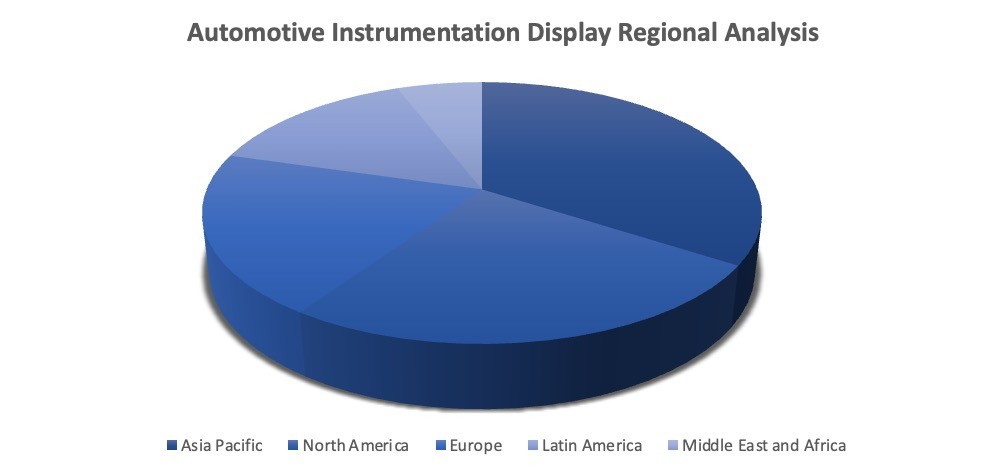
Global Automotive Instrumentation Display Market is segmented based on regional analysis into five major regions: North America, Latin America, Europe, Asia Pacific and the Middle East and Africa.
Asia-Pacific leads the market due to its significant automotive manufacturing presence, notably in China, Japan, and South Korea. The increasing need for passenger and commercial vehicles, along with the region's robust production capacities, drive the utilization of modern instrument display. Moreover, the quick growth of the electric car industry and rising funds in automotive technology continue to strengthen the region's control. Supportive government policies and the existence of top automotive manufacturers are helping drive growth and innovation in this market sector.
On the contrary, North America and Europe also possess considerable market share because of their robust automotive sectors and emphasis on cutting-edge vehicle technologies like ADAS. Smaller market shares in Latin America and the Middle East and Africa regions are due to moderate vehicle production and slower adoption of advanced technologies.
Source: Fatpos Global
Impact of Covid-19 on The Market
The Covid-19 pandemic had a significant impact on the market. Global supply chain disruptions, factory closures, and reduced consumer demand led to a decrease in vehicle production and sales, which affected the demand for instrument display. Car makers faced difficulties in launching new models, which hindered the adoption of advanced instrument display technologies.
However, as the industry began to recover, there was a shift towards digitalization and the integration of advanced functionalities such as ADAS, which rely on complex instrument display. The pandemic accelerated the transition to electric vehicles (EVs), increasing the demand for innovative and personalized instrument display. Despite the challenges during the pandemic, the market has shown signs of progress and development during the recovery period.
Market is further segmented by region into:
- North America Market Size, Share, Trends, Opportunities, Y-o-Y Growth, CAGR – United States and Canada
- Latin America Market Size, Share, Trends, Opportunities, Y-o-Y Growth, CAGR – Mexico, Argentina, Brazil, and Rest of Latin America
- Europe Market Size, Share, Trends, Opportunities, Y-o-Y Growth, CAGR – United Kingdom, France, Germany, Italy, Spain, Belgium, Hungary, Luxembourg, Netherlands, Poland, NORDIC, Russia, Turkey, and Rest of Europe
- Asia Pacific Market Size, Share, Trends, Opportunities, Y-o-Y Growth, CAGR – India, China, South Korea, Japan, Malaysia, Indonesia, New Zealand, Australia, and Rest of APAC
- Middle East and Africa Market Size, Share, Trends, Opportunities, Y-o-Y Growth, CAGR – North Africa, Israel, GCC, South Africa, and Rest of MENA
Market Scope and Segments:
|
ATTRIBUTE |
DETAILS |
|
Study Period |
2018-2034 |
|
Base Year |
2023 |
|
Forecast Period |
2024-2034 |
|
Historical Period |
2019-2022 |
|
Growth Rate |
CAGR of 7.9% from 2024-2034 |
|
Unit |
Value (US$ Billion) |
|
Segmentation |
Main Segments List |
|
By Display Type |
|
|
By Vehicle Type |
|
|
By Region |
|
Frequently Asked Questions (FAQ):
Automotive instrumentation display market size was valued at US$ 8.3 billion in 2023 and is projected to reach the value of US$ 19.1 billion in 2034, exhibiting a CAGR of 7.9% during the forecast period.
The market encompasses the design, manufacture, and sale of display that provide crucial vehicle information like speed, fuel level, and engine performance to drivers. It includes analog, digital, and hybrid display types.
The Hybrid and Passenger Vehicle segment accounted for the largest market share.
Key players in the automotive instrumentation display market include Bosch Limited, Continental AG, Denso Corporation, Harman International, NXP Semiconductors, Clarion Co., Ltd., STMicroelectronics, LG Display, Johnson Controls International, Panasonic Corporation, Delphi Technologies, Visteon Corporation, Yazaki Corporation, Delphi Technologies Magneti Marelli and Other Prominent Players.
Rising demand for advanced driver assistance systems, electrification, and consumer preference for digital and customizable display drive the Market.
 Select License Type


.png)


