


UPS Battery Market Research 2035
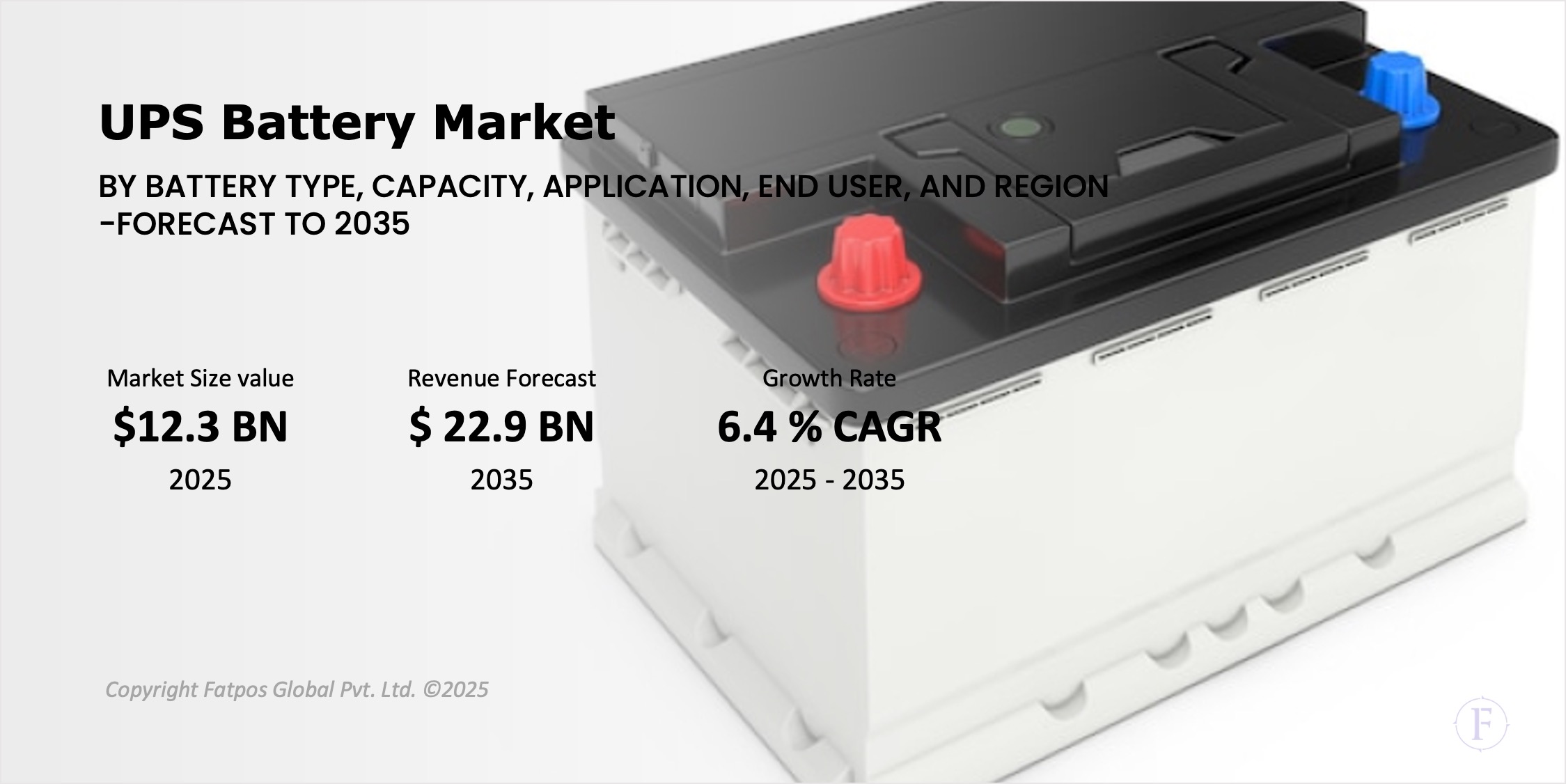
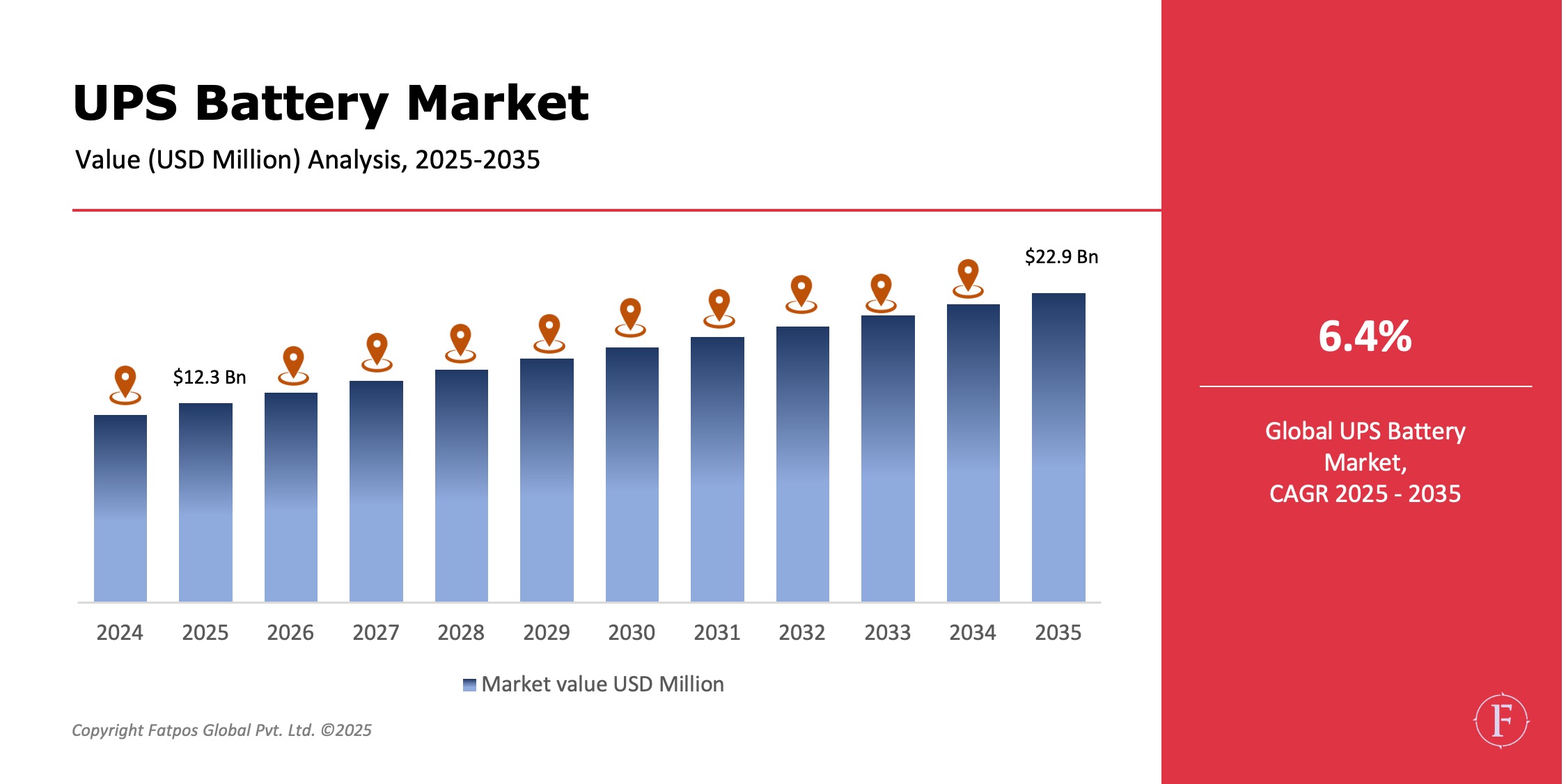
The UPS Battery Market Size was USD 12.3 billion in 2025 and is projected to reach USD 22.9 billion by 2035, registering a CAGR of 6.4%, The Market growth is driven by rising demand for uninterrupted power supply systems, rapid expansion of data centers, increasing digitalization across industries, growing reliance on critical infrastructure, and rising power reliability concerns worldwide.
UPS batteries play a crucial role in ensuring power continuity, equipment protection, and operational reliability during power outages and voltage fluctuations. Advancements in battery technologies, particularly the shift toward lithium-ion UPS batteries, are reshaping the market by offering longer life cycles, faster charging, and reduced maintenance requirements.
Product Overview
UPS batteries form the core of power backup systems, delivering short- to medium-duration electricity during outages. They are categorized by battery type, with lead-acid batteries favored for their cost-effectiveness and robust supply chains, while lithium-ion batteries emerge in popularity thanks to superior energy density, extended lifespan, and compact design. Nickel-cadmium options excel in demanding industrial settings with high reliability and temperature resilience, alongside emerging types like nickel-metal hydride. By capacity, below 100 kVA suits homes and small businesses; 100–500 kVA dominates data centers and factories; and above 500 kVA powers massive data centers, utilities, and critical operations.
Key Takeaways :
- The UPS Battery Market is expected to grow at ~6.4% CAGR through 2035.
- Lead-acid batteries currently dominate market share, while lithium-ion is the fastest-growing segment.
- Data centers are the largest application segment globally.
- Increasing focus on energy efficiency, compact design, and reduced maintenance.
- Asia-Pacific is the fastest-growing regional market.
- UPS battery replacement demand contributes significantly to recurring revenue.
Market Dynamics
Drivers
The rapid expansion of data centers and cloud computing drives unprecedented demand for UPS batteries, as these facilities require uninterrupted power to handle massive data loads. Critical industries like healthcare, finance, and telecom increasingly rely on robust backup systems to prevent costly downtimes. Rising digitalization and automation across manufacturing, retail, and smart cities amplify the need for seamless energy continuity. In emerging economies, frequent power outages and grid instability—exacerbated by climate events and infrastructure gaps—underscore the urgency for reliable solutions. Meanwhile, lithium-ion battery advancements, offering higher density and longevity, fuel this market's explosive growth.
Restrictions
Lithium-ion UPS batteries face significant challenges that hinder widespread adoption. Their high initial cost—often 2-3 times that of lead-acid alternatives—stems from advanced materials and manufacturing, making them less accessible despite lower long-term ownership costs through reduced maintenance and replacements. Environmental concerns loom large, as battery disposal raises risks of toxic leaks and heavy metal pollution, while recycling infrastructure lags, complicating sustainable end-of-life management. Safety issues, including thermal runaway and fire hazards, demand sophisticated management systems to mitigate overheating and ensure stability in high-demand UPS applications.
Opportunities
The proliferation of edge data centers and 5G infrastructure heightens UPS demand for low-latency, reliable power at distributed sites like telecom towers and smart factories. Lithium-ion batteries paired with smart BMS gain traction through IoT integration, enabling real-time monitoring, predictive maintenance, and optimized performance to cut downtime and costs. Surging investments in renewable energy microgrids leverage modular storage for resilient, scalable backup amid grid volatility. Modular, scalable UPS systems dominate, offering flexibility for growing IT, manufacturing, and hyperscale needs without excess upfront spending.
Challenges
UPS market growth confronts key challenges in lifecycle management and beyond. Optimizing lifecycle costs involves strategic battery replacements, which can account for 35-50% of total expenses, alongside robust recycling programs that recover 95% of materials like lead and lithium while slashing disposal fees and emissions. Ensuring safety and reliability demands protections against overloads, thermal runaway, and high-load stresses, with simulations guaranteeing over 10-year performance even at 70°C. Intensifying competition from battery energy storage systems (BESS), generators, inverters, and solar setups pressures UPS via cost declines and hybrid innovations.
UPS Battery Market Trends
The UPS battery market evolves rapidly through technological and sustainability shifts. A decisive move from lead-acid to lithium-ion batteries accelerates, driven by 3-5x longer lifespans, 50% higher efficiency, and reduced weight, slashing total ownership costs by up to 40% over a decade. Integration of advanced monitoring and predictive maintenance via IoT-enabled BMS prevents failures, extends runtime, and optimizes performance in real-time. Compact, high-density solutions dominate edge and hyperscale deployments, fitting more power into less space for 5G and modular data centers. Demand surges for eco-friendly, recyclable materials amid stricter regulations, recovering 95% of critical minerals. AI-powered platforms enhance management, forecasting outages and automating failover for mission-critical reliability.
Key Players in the Global UPS Battery Industry
- Schneider Electric
- Vertiv Group
- Eaton Corporation
- APC by Schneider Electric
- Exide Technologies
- GS Yuasa Corporation
- Panasonic Corporation
- East Penn Manufacturing
- Leoch International Technology
- EnerSys
- Delta Electronics
- Hitachi Energy
Regional & Country Analysis
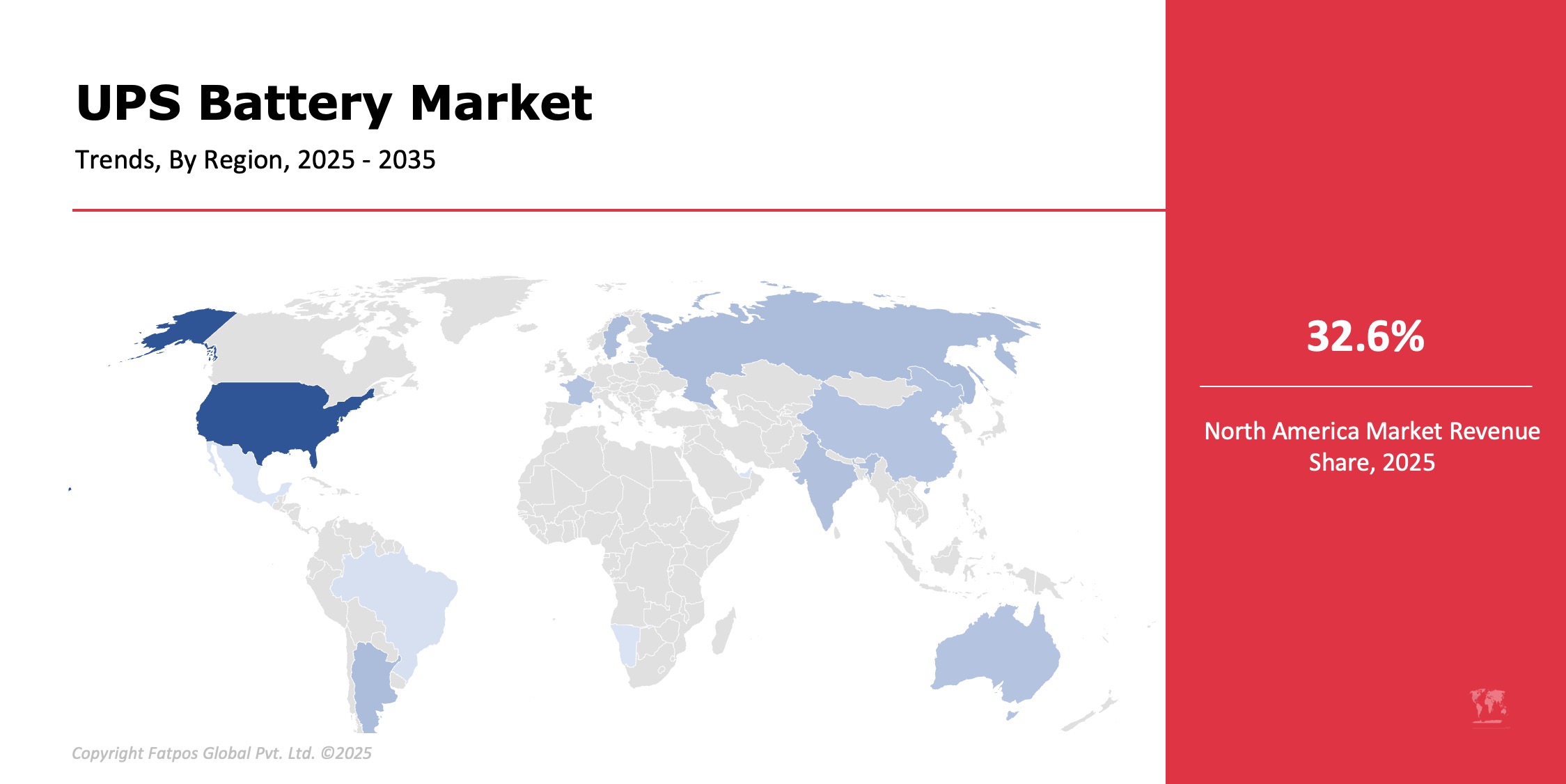
North America leads the UPS battery market with robust demand from massive hyperscale data centers, the resilient BFSI sector, and expanding healthcare facilities requiring uninterrupted power. Europe experiences steady growth fueled by stringent energy efficiency regulations, industrial automation, and smart grid infrastructure upgrades. Asia-Pacific emerges as the fastest-growing region, propelled by explosive telecom network expansions, data center booms, and rapid industrialization in China, India, and Southeast Asia. Latin America sees rising adoption in commercial buildings and telecom, while Middle East & Africa unlock emerging opportunities through data center investments, utility modernizations, and ambitious smart city projects.
Segmentation Highlights
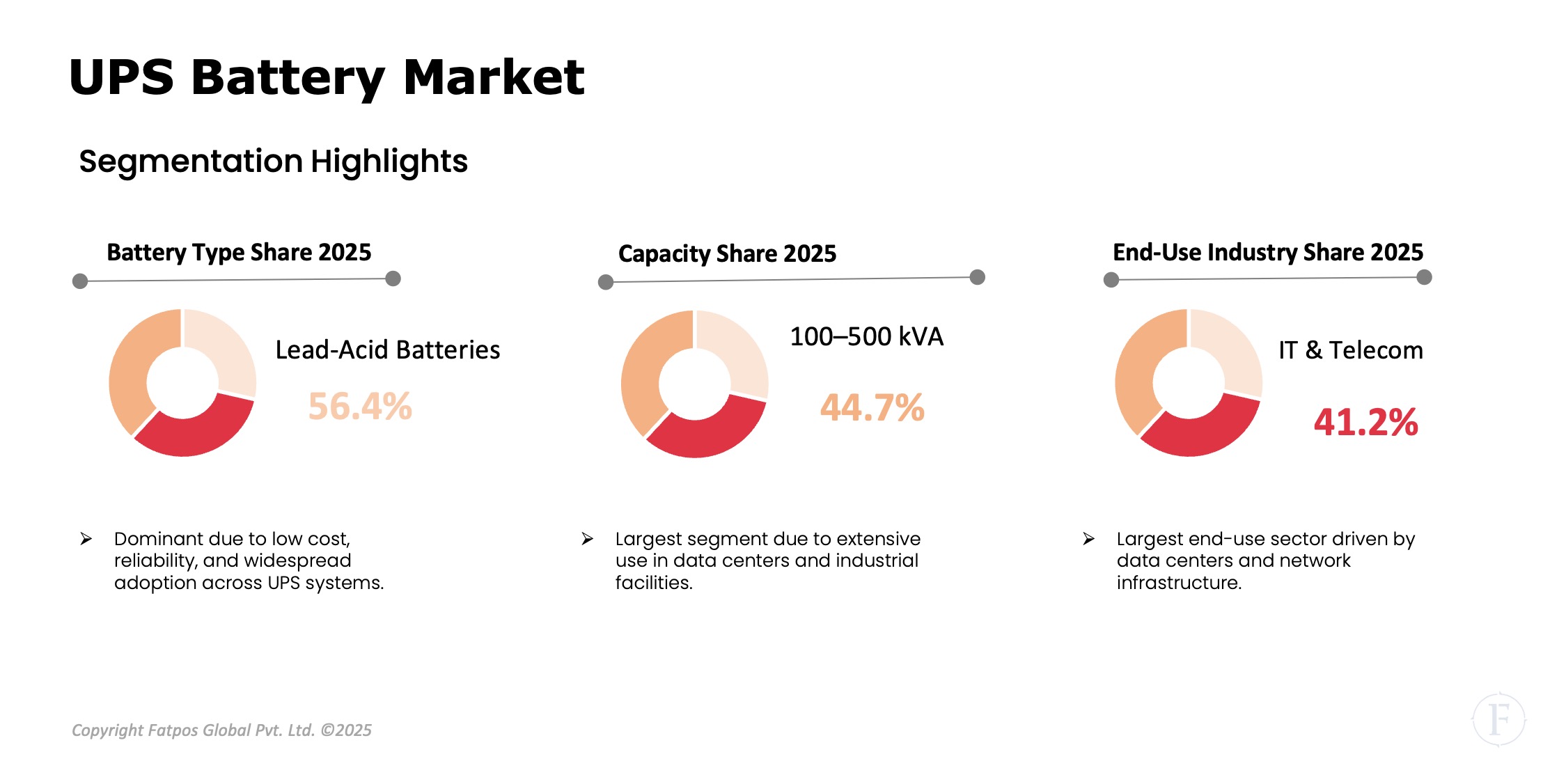
UPS batteries segment by type sees lead-acid maintaining dominance through affordability and reliability, while lithium-ion exhibits the fastest growth due to superior efficiency and longevity [prior context]. The 100–500 kVA capacity range commands the largest market share, powering dominant data center and industrial needs. Data centers spearhead application demand, trailed by industrial facilities and commercial buildings requiring seamless backups. IT and telecom end-users consume the biggest portion, driven by cloud infrastructure, 5G rollout, and mission-critical uptime demands across global deployments.
Report Key Elements
|
ATTRIBUTES |
DETAILS |
|
Study Period |
2019–2035 |
|
Base Year |
2024 |
|
Forecast Period |
2025–2035 |
|
UPS Battery Market Size by 2035 |
USD 22.9 billion |
|
Market CAGR |
6.4% |
| By Battery Type | Lead-Acid, Lithium-Ion, Nickel-Cadmium, Others |
|
By Capacity |
Below 100 kVA, 100–500 kVA, Above 500 kVA |
|
By Application |
Data Centers, Industrial, Commercial, Residential, Telecom |
|
By End User |
IT & Telecom, BFSI, Healthcare, Manufacturing, Energy & Utilities, Government |
|
By Region |
NA, Europe, APAC, LATAM, MEA |
|
UPS Battery Market: Key Players |
Schneider Electric, Vertiv Group, Eaton Corporation, APC by Schneider Electric |
Global UPS Battery Industry Instances
- Data center operators transitioned to lithium-ion UPS systems for space optimization.
- Telecom providers upgraded battery-backed UPS infrastructure for 5G rollout.
- Hospitals deployed high-reliability UPS batteries for critical care systems.
- Manufacturers introduced smart battery monitoring solutions.
Analyst Review
As per our UPS Battery Market analysis report, market is poised for sustained growth as power reliability becomes critical across digital and industrial ecosystems. While lead-acid batteries continue to dominate due to cost advantages, lithium-ion technologies are gaining traction owing to superior performance and lower total cost of ownership. Companies focusing on innovation, safety, and sustainability will be best positioned to capture long-term opportunities through 2035.
Frequently Asked Questions (FAQ):
To provide backup power during outages and protect critical equipment.
Lead-acid batteries.
Lithium-ion UPS batteries.
Data center expansion and power reliability needs.
Asia-Pacific.
 Select License Type


.png)


