



Smart Labels Market Research 2035
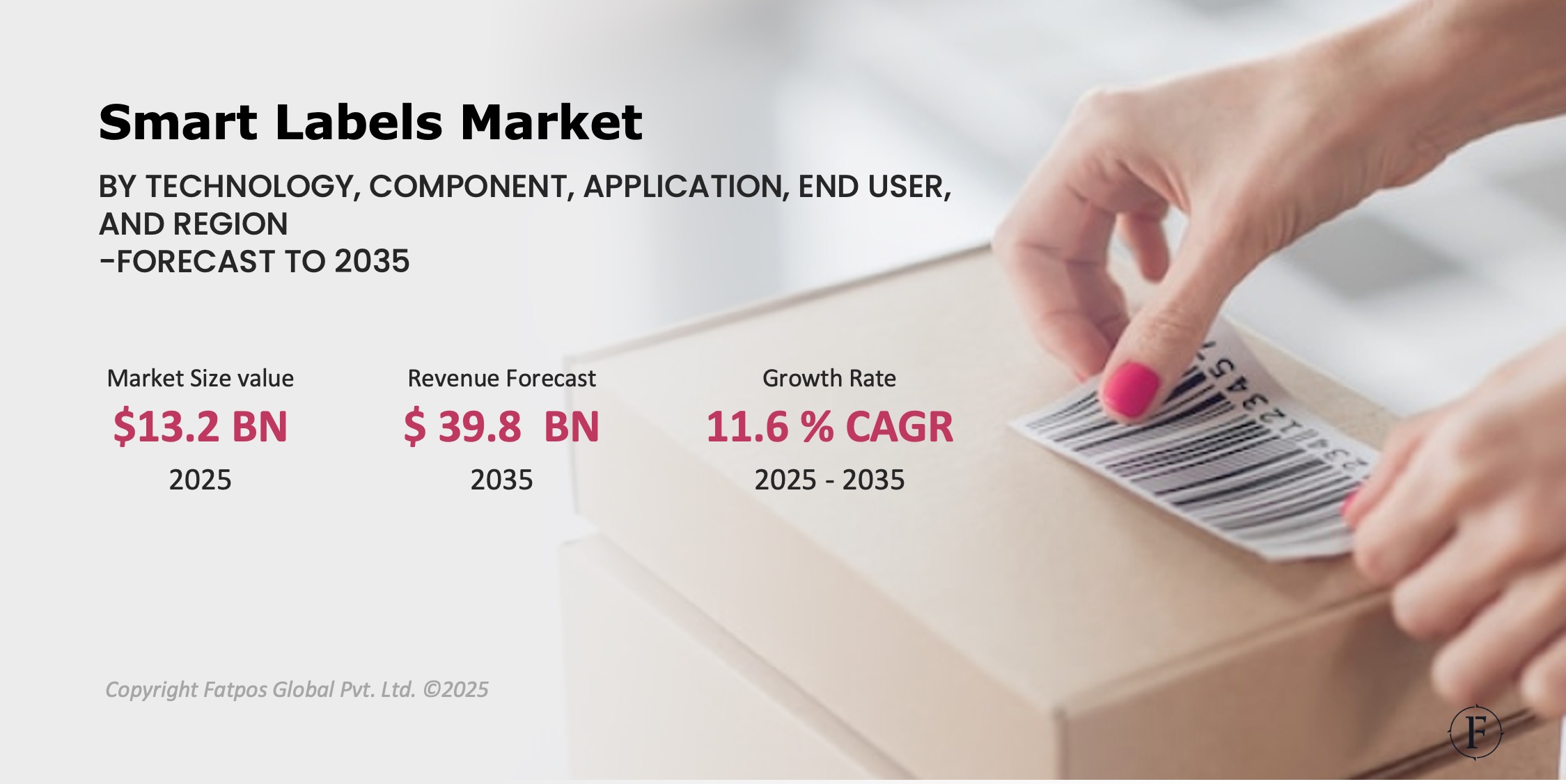
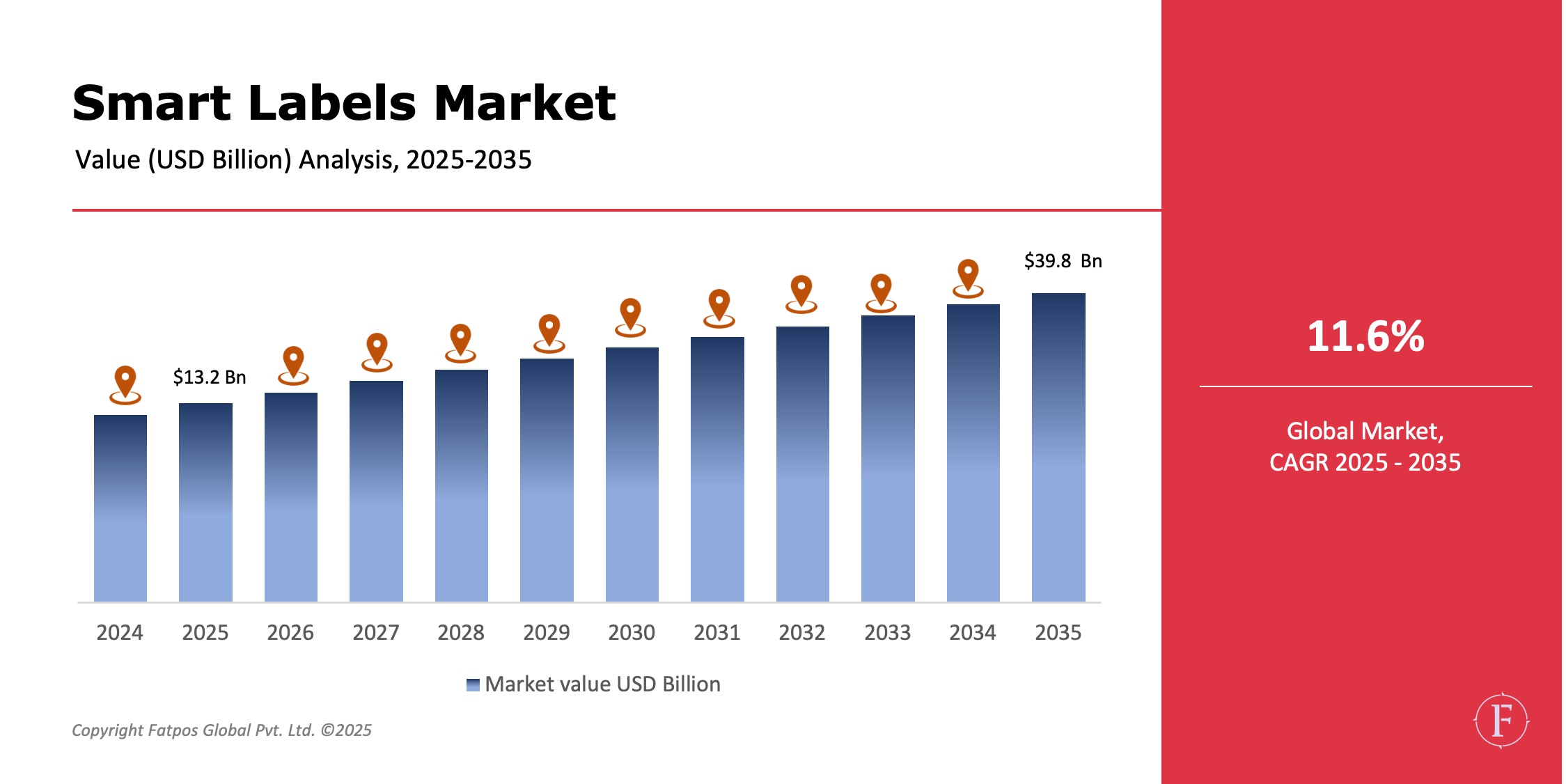
The Smart Labels Market was valued at USD 13.2 billion in 2025 and is projected to reach USD 39.8 billion by 2035, registering a CAGR of 11.6% during the forecast period. Market growth is driven by increasing demand for real-time tracking and monitoring solutions, rising adoption of RFID and NFC technologies, growing focus on supply chain transparency, and expanding applications across retail, logistics, healthcare, and food & beverage industries.
The smart labels industry represents a critical segment within the broader automatic identification and data capture (AIDC) ecosystem, enabling enhanced product visibility, authentication, inventory management, and condition monitoring across complex global supply chains.
Product Overview
Smart labels are advanced labeling solutions embedded with digital technologies such as RFID chips, sensors, and communication modules that enable data storage, tracking, and real-time information exchange. These labels go beyond traditional barcodes by offering enhanced functionality such as item-level tracking, temperature monitoring, anti-theft protection, and product authentication.
By technology, the market includes RFID labels widely used for inventory tracking, electronic article surveillance labels for theft prevention, sensing labels for monitoring environmental conditions, and NFC labels for consumer engagement and authentication. Smart labels are used across retail, logistics, healthcare, pharmaceuticals, and manufacturing sectors, with retail and logistics representing the largest application areas due to high-volume item tracking requirements.
Key Takeaways :
- The Smart Labels Market is projected to grow at approximately 6% CAGR through 2035.
- RFID-based smart labels represent the largest technology segment.
- Retail and logistics applications dominate global demand.
- Increasing focus on traceability and inventory accuracy drives adoption.
- Asia-Pacific is expected to be the fastest-growing regional market.
- Integration with IoT, analytics, and digital platforms is a key industry trend.
Market Dynamics
Drivers
The growing need for real-time product tracking, inventory optimization, and supply chain visibility is a primary driver of the Smart Labels Market. Retailers and logistics providers increasingly deploy smart labeling solutions to reduce shrinkage, improve stock accuracy, and enhance operational efficiency.
Rising concerns regarding food safety, pharmaceutical traceability, and counterfeit prevention further support market growth. Government regulations mandating serialization, traceability, and product authentication across healthcare and food industries are accelerating the adoption of smart labels worldwide.
Restrictions
High initial implementation costs associated with smart labeling systems, including infrastructure upgrades, readers, software integration, and data management platforms, act as a key restraint for market growth. Small and medium-sized enterprises often face budget limitations that slow adoption.
Technical challenges such as interoperability issues, data security risks, and lack of global standardization can hinder large-scale deployment. Additionally, environmental concerns related to electronic waste generated from smart labels pose sustainability challenges.
Opportunities
Emerging economies present significant growth opportunities due to expanding retail networks, rising e-commerce activity, and increasing digitalization of supply chains. Advancements in low-cost RFID chips, printable electronics, and battery-free sensing technologies are making smart labels more accessible.
Integration of smart labels with IoT platforms, blockchain, and data analytics enables advanced applications such as real-time condition monitoring, predictive logistics, and enhanced consumer engagement, creating new value propositions for market participants.
Challenges
Ensuring data privacy and cybersecurity across connected labeling systems remains a major challenge, particularly in regulated industries such as healthcare and pharmaceuticals. Managing large volumes of data generated by smart labels also requires robust IT infrastructure and analytics capabilities.
Sustainability and recyclability of electronic components pose additional challenges, increasing pressure on manufacturers to develop eco-friendly smart labeling solutions without significantly increasing costs.
Smart Labels Market Trends
The Smart Labels Market is witnessing rapid evolution driven by automation, digital transformation, and smart packaging initiatives. Increasing adoption of RFID labels for item-level tracking and inventory management is a major trend across retail and logistics sectors.
Advancements in flexible electronics, printed sensors, and battery-free technologies are enabling lightweight and cost-effective smart labels. Strategic collaborations between label manufacturers, technology providers, and software companies are strengthening ecosystem development. Asia-Pacific continues to attract investments due to manufacturing expansion and smart logistics adoption.
Key Players in the Global Smart Labels Industry
- Avery Dennison Corporation
- CCL Industries Inc.
- Zebra Technologies Corporation
- SATO Holdings Corporation
- Smartrac Technology GmbH
- Alien Technology LLC
- Checkpoint Systems, Inc.
- Honeywell International Inc.
- Invengo Technology Pte. Ltd.
- Identiv, Inc.
Regional & Country Analysis
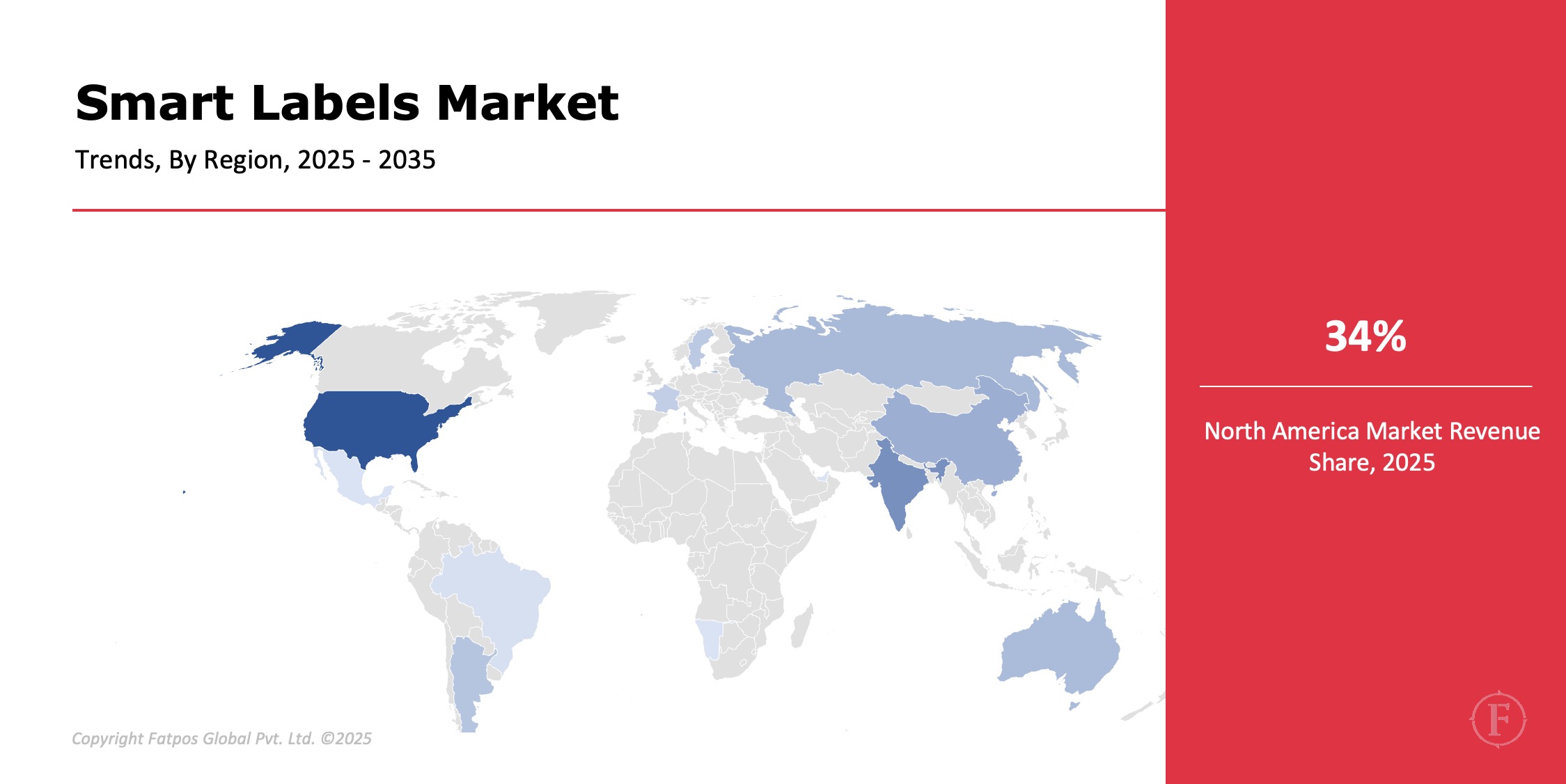
North America holds a significant share of the global Smart Labels Market, supported by early adoption of RFID technology, strong retail infrastructure, and regulatory requirements for traceability. The United States leads due to widespread use across retail, logistics, and healthcare.
Europe demonstrates steady growth driven by food safety regulations, pharmaceutical serialization mandates, and increasing adoption of smart packaging. Asia-Pacific is expected to be the fastest-growing region, supported by expanding manufacturing activities, e-commerce growth, and investments in smart supply chain infrastructure across China, Japan, India, and Southeast Asia. Latin America and the Middle East & Africa represent emerging markets.
Segmentation Highlights
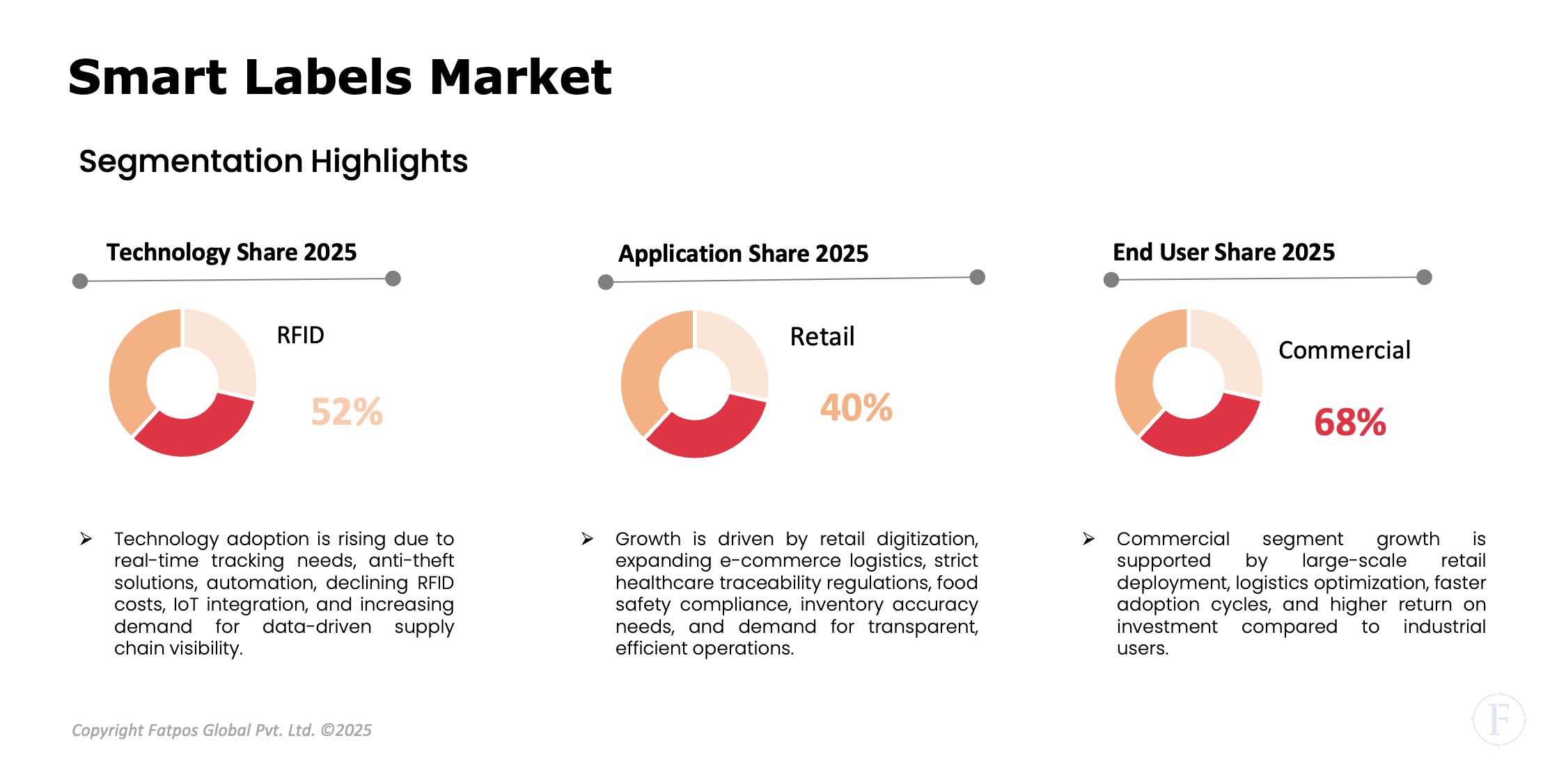
By technology, RFID smart labels account for the largest smart labels market share due to widespread adoption in retail and logistics. By application, retail dominates the market, followed by logistics & transportation and healthcare. By end user, commercial users represent the largest segment, while industrial adoption is steadily increasing.
Report Key Elements
|
ATTRIBUTES |
DETAILS |
|
Study Period |
2019–2035 |
|
Base Year |
2024 |
|
Forecast Period |
2025–2035 |
|
Market Size by 2035 |
USD 39.8 billion |
|
Market CAGR |
11.6% |
|
By Technology |
RFID, EAS, Sensing, NFC |
|
By Component |
Transceivers, Batteries, Sensors |
|
By Application |
Retail, Logistics, Healthcare, Food & Beverage, Manufacturing |
|
By End User |
Commercial, Industrial |
|
By Region |
North America, Europe, Asia-Pacific, Latin America, MEA |
|
Smart Labels Market: Key Players |
Avery Dennison Corporation, CCL Industries Inc., Zebra Technologies Corporation, SATO Holdings Corporation, Smartrac Technology GmbH, Alien Technology LLC, Checkpoint Systems, Inc., Honeywell International Inc. |
Global Smart Labels Industry Instances
- Retailers deployed RFID labels for real-time inventory visibility.
- Logistics providers implemented smart labels for shipment monitoring.
- Food producers used sensing labels for temperature and freshness tracking.
- Governments supported traceability initiatives across regulated industries.
Analyst Review
As per our Smart Labels Market Analysis, the market is expected to experience strong growth driven by supply chain digitalization, regulatory compliance, and technological innovation. While implementation costs and sustainability concerns persist, advancements in low-cost and eco-friendly smart labels are expected to support long-term market expansion.
Frequently Asked Questions (FAQ):
Smart labels are digitally enabled labels that enable real-time tracking, condition monitoring, authentication, and seamless data exchange across supply chains.
Market growth is driven by supply chain transparency needs, rising RFID adoption, regulatory traceability requirements, and digitalization initiatives globally.
RFID-based smart labels dominate due to efficiency, automation benefits, and extensive use in retail, logistics, and inventory management.
Asia-Pacific is the fastest-growing region due to rapid industrialization, expanding retail sector, e-commerce growth, and technology adoption.
The long-term outlook indicates strong growth supported by smart supply chain transformation, IoT integration, automation, and regulatory compliance.
 Select License Type


.png)


