


Smart Glasses Market Research 2035
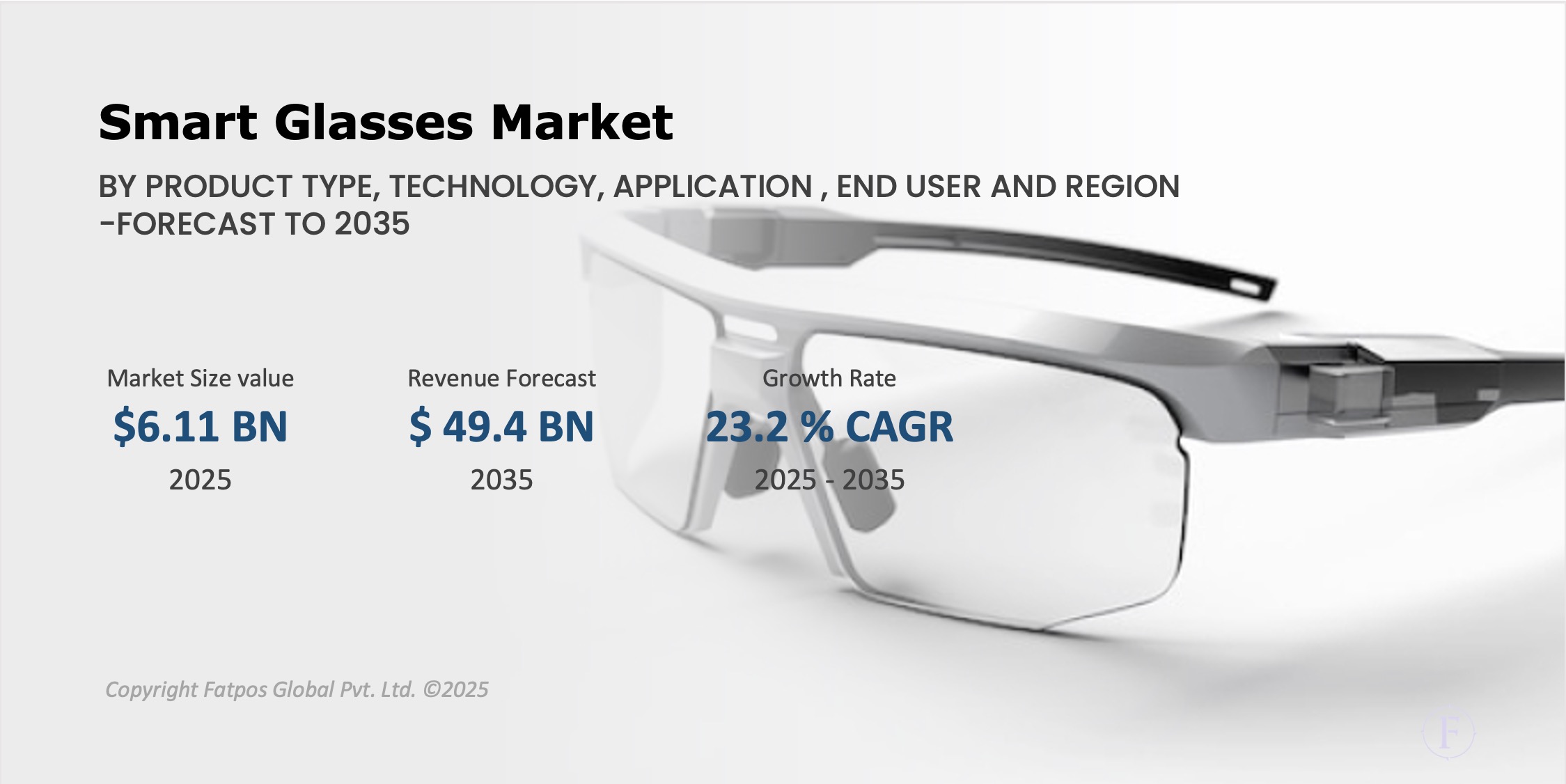
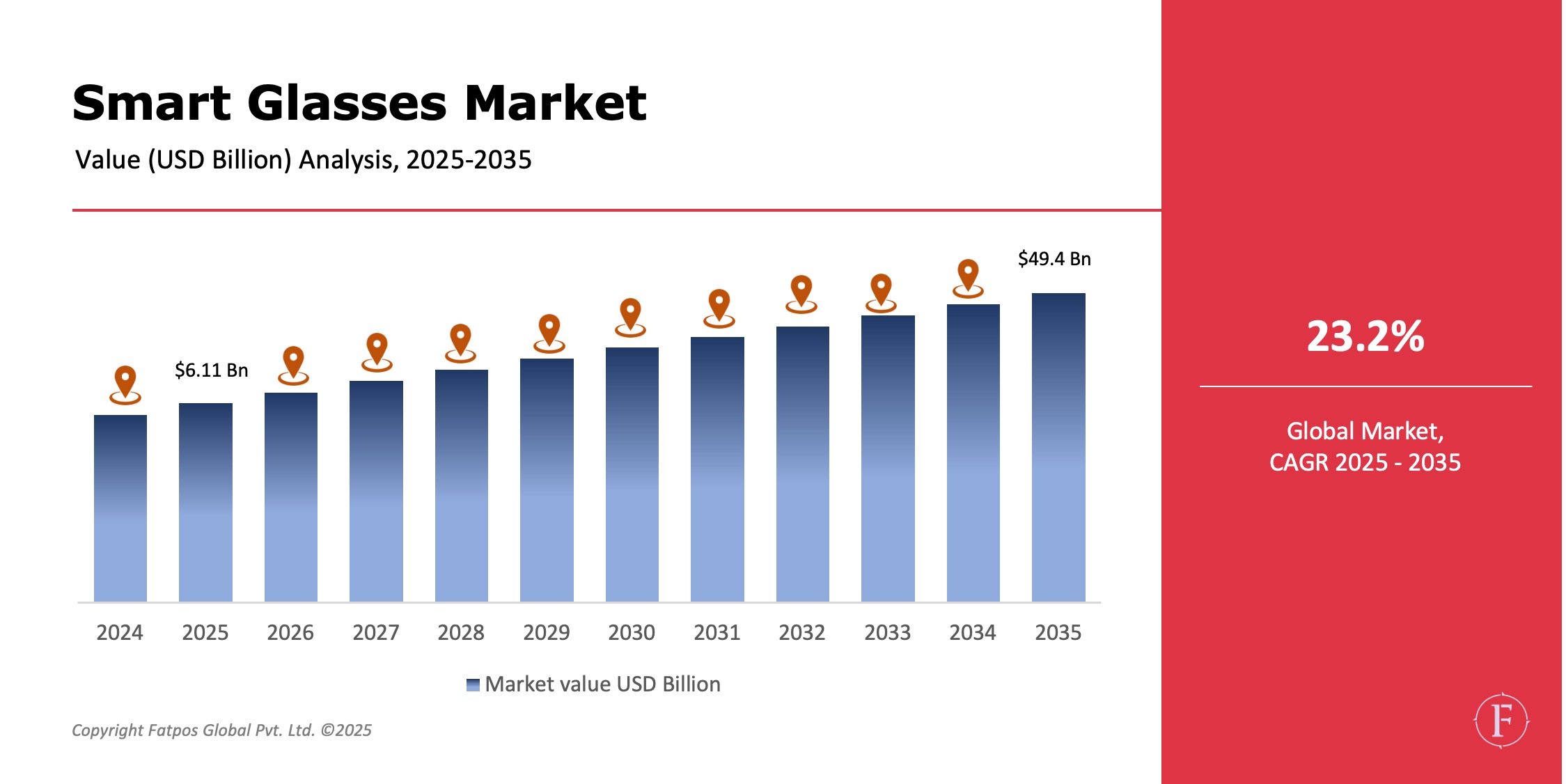
The Smart Glasses Market was valued at USD 6.11 billion in 2025 and is projected to reach USD 49.4 billion by 2035, registering a CAGR of 23.2% during the forecast period. Market growth is driven by increasing adoption of augmented reality (AR) and mixed reality (MR) technologies, rising enterprise demand for hands-free information access, expanding applications in industrial training and remote assistance, and continuous advancements in display, optics, and wearable computing technologies.
The smart glasses industry represents a key segment within the broader wearable technology and extended reality ecosystem, enabling real-time visualization, data overlay, and contextual information delivery across enterprise, consumer, and defense applications.
Product Overview
Smart glasses are wearable electronic devices equipped with transparent or semi-transparent displays that overlay digital information onto the user's field of vision. These devices integrate display modules, sensors, processors, cameras, and connectivity solutions to deliver augmented, virtual, or mixed reality experiences. By product type, the market includes augmented reality smart glasses for real-world data overlay, virtual reality smart glasses for immersive digital environments, and mixed reality devices that combine both physical and virtual elements.
By technology, smart glasses utilize optical see-through systems, video see-through displays, and advanced waveguide-based optics to enable compact form factors and improved visual clarity. Applications span enterprise and industrial operations, healthcare procedures, consumer entertainment, defense training, and educational use cases, with enterprises representing the primary adopters due to productivity and efficiency benefits.
Key Takeaways :
- The Smart Glasses Market is projected to grow at approximately 23.2% CAGR through 2035.
- Augmented reality smart glasses represent the largest market segment.
- Enterprise and industrial applications dominate current demand.
- Advancements in waveguide optics and display technologies are accelerating adoption.
- Asia-Pacific is expected to be the fastest-growing regional market.
- Integration with AI and cloud platforms is a key industry trend.
Market Dynamics
Drivers
Growing demand for hands-free, real-time access to information in enterprise environments is a primary driver of the smart glasses market. Industries such as manufacturing, logistics, energy, and field services increasingly deploy smart glasses for remote assistance, workflow guidance, and training applications, improving operational efficiency and reducing error rates.
Advancements in AR and MR technologies, coupled with improvements in processing power, battery efficiency, and connectivity, have enhanced device performance and usability. Rising investments by technology companies and increasing adoption of digital transformation initiatives across industries further support market growth.
Restrictions
High device costs and limited affordability remain key restraints, particularly for consumer adoption. Advanced smart glasses require sophisticated optics, displays, and sensors, increasing manufacturing complexity and pricing.
Privacy and data security concerns related to camera-enabled wearable devices pose regulatory and social challenges, especially in public and workplace environments. Additionally, issues related to device comfort, battery life, and limited field of view continue to affect user experience and adoption rates.
Opportunities
Expansion of smart glasses applications in healthcare presents significant growth opportunities, including surgical navigation, diagnostics, telemedicine, and medical training. Increasing use of smart glasses in defense and security for training, situational awareness, and simulation further strengthens demand.
Emerging markets in Asia-Pacific and the Middle East offer growth potential due to expanding industrial bases and government-led digital initiatives. Integration of artificial intelligence, cloud computing, and edge processing enables advanced functionalities such as real-time translation, object recognition, and predictive maintenance, enhancing the value proposition of smart glasses.
Challenges
Ensuring user comfort and long-duration wearability remains a technical challenge, requiring continuous innovation in lightweight materials and ergonomic design. Limited battery life and thermal management issues also constrain extended usage scenarios.
The smart glasses market faces challenges related to ecosystem fragmentation, including lack of standardized platforms, software compatibility issues, and dependence on application developer support. Regulatory compliance across regions adds complexity to global commercialization strategies.
Smart Glasses Market Trends
The smart glasses market is witnessing rapid evolution driven by enterprise adoption and technological advancements. Increasing deployment of AR smart glasses in industrial and enterprise workflows is shifting market focus from consumer entertainment to productivity-driven applications. Development of waveguide-based displays and micro-LED technology is enabling slimmer designs and improved visual performance.
Integration of AI-driven analytics, computer vision, and voice-based interfaces enhances functionality and user interaction. Partnerships between hardware manufacturers, software developers, and cloud service providers are strengthening ecosystem development. Asia-Pacific continues to attract investments due to manufacturing growth, smart factory initiatives, and rising adoption of advanced technologies.
Key Players in the Global Smart Glasses Industry
- Microsoft Corporation
- Google LLC
- Meta Platforms, Inc.
- Vuzix Corporation
- Magic Leap, Inc.
- Sony Group Corporation
- Apple Inc.
- Samsung Electronics
- Epson Corporation
- Lenovo Group
Regional & Country Analysis
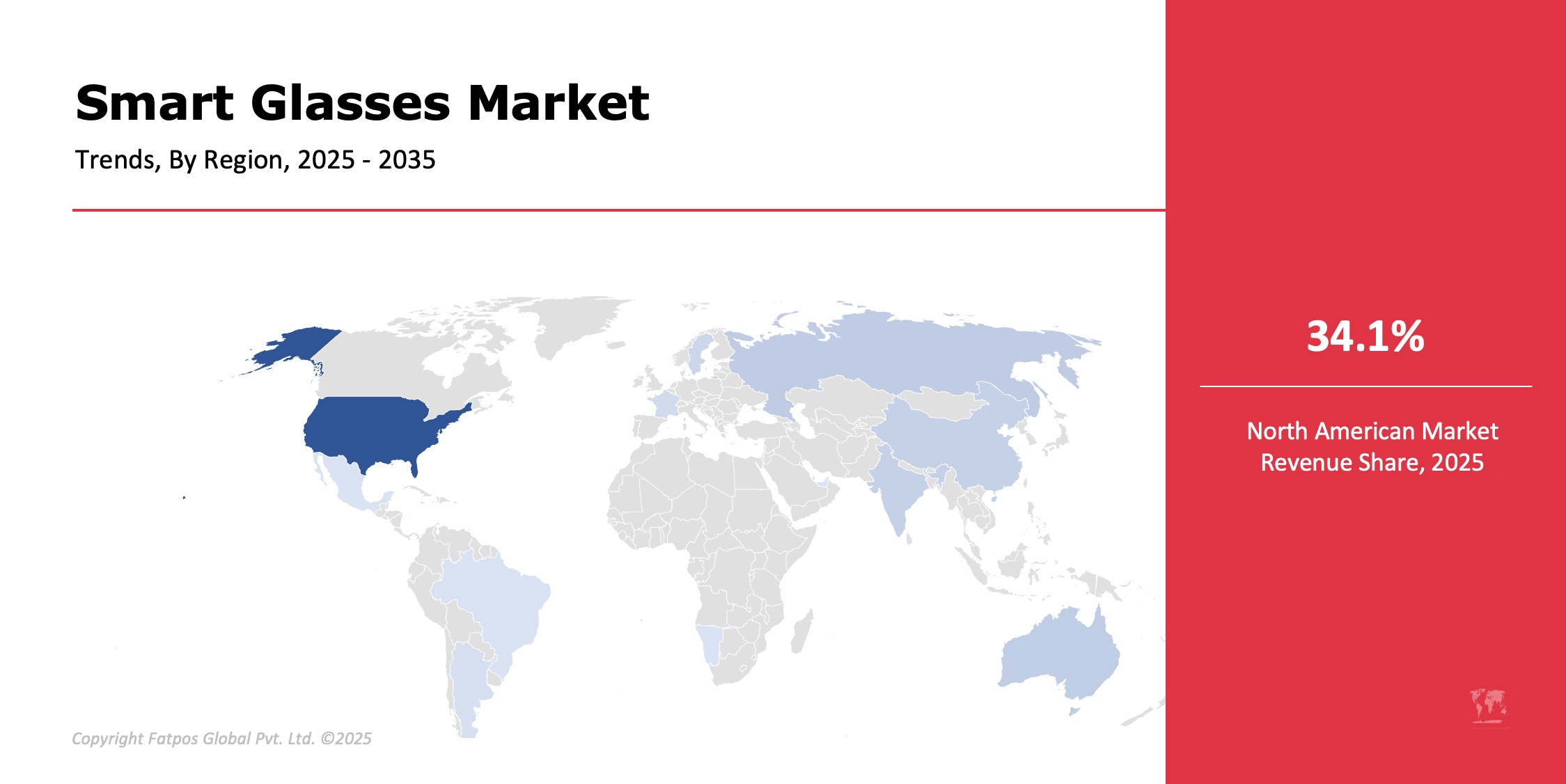
North America holds a significant share of the global smart glasses market, supported by strong technology adoption, enterprise digitalization, and presence of major technology companies. The United States leads in enterprise and defense applications, supported by robust R&D investments.
Europe demonstrates steady growth driven by industrial automation, healthcare adoption, and government-supported innovation programs. Asia-Pacific is expected to be the fastest-growing region, supported by manufacturing expansion in China, Japan, and South Korea, along with increasing adoption of smart factory and enterprise AR solutions. Latin America and the Middle East & Africa are emerging markets, supported by infrastructure development and digital transformation initiative.
Segmentation Highlights
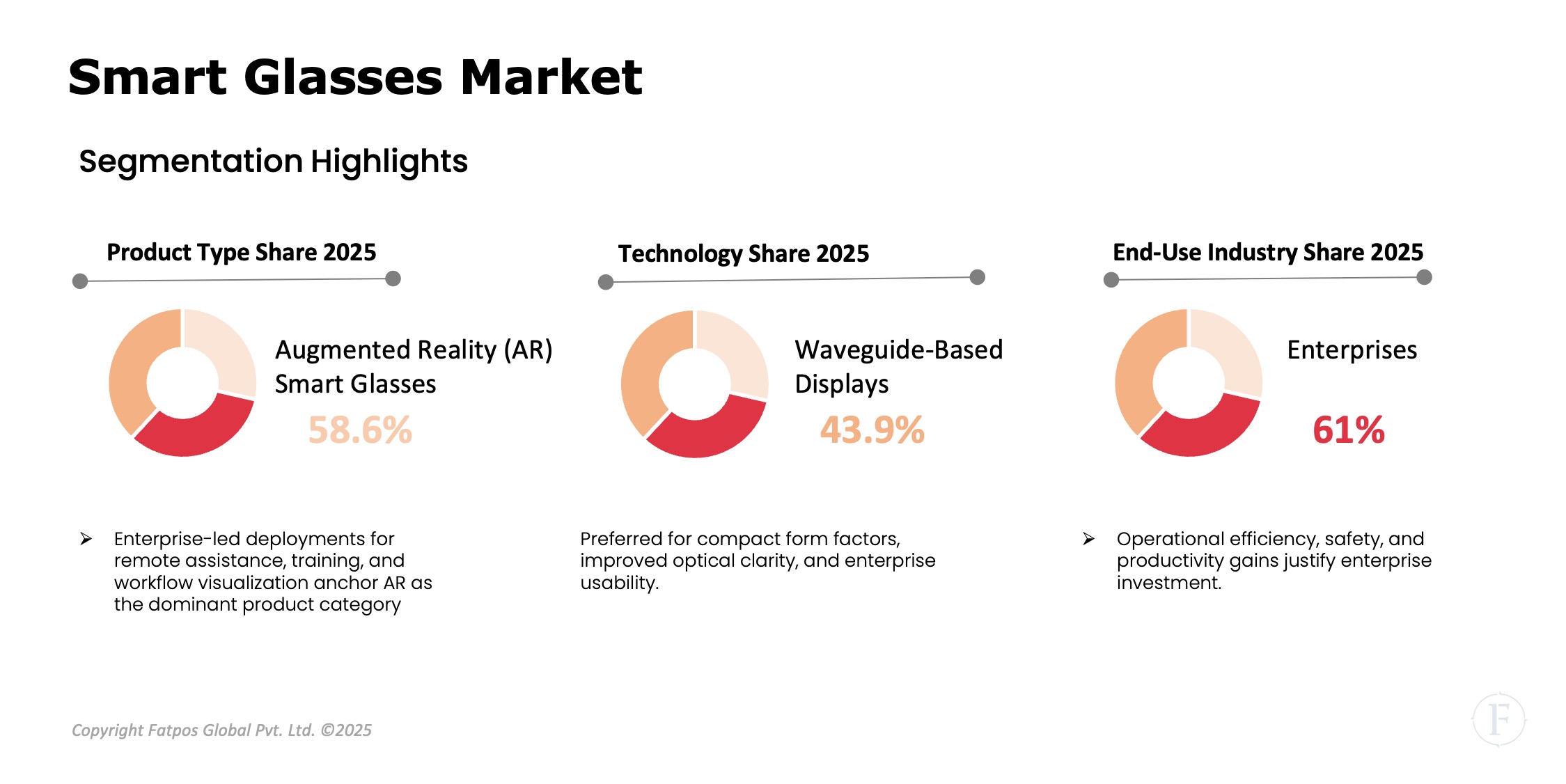
By product type, augmented reality smart glasses account for the largest market share due to widespread enterprise adoption. By application, enterprise and industrial use cases dominate, followed by healthcare and defense. By technology, waveguide-based displays are gaining traction due to compact design advantages and improved optical performance.
Enterprises represent the largest end-user segment, while consumer adoption is expected to grow gradually as device affordability and usability improve.
Report Key Elements
|
ATTRIBUTES |
DETAILS |
|
Study Period |
2019–2035 |
|
Base Year |
2024 |
|
Forecast Period |
2025–2035 |
|
Market Size by 2035 |
USD 49.4 billion |
|
Market CAGR |
23.2% |
|
By Product Type |
AR, VR, MR Smart Glasses |
|
By Technology |
Optical See-Through, Video See-Through, Waveguide |
|
By Application |
Enterprise, Healthcare, Consumer, Defense, Education |
|
By End User |
Enterprises, Consumers, Government & Defense |
|
By Region |
North America, Europe, Asia-Pacific, Latin America, MEA |
|
Smart Glasses Market: Key Players |
Microsoft Corporation, Google LLC, Meta Platforms, Inc., Vuzix Corporation, Magic Leap, Inc., Sony Group Corporation, Apple Inc. |
Global Smart Glasses Industry Instances
- Enterprises deployed smart glasses for remote assistance and training.
- Healthcare providers adopted AR smart glasses for surgical and diagnostic support.
- Technology companies invested in lightweight and high-resolution display systems.
- Governments supported adoption through digital transformation and defense programs.
Analyst Review
As per our Smart Glasses Market Analysis, the smart glasses market is expected to experience rapid growth over the forecast period, driven by enterprise adoption, technological innovation, and expanding application areas. While cost, comfort, and regulatory challenges remain, advancements in optics, AI integration, and ecosystem development are expected to strengthen long-term market prospects.
Frequently Asked Questions (FAQ):
Smart glasses are wearable devices that overlay digital information onto the user’s field of vision.
Enterprise demand, AR/MR adoption, and digital transformation initiatives.
Augmented reality smart glasses for enterprise applications.
Asia-Pacific.
Strong growth supported by enterprise use cases and technology advancements.
 Select License Type


.png)


