


Radiation Hardened Electronics Market Size
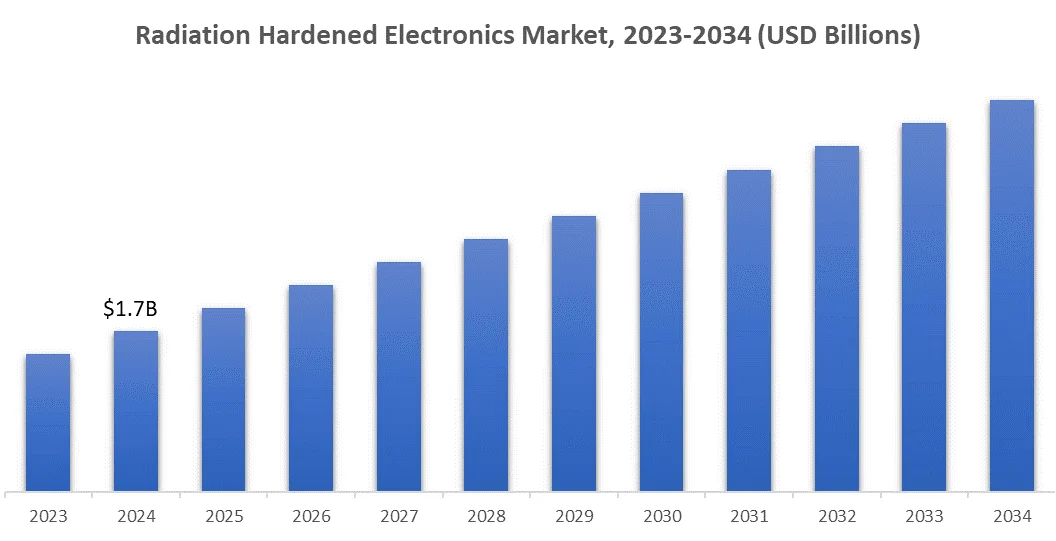
Radiation Hardened Electronics Market, valued at USD 1.6 billion in 2023, is anticipated to grow at a CAGR of 4.4% during the forecast period from 2024 to 2034, reaching a projected market size of USD 2.6 billion by 2034.
Product Overview:
Radiation-hardened electronics are designed specifically to withstand high levels of ionizing radiation and are used in space, nuclear reactors, and military settings. These electronic devices are designed to endure damage caused by radiation, which can lead to malfunctions or failures in regular electronic parts. Important parts consist of CPUs, RAM, power control systems, and sensors, all produced using specific production methods such as Radiation Hardening by Design (RHBD) and Radiation Hardening by Process (RHBP). These techniques involve using materials and design strategies to reduce radiation impacts, guaranteeing that the parts retain their efficiency and durability in challenging situations. The need for these strong systems is fuelled by their vital function in crucial applications where failure is unacceptable.
Market Highlights:
Radiation Hardened Electronics Market is expected to exhibit a CAGR of 4.4% during the forecast period, 2024-2034
Radiation Hardened Electronics Market is expected to attain a market value of USD 2.6 billion, growing at a CAGR of 4.4% during the forecasted period. The growth of the radiation-hardened electronics market is influenced by the rising demand for space exploration, military, and nuclear power applications. As the number of space missions and satellite launches increases, there is a growing demand for durable electronics that can withstand extreme conditions. Developments in radiation-hardening techniques improve the reliability and performance of components. Additionally, rising geopolitical tensions are increasing direct investments in advanced defense systems, which is enhancing the market even more. Continuous innovations, increasing applications in emerging areas such as commercial space travel, and significant government funding for space and defense projects will push future market growth. This mix of elements guarantees a strong and growing market for electronics that are resistant to radiation.
Source: Fatpos Global
Radiation Hardened Electronics Market Segmentation:
Processors and Controllers segment will lead due to its critical functionality in space and military applications
Radiation Hardened Electronics Market is segmented based on Component into Mixed Signals ICs, Processors & Controllers, Power Management, Memory, Sensors and Others. In the current market and regulatory landscape, the processors and controllers segment dominates the radiation-hardened electronics market owing to the vital role they play in space and military applications, executing crucial computational functions in harsh conditions. Technological developments have substantially increased their performance and energy efficiency, with corporations such as BAE Systems and Microchip Technology Inc. leading these developments. These components are critical for satellites and space missions so that they can perform intricate tasks such as data processing and navigation while withstanding high radiation. Furthermore, significant investments from the government and defense sectors in projects such as GPS satellites and military communication systems highlight the critical role of these advanced, dependable components in national security and space exploration.
Radiation Hardening by Design to dominate the market owing to its cost effectiveness and ability to mitigate radiation effects
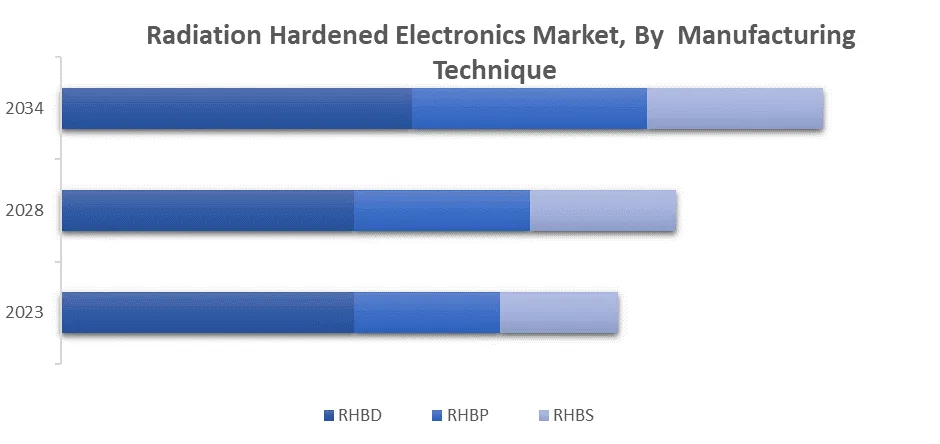
The Radiation Hardened Electronics Market is categorized based on type into Radiation Hardening by Design (RHBD), Radiation Hardening by Process (RHBP), and Radiation Hardening by Software (RHBS). In the current market environment, radiation hardening by design (RHBD) holds the most prominent position due to its better cost-effectiveness and adaptability features. RHBD, in contrast to RHBP, does not require specialized fabrication, which can result in higher costs. Instead, it utilizes standard manufacturing processes, making it both affordable and scalable. This approach speeds up development cycles for various chip designs and also addresses radiation effects like Total Ionizing Dose (TID) and Single Event Effects (SEE) by using innovative design strategies like redundancy circuits and layout optimization. Moreover, RHBD has the capability to adapt alongside the progression of commercial electronics technologies, seamlessly integrating into new chip architectures. This approach also works well with RHBP to strengthen hardening and Radiation Hardening by Software (RHBS) to improve error handling, providing a flexible, affordable option to address various market requirements for radiation resilience.
Market Dynamics:
Growth Drivers
Growing Number of Space Missions and Satellite Launches to Increased Demand for Radiation Hardened Electronics
There has been a significant rise in space missions and satellite launches in recent years, creating a notable demand for dependable radiation-hardened electronics. These elements are essential for the development and success of space exploration, communication, and Earth observation missions that must operate in the challenging radiation environments of space. Standard electronics degrade rapidly in such situations, making radiation-hardened options essential for preserving functionality and data integrity. As missions venture into increasingly intense radiation areas, the durability needed for these parts becomes stronger, particularly for probes, rovers, and deep-space satellites. Furthermore, the rise of small satellite networks for global internet connectivity and other uses has generated a substantial demand for cost-effective, easily accessible radiation-resistant electronics. Commercially available components, known as commercial off-the-shelf (COTS), are becoming more popular in this industry as they can efficiently and affordably meet the increasing demands.
Need for Robust and Reliable Electronics in High-Radiation Environment to Improve Growth Prospects
Nuclear power plants require robust and dependable electronics for safe and efficient operation in environments with high levels of radiation. Exposure to radiation can result in standard electronics malfunctioning, which can lead to safety risks and expensive periods of inactivity. Radiation-resistant electronics help prevent these dangers, guaranteeing flawless operation. It is essential to replace old electronics with radiation-resistant versions in order to ensure the continued safe operation of nuclear power plants undergoing lifetime extensions. Furthermore, the advancement of newer reactors, like small modular reactors, requires compact and effective radiation-resistant electronics for controlling and monitoring systems. These sophisticated creations require better functioning components that are able to withstand radiation, meeting the evolving needs of contemporary nuclear power plants and guaranteeing their long-term safety and reliability.
Restraints
High Development and Manufacturing Costs of Radiation Hardened Electronics to Restrict Market Growth
Higher costs of development and manufacturing act as a major challenge to the growth of the radiation-hardened electronics market. Specific methods, such as ion implantation and epitaxial growth, are needed to produce materials that can withstand radiation, but these materials are not utilized in commercial electronics. Furthermore, stringent testing and qualification processes contribute to the increased duration and expenses of the overall development. Limited production volumes further escalate costs due to economies of scale being unachievable. This market focuses on high-value applications such as aerospace, defense, and nuclear power, prioritizing reliability over cost, which restricts market growth and deters potential newcomers. Nevertheless, these expensive expenses encourage creativity, pushing for research on cheaper radiation-hardening methods. Possible solutions include standardizing components, streamlining qualification procedures, and creating dual-use designs that merge radiation resistance with commercial functionality, which could reduce manufacturing expenses and expand market reach.
Recent Developments
- In between years 2023-2024, BAE Systems collaborated with GlobalFoundries to produce radiation-hardened single board computers (SBC) for space. The new RAD510 System on Chip (SoC) offers twice the performance capability of the industry-standard RAD750 microprocessor. The company also introduced The RAD510 SoC, designed for space-based computing, integrating into SBCs that provide enhanced performance while demanding less power.
- In 2023, Infineon Technologies AG, completed the acquisition of Cypress Semiconductor, enhancing its portfolio of radiation-hardened components, especially in power management and microcontrollers. The company also introduced a new line of new line of radiation-hardened MOSFETs designed for space applications, focusing on high reliability and performance in harsh environments.
- In 2023, Renesas Electronics Corporation, acquired Dialog Semiconductor, which significantly boosts it capabilities in developing radiation-hardened integrated circuits, expanding its presence in the aerospace and defense sectors. The company also introduced a series of microcontrollers specifically designed for high-radiation environments, improving the reliability of space and military applications.
- In 2023, Microchip Technology, expanded its range of radiation-hardened Field-Programmable Gate Arrays (FPGAs) to include higher performance and more robust designs suitable for space applications. The company also entered into a joint venture with a leading aerospace company to develop next-generation radiation-hardened avionics systems.
Radiation Hardened Electronics Market. Key Players:
- BAE Systems
- Infineon Technologies AG
- Renesas Electronics Corporation
- Microchip Technology Inc.
- Texas Instruments Incorporated
- Cobham Advanced Electronic Solutions
- Honeywell International Inc.
- STMicroelectronics
- Xilinx Inc.
- Teledyne Technologies Incorporated
- VPT, Inc.
- Data Device Corporation (DDC)
- Maxwell Technologies Inc.
- Analog Devices, Inc.
- TTM Technologies
- Other Prominent Players (Company Overview, Business Strategy, Key Product Offerings, Financial Performance, Key Performance Indicators, Risk Analysis, Recent Development, Regional Presence, SWOT Analysis)
Regional Analysis
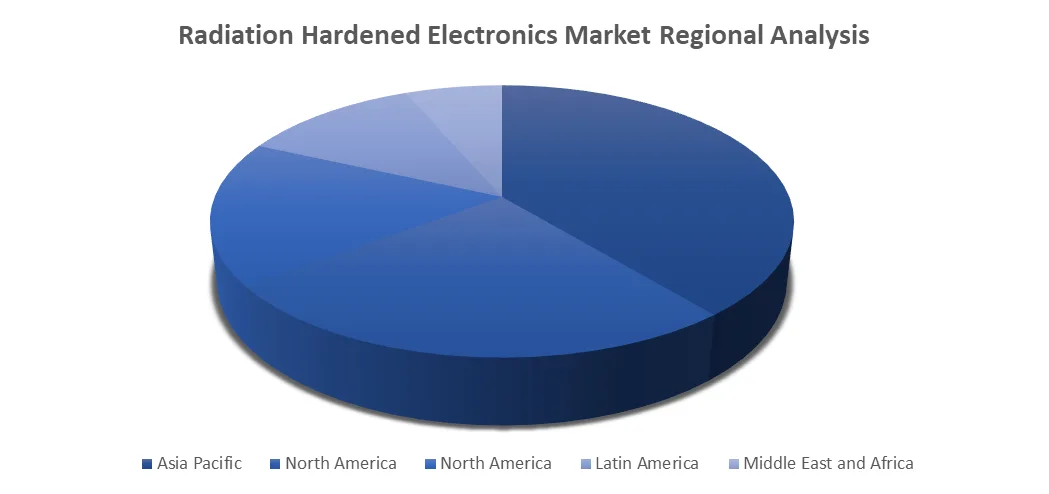
Radiation Hardened Electronics Market is segmented based on regional analysis into five major regions: North America, Latin America, Europe, Asia Pacific and the Middle East and Africa. The Asia Pacific region currently holds the dominant market position, with the regions high pace of space programs, especially in China and India, leads to a higher need for radiation-resistant electronics for satellite and exploration missions. specially in China and India, leads to a higher need for radiation-resistant electronics for satellite and exploration missions.
On the contrary, North America’s market share is impacted by established market players and a focus on internal development. The fragmented market landscape is impacting Europe's robust aerospace industry. Latin America and the Middle East & Africa are in the early stages to develop their space programs, leading to a limited market for radiation-resistant electronics.
Source: Fatpos Global
Impact of Covid-19 on Radiation Hardened Electronics Market
Covid-19 pandemic had a diverse impact on the Radiation Hardened Electronics Market. In the earlier stages Lockdowns and travel restrictions disrupted the global supply chains, creating delays in obtaining various raw materials and components, which in turn led to decreased production rates and delays in various projects. Manufacturing and project timelines were further disrupted by labor shortages caused by social distancing measures and worker illness. Furthermore, a few governments redirected funds from space exploration and defense initiatives at the beginning of the pandemic, which may have led to a decrease in the need for radiation-resistant electronics. Nevertheless, the effect was not completely negative, with supply chains disruptions prompting certain nations to prioritize the domestic manufacturing of radiation-resistant electronics, which could improve their market position in the future.
Radiation Hardened Electronics Market is further segmented by region into:
- North America Market Size, Share, Trends, Opportunities, Y-o-Y Growth, CAGR – United States and Canada
- Latin America Market Size, Share, Trends, Opportunities, Y-o-Y Growth, CAGR – Mexico, Argentina, Brazil, and Rest of Latin America
- Europe Market Size, Share, Trends, Opportunities, Y-o-Y Growth, CAGR – United Kingdom, France, Germany, Italy, Spain, Belgium, Hungary, Luxembourg, Netherlands, Poland, NORDIC, Russia, Turkey, and Rest of Europe
- Asia Pacific Market Size, Share, Trends, Opportunities, Y-o-Y Growth, CAGR – India, China, South Korea, Japan, Malaysia, Indonesia, New Zealand, Australia, and Rest of APAC
- Middle East and Africa Market Size, Share, Trends, Opportunities, Y-o-Y Growth, CAGR – North Africa, Israel, GCC, South Africa, and Rest of MENA
Radiation Hardened Electronics Market Scope and Segments:
|
ATTRIBUTE |
DETAILS |
|
Study Period |
2018-2034 |
|
Base Year |
2023 |
|
Forecast Period |
2024-2034 |
|
Historical Period |
2019-2022 |
|
Growth Rate |
CAGR of 4.4% from 2024-2034 |
|
Unit |
Value (USD Billion) |
|
Segmentation |
Main Segments List |
|
By Component |
|
|
By Manufacturing Technique |
|
|
By Product Type |
|
|
By Application |
|
|
By Region |
|
Frequently Asked Questions (FAQ):
Radiation Hardened Electronics Market size was valued at USD 1.6 billion in 2023 and is projected to reach the value of USD 2.6 billion in 2034, exhibiting a CAGR of 4.4% during the forecast period.
The market for Radiation Hardened Electronics involves creating and manufacturing electronic parts that can endure high levels of radiation, guaranteeing dependable performance in space, military, and nuclear settings. These specific parts can withstand damage caused by radiation, enabling them to remain functional in extreme environments.
The Processors and Controllers segment and Radiation Hardening by Design (RHBD) segment accounted for the largest Radiation Hardened Electronics Market share.
Key players in the Radiation Hardened Electronics Market include BAE Systems, Infineon Technologies AG, Renesas Electronics Corporation, Microchip Technology Inc., Texas Instruments Incorporated, Cobham Advanced Electronic Solutions, Honeywell International Inc., STMicroelectronics, Xilinx Inc., Teledyne Technologies Incorporated, VPT, Inc., Data Device Corporation (DDC), Maxwell Technologies Inc., Analog Devices, Inc., TTM Technologies. and Other Prominent Players.
The growing need for dependable electronics in space exploration, military advancement, and nuclear power applications is fuelling the Radiation Hardened Electronics Market.
 Select License Type


.png)


