


Kids Smartwatch Market Research, 2034
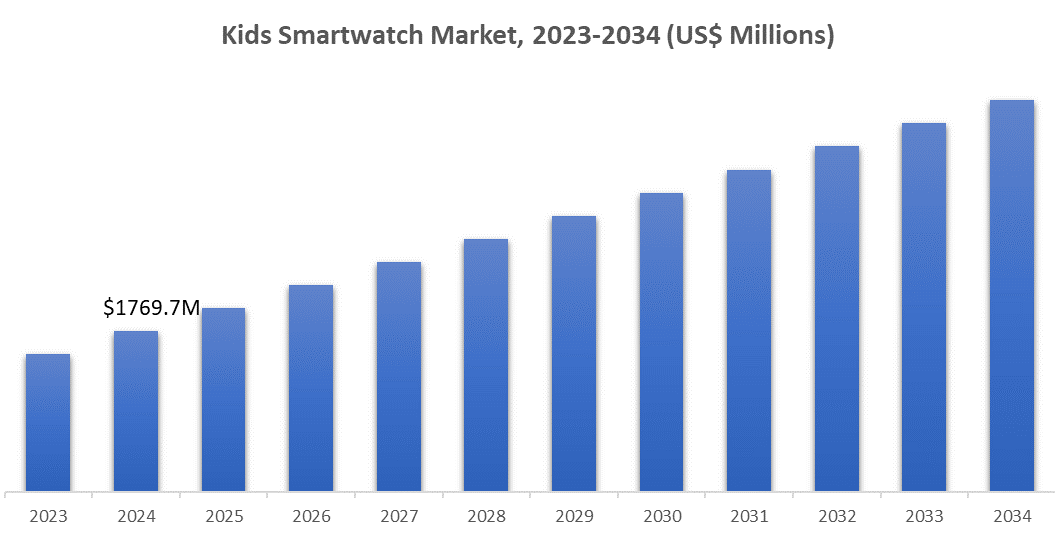
The global kids smartwatch market is expected to grow at a CAGR of 14% during the forecast period (2024-2034). The market size was valued at US$ 1555.2 million in 2023 and is projected to reach US$ 6568.2 million by 2034.
Kids smartwatches are wearable gadgets made for children, blending the basic watch features with more advanced functions such as GPS tracking, communication options, and educational apps. Provided with interfaces designed for children, these smartwatches frequently come with parental control capabilities, enabling parents to oversee their child's location, establish geofences, and communicate via voice or text.
They also provide entertainment options like games, fitness monitoring to promote physical activity, and occasionally educational material to aid learning. There are two primary types of kids' smartwatches: integrated ones that need to connect to a parent's smartphone, and standalone ones that operate on their own with a SIM card. These devices address both safety issues and the increasing popularity of digital interaction among kids.
Market Highlights:
The market driven by rising parental concerns regarding child safety, as GPS tracking and communication functions offer reassurance. The increasing popularity of wearable technology among younger generations, along with improvements in smartwatch features such as fitness tracking, educational applications, and entertainment, is driving up the demand.
Moreover, the growing integration of parental control functions enables the real-time supervision and control of these devices, making them attractive to parents. As technology advances, future expansion is expected to come from improvements in connectivity like 5G, along with the growth of educational and health applications, maintaining relevance and attractiveness in the market.
Source: Fatpos Global
Market Segmentation:
Integrated smartwatches thrive owing to seamless and easier parental control
The market is segmented based on Product Type into Integrated and Standalone. Integrated smartwatches are currently leading the market due to their seamless integration with parent smartphones, which makes them highly desirable. These smartwatches rely on the parent's smartphone for essential features such as live GPS tracking, communication through voice or text, and simple parental control management via a specialized application.
Being synched with the parent's device ensures continual monitoring and security, making it the preferred choice for safety-conscious parents. Additionally, integrated smartwatches are usually more affordable and consume less power than standalone ones since they do not require their own SIM card. The dominance of the integrated segment in the market is further strengthened by the increasing focus on child safety and the suitability of controlling the device with a current smartphone.
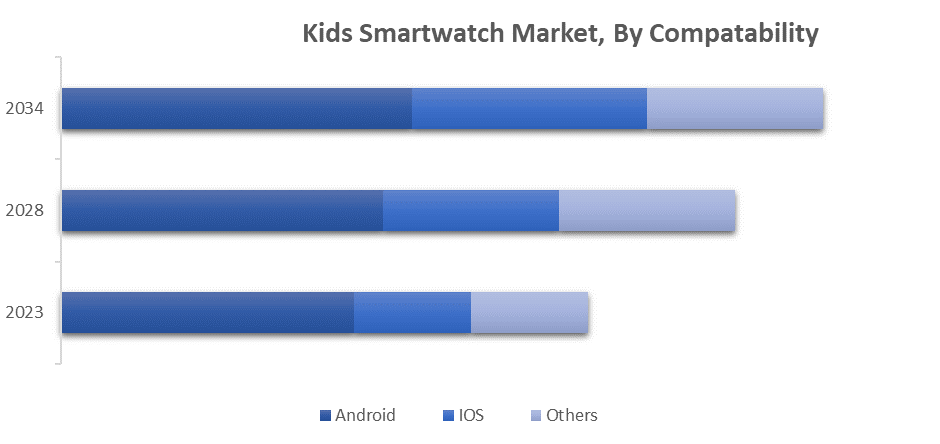
Android has emerged as the dominating segment due to its wide range and open-source nature
The market is categorized based on Compatibility with IOS, Android, and Others. Several key factors have led to Android surpassing iOS and other platforms as the dominant operating system for kids’ smartwatches. Its affordability and diverse device range cater to different budgets, offering parents more choices than iOS. The customizable nature of Android, being open-source, enables manufacturers to tailor devices to meet the specific requirements of young users.
Moreover, Android's dominant presence in emerging markets has resulted in a wide array of applications, accessories, and support services for users. Android's popularity among parents enhances its attractiveness even more. The Google Play Store strengthens its dominance with a wide range of child-appropriate apps, and parental controls, and fosters innovation, better features, and cost-effectiveness through the competition among Android smartwatch makers.
Source: Fatpos Global
Market Dynamics:
Growth Drivers
Increasing Awareness Towards Child Safety to Boost Demand for Kids Smartwatches
Rising concerns regarding the safety of children have significantly increased the demand for smartwatches with GPS capabilities. Parents are actively looking for ways to make sure their children are safe, and real-time location tracking gives an important sense of security. These smartwatches help parents track their child's location constantly, create safe areas (geofences), and get notifications if their child exits certain locations.
Increased awareness is enhanced by growing safety concerns in cities and the requirement for instant communication during emergencies. As a consequence, the increasing need for GPS-enabled smartwatches among parents has made them a crucial device, fueling their rise in popularity and market growth.
Rising Adoption of Wearable Technology Among Kids for Education and Entertainment to Drive Market Growth
The growing popularity of wearable technology among kids is driving market expansion owing to its attractive educational and entertainment options. Children's smartwatches have evolved to include various interactive features such as games, fitness monitoring, and educational applications, becoming appealing to both kids and their parents.
These features not only offer amusement but also promote physical movement and education, in line with the current pattern of incorporating technology into everyday routines. The increase in parents acknowledging the advantages of these gadgets for their children's development and involvement is propelling the market growth for children's smartwatches.
Restraints
High Costs of Advanced Smartwatches May Hinder Market Adoption
Expensive advanced smartwatches can significantly hinder market adoption, specifically in segments focused on affordability. The cost of luxury children's smartwatches increases due to the inclusion of advanced GPS tracking, high-resolution screens, and extensive app libraries. For families on a lower budget, these expenses may be too high, preventing them from buying such devices.
This financial barrier may limit the widespread adoption of advanced models, as parents might choose cheaper, simpler options or decide not to buy smartwatches at all. Moreover, parents' expectations may not always match the perceived value of these costly features, which can also affect adoption rates. Therefore, the significant obstacle to wider market adoption and expansion is the expensive price of advanced smartwatches.
Recent Developments
- In 2023-24, VTech Holdings Ltd. launched the KidiZoom Smart Watch DX4, featuring a larger display, improved camera, and additional educational apps. The company also introduced a new line of KidiZoom Smart Watches designed for younger children, with simplified features and a more durable design.
- In 2023-24, LG Electronics Inc. released the GizomPal 4, a smartwatch with cellular connectivity, allowing for voice calls and messaging. The company actively partnered with educational content providers to offer a wider range of educational apps and resources on its kids' smartwatches.
- In 2023-24, Doki Technologies introduced the Doki Watch 5, with advanced features such as heart rate monitoring, GPS tracking, and customizable watch faces. The company acquired a smaller smartwatch manufacturer to expand its product line and market reach.
- In 2023-24, Garmin released the Vivofit Jr. 4, a kids' smartwatch with longer battery life, improved water resistance, and new activity challenges. The company also announced a new line of Vivofit Jr. watches specifically designed for girls, with different color options and character designs.
- In 2023-24, Xiaomi Corporation launched the Amazfit Bip Lite Kids, an affordable smartwatch with basic features like location tracking and communication. The company also partnered with schools and training organizations to promote the use of its kids' smartwatches for educational and monitoring purposes.
Key Players:
- VTech Holdings Ltd.
- LG Electronics Inc.
- Fitbit, Inc.
- Garmin Ltd.
- Xiaomi Corporation
- Doki Technologies
- Huawei Technologies Co., Ltd.
- Tencent
- Apple Inc.
- LeapFrog Enterprises, Inc.
- Alcatel-Lucent
- Omate Inc.
- Kido Technologies Inc.
- Kurio (KD Interactive)
- TCL Communication
- Other Prominent Players (Company Overview, Business Strategy, Key Product Offerings, Financial Performance, Key Performance Indicators, Risk Analysis, Recent Development, Regional Presence, SWOT Analysis)
Regional Analysis
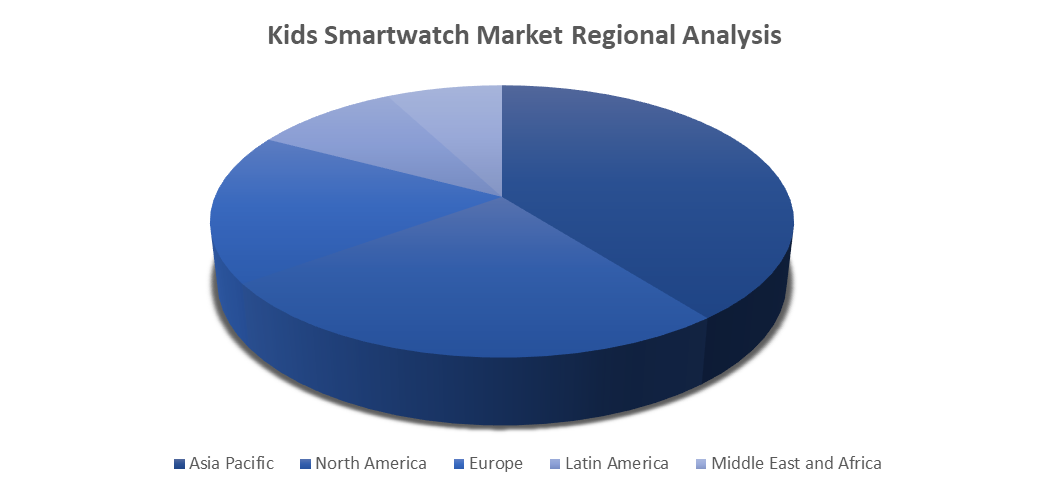
Global market is segmented based on regional analysis into five major regions: North America, Latin America, Europe, Asia Pacific, and the Middle East and Africa. Asia Pacific leads in the children's smartwatch industry due to its significant population, rapid technological adoption, and rising disposable incomes.
The substantial number of consumers in countries such as China and India is one of the main reasons for the high demand for inexpensive smartwatches with advanced features in the region. Moreover, the increasing focus on incorporating technology into everyday activities in the region, along with the progress in wearable technology, is also driving the growth of the market.
The market in Asia Pacific is characterized by many local and global competitors who provide a wide range of product choices to suit different budgets and preferences. North America, Latin America, Europe, the Middle East, and Africa all play a role in the global market, but none have the same level of dominance as Asia Pacific. North America has a high adoption rate of wearable technology and strong consumer spending power but is experiencing market saturation.
Europe is showing a rising curiosity in advanced capabilities and protecting children, while Latin America, the Middle East, and Africa are developing markets experiencing a growing demand due to growing awareness and better economic circumstances.
Source: Fatpos Global
Impact of Covid-19 on the Market
The Kid's smartwatch market experienced a varied effect from the COVID-19 pandemic. The increased use of remote learning and screen time during lockdowns led to a rise in the demand for educational and communication functions in children's smartwatches. Parents actively started looking for methods to keep their children interested and connected, increasing the demand for devices that offer interactive and educational features.
Conversely, economic instabilities and interruptions in international supply chains resulted in reduced consumer expenditures and setbacks in manufacturing and delivery. The pandemic has also emphasized the significance of health and safety functionalities, such as contactless communication and tracking abilities, shaping upcoming product advancements. In general, the pandemic sped up certain trends but also brought about challenges that impacted market dynamics.
Market is further segmented by region into:
- North America Market Size, Share, Trends, Opportunities, Y-o-Y Growth, CAGR – United States and Canada
- Latin America Market Size, Share, Trends, Opportunities, Y-o-Y Growth, CAGR – Mexico, Argentina, Brazil, and Rest of Latin America
- Europe Market Size, Share, Trends, Opportunities, Y-o-Y Growth, CAGR – United Kingdom, France, Germany, Italy, Spain, Belgium, Hungary, Luxembourg, Netherlands, Poland, NORDIC, Russia, Turkey, and Rest of Europe
- Asia Pacific Market Size, Share, Trends, Opportunities, Y-o-Y Growth, CAGR – India, China, South Korea, Japan, Malaysia, Indonesia, New Zealand, Australia, and Rest of APAC
- Middle East and Africa Market Size, Share, Trends, Opportunities, Y-o-Y Growth, CAGR – North Africa, Israel, GCC, South Africa, and Rest of MENA
Market Scope and Segments:
|
ATTRIBUTE |
DETAILS |
|
Study Period |
2018-2034 |
|
Base Year |
2023 |
|
Forecast Period |
2024-2034 |
|
Historical Period |
2019-2022 |
|
Growth Rate |
CAGR of 14% from 2024-2034 |
|
Unit |
Value (US$ Million) |
|
Segmentation |
Main Segments List |
|
By Product Type |
|
|
By Compatibility |
|
|
By Application |
|
|
By Connectivity |
|
|
By Distribution Channel |
|
|
By Region |
|
Frequently Asked Questions (FAQ):
The global kids smartwatch market size was valued at US$ 1555.2 million in 2023 and is projected to reach the value of US$ 6568.2 million in 2034, exhibiting a CAGR of 14% during the forecast period.
The market for kids smartwatches include devices that are worn on the body and are specifically made for children. These devices come with features such as GPS tracking, tools for communication, apps for learning, and entertainment options. These smartwatches are designed to improve child safety and offer engaging experiences, attracting parents who want to use technology to monitor and connect with their kids.
The Integrated and Android segment accounted for the largest market share.
Key players in the global kids smartwatch market include VTech Holdings Ltd., LG Electronics Inc., Fitbit, Inc., Garmin Ltd., Xiaomi Corporation, Doki Technologies, Huawei Technologies Co., Ltd., Tencent, Apple Inc., LeapFrog Enterprises, Inc., Alcatel-Lucent, Omate Inc., Kido Technologies Inc., Kurio (KD Interactive), TCL Communication and Other Prominent Players.
Factors driving the market include increasing parental concerns about child safety, rising adoption of wearable technology, and growing demand for educational and entertainment features.
 Select License Type


.png)


