


Hydrogen Gas Market Research, 2034
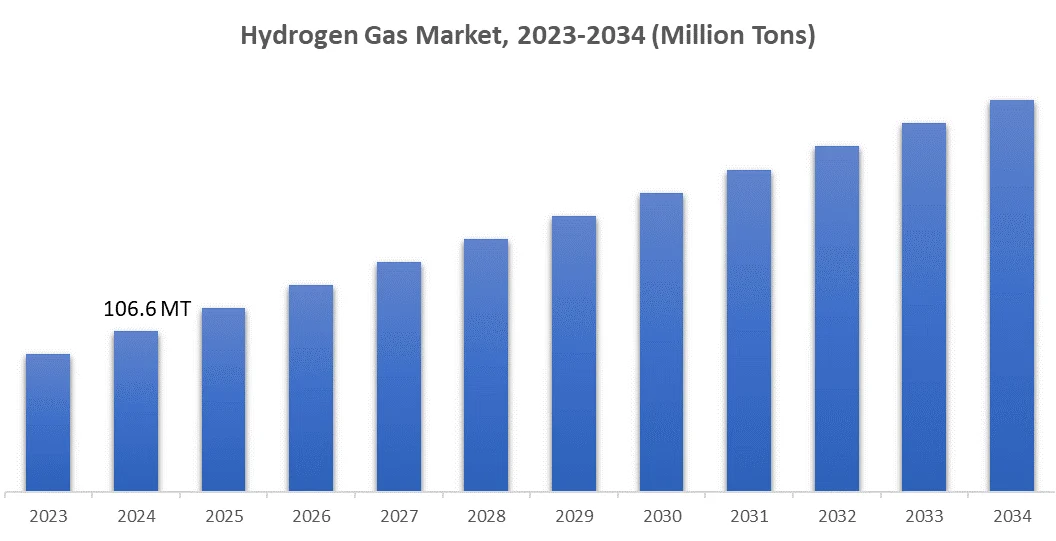
Hydrogen Gas Market is anticipated to grow at a CAGR of 4% in the forecast period (2024-2034), with the market size valued at USD 102.5 million tons in 2023 and projected to reach USD 158.3 million tons by 2034.
Hydrogen gas (H2) is a versatile and environmentally friendly energy carrier with a wide range of applications. It is primarily used in industrial processes such as ammonia production and petroleum refining. There are several methods for producing hydrogen, including steam methane reforming, electrolysis, and gasification. Its significance is substantial in the growing clean energy sector, particularly in fuel cell cars and electricity production, as it emits no pollutants when used as an energy source. The ongoing advancement and adoption of clean energy are driven by increasing government support, technological progress, and a growing demand for sustainability.
Market Highlights:
Hydrogen Gas Market is expected to exhibit a CAGR of 4% during the forecast period, 2024-2034
Hydrogen Gas Market is expected to reach a volume of 158.3 million tons, with a 4% CAGR, due to increasing demand for clean energy solutions and decarbonization initiatives. Government support and funding for hydrogen infrastructure is speeding up market growth. Advancements in technology, like enhanced electrolysis and upgraded fuel cell technologies, have significantly reduced the costs of production. The increasing popularity of fuel cell vehicles and the demand for energy storage solutions are contributing to hydrogen's growing attractiveness. Furthermore, the growth of hydrogen is backed by its potential to reduce carbon emissions in industrial processes. With an emphasis on sustainability from industries and governments, the future is optimistic for the significant growth of hydrogen gas as a cleaner alternative to fossil fuels.
Hydrogen Gas Market Segmentation:
Steam Methane Reforming (SMR) holds the prominent position due to lower costs and better scalability
Hydrogen Gas Market is segmented based on Production Methods into Steam Methane Reforming (SMR), Electrolysis, Gasification, and Others. At present, Steam Methane Reforming (SMR) is the dominant method for producing hydrogen, responsible for more than 95% of the global hydrogen production. This superiority stems from its financial feasibility as an established technology with reduced manufacturing expenses in comparison to alternative techniques. The widespread natural gas network guarantees a consistent source of resources and cuts down on transportation expenses. SMR's ability to scale up allows it to meet the substantial hydrogen needs across different industries at a large scale. Although not the most effective option, SMR provides satisfactory energy conversion rates. The SMR process consists of reacting methane with steam under high temperatures and pressures with the help of a catalyst to generate hydrogen and carbon monoxide, then undergoing a water-gas shift reaction to produce more hydrogen and carbon dioxide. The gas mixture obtained is subsequently cleaned to produce hydrogen of high purity.
Chemical Segment is the dominant consumer of hydrogen gas due to its diverse and complex applications
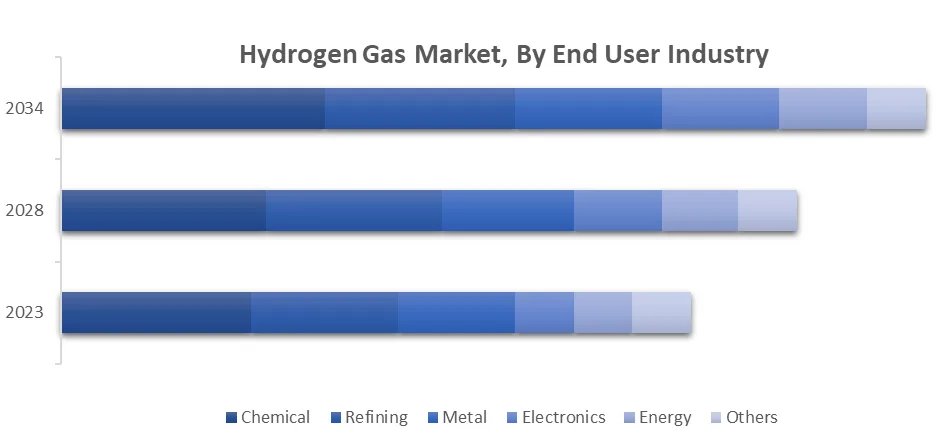
Hydrogen Gas Market is segmented based on the End User Industry into Chemical, Refining, Metal, Electronics, Energy, and Others. Several factors contribute to the dominance of the chemical segment in the Hydrogen Gas Market. A large amount of hydrogen is required for producing ammonia, which is vital for fertilizers, due to the expansion of the agricultural industry. Hydrogen is an important component in the production of methanol, commonly utilized as a chemical raw material, cleaning agent, and energy source. Hydrogen plays a vital role in improving the quality of petroleum products and removing any form of impurities during refining procedures. Furthermore, hydrogen is used as an ingredient in the production of plastics, pharmaceuticals, and various other industrial chemicals. The chemical industry needs a significant amount of hydrogen due to its wide range of products and extensive operations. With the growth of the chemical industry globally, the demand for hydrogen is expected to increase.
Market Dynamics:
Growth Drivers
Increasing Demand for Clean Energy Sources to Facilitate Market Growth and Development
Growing awareness and strict regulations around reducing carbon emissions are greatly fueling the need for hydrogen as a clean energy alternative. Governments all over the world are implementing policies and incentives to make a transition from traditional fuels to sustainable energy options. Using hydrogen as a fuel is crucial in reaching net-zero emissions goals as it only produces water vapor when burned. Industries are increasingly incorporating hydrogen for uses in transportation, power production, and industrial procedures to comply with environmental regulations. Both public and private sectors are making substantial investments in hydrogen infrastructure and technologies, which is increasing its adoption rate. With the increasing emphasis on decarbonization worldwide, hydrogen is becoming a more prominent clean energy source.
Advancements in Hydrogen Production Techniques to Drive Market Expansion
Advancements in hydrogen production techniques are improving the market feasibility and prompting market expansion. The cost competitiveness of traditional fossil fuel-based production is being matched by more efficient electrolysis methods that use electricity to separate water into hydrogen and oxygen. Advancements in gasification technology can assist in transforming organic or fossil fuel-based materials into hydrogen more efficiently, resulting in lower emissions. These technological advancements are making hydrogen production more sustainable and economically viable. Furthermore, research in new production techniques, such as utilizing sustainable energy sources for electrolysis, is progressing. As these technologies grow and expand, they reduce production expenses, boost hydrogen supply, and support the market's growth.
Restraints
Limited Infrastructure for Hydrogen Storage and Distribution Can Hinder Market Growth
Inefficient and limited infrastructure for storing, distributing, and refueling hydrogen acts as a major obstacle to the market's expansion. The current infrastructure is not sufficient to facilitate the widespread use of hydrogen, especially in the transportation industry. Constructing a widespread network of hydrogen refueling stations requires significant investment and time. Additionally, storing hydrogen is difficult since it has low energy density and requires expensive and complex high-pressure or cryogenic systems. Efficient hydrogen delivery to end-users is made more complex by the absence of a strong distribution network. The lack of proper infrastructure is hindering the growth and availability of hydrogen as an energy source, which is impeding its market expansion despite its potential advantages in clean energy and reducing carbon emissions.
Recent Developments
- In 2023-24, Air Liquide has been aggressively investing in green hydrogen projects. They announced plans for large-scale green hydrogen production facilities in various regions. The company has formed partnerships with renewable energy providers and industrial clients to secure long-term hydrogen supply and demand.
- In 2023-24, Linde plc has been expanding its global hydrogen network, focusing on both grey and blue hydrogen production. They have made significant investments in hydrogen production facilities and distribution infrastructure.
- In 2023-24, Air Products and Chemicals, Inc. has been actively pursuing opportunities in the hydrogen mobility sector, including the development of hydrogen fueling stations and partnerships with automotive manufacturers.
- In 2023-24, Nel ASA has been focused on developing integrated solutions for hydrogen production, storage, and distribution. They have secured several contracts for hydrogen projects. The company has also invested in research and development to enhance the performance and cost-effectiveness of its hydrogen technologies.
- In 2023-24, Ballard Power Systems has been increasingly focused on improving its fuel cell technology for various applications, including heavy-duty vehicles and stationary power.
Hydrogen Gas Market, Key Players:
- Air Liquide
- Linde plc
- Air Products and Chemicals, Inc.
- ITM Power
- Nel ASA
- Ballard Power Systems
- Plug Power Inc.
- Toshiba Corporation
- Mitsubishi Heavy Industries Ltd.
- SunHydrogen Inc.
- Siemens AG
- Hydrogenics
- Cummins Inc.
- Enapter
- Hexagon Composites
- Other Prominent Players (Company Overview, Business Strategy, Key Product Offerings, Financial Performance, Key Performance Indicators, Risk Analysis, Recent Development, Regional Presence, SWOT Analysis)
Regional Analysis
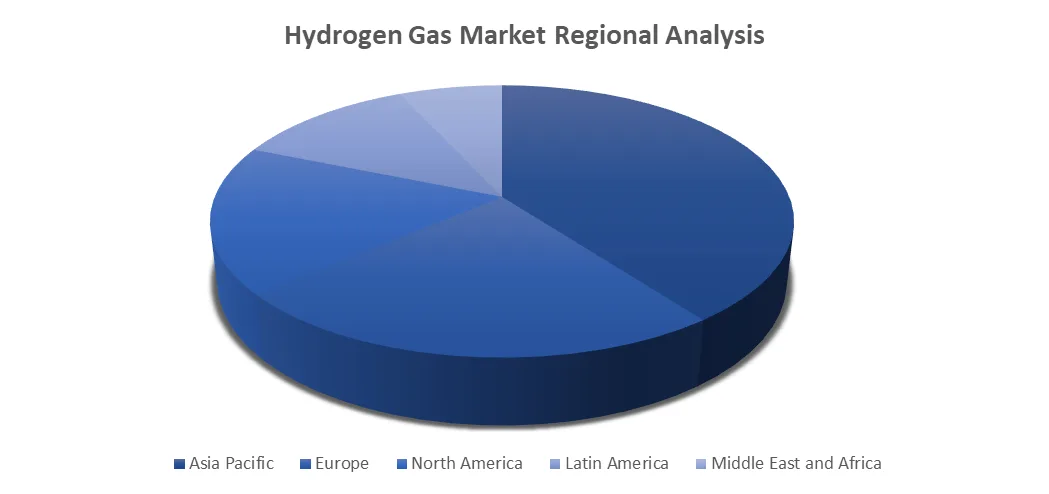
Hydrogen Gas Market is segmented based on regional analysis into five major regions: North America, Latin America, Europe, Asia Pacific, and the Middle East and Africa. The Asia-Pacific region is currently the leading region for hydrogen gas due to various factors. The increasing demand for hydrogen is fueled by quick industrial growth in places such as China, India, and South Korea. These countries have put in place favourable policies and incentives to encourage the production and use of hydrogen. Moreover, the region has plentiful natural gas and renewable energy sources which are necessary for producing hydrogen. There is an increasing focus on clean energy projects, with hydrogen being seen as a crucial element in the transition to sustainable energy solutions.
Although North America and Europe are investing heavily in their significant hydrogen markets, Asia-Pacific's size and pace of development currently provide it with the advantage. Nevertheless, the global hydrogen scene is always changing, with regional control potentially changing in the future.
Hydrogen Gas Market is further segmented by region into:
- North America Market Size, Share, Trends, Opportunities, Y-o-Y Growth, CAGR – United States and Canada
- Latin America Market Size, Share, Trends, Opportunities, Y-o-Y Growth, CAGR – Mexico, Argentina, Brazil, and Rest of Latin America
- Europe Market Size, Share, Trends, Opportunities, Y-o-Y Growth, CAGR – United Kingdom, France, Germany, Italy, Spain, Belgium, Hungary, Luxembourg, Netherlands, Poland, NORDIC, Russia, Turkey, and Rest of Europe
- Asia Pacific Market Size, Share, Trends, Opportunities, Y-o-Y Growth, CAGR – India, China, South Korea, Japan, Malaysia, Indonesia, New Zealand, Australia, and Rest of APAC
- Middle East and Africa Market Size, Share, Trends, Opportunities, Y-o-Y Growth, CAGR – North Africa, Israel, GCC, South Africa, and Rest of MENA
Hydrogen Gas Market Scope and Segments:
|
ATTRIBUTE |
DETAILS |
|
Study Period |
2018-2034 |
|
Base Year |
2023 |
|
Forecast Period |
2024-2034 |
|
Historical Period |
2019-2022 |
|
Growth Rate |
CAGR of 4% from 2024-2034 |
|
Unit |
Value (Million Ton) |
|
Segmentation |
Main Segments List |
|
By Type |
|
|
By Distribution |
|
|
By Production Methods |
|
|
By End User Industry |
|
|
By Region |
|
Frequently Asked Questions (FAQ):
Hydrogen Gas Market size was valued at USD 102.5 million tons in 2023 and is projected to reach the value of USD 158.3 million tons in 2034, exhibiting a CAGR of 4% during the forecast period.
The hydrogen gas market involves the production, distribution, and consumption of hydrogen as an energy carrier and industrial feedstock. It encompasses various sectors including transportation, energy storage, industrial processes, and fuel cells. The market is growing due to increasing demand for clean energy solutions and efforts to reduce carbon emissions globally.
The Steam Methane Reforming and Chemical segment accounted for the largest Hydrogen Gas Market share.
Key players in the Hydrogen Gas Market include Air Liquide, Linde plc, Air Products and Chemicals, Inc., ITM Power, Nel ASA, Ballard Power Systems, Plug Power Inc., Toshiba Corporation, Mitsubishi Heavy Industries Ltd., SunHydrogen Inc., Siemens AG, Hydrogenics, Cummins Inc., Enapter, Hexagon Composites, and Other Prominent Players.
The growing emphasis on decarbonization, coupled with increasing demand from industries like chemicals, refining, and transportation, is driving the hydrogen gas market.
 Select License Type


.png)


