



Bio Oil Market Research 2035
The Bio Oil Market was valued at approximately USD 2.9 billion in 2025 and is projected to reach USD 6.1 billion by 2035, growing at a CAGR of 7.7% during the forecast period. Market growth is primarily driven by increasing demand for renewable energy, decarbonization targets, and rising adoption of sustainable fuel alternatives across industrial and power generation sectors.

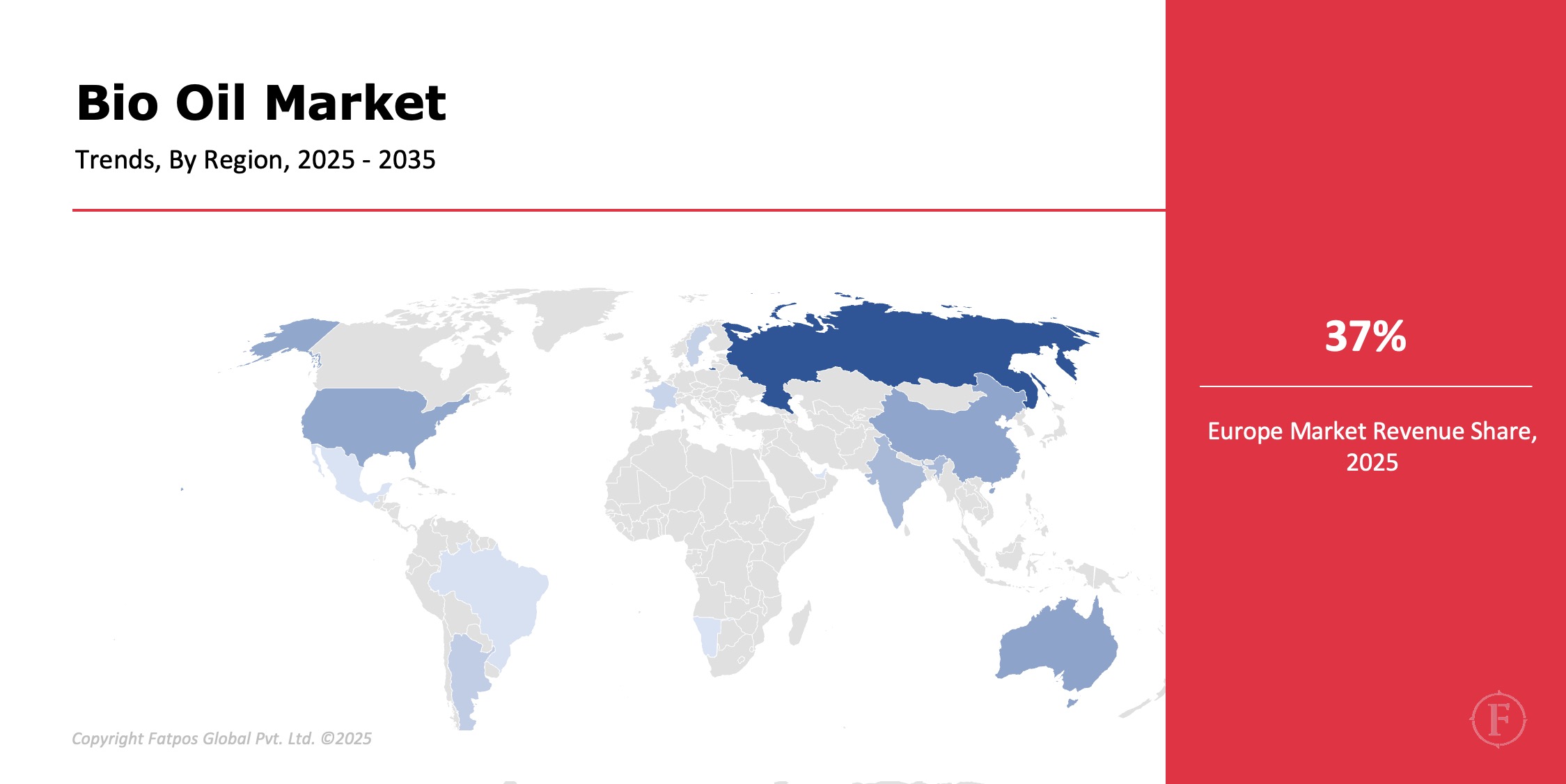
Bio oil, also known as pyrolysis oil, is produced from biomass through thermochemical conversion. It is increasingly used as a substitute for fossil fuels in heating, electricity generation, and chemical production. Strong policy support for bioenergy, coupled with advancements in conversion technologies, continues to support market expansion globally. Supportive government policies, carbon reduction targets, and waste-to-energy initiatives are accelerating market adoption. Advancements in fast pyrolysis technology have improved bio oil yield, quality, and commercial feasibility. Industrial users are increasingly replacing heavy fuel oil with bio oil to reduce emissions and comply with environmental regulations. Europe leads the market due to strong renewable energy mandates, while Asia-Pacific shows rapid growth supported by abundant biomass availability.
Product Overview
Bio oil is a dark, viscous renewable liquid fuel produced from biomass sources such as agricultural residues, forestry waste, and organic materials. It is primarily generated through fast pyrolysis, a thermochemical process that rapidly heats biomass in the absence of oxygen, converting it into liquid fuel, biochar, and syngas. This process allows efficient utilization of waste biomass while reducing environmental impact. Bio oil is widely used in industrial boilers, furnaces, turbines, and engines for heat and power generation as a substitute for fossil-based fuels.
Beyond energy applications, bio oil serves as an important feedstock for producing renewable chemicals, resins, and upgraded biofuels. Continuous research and development efforts focus on improving bio oil stability, lowering oxygen content, and reducing acidity to enhance storage and handling characteristics. Advancements in catalytic upgrading and co-processing technologies are also enabling bio oil to be refined into transportation fuels compatible with existing fuel infrastructure, supporting broader commercial adoption.
Key Takeaways:
- Bio Oil Market to grow at 7.7% CAGR through 2035
- Forestry residues are the leading biomass source
- Heat & power generation dominates application segment
- Fast pyrolysis remains the most widely adopted technology
- Industrial end users account for the largest market share
- Europe leads global bio oil adoption

Market Dynamics
Drivers
The Bio Oil Market is driven by global efforts to reduce greenhouse gas emissions and dependence on fossil fuels. Governments worldwide are promoting renewable energy adoption through subsidies, mandates, and carbon pricing mechanisms. Bio oil offers a cost-effective solution for utilizing waste biomass while generating renewable energy.
Growing industrial demand for low-carbon fuels, rising waste-to-energy projects, and increasing investments in bio-refineries further drive market growth. Technological advancements improving bio oil yield and quality have enhanced its commercial viability across multiple applications.
Restraints
Market growth is restrained by bio oil’s lower energy density and higher acidity compared to conventional fossil fuels. Storage and transportation challenges, including corrosion risks, limit widespread adoption. High initial investment costs for pyrolysis plants can deter small-scale producers.
Limited compatibility with existing fuel infrastructure and engines restricts bio oil usage in transportation without upgrading. Feedstock availability fluctuations and logistics complexity also pose operational challenges, particularly in developing regions.
Opportunities
The Bio Oil Market presents strong opportunities in upgrading bio oil into advanced biofuels and renewable chemicals. Growing demand for sustainable aviation fuel and bio-based chemicals supports future expansion. Integration of bio oil production with waste management systems offers economic and environmental benefits.
Emerging economies with abundant biomass resources provide untapped growth potential. Continuous R&D in catalytic upgrading and co-processing with fossil fuels can significantly expand application scope and commercial adoption.
Challenges
The Bio Oil Market faces challenges related to fuel stability, standardization, and infrastructure compatibility. Variability in feedstock quality impacts consistency of bio oil properties. High oxygen content and acidity require specialized handling and upgrading technologies. Scaling production while maintaining cost efficiency remains difficult. Regulatory uncertainty in certain regions affects long-term investment planning.
Additionally, competition from other renewable energy sources such as biogas and bioethanol adds market pressure. Ensuring reliable feedstock supply chains and improving fuel performance are critical challenges for sustainable market growth.
Bio Oil Market Trends
Key trends include increasing adoption of fast pyrolysis technology and integration of bio oil production with combined heat and power plants. Industrial users are shifting toward bio oil as a low-carbon alternative for boilers and furnaces.
Research into bio oil upgrading for transportation fuels and chemical feedstocks is accelerating. Circular economy initiatives promoting waste biomass utilization are strengthening market demand. Strategic partnerships between energy companies and technology providers are shaping industry development.
Key Players in the Global Bio Oil Industry
- BTG Bioliquids
- Ensyn Corporation
- Valmet
- Airex Energy
- Pyrocell
- Fortum
- Green Fuel Nordic
- Preem
- UPM
- Chevron Lummus Global
Regional & Country Analysis
Europe dominates the Bio Oil Market due to strong renewable energy mandates and widespread biomass availability in countries such as Finland, Sweden, and Germany. North America follows, supported by industrial bioenergy adoption and waste-to-energy initiatives in the United States and Canada.
Asia-Pacific is the fastest-growing region, driven by abundant agricultural residues and rising energy demand in China, India, and Southeast Asia. Latin America benefits from forestry resources and bioenergy investments, particularly in Brazil. The Middle East & Africa show gradual growth, supported by emerging renewable energy diversification strategies.
Segmentation Highlights
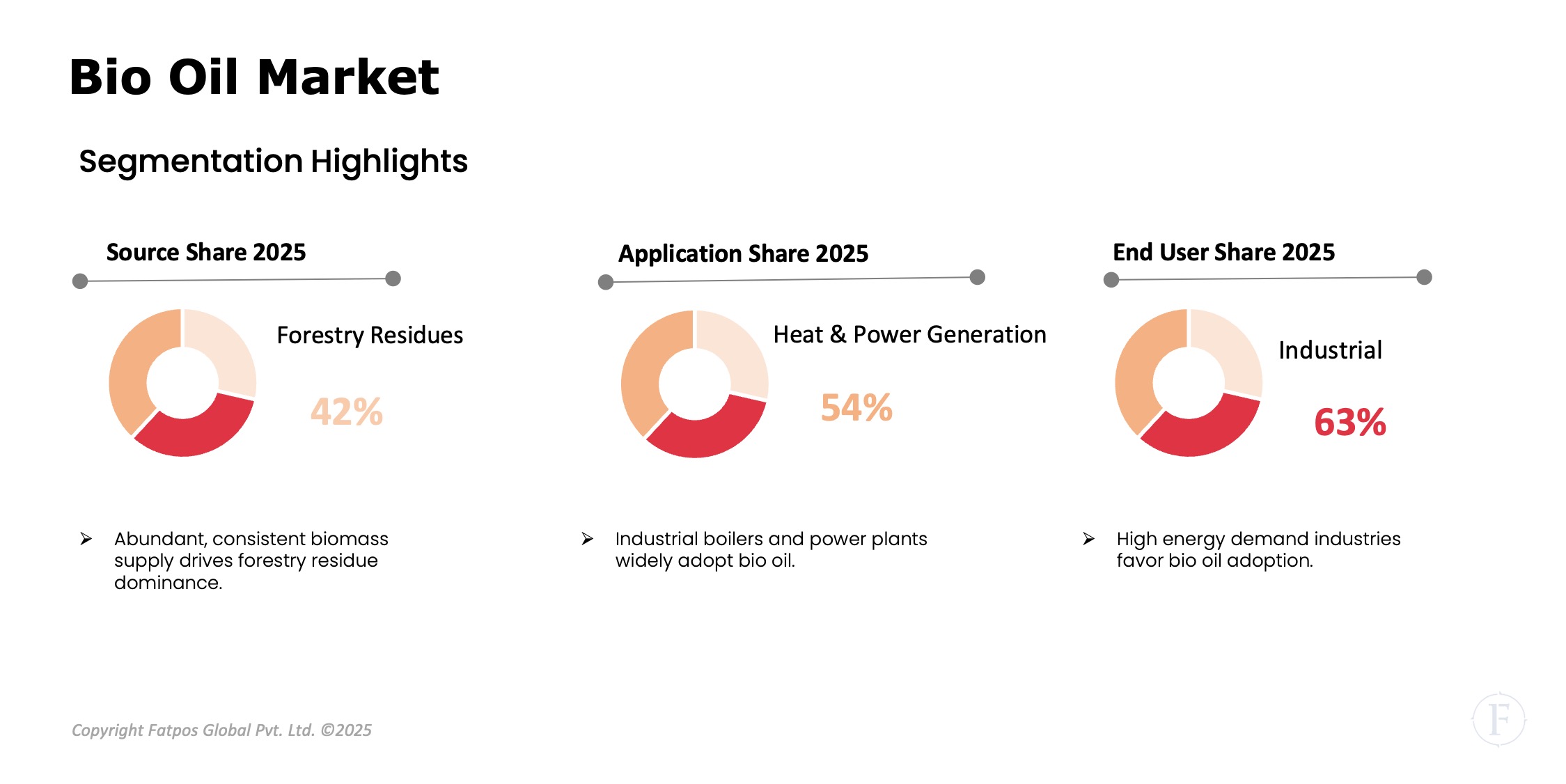
Forestry residues dominate the bio oil source segment due to consistent availability and cost efficiency. Heat and power generation leads applications as industries adopt low-carbon fuels. Fast pyrolysis remains the preferred technology for high liquid yield and scalability. Industrial users account for the largest end-user share driven by energy-intensive operations. Regionally, Europe leads the market supported by strong renewable energy policies, while Asia-Pacific emerges as the fastest-growing region due to abundant biomass resources and rising energy demand.
Report Key Elements
|
ATTRIBUTES |
DETAILS |
|
Study Period |
2019–2035 |
|
Base Year |
2024 |
|
Forecast Period |
2025–2035 |
|
Market Size by 2035 |
USD 6.1 Billion |
|
Market CAGR |
7.7% |
|
By Source |
Forestry, Agricultural, Organic Waste |
|
By Application |
Heat & Power, Transport, Chemicals |
|
By Technology |
Fast Pyrolysis, Slow Pyrolysis |
|
By End User |
Industrial, Commercial, Residential |
|
By Region |
North America, Europe, Asia-Pacific, Latin America, MEA |
|
Bio Oil Market: Key Players |
BTG Bioliquids, Ensyn Corporation, Valmet, Airex Energy |
Global Bio Oil Industry Instances
- Energy companies expanded bio oil-based district heating projects
- Industries replaced heavy fuel oil with bio oil in boilers
- Governments funded pyrolysis plant development programs
- Technology firms improved bio oil upgrading processes
Analyst Review
As per our Bio Oil Market analysis, the market will witness sustained growth through 2035 driven by decarbonization goals and biomass utilization. Technological innovation, policy support, and industrial adoption will remain key growth enablers globally.

Frequently Asked Questions (FAQ):
Bio oil is a renewable liquid fuel produced from biomass through pyrolysis, used as an alternative to fossil-based fuels.
Market growth is driven by renewable energy demand, biomass waste utilization, carbon emission reduction goals, and supportive environmental policies.
Heat and power generation dominates due to bio oil’s suitability for boilers, furnaces, and combined heat and power systems.
Industrial sectors are the largest end users, driven by energy-intensive operations seeking cost-effective and low-carbon fuel alternatives.
Europe leads the market due to strong bioenergy policies, sustainability targets, and abundant biomass resources.
 Select License Type


.png)


