


Humanoid Robot Market Research, 2034
The global humanoid robot market will witness a significant increase, with a projected CAGR of 44% between 2024 and 2034. The market size is estimated to grow from US$ 1.9 billion in 2023 to US$ 104.1 billion by 2034.
Humanoid robots are designed to imitate the look and actions of humans. These robots have similar structures to humans, such as a head, torso, arms, and legs, and are commonly fitted with sensors, actuators, and advanced AI to imitate human actions and engagements. Their structure allows them to complete activities that require human-like accuracy, such as assisting in personal grooming, participating in social engagements, or working in complex settings.
Human-like robots are utilized in a variety of sectors, such as healthcare, education, hospitality, and research. Their primary aim is to improve the way humans and robots interact through intuitive and relatable interfaces, which can be useful in various settings including daily life and specific industries.
Market Highlights:
The market growth influenced by the advancements in artificial intelligence, robotics, and machine learning that improve their capabilities and flexibility. The increasing need for automation in healthcare, personal care, and service sectors drives the growth in popularity, as humanoid robots provide effective answers for elderly assistance, education, and customer support.
Moreover, the growing emphasis on research and space exploration boosts innovation. Ongoing technological advancements, reduced expenses, and increasing usage in various industries will contribute to future expansion. The anticipation is for a significant increase in the integration of robots into daily life and specialized fields as their affordability and capabilities improve.

Market Segmentation:
Biped segment dominates the market due to its human-like interaction capabilities and versatility across various environments
The market is segmented based on Motion Type into Biped and Wheel Drive. Bipedal robots have emerged as the leading segment in the humanoid robot industry owing to several important factors. Their ability to emulate humans enables a more genuine and natural connection with individuals, promoting familiarity and approval. Biped robots are highly versatile and capable of moving through a wide range of terrains such as stairs and uneven surfaces, making them ideal for multiple environments.
They additionally provide improved agility, offering increased flexibility to execute complex tasks that require accuracy and precision, especially in sectors like manufacturing, healthcare, and personal support. Furthermore, their human-like looks and actions trigger more intense emotional reactions, fostering a feeling of closeness. Advances in technology for balance control, gait generation, and sensors have enhanced stability and efficiency, reaffirming their superiority.
Hardware components are poised to dominate the market due to their essential role in powering robotic operations and capabilities
The market is classified based on Components into Hardware and Software. Hardware is currently the main driving force in the market as it plays a critical role in shaping the robot's physical abilities like strength, speed, and agility. These qualities are mainly influenced by physical parts such as actuators, sensors, and structural components.
Although newer developments in software are important, they are frequently restricted by the constraints of the hardware it runs on, including sensor precision and computing capabilities. The market accessibility for advanced software is affected by the cost of high-performance hardware components, which are necessary for optimal functionality.
Furthermore, the robot's capabilities to interact with surroundings and carry out tasks are strongly influenced by its physical design, determined by its hardware, highlighting the significant role of hardware in the market.

Market Dynamics:
Growth Drivers
Demand For Automation in Various Industries is Driving the Adoption of Humanoid Robots
The increasing demand for automation in industries such as healthcare, education, and retail is playing a major role in the rise of humanoid robot use. In the healthcare sector, humanoid robots are used for patient care, helping the elderly, and carrying out specific medical procedures, alleviating the pressure from healthcare workers and providers. Interactive teaching aids are being more commonly utilized in education to enhance learning experiences with personalized interactions.
Humanoid robots are being used in retail settings for customer service, inventory management, and other everyday responsibilities, providing a benefit to the retail industry. The demand for efficiency, precision, and consistent service in these industries has sped up the incorporation of humanoid robots, which can complete tasks dependably and with more accuracy, helping to combat labour shortages and enhance service provision.
Development in Manufacturing Technology to Make Humanoid Robots Affordable for Several Applications
Improvements in manufacturing technology are reducing the cost of humanoid robots, and expanding their applications in different sectors. Advancements in materials science, manufacturing methods, and component size reduction have significantly reduced the expenses related to constructing humanoid robots, allowing a broader array of businesses and consumers to obtain them.
With increased production and reduced costs, more companies have the opportunity to adopt humanoid robots for tasks such as automation, customer service, and personal assistance. This affordability also promotes the creation of new possibilities for use, as smaller businesses and start-ups are now able to consider humanoid robots for specific tasks. The move towards robotics solutions that are more economical is predicted to boost market expansion, as lower costs eliminate a major obstacle to acceptance.
Restraints
Developing and Integrating Advanced Robotics Technologies Remains Complex and Challenging
Incorporating cutting-edge AI and robotics technologies into humanoid robots is challenging because of the complexity of these systems. Developing a humanoid robot requires integrating various fields such as mechanical engineering, computer science, artificial intelligence, and human-robot interaction. The AI algorithms powering these robots must be advanced to handle large volumes of data, make quick decisions, and adjust to changing surroundings for autonomous task execution.
Moreover, achieving smooth integration of AI with hardware components such as sensors, actuators, and power systems poses a significant challenge. The increased complexity frequently results in longer development time, higher expenses, and reliability concerns, which can hinder the widespread adoption and deployment of advanced humanoid robots.
Recent Developments
- In 2024, Honda introduced the "ASIMO Next," an advanced version of its ASIMO robot with improved mobility and AI capabilities. The company has actively announced its strategic partnerships with several tech firms to integrate their humanoid robots into smart home systems, aiming to enhance personal assistance and home automation.
- In 2023, SoftBank Robotics Group Corp. launched the "Pepper X," an upgraded version of its Pepper robot with enhanced emotional recognition and natural language processing capabilities. The company has also acquired a majority stake in a robotics software company to enhance its robots' AI and machine learning capabilities.
- In 2024, UBTECH Robotics unveiled the "Walker Pro," a humanoid robot designed for industrial applications and enhanced with advanced mobility and dexterity features. The company entered into a joint venture with a major AI company to develop more sophisticated humanoid robots for the service and entertainment sectors.
- In 2023, Toyota Motor Corporation released the "T-HR3" robot, focusing on remote operation and telepresence applications, designed to assist in hazardous environments. The company announced a new research initiative in 2024 to develop humanoid robots that integrate with autonomous vehicles, aiming to enhance mobility and human-robot interaction.
- In 2023, Hanson Robotics introduced "Sophia 2.0," featuring upgraded AI algorithms and improved facial recognition for more natural interactions.
Key Players:
- Honda Motor Co., Ltd.
- SoftBank Robotics Group Corp.
- UBTECH Robotics
- Toyota Motor Corporation
- Hanson Robotics
- Boston Dynamics
- IBM Corporation
- Samsung Electronics
- Aldebaran Robotics
- KUKA Robotics
- Robotic Research, LLC
- Engineered Arts
- Pal Robotics
- H Robotics
- HRI Robotics
- Other Prominent Players (Company Overview, Business Strategy, Key Product Offerings, Financial Performance, Key Performance Indicators, Risk Analysis, Recent Development, Regional Presence, SWOT Analysis)
Regional Analysis
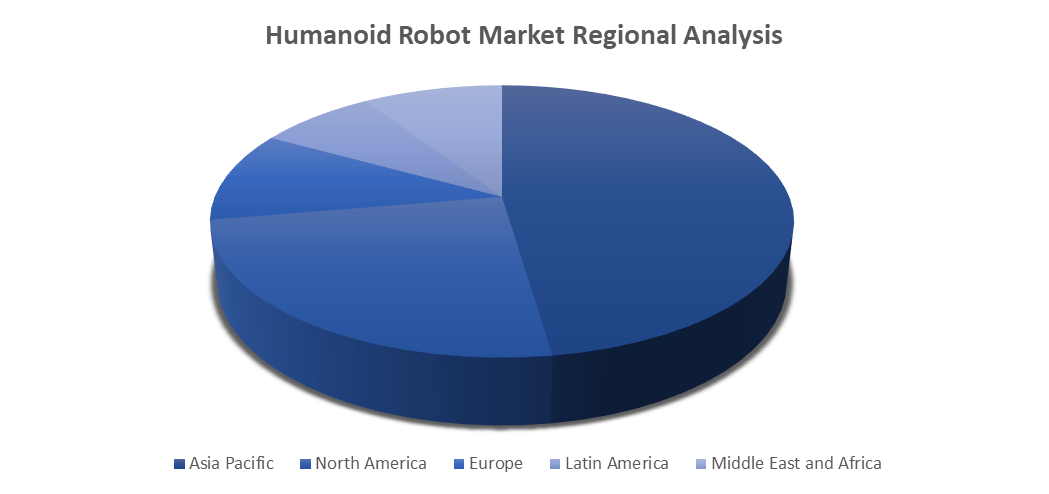
Global Humanoid Robots Market is segmented based on regional analysis into five major regions: North America, Latin America, Europe, Asia Pacific and the Middle East and Africa.
Asia Pacific region leads the market due to rapid technological development, large investments in robotics, and a strong demand for automation across different industries. Japan, South Korea, and China lead the way in robotics due to government backing, a solid manufacturing sector, and a culture that values robotic technology. Japan and South Korea are at the forefront of robotics innovation globally, with corporations such as Honda and SoftBank Robotics leading the way in creating humanoid robots.
However, North America is a major contributor to the humanoid robot industry due to robust R&D efforts, particularly in the U.S., which sees substantial investments in AI and robotics.
Europe, particularly countries such as Germany and France, is paying close attention to industrial automation and healthcare applications.
Latin America and the Middle East & Africa are developing markets, where the uptake of new technologies is hindered by economic restrictions and technological constraints. Yet, there is an increasing interest in automation and robotics in these areas, especially in industries such as agriculture, mining, and retail, which has the potential to boost market growth in the future.
Market is further segmented by region into:
- North America Market Size, Share, Trends, Opportunities, Y-o-Y Growth, CAGR – United States and Canada
- Latin America Market Size, Share, Trends, Opportunities, Y-o-Y Growth, CAGR – Mexico, Argentina, Brazil, and Rest of Latin America
- Europe Market Size, Share, Trends, Opportunities, Y-o-Y Growth, CAGR – United Kingdom, France, Germany, Italy, Spain, Belgium, Hungary, Luxembourg, Netherlands, Poland, NORDIC, Russia, Turkey, and Rest of Europe
- Asia Pacific Market Size, Share, Trends, Opportunities, Y-o-Y Growth, CAGR – India, China, South Korea, Japan, Malaysia, Indonesia, New Zealand, Australia, and Rest of APAC
- Middle East and Africa Market Size, Share, Trends, Opportunities, Y-o-Y Growth, CAGR – North Africa, Israel, GCC, South Africa, and Rest of MENA
Market Scope and Segments:
|
ATTRIBUTE |
DETAILS |
|
Study Period |
2018-2034 |
|
Base Year |
2023 |
|
Forecast Period |
2024-2034 |
|
Historical Period |
2019-2022 |
|
Growth Rate |
CAGR of 44% from 2024-2034 |
|
Unit |
Value (US$ Billion) |
|
Segmentation |
Main Segments List |
|
By Component |
|
|
By Motion Type |
|
|
By Application |
|
|
By Region |
|
Frequently Asked Questions (FAQ):
The global humanoid robot market size was valued at US$ 1.9 billion in 2023 and is projected to reach the value of US$ 104.1 billion in 2034, exhibiting a CAGR of 44% during the forecast period.
The market encompasses the development, production, and sale of robots designed to resemble humans in appearance and movement. These robots are often used for tasks such as research, education, entertainment, and personal assistance.
The Biped and Hardware segment accounted for the largest market share.
Key players in the humanoid robot market include Honda Motor Co., Ltd., SoftBank Robotics Group Corp., UBTECH Robotics, Toyota Motor Corporation, Hanson Robotics, Boston Dynamics, IBM Corporation, Samsung Electronics, Aldebaran Robotics, KUKA Robotics, Robotic Research, LLC, Engineered Arts, Pal Robotics, H Robotics, HRI Robotics and Other Prominent Players.
Increasing demand for automation, advancements in AI and robotics technology, and the necessity for human-like interaction in different industries are the main drivers of the market.
 Select License Type


.png)


