


Composite Insulator Market Size
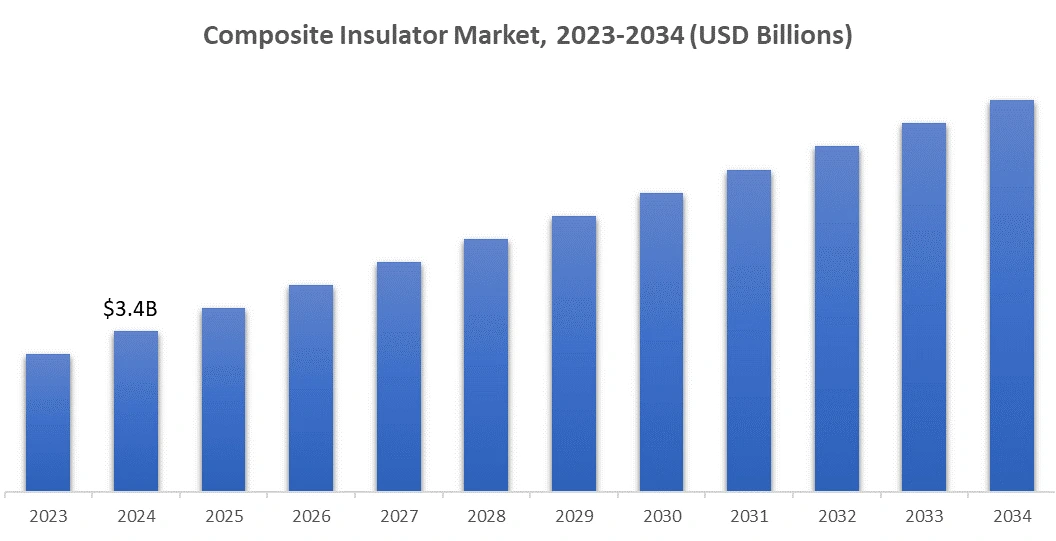
The Composite Insulator Market is expected to grow at a CAGR of 6.0% during the forecast period from 2024 to 2034. The market size was valued at USD 3.2 billion in 2023 and is projected to reach USD 6.1 billion by 2034.
Product Overview:
Composite insulators, or polymeric or non-ceramic insulators, are electrical insulating devices manufactured by creating a blend of polymer materials and fiberglass cores. They are widely used in high-voltage power transmission and distribution systems to keep conductors apart and avoid any form of electricity leakage, particularly in regions with significant pollution or severe weather. In comparison to conventional ceramic or glass insulators, composite insulators provide several benefits such as reduced weight, improved resistance to damage, and superior performance in contaminated or coastal settings. These qualities render them perfect for contemporary power infrastructure initiatives, facilitating effective and dependable power distribution throughout vast networks. Composite insulators are increasingly favored for new setups and replacing conventional insulators, leading to their growing market demand.
Market Highlights:
The Composite Insulator Market is expected to exhibit a CAGR of 6.0% during the forecast period, 2024-2034
The Composite Insulator Market is expected to achieve an overall valuation of USD 6.1 billion, expanding at a CAGR of 6.0% throughout the forecast period due to several compelling factors. The modernization and growth of power infrastructure, particularly in emerging economies, have substantially propelled the demand for dependable and long-lasting insulators. Composite insulators provide outstanding performance in severe environmental settings, including pollution and coastal exposure, making them perfect for power transmission and distribution in difficult zones. Increasing investment in renewable energy initiatives further propels market demand, as composite insulators are extensively utilized for secure power transmission from renewable sources situated in distant locations. Anticipated growth will occur as emerging markets focus on enhancing energy infrastructure, while established areas persist in upgrading outdated systems to composite insulators for better efficiency and resilience.
Source: Fatpos Global
Composite Insulator Market Segmentation:
High-voltage composite insulators lead the market, ensuring reliable power transmission over long distances
The Composite Insulator Market is classified based on the Voltage into High Voltage, Medium Voltage, and Low Voltage. High-voltage composite insulators are expected to dominate the market accredited to the vital role they play in long-distance electricity transmission. These insulators are crucial for supporting high-voltage transmission lines and substations, especially in regions with tough environmental conditions such as high pollution levels or coastal areas. High voltage insulators provide outstanding resistance to corrosion, strong mechanical properties, and environmental durability, which makes them ideal for applications of 220 kV and higher. As infrastructure and renewable energy projects expand at a faster rate, high-voltage insulators are playing a crucial role in dependable power distribution in nations such as China and India, where demand is influenced by large-scale initiatives. As developed countries improve their outdated grid systems, high-voltage insulators continue to play an essential role in effective power transmission.
Suspension Insulators dominate the market, driven by their flexibility, scalability, and efficient performance in high-voltage transmission lines
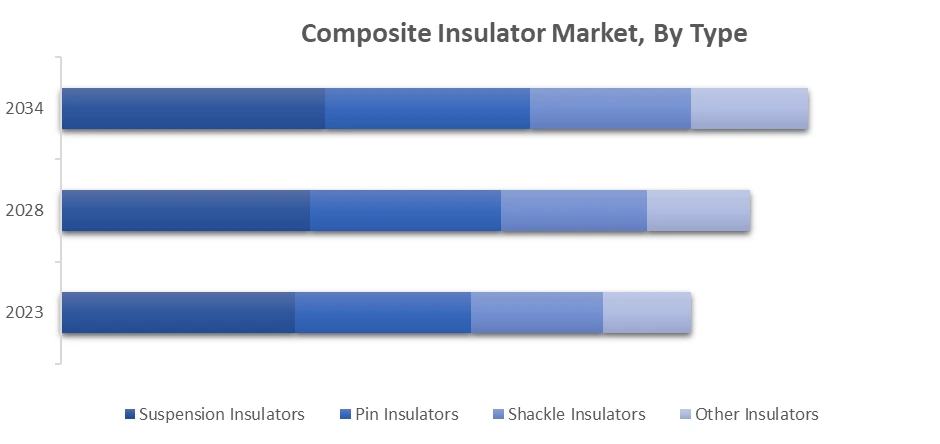
The Composite Insulators Market is segmented based on the Type into Pin Insulators, Suspension Insulators, Shackle Insulators, and Other Insulators. Suspension insulators are the predominant variety of composite insulators. Their design offers flexibility and expandability in high-voltage transmission lines, facilitating better management of electrical load and effective operation in different environmental conditions. They are particularly useful for overhead transmission lines, where dependability and resilience against elements such as wind load, ice, and pollution are crucial. Suspension insulators also minimize the probability of power outages and work efficiently in various environmental conditions, making them vital for extensive transmission networks in both developed and developing markets. Due to their durability and low maintenance requirements, suspension insulators are perfect for high-voltage and ultra-high-voltage uses.
Market Dynamics:
Growth Drivers
Expansion in Urbanization and Industrialization in Emerging Markets to Fuel Market Growth
Fast-paced urban expansion and industrial development, particularly in developing regions such as Asia-Pacific and Latin America, significantly propel growth in the composite insulator market. As urban areas grow and industries evolve, the demand for dependable electricity infrastructure increases. Composite insulators are favored in new power infrastructure initiatives due to their strength, lightweight construction, and ability to withstand severe weather, making them suitable for broad and diverse settings. The growing industrial segments in nations such as China, India, and Brazil also fuel demand, since industries need reliable and consistent power sources. As a direct result, this growth of urban and industrial sectors in developing markets is anticipated to propel the composite insulator market in the coming ten years.
Growth in Renewable Energy Projects to Drive Demand for Composite Insulators
A global trend has been emerging towards embracing renewable energy sources such as wind, solar, and hydroelectric power, resulting in a higher demand for composite insulators. Numerous renewable energy generation facilities are situated in isolated and dangerous locations, which makes insulators ideal and capable of enduring environmental pressures such as strong winds, salt exposure, and dust. Composite insulators effectively address these requirements, providing lightweight and durable insulation solutions for the transmission of renewable energy. The rise in investments in renewable energy corresponds with global climate objectives, and as countries improve their renewable generation capabilities, composite insulators will be essential for transporting dependable energy from distant sources to cities.
Restraints
High Initial Cost of Composite Insulators May Restrict Market Growth
Despite offering long-term advantages and operational effectiveness, composite insulators have higher initial costs compared to conventional ceramic or glass insulators. For projects with limited budgets, especially in regions with underdeveloped infrastructure, this higher expense can serve as a disincentive. Furthermore, although they offer benefits, shifting from conventional to composite insulators may necessitate extra spending on training and equipment modifications, increasing initial costs. As a result, certain markets, particularly in developing nations, might be reluctant to embrace composite insulators, hindering overall market penetration in regions sensitive to price.
Recent Developments
- ABB continues to innovate in the composite insulator space, focusing on environmentally friendly solutions. In 2023, the company launched new sustainable products for high-voltage power transmission. ABB is also reducing its environmental footprint by incorporating recyclable materials and enhancing product durability.
- Siemens introduced a high-performance composite insulator line in 2023, designed for extreme environmental conditions. The company collaborates with energy providers to modernize grid infrastructure and enhance insulation solutions for renewable energy applications.
- TE Connectivity expanded its composite insulator range for railway applications, ensuring safe and reliable transmission for high-speed trains. The company invests in research to improve insulator resilience and reduce maintenance needs in challenging environments.
- GE Grid Solutions focuses on developing eco-efficient composite insulators for renewable energy transmission. In 2023, the company introduced insulators specifically designed for offshore wind applications, strengthening its product portfolio.
Composite Insulator Market: Key Players
- ABB Ltd.
- TE Connectivity
- GE Grid Solutions
- SIEMENS AG
- Seves Group
- Lapp Insulators
- Hubbell Power Systems
- Aditya Birla Insulators
- MacLean Power Systems
- Victor Insulators
- Orient Power Insulators Ltd.
- Elsewedy Electric
- Sediver SA
- INAEL Electrical Systems
- Bharat Heavy Electricals Limited (BHEL)
- Other Prominent Players (Company Overview, Business Strategy, Key Product Offerings, Financial Performance, Key Performance Indicators, Risk Analysis, Recent Development, Regional Presence, SWOT Analysis)
Regional Analysis
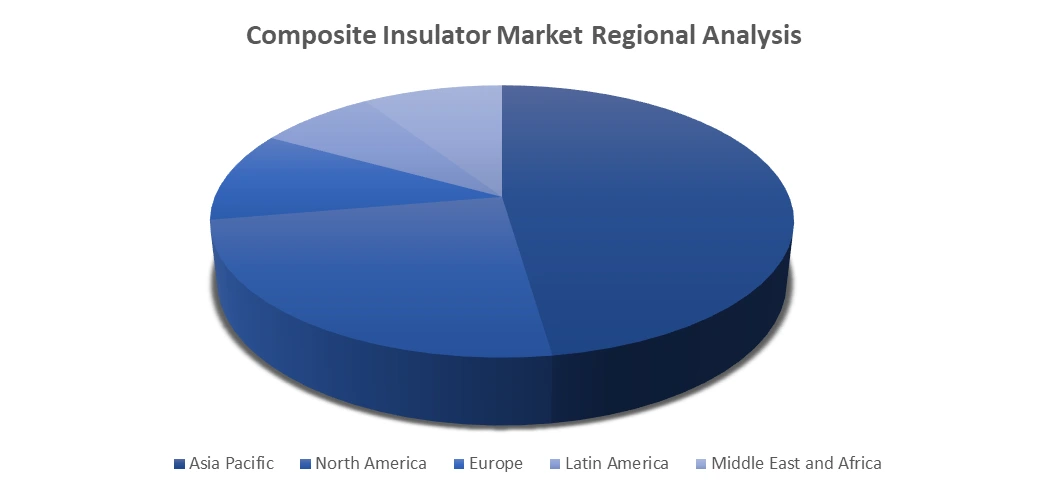
The Composite Insulator Market is segmented based on regional analysis into five major regions: North America, Latin America, Europe, Asia Pacific, and the Middle East and Africa. The Asia Pacific region tends to lead the market, mainly owing to the rapid urbanization, industrial growth, and infrastructural developments in nations such as China, India, and Southeast Asia. Governments with the help of public and private partnerships have significantly invested in the energy infrastructure, supported by the region's dedication to meet its renewable energy targets. China's vast expansion of its power grid and India's improvements in rural electrification and transmission have turned the region into a major consumer of composite insulators. The need for dependable and effective electrical infrastructure, especially in areas with high pollution or humidity, supports the adoption of composite insulators in the Asia-Pacific market.
While not the largest, North America and Europe are important markets fueled by investments in updating power infrastructure and renewable energy initiatives. North America focuses on improving grid reliability, while Europe highlights environmental and technological criteria, leading to the increased use of composite insulators. Latin America, along with the Middle East and Africa, represents emerging markets where the demand for power infrastructure is increasing. Nevertheless, constrained budgets and current dependence on conventional insulators hinder their adoption rates, although government programs are anticipated to promote expansion in these areas over the coming ten years.
Source: Fatpos Global
Impact of Covid-19 on Composite Insulator Market
The COVID-19 pandemic had a multifaceted impact on the composite insulator market, mainly due to supply chain disruptions and concentrated construction activities. A significant slowdown in manufacturing activities due to lockdowns and restrictions hampered the supply and transportation of crucial raw materials. Numerous extensive energy infrastructure initiatives were delayed, resulting in a short-term reduction in demand. Nonetheless, the market recovered as governments focused on vital services, such as energy initiatives, and maintained funding for renewable energy infrastructure. As the global economy adjusts to new standards, remote energy sources are gaining popular ground, driving the need for dependable insulators to ensure power transmission safety. In summary, although the pandemic temporarily hindered growth, it highlighted the need for robust energy infrastructure, resulting in an increased emphasis on composite insulators for upgrading grids worldwide.
Composite Insulator Market is further segmented by region into:
- North America Market Size, Share, Trends, Opportunities, Y-o-Y Growth, CAGR – United States and Canada
- Latin America Market Size, Share, Trends, Opportunities, Y-o-Y Growth, CAGR – Mexico, Argentina, Brazil, and Rest of Latin America
- Europe Market Size, Share, Trends, Opportunities, Y-o-Y Growth, CAGR – United Kingdom, France, Germany, Italy, Spain, Belgium, Hungary, Luxembourg, Netherlands, Poland, NORDIC, Russia, Turkey, and Rest of Europe
- Asia Pacific Market Size, Share, Trends, Opportunities, Y-o-Y Growth, CAGR – India, China, South Korea, Japan, Malaysia, Indonesia, New Zealand, Australia, and Rest of APAC
- Middle East and Africa Market Size, Share, Trends, Opportunities, Y-o-Y Growth, CAGR – North Africa, Israel, GCC, South Africa, and Rest of MENA
Composite Insulator Market Scope and Segments:
|
ATTRIBUTE |
DETAILS |
|
Study Period |
2018-2034 |
|
Base Year |
2023 |
|
Forecast Period |
2024-2034 |
|
Historical Period |
2019-2022 |
|
Growth Rate |
CAGR of 6.0% from 2024-2034 |
|
Unit |
Value (USD Billion) |
|
Segmentation |
Main Segments List |
|
By Voltage |
|
|
By Application |
|
|
By Type |
|
|
By Voltage Rating |
|
|
By End Use |
|
|
By Installation |
|
|
By Region |
|
Frequently Asked Questions (FAQ):
The Composite Insulator Market size was valued at USD 3.2 billion in 2023 and is projected to reach the value of USD 6.1 billion in 2034, exhibiting a CAGR of 6.0% during the forecast period.
The Composite Insulator Market encompasses the creation, production, and provision of high-quality insulators for electrical transmission and distribution networks. These insulators, crafted from substances such as silicone rubber and fiberglass, provide enhanced electrical insulation, longevity, and resistance to environmental factors, suitable for use in power transmission, rail systems, and renewable energy.
The High Voltage and Suspension Insulator segment accounted for the largest Composite Insulator Market share.
Key players in the Composite Insulator Market include ABB Ltd., TE Connectivity, GE Grid Solutions, SIEMENS AG, Seves Group, Lapp Insulators, Hubbell Power Systems, Aditya Birla Insulators, MacLean Power Systems, Victor Insulators, Orient Power Insulators Ltd., Elsewedy Electric, Sediver SA, INAEL Electrical Systems, Bharat Heavy Electricals Limited (BHEL) and Other Prominent Players.
The Composite Insulator Market is driven by increasing demand for high-voltage transmission, renewable energy integration, grid modernization, and urbanization, along with the need for reliable, efficient, and environmentally friendly electrical insulation solutions.
 Select License Type


.png)


