


Carbon Black Market Size
Carbon Black Market, valued at USD 23.8 billion in 2023, is expected to experience steady growth over the next decade. With a projected Compound Annual Growth Rate (CAGR) of 5.1% from 2024 to 2034, industry analysts forecast the market to reach USD 41.4 billion by the end of 2034.
Product Overview:
Carbon black is a versatile form of elemental carbon created through incomplete combustion or thermal decomposition of hydrocarbons. It is a fine black powder and is widely used due to its unique qualities such as high tensile strength, abrasion resistance, and conductivity. Carbon black is primarily used in tire production to improve strength and overall performance by acting as a reinforcing filler. It is also crucial in industries like plastics, inks, and coatings to enhance strength and colour attributes in non-tire rubber products. However, environmental concerns arise from emissions and health risks related to the small particle size of carbon black during its production and use. Efforts are being made to develop sustainable production methods and minimize environmental impacts, ensuring its role in industrial applications while addressing regulatory challenges and advancing technology.
Market Highlights:
Carbon Black Market is expected to exhibit a CAGR of 5.1% during the forecast period, 2024-2034
Carbon Black Market is expected to achieve a value of USD 41.4 billion, with a growth rate of 5.1% in the predicted timeframe driven by rising demand in sectors like automotive, where it is crucial for tire strengthening due to its excellent characteristics. Market growth is further driven by the expansion into applications such as plastics and coatings beyond tires. Furthermore, increasing industrialization and infrastructure development on a global scale are also factors that contribute to ongoing demand. Moving forward, developments in overall carbon black production technology enhance sustainability and efficiency to further fuel market growth. Additionally, the continued focus on environmental efforts and meeting regulations is predicted to influence future market trends, promoting advancements in sustainable production methods and uses, therefore maintaining carbon black's importance in various industrial fields.
_.webp)
Source: Fatpos Global
Carbon Black Market Segmentation:
Furnace Black segment holds the dominant position due to better cost-effectiveness and superior dispersibility
Carbon Black Market is categorized based on Type into Furnace Black, Thermal Black, Channel Black, Acetylene Black, and Others. Currently, Furnace black is the dominating player in the market, representing around 70-75% of the total carbon black market globally. Its main applications involve tire manufacturing, specifically for passenger vehicles and light trucks, to improve wear resistance, strength, and rolling resistance. Manufacturers can customize furnace black for specific uses by choosing from a variety of particle sizes and surface areas. Its excellent ability to disperse in rubber mixtures guarantees even spread and enhanced effectiveness. Moreover, furnace black is economically advantageous due to its efficient and competitive manufacturing methods in comparison to other types of carbon black. The technical benefits and economic advantages of furnace black make it the top choice for a range of industrial uses.
Tires & Rubber Products to lead the market owing to their essential function in vehicle performance and versatility
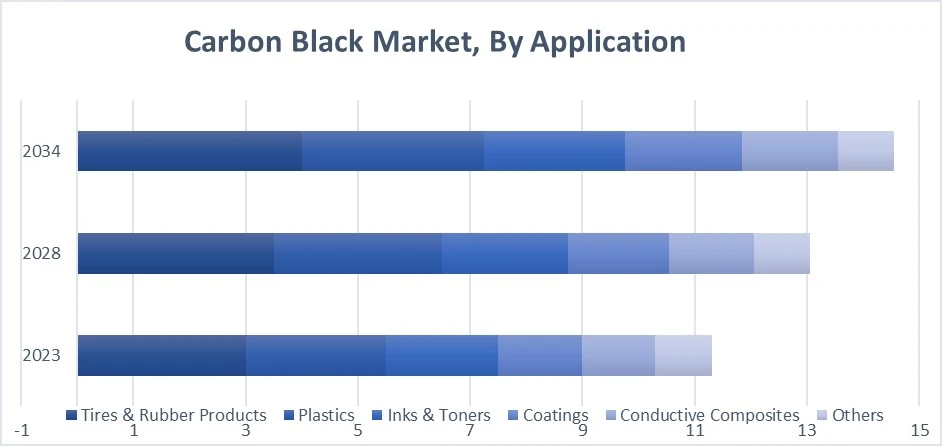
Carbon Black Market is segmented based on Application into Tires & Rubber Products, Plastics, Inks & Toners, Coatings, Conductive Composites and Others. The Tires & Rubber Products sector dominates the carbon black market, holding 60-65% of the overall market share. Carbon black is crucial in the production of tires, as it acts as a significant strengthening agent that boosts durability, and robustness, and reduces friction, ultimately enhancing gas mileage. Its flexibility applies to different rubber items such as hoses, belts, gaskets, seals, shoe soles, and conveyor belts. The strong presence of this sector is backed by the large worldwide tire market, fuelled by rising car sales. Carbon black plays a crucial role in improving tire performance and safety, leading to its constant importance in this market segment without any noticeable substitute
Market Dynamics:
Growth Drivers
Increasing Demand from the Automotive Industry for Tire Manufacturing to Propel Market Growth
The carbon black market is closely linked to the automotive sector, with tires being the largest consumer, making up 60-65% of the market share. Carbon black plays a vital role in enhancing tire durability, strength, and fuel efficiency, resulting in tires that last longer, are safer, and require less energy to roll. The continuous expansion of the global automotive industry leads to an increased need for tires and carbon black due to the growing production of vehicles in diverse categories. Moreover, developing countries such as China and India are experiencing an increase in the number of people owning cars, which is also boosting demand. This close connection between the expansion of the automotive industry and the production of tires supports the enduring and increasing need for carbon black.
Expansion of Construction and Industrial Activities Globally to Positively Influence Market Growth
Carbon black’s diverse applications extend beyond just tires, facilitating to boost of market growth in the construction and industrial sectors. In the construction industry, carbon black improves rubber items such as hoses and belts used for conveying materials, gaskets, and seals for keeping water out, and expansion joints for accommodating structural movement. Industrial uses involve reinforcing conveyor belts for moving materials, damping mounts for reducing noise, and hoses for handling fluids and gases. Increasing investments in infrastructure projects globally are driving up the need for construction materials and industrial rubber products, ultimately leading to a rise in the carbon black market. Moreover, the need for tires rises due to the increased transportation of materials and equipment in these industries, which strengthens the market position of carbon black.
Restraints
Volatility in Raw Material Prices to Hinder Comprehensive Market Growth
Volatile raw material prices present major obstacles to the steady expansion of the carbon black industry. The production of carbon black is largely dependent on crude oil, natural gas, and other chemicals, which can be influenced by changes in global market conditions, political uncertainty, and supply chain interruptions. Escalating costs of raw materials raise production expenses for manufacturers, leading them to either bear the costs and cut down on profits and investments, or hike prices, possibly lowering demand. This volatility creates uncertainty, leading manufacturers to adopt risk management tactics such as hedging contracts, diversifying suppliers, and optimizing production processes to reduce effects. In general, fluctuations in raw material prices hinder steady and foreseeable growth in the carbon black industry.
Recent Developments
- In 2024, Birla Carbon commissioned a new furnace black production line in Thailand to cater to the rising demand in Southeast Asia. The company also launched a new range of sustainable carbon blacks produced using bio-based feedstocks, aligning with growing eco-conscious market preferences.
- During the first half of 2023, Cabot Corporation formed a joint venture with a Chinese company to establish a new carbon black production facility in China, capitalizing on the expanding Asian market. In the second quarter of 2024, the company acquired a leading manufacturer of specialty chemicals used in rubber compounding, aiming to strengthen its product portfolio and technological expertise.
- Throughout 2023, Phillips Carbon Black Limited implemented operational efficiency measures to reduce production costs and enhance profitability in a volatile market environment. In the first quarter of 2024, the company partnered with a tire manufacturer to develop and supply customized carbon black grades for their next-generation tire formulations, focusing on improved performance and fuel efficiency.
- During the first half of 2024, Tokai Carbon Co., Ltd. developed a new conductive carbon black with superior properties for lithium-ion battery applications, catering to the booming energy storage market.
Carbon Black Market
Key Players:
- Orion Engineered Carbons
- Birla Carbon
- Cabot Corporation
- Phillips Carbon Black Limited
- Tokai Carbon Co., Ltd.
- ASAHI CARBON CO., LTD.
- Chengshan Group
- OCI Company Ltd
- KOSMOS CARBON COMPANY
- Mitsubishi Chemical Corporation
- Abu Dhabi National Oil Company (ADNOC)
- Nippon Steel Chemical & Material Co., Ltd.
- Shandong Huadong Rubber Types Co., Ltd
- Himadri Speciality Chemical Ltd
- OMSK Carbon Group
- Other Prominent Players (Company Overview, Business Strategy, Key Product Offerings, Financial Performance, Key Performance Indicators, Risk Analysis, Recent Development, Regional Presence, SWOT Analysis)
Regional Analysis
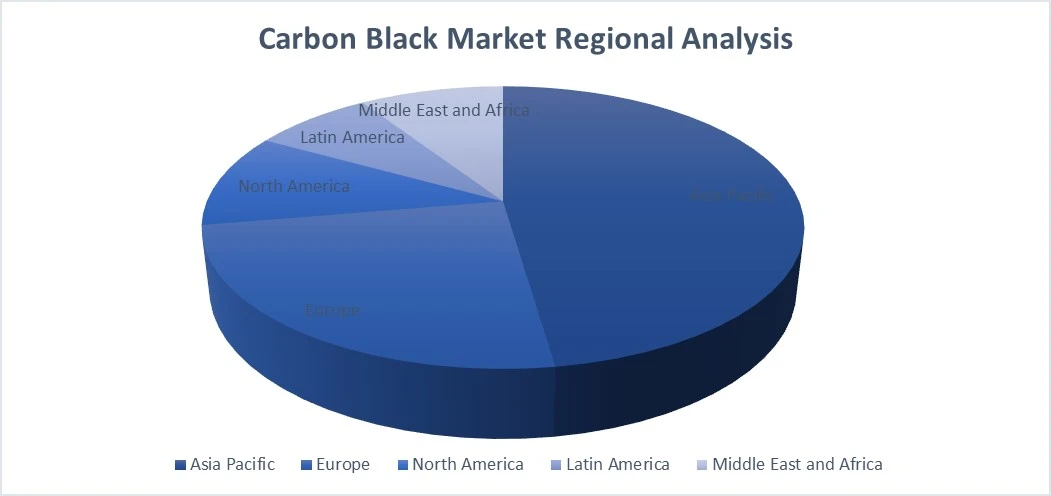
Carbon Black Market is segmented based on regional analysis into five major regions: North America, Latin America, Europe, Asia Pacific, and the Middle East and Africa. Asia-Pacific dominates the global carbon black market, accounting for 50-55% of the overall market share. The prevalence is fuelled by fast industrial growth in nations like China and India, increasing the need for items incorporating carbon black, like tires, construction materials, and industrial rubber goods. The region now stands as the global center for tire manufacturing, serving both local and overseas markets, driving the need for carbon black. The fast pace of urbanization and development of infrastructure continue to boost the need for construction and industrial purposes. Moreover, the cost-effective benefits in manufacturing make Asia-Pacific an appealing choice for companies, increasing production capabilities and cutting costs.
Other regions, such as North America and Europe, have more mature markets and have experienced slower growth. However, they have shifted their focus to manufacturing high-performance and specialty carbon blacks. Latin America and the Middle East & Africa currently have a small market share but show strong future growth potential due to increasing industrialization and development activities in these regions.
Source: Fatpos Global
Impact of Covid-19 on Carbon Black Market
Carbon black market was temporarily affected by the COVID-19 pandemic. Lockdowns and travel restrictions affected the supply chain of raw materials, leading to possible shortages and fluctuations in prices. Reduced tire demand resulted from lower automobile production, consequently affecting the consumption of carbon black. Furthermore, numerous construction and industrial activities were paused, leading to a temporary drop in the need for carbon black. Even though there were difficulties at the beginning, the carbon black market showed strength. Demand in the tire segment particularly picked up as economies reopened. The pandemic may accelerate a shift toward sustainable practices, increasing demand for carbon black made from bio-based materials or cleaner techniques. The lasting effects could impact where manufacturing is located and shift attention back to local production to reduce supply chain weaknesses.
Carbon Black Market is further segmented by region into:
- North America Market Size, Share, Trends, Opportunities, Y-o-Y Growth, CAGR – United States and Canada
- Latin America Market Size, Share, Trends, Opportunities, Y-o-Y Growth, CAGR – Mexico, Argentina, Brazil, and Rest of Latin America
- Europe Market Size, Share, Trends, Opportunities, Y-o-Y Growth, CAGR – United Kingdom, France, Germany, Italy, Spain, Belgium, Hungary, Luxembourg, Netherlands, Poland, NORDIC, Russia, Turkey, and Rest of Europe
- Asia Pacific Market Size, Share, Trends, Opportunities, Y-o-Y Growth, CAGR – India, China, South Korea, Japan, Malaysia, Indonesia, New Zealand, Australia, and Rest of APAC
- Middle East and Africa Market Size, Share, Trends, Opportunities, Y-o-Y Growth, CAGR – North Africa, Israel, GCC, South Africa, and Rest of MENA
Carbon Black Market Scope and Segments:
|
ATTRIBUTE |
DETAILS |
|
Study Period |
2018-2034 |
|
Base Year |
2023 |
|
Forecast Period |
2024-2034 |
|
Historical Period |
2019-2022 |
|
Growth Rate |
CAGR of 5.1% from 2024-2034 |
|
Unit |
Value (USD Billion) |
|
Segmentation |
Main Segments List |
|
By Type |
|
|
By Grade |
|
|
By Application |
|
|
By Region |
|
Frequently Asked Questions (FAQ):
Carbon Black Market size was valued at USD 23.8 billion in 2023 and is projected to reach the value of USD 41.4 billion in 2034, exhibiting a CAGR of 5.1% during the forecast period.
The carbon black market encompasses the production and sale of carbon black, a fine black powder used as a reinforcing agent in tires, as well as in other rubber products, plastics, inks, and coatings, driven by its properties like strength, durability, and conductivity.
The Furnace Black segment and Tires & Rubber Products segment accounted for the largest Carbon Black Market share.
Key players in the Carbon Black Market include Orion Engineered Carbons, Birla Carbon, Cabot Corporation, Phillips Carbon Black Limited, Tokai Carbon Co., Ltd., ASAHI CARBON CO., LTD., Chengshan Group, OCI Company Ltd, KOSMOS CARBON COMPANY, Mitsubishi Chemical Corporation, Abu Dhabi National Oil Company (ADNOC), Nippon Steel Chemical & Material Co., Ltd., Shandong Huadong Rubber Types Co., Ltd, Himadri Speciality Chemical Ltd, OMSK Carbon Group and Other Prominent Players.
Rising demand for tires and construction alongside a booming Asia-Pacific region propels the Carbon Black Market.
 Select License Type


.png)


