



Feeding Systems Market Research, 2034
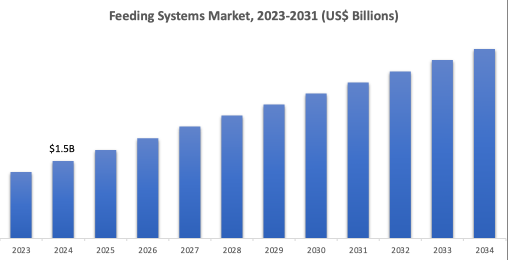
The global feeding systems market is projected to grow at a CAGR of 8.1% from 2023 to 2034, with a market size valued at US$ 1.3 billion in 2023 and anticipated to reach US$ 3.2 billion by 2034.
Feeding systems are advanced technological solutions that are designed to automate and enhance animal feeding and agricultural management tasks. These systems include advanced hardware, software, and services that enable accurate feeding, monitoring, and management of livestock across different agricultural environments.
They utilize cutting-edge technologies such as rail-guided systems, conveyor belts, and autonomous platforms to deliver precise feed amounts, oversee animal nutrition, check health metrics, and improve overall agricultural efficiency. Contemporary feeding systems combine sensors, data analysis, and automated controls to ensure effective feed distribution, reduce manual labour, enhance animal welfare, and boost agricultural efficiency throughout different farming sectors.
Market Highlights:
The global feeding systems market is projected to achieve a comprehensive valuation of US$ 3.2 billion, growing at a CAGR of 8.1% during the forecast timeline, fueled by increasing automation in agriculture, reducing the overall reliance on manual labour, and improving operational efficiency. Rising global demand for meat and dairy has resulted in an all-inclusive growth of large-scale livestock farming, greatly benefiting from precision feeding techniques.
Additionally, developments in IoT and AI technologies enable improved animal health monitoring and feed optimization. Government backing via subsidies for precision agriculture and a transition to sustainable farming methods further propels this market growth.
Source: Fatpos Global
Market Segmentation:
Conveyor belt feeding systems lead the market, driven by their extensive use across various livestock operations
The market is bifurcated based on the System Type into Rail-Guided Feeding Systems, Conveyor Belt Feeding Systems, and Self-Propelled Feeding Systems. Conveyor belt feeding systems lead the market owing to their extensive applications in large-scale livestock operations such as dairy and poultry farms. These systems provide steady feed distribution, reduce overall manual labor, and lessen feed wastage.
Their adaptability empowers integration with automated and IoT-driven technologies for accurate feeding. Conveyor belts are especially popular in regions with developed agricultural methods, like North America and Europe, since they accommodate large feeding requirements and promote operational efficiency.
Dairy farm management will lead the market, driven by the need for precise feeding strategies
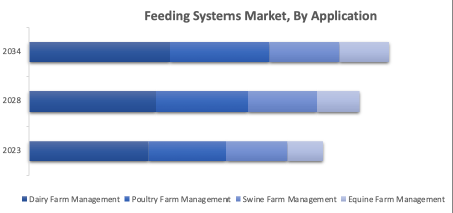
The market is segmented based on the Application into Dairy Farm Management, Poultry Farm Management, Swine Farm Management, and Equine Farm Management. Dairy farm management leads the market since these farms require accurate feeding techniques to improve the overall milk output and the health of the herd.
Automated feeding systems are widely utilized for Total Mixed Ration (TMR) feeding, guaranteeing nutritional balance and minimizing waste. Sophisticated monitoring features, incorporating IoT and AI integration, render these systems essential in extensive dairy operations. Areas like Europe and North America are at the forefront of adoption because of strict regulations and a focus on animal welfare.
Source: Fatpos Global
Market Dynamics:
Growth Drivers
Growing Demand for Automation in Livestock Farming to Present Market Growth Opportunities
Automation technology has been vital in transforming livestock farming by providing precision in feed distribution, improving resource efficiency, and reducing the overall reliance on labour, especially in regions which are dealing with workforce shortages. Technologies such as Artificial Intelligence (AI) and the Internet of Things (IoT) facilitate real-time observation of animal behavior and feed intake, guaranteeing effective feeding routines customized to meet each animal's nutritional requirements.
These innovations significantly enhance large-scale commercial farming by optimizing operations and minimizing waste. Automation boosts productivity and reduces operational expenses, establishing itself as an essential resource for contemporary agriculture. Nations with sophisticated agricultural methods, such as the U.S., Germany, and China, are at the forefront of embracing automated systems, motivated by their aim to enhance livestock production in response to the rising global need for meat and dairy.
Increased Focus on Animal Health and Welfare to Fuel Market Expansion
Automated feeding systems are essential for improving animal health by providing feed in exact amounts and at ideal times, reducing the overall stress on the livestock. These systems assist in sustaining regular feeding schedules, and enhancing digestion and general health, which is crucial for productivity concerning milk output, growth rates, or egg yield.
The compatibility of these systems with stringent animal welfare standards in regions such as the European Union and North America has additionally fueled adoption. Improved monitoring features, including sensors and AI, empower farmers to monitor feed usage and health indicators, facilitating early identification of problems. Automated systems lessen human involvement, leading to fewer disruptions and fostering a healthier atmosphere for livestock.
Restraints
Lack of Awareness in Emerging Markets May Hinder Market Growth
In developing regions, the adoption of feeding systems is hindered by a lack of awareness and technical prowess. Numerous farmers are not well-acquainted with modern feeding technologies and their advantages, resulting in low adoption levels. Moreover, the training programs and resources designed to inform farmers about these systems are frequently inadequate.
Economic limitations intensify this problem, as smaller farms find it challenging to allocate resources for both acquiring equipment and enhancing their workforce skills. Infrastructure issues, such as inconsistent electricity and restricted internet access, additionally hinder the incorporation of automated feeding systems. This absence of knowledge and infrastructure poses a major obstacle, causing numerous farms to rely on conventional and labor-heavy feeding approaches.
Recent Developments
- In 2023, DeLaval Inc. introduced the OptiWagon, a robotic feeding system that delivers customized feed mixes. The company also collaborated with AI firms to develop real-time herd management solutions.
- GEA Group AG launched an AI-integrated feeding system in Europe in 2023, optimizing feed delivery. The company expanded its hardware product line for automated dairy feeding systems.
- Trioliet B.V. introduced the Triomatic T15 robotic feeding system in 2023, enhancing feeding efficiency. The company increased production capacity with a new facility in the Netherlands.
- Lely Holding S.a.r.l. released the Astronaut A5 in 2024, featuring smart feed dispensing for dairy farms. The company also launched an updated farm management software.
- AGCO Corporation partnered with precision farming startups in 2024 to enhance software compatibility. The company introduced high-capacity feeders designed for large-scale farms.
- VDL Agrotech entered the Latin American market in 2024 with compact feeder systems. The company invested in developing renewable energy-compatible feeding systems.
Key Players:
- DeLaval Inc.
- GEA Group AG
- Trioliet B.V.
- Lely Holding S.à r.l.
- BouMatic LLC
- AGCO Corporation
- Fullwood Packo Ltd.
- Dairymaster
- Rovibec Agrisolutions Inc.
- VDL Agrotech
- Pellon Group Oy
- Big Dutchman AG
- Afimilk Ltd.
- Keydollar Systems B.V.
- Schauer Agrotronic GmbH
- Other Prominent Players (Company Overview, Business Strategy, Key Product Offerings, Financial Performance, Key Performance Indicators, Risk Analysis, Recent Development, Regional Presence, SWOT Analysis)
Regional Analysis
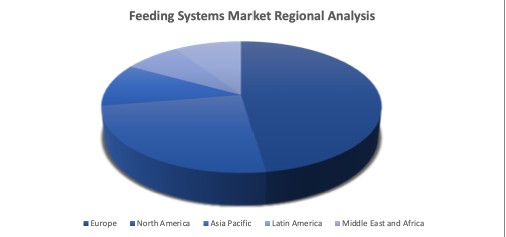
The Global market is segmented based on regional analysis into five major regions: North America, Latin America, Europe, Asia Pacific, Middle East, and Africa.
The European region maintains a top market position all attributed to the region's strict animal welfare laws, innovative agricultural technologies, and a significant focus on sustainability. Nations such as Germany and the Netherlands have considerable implementation of automated feeding technologies in dairy and poultry agriculture. Moreover, financial incentives and investments in R&D strengthen the region's dominance.
North America while not being the dominant region stands as a strong competitor, propelled by extensive commercial agriculture in the U.S. and Canada, especially within the dairy and pig sectors.
The Asia-Pacific region has witnessed rapid growth in recent years due to the increased livestock output and the ongoing demand for effective agricultural practices in China, India, and Southeast Asia.
At the same time, Latin America and the Middle East & Africa are developing markets with increasing uptake of feeding technologies, though they face limitations due to infrastructure and economic challenges.
Source: Fatpos Global
Impact of Covid-19 on The Market
The COVID-19 pandemic had a significant impact on the market, which directly resulted in disrupted supply chains and ongoing delays in the production and distribution of feeding systems. Moreover, severe labor shortages highlighted the significance of automation, and increasing interest in feeding technologies.
Although the economic slowdown impacted investments in emerging markets, areas with established automated systems, such as Europe and North America, showed resilience. The recovery since the pandemic has resulted in a constant rise in the demand for sustainable and efficient agricultural methods, boosting market growth.
Market is further segmented by region into:
- North America Market Size, Share, Trends, Opportunities, Y-o-Y Growth, CAGR – United States and Canada
- Latin America Market Size, Share, Trends, Opportunities, Y-o-Y Growth, CAGR – Mexico, Argentina, Brazil, and Rest of Latin America
- Europe Market Size, Share, Trends, Opportunities, Y-o-Y Growth, CAGR – United Kingdom, France, Germany, Italy, Spain, Belgium, Hungary, Luxembourg, Netherlands, Poland, NORDIC, Russia, Turkey, and Rest of Europe
- Asia Pacific Market Size, Share, Trends, Opportunities, Y-o-Y Growth, CAGR – India, China, South Korea, Japan, Malaysia, Indonesia, New Zealand, Australia, and Rest of APAC
- Middle East and Africa Market Size, Share, Trends, Opportunities, Y-o-Y Growth, CAGR – North Africa, Israel, GCC, South Africa, and Rest of MENA
Market Scope and Segments:
|
ATTRIBUTE |
DETAILS |
|
Study Period |
2018-2031 |
|
Base Year |
2023 |
|
Forecast Period |
2024-2034 |
|
Historical Period |
2019-2022 |
|
Growth Rate |
CAGR of 8.1% from 2021-2031 |
|
Unit |
Value (US$ Billion) |
|
Segmentation |
Main Segments List |
|
By System Type |
|
|
By Offering |
|
|
By Application |
|
|
By Region |
|
Frequently Asked Questions (FAQ):
The global feeding systems market size was valued at US$ 1.3 billion in 2023 and is projected to reach US$ 3.2 billion in 2034, exhibiting a CAGR of 8.1% during the forecast period.
The market encompasses automated and precision feeding solutions for livestock, including dairy farms, poultry, and swine. These systems optimize feed delivery, reduce waste, and improve animal health, increasing overall efficiency and productivity in agricultural operations.
The Conveyor Belt Feeding Systems and Dairy Farm Management segment accounted for the largest market share.
Key players in the feeding systems market include DeLaval Inc., GEA Group AG, Trioliet B.V., Lely Holding S.à r.l., BouMatic LLC, AGCO Corporation, Fullwood Packo Ltd., Dairymaster, Rovibec Agrisolutions Inc., VDL Agrotech, Pellon Group Oy, Big Dutchman AG, Afimilk Ltd., Keydollar Systems B.V., Schauer Agrotronic GmbH. and Other Prominent Players.
The market is propelled by a growing need for precision livestock management, an increasing emphasis on animal health and welfare, and a rising demand for effective and automated feeding solutions.
 Select License Type


.png)


