


Hydrogen Plants Market Research 2035
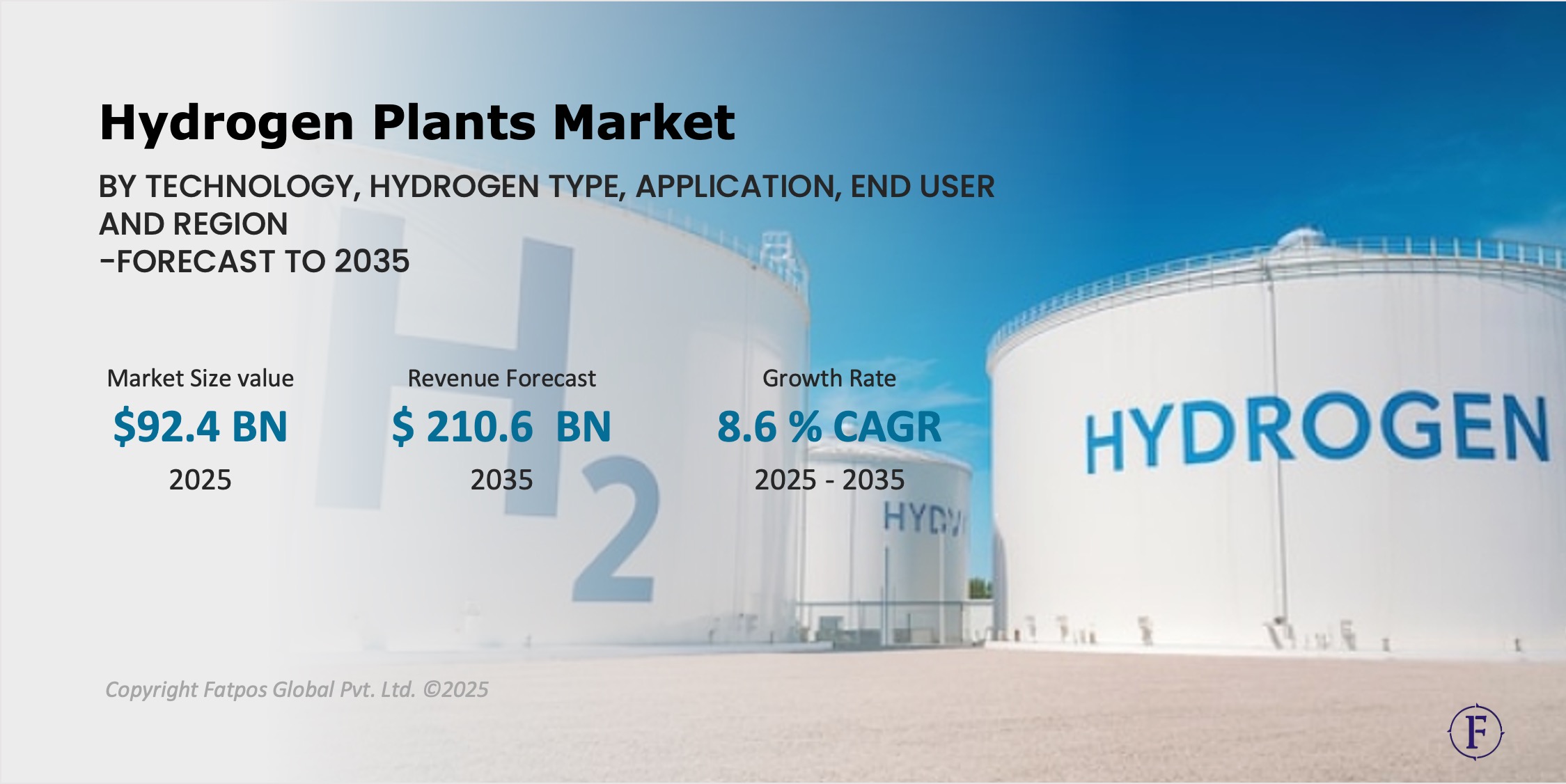
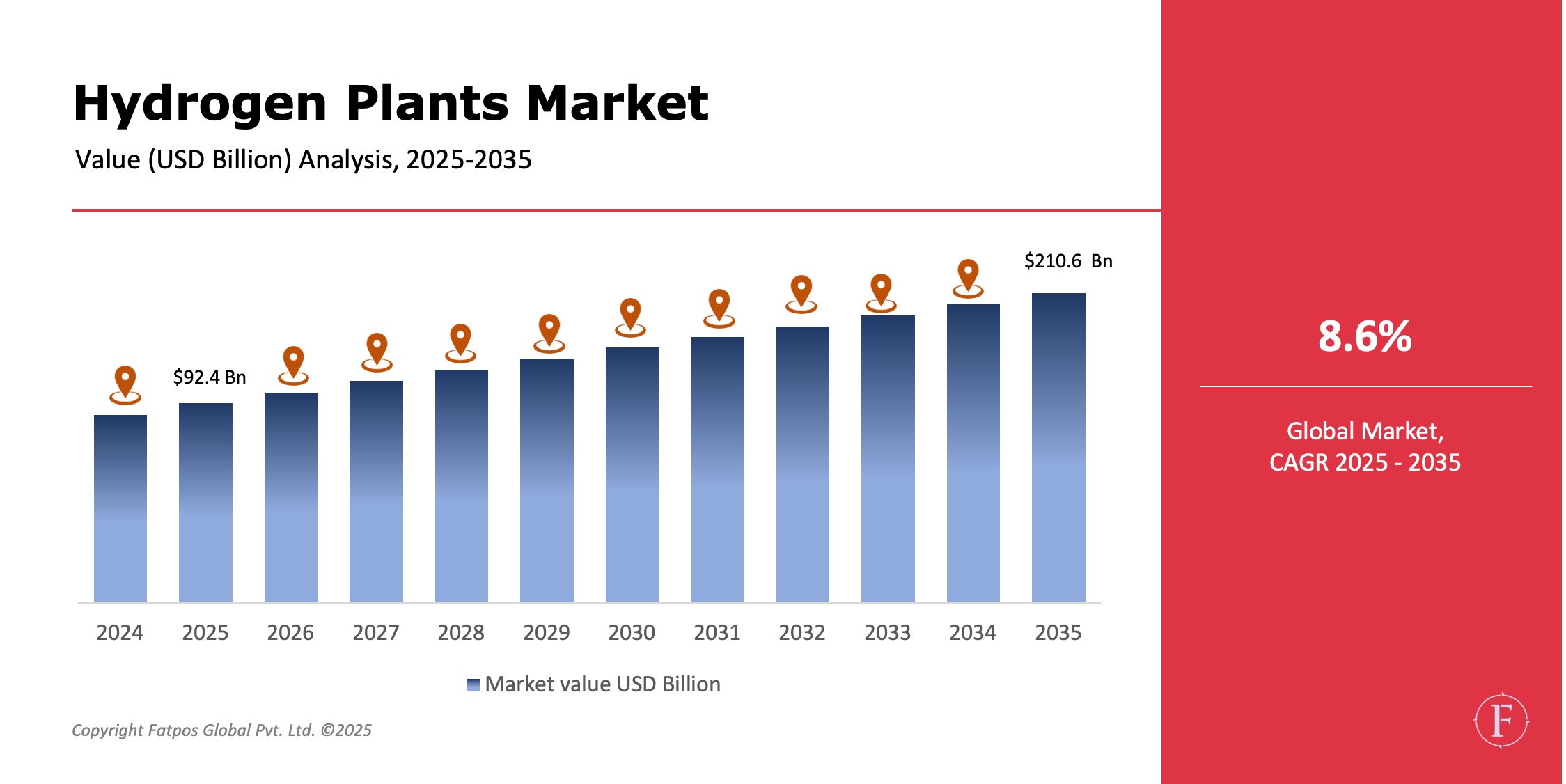
The Hydrogen Plants Market was valued at USD 92.4 billion in 2025 and is projected to reach USD 210.6 billion by 2035, registering a CAGR of 8.6% during the forecast period. Market growth is driven by increasing global focus on decarbonization, rising demand for clean energy solutions, expansion of hydrogen-based industrial applications, and strong government support for hydrogen infrastructure development.
Hydrogen plants form the backbone of the hydrogen economy, enabling large-scale production of hydrogen for use in refining, chemicals, power generation, and emerging mobility applications. The market is evolving rapidly as industries and governments transition toward low-carbon and renewable hydrogen pathways.
Product Overview
Hydrogen plants are industrial facilities designed to produce hydrogen gas using various feedstocks and technologies. These plants can be centralized large-scale facilities supplying hydrogen to multiple industries or decentralized units installed near end-use locations.
By technology, hydrogen production includes steam methane reforming (SMR), electrolysis, coal gasification, and partial oxidation. SMR remains the most widely used method due to its cost efficiency, while electrolysis is gaining momentum as renewable energy integration enables green hydrogen production. Hydrogen plants are further categorized by hydrogen type into grey, blue, and green hydrogen, based on carbon intensity and carbon capture integration.
Key Takeaways :
- The hydrogen plants market is projected to grow at approximately 8.6% CAGR through 2035.
- Steam Methane Reforming remains the dominant production technology.
- Green hydrogen is the fastest-growing hydrogen type.
- Industrial applications account for the largest market share.
- Europe and Asia-Pacific are leading investment regions.
- Government policies and net-zero targets strongly support market growth.
Market Dynamics
Drivers
Global decarbonization goals and net-zero emission targets are the primary drivers of the hydrogen plants market. Governments worldwide are promoting hydrogen as a key pillar of energy transition strategies, supporting investments in hydrogen production infrastructure.
Rising demand for hydrogen in refining and chemical industries, particularly for ammonia and methanol production, further drives market growth. Increasing adoption of hydrogen in power generation, grid balancing, and fuel cell vehicles also contributes to expanding hydrogen plant capacity globally.
Restrictions
High capital investment requirements and long project development timelines pose significant restraints for hydrogen plant deployment. Infrastructure challenges related to hydrogen storage, transportation, and distribution further limit market expansion.
In the case of green hydrogen, high production costs associated with electrolyzers and renewable electricity remain a barrier, particularly in cost-sensitive markets. Regulatory uncertainty in some regions also impacts investment decisions.
Opportunities
Rapid advancements in electrolyzer technologies and declining renewable energy costs present major growth opportunities for green hydrogen plants. Government subsidies, tax incentives, and hydrogen roadmaps are accelerating project announcements and capacity expansion.
Emerging applications in hydrogen mobility, synthetic fuels, and energy storage create new demand avenues. Developing economies are also investing in hydrogen export hubs, creating opportunities for large-scale hydrogen plant development.
Challenges
Scaling hydrogen plants while maintaining cost efficiency and operational reliability remains a key challenge. Integration of carbon capture systems for blue hydrogen plants adds technical complexity.
The hydrogen market also faces challenges related to safety standards, skilled workforce availability, and coordination across hydrogen value chains. Ensuring long-term offtake agreements is critical for project viability.
Hydrogen Plants Market Trends
The hydrogen plants market is witnessing a transition from conventional grey hydrogen toward low-carbon blue and green hydrogen solutions. Large-scale electrolyzer installations and renewable-powered hydrogen plants are becoming increasingly common.
Strategic partnerships between energy companies, technology providers, and governments are accelerating hydrogen infrastructure development. Hydrogen hubs and industrial clusters are emerging as key market trends, enabling shared infrastructure and cost optimization.
Key Players in the Global Hydrogen Plants Industry
- Air Liquide
- Linde plc
- Air Products and Chemicals, Inc.
- Siemens Energy
- Nel ASA
- Thyssenkrupp AG
- McPhy Energy
- Plug Power Inc.
- Technip Energies
- Cummins Inc.
Regional & Country Analysis
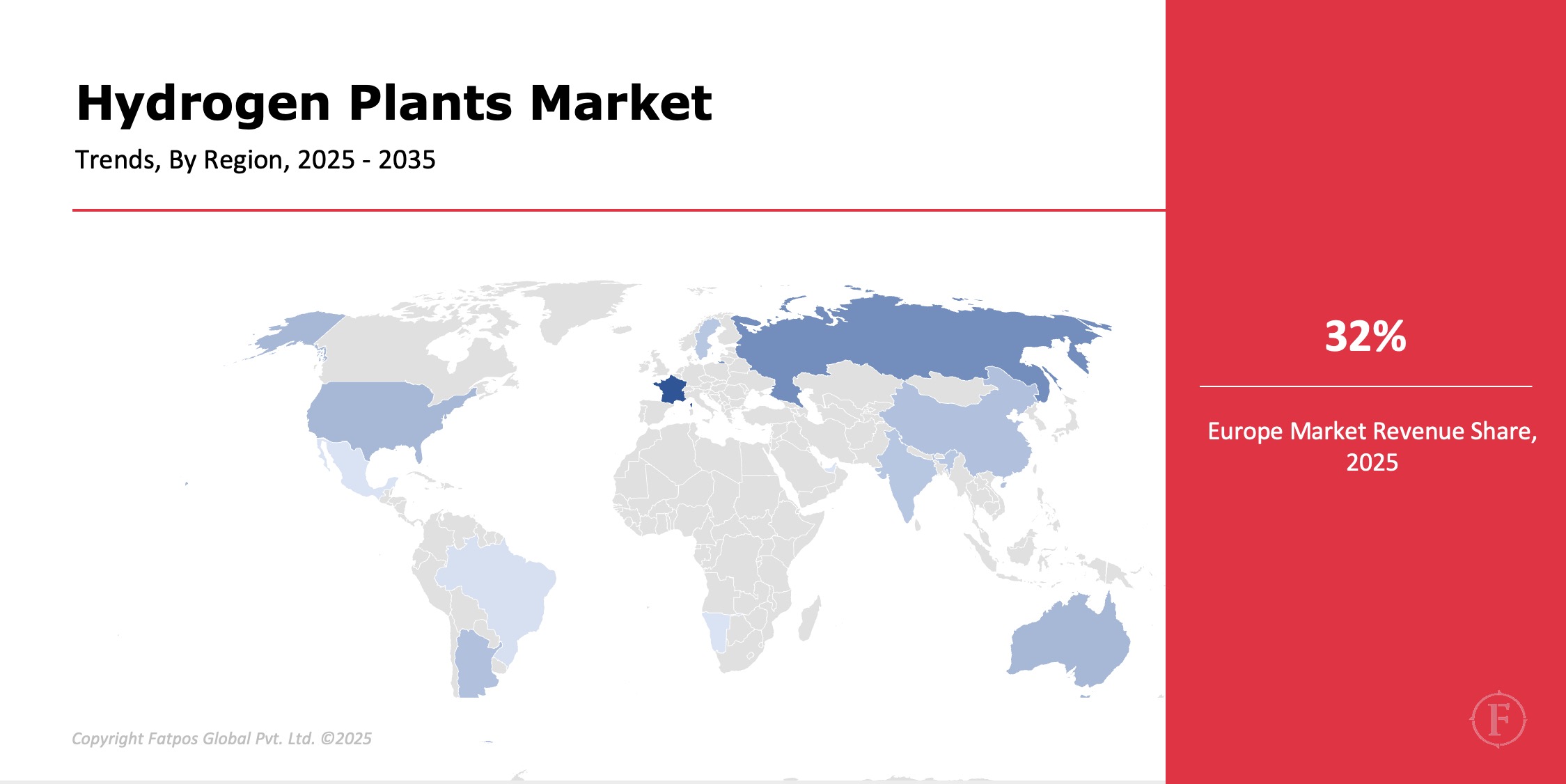
Europe holds a significant share of the global hydrogen plants market, driven by aggressive decarbonization policies and strong government funding for green hydrogen projects. Germany, France, and the Netherlands are leading hydrogen plant deployments.
Asia-Pacific is a major growth region, supported by large-scale hydrogen initiatives in China, Japan, South Korea, and Australia. North America demonstrates strong momentum driven by hydrogen tax credits and industrial demand. The Middle East is emerging as a hydrogen export hub, while Latin America and Africa show long-term potential due to abundant renewable resources.
Segmentation Highlights
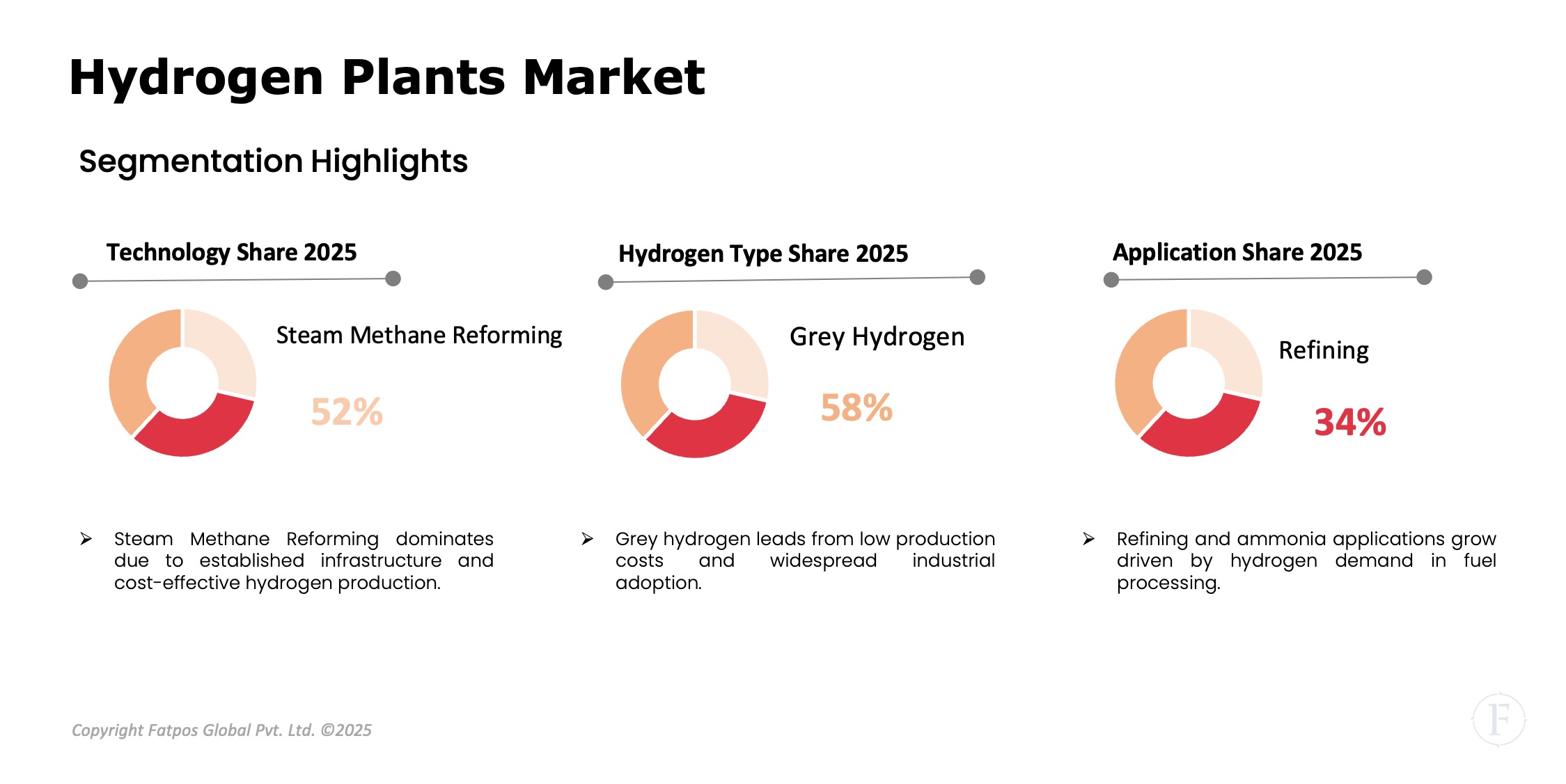
By technology, steam methane reforming dominates the market, while electrolysis is gaining rapid traction. By hydrogen type, grey hydrogen accounts for the largest installed base, though green hydrogen is expected to witness the highest growth rate. Industrial applications dominate end use, followed by energy and transportation sectors.
Report Key Elements
|
ATTRIBUTES |
DETAILS |
|
Study Period |
2019–2035 |
|
Base Year |
2024 |
|
Forecast Period |
2025–2035 |
|
Market Size by 2035 |
USD 210.6 billion |
|
Market CAGR |
8.6% |
|
By Technology |
Steam Methane Reforming, Electrolysis, Coal Gasification, Partial Oxidation |
|
By Hydrogen Type |
Grey, Blue, Green |
|
By Application |
Refining, Ammonia & Methanol, Power Generation, Transportation, Others |
|
By End User |
Industrial, Energy, Mobility |
|
By Region |
North America, Europe, Asia-Pacific, Latin America, MEA |
|
Hydrogen Plants Market: Key Players |
Air Liquide, Linde plc, Air Products and Chemicals, Inc., Siemens Energy, Nel ASA |
Global Hydrogen Plants Industry Instances
- Governments launched national hydrogen strategies and funding programs.
- Energy companies invested in large-scale green hydrogen plants.
- Industrial users signed long-term hydrogen offtake agreements.
- Hydrogen hubs and export corridors were announced globally.
Analyst Review
As per our Hydrogen Plants Market Analysis, the market is positioned for strong long-term growth driven by energy transition initiatives, technological advancements, and expanding industrial demand. While cost and infrastructure challenges persist, sustained policy support and innovation are expected to accelerate hydrogen plant deployment worldwide.
Frequently Asked Questions (FAQ):
Hydrogen plants are industrial facilities producing hydrogen gas for energy, chemical processing, refining, and clean mobility applications.
Market growth is driven by decarbonization goals, clean energy transition, rising hydrogen demand, and supportive government incentives worldwide.
Steam methane reforming-based hydrogen plants dominate due to cost efficiency, established infrastructure, and large-scale industrial hydrogen production.
Asia-Pacific is the fastest-growing region driven by industrial expansion, energy transition policies, and increasing investments in hydrogen infrastructure.
The long-term outlook shows strong growth supported by global energy transition strategies, green hydrogen adoption, and sustainability initiatives.
 Select License Type


.png)


